
Why Shoumei White Tea Ages Well — A Storage & Flavor Guide
Aged white tea is a narrower subject than the marketing suggests. Shoumei is the grade most often aged, and the one where the gap between folklore and evidence is widest. The folklore says older is always better. The evidence says something more interesting: the tea does change measurably, the change has a shape, and it does not continue improving forever.
This guide covers what Shoumei is, what actually happens to it in storage, where the published research agrees and where it does not, and how to judge a vintage claim.
Table of Contents

What Shoumei Is
Under GB/T 22291-2017, Shoumei is made from the tender shoots or leaves of the Daibai, Shuixian or population (群体种) cultivars, processed by withering, drying and sorting. It has two grades in the standard.
Two things distinguish it from the other three categories. It is the only grade that may use leaves rather than shoots, and it is the only one open to all three cultivar groups. That breadth is why Shoumei is the cheapest white tea and why it varies so much between producers.
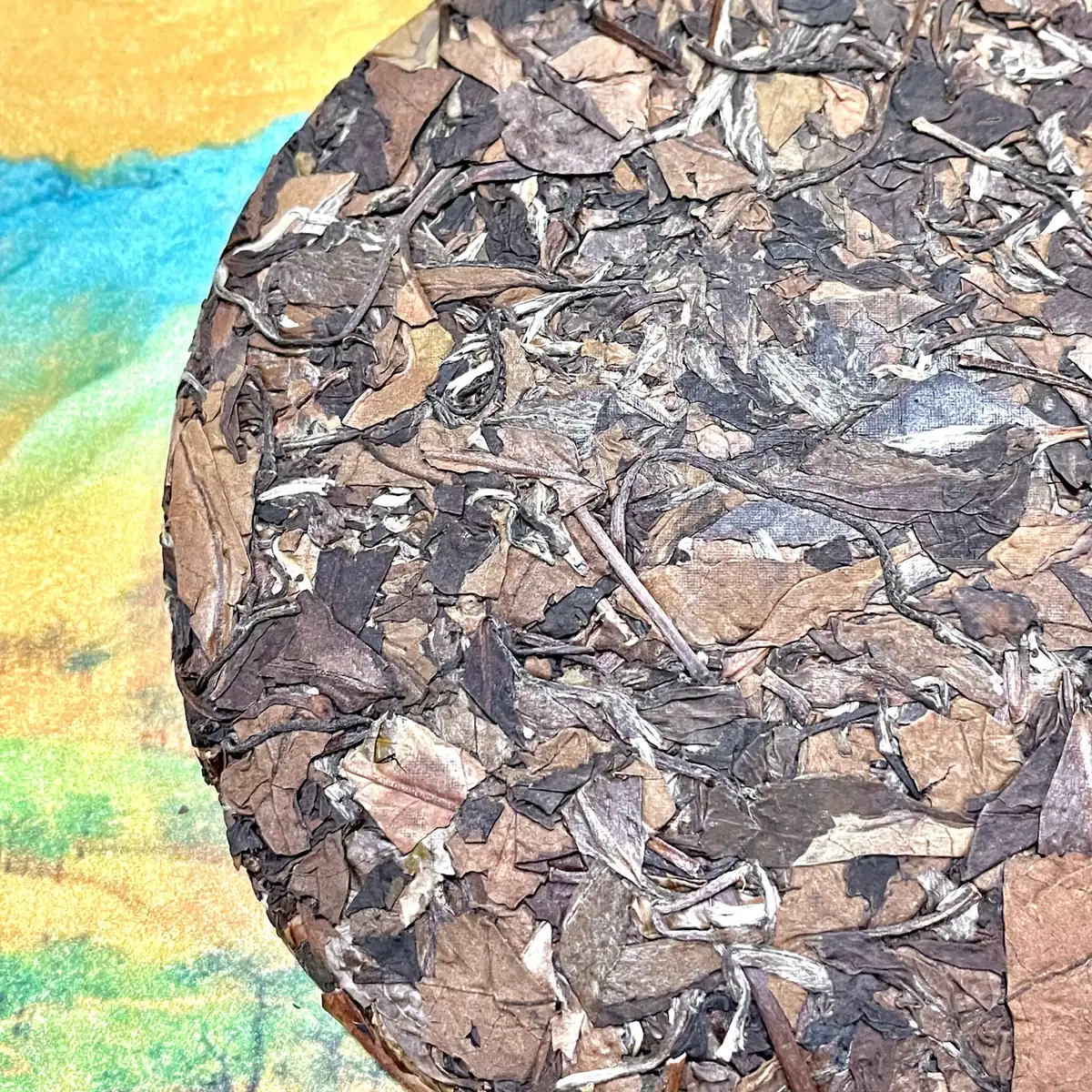
The visible stem is not a defect. It is what the picking standard permits, and it turns out to matter for aging.
Why the Stem Matters
Stem has a bad reputation in tea writing, largely inherited from grades where it signals low picking standards. In Shoumei it is structural.
Stem tissue holds sugars and structural carbohydrates that leaf tissue does not, and it dries differently — more slowly, and to a different final moisture. Over years of storage, that difference shows: stem-heavy tea has more material available to transform.
This is a reasonable inference from composition rather than a directly measured effect, and it is worth saying so. What has been measured is the outcome: studies tracking white tea over years consistently find Shoumei-type material changing more than bud-heavy material.
What Actually Changes
The direction of change is well established across several studies.
Catechins fall. A study of white teas across multiple vintages found total catechins dropping 9.2% after one year and 22.0% after two, with almost none remaining at twenty years (Zhou et al., 2014). Since catechins are what make tea astringent, this is the single biggest driver of the softening that aged-tea drinkers describe.
Amino acids fall. The fresh, savoury character of young white tea fades as free amino acids decline. The same twenty-year series recorded that decline.
Soluble sugars and other compounds shift. A tighter study following Zhenghe Bai Mu Dan — the closest controlled design available — found water extract, flavonoids, tea polyphenols, free amino acids, catechins, theophylline and theobromine all falling significantly over eight years, while sweetness and mellowness rose in sensory evaluation (Shen & Zhu, 2025).
Caffeine barely moves. It appears in the “changed least” group in every study. Aged white tea is not lower in caffeine, and anyone selling it on that basis is misinformed or worse.
The Flavonoid Question, Honestly
Here the literature genuinely disagrees, and it is worth reporting rather than resolving.
Zhou et al. (2014) reported that aged white tea contains more flavonoids than fresh, with the twenty-year sample significantly higher than every other vintage. Shen and Zhu (2025) reported flavonoids falling significantly over eight years of storage.
Both are peer-reviewed, both used standard methods, and they reach opposite conclusions. The likely explanations are different grades, different vintage spans, different analytical methods, and possibly different storage conditions. There is no basis for picking the more flattering number.
What this means for a buyer: ignore any claim that aging reliably raises flavonoid content. The evidence does not support the general statement in either direction.
Is Older Always Better?
No, and this is where the marketing diverges most sharply from the research.
A study of white tea cakes aged between 2 and 19 years found four years scoring highest on sensory evaluation — not the oldest sample. A storage trial found that the optimal condition differs by grade: Bai Mu Dan at 25 °C and 40% relative humidity, Shoumei at 25 °C and 60%.
What that suggests is a window rather than a slope. Young Shoumei is fresh and a little sharp; a few years in, it softens and sweetens; by ten or twenty years the catechins are largely gone and the tea can become smooth but thin. Past a certain point you are no longer gaining complexity, you are losing material.
The precise peak depends on the tea, the storage and your taste. Anyone who tells you a specific year is universally optimal is selling something.
What Counts as “Aged White Tea”
There is a standard, and it is worth knowing because the word is used loosely in commerce.
T/CSTEA 00021-2021 defines aged white tea as white tea that has been naturally aged for five years or more, is clearly distinct from newly made tea, and shows the characteristic aged aroma (陈香) or aged character (陈韵). It classifies aged white tea into three style types — 陈蜜型 (honeyed), 陈醇型 (mellow) and 陈药型 (medicinal) — each in three grades.
So a three-year-old cake described as “aged” is using the word outside its standard meaning. That is not automatically dishonest — “aged” is also used loosely in English — but a seller who knows the standard and still calls three years “aged” is telling you something about their sales practice.
Storing for the Long Term
The conditions are the same as for any white tea, and they matter more for Shoumei because you are asking the tea to sit for years.
GB/T 30375-2013 sets the target at 25 °C or below and 50% relative humidity or below. The finished-tea moisture limit under GB/T 22291-2017 is 8.5%. Sealed, dark and away from odours covers the rest.
One finding from the storage research deserves emphasis: in a one-year trial, some samples exceeded the 8.5% moisture limit even under the control condition of natural temperature with humidity at or below 60%. In other words, ordinary room conditions can be marginal. If you are aging deliberately, a hygrometer and a sealed barrier are not optional extras.
Full detail on containers, humidity and how to judge a cake that has turned is in how to store white tea.
Cakes or Loose Leaf?
If you intend to age Shoumei, the form matters less than the storage — but the two forms are not equivalent.
Loose leaf is easier to inspect, easier to re-seal and easier to taste as it develops. You can open the bag, smell it, take out a portion and close it again without disturbing much. If you are learning how aging works, loose leaf is the better teaching material.
Compressed cakes, typically 300 g or 350 g, take less space and are the traditional form for long storage. A cake is also a sealed unit in a way a bag is not — less surface exposed, fewer openings. The trade-off is that you cannot inspect the interior without breaking the cake, and a problem in the centre may not be visible until you do.
There is no strong evidence that compression itself improves aging, and one line of research suggests pressing can accelerate the decline of some compounds. So “cakes age better” should be treated as a packaging convention rather than a chemical advantage. Choose by how much space you have and how often you want to open it.
Judging a Vintage Claim
You cannot verify a year from the leaf, and neither can a laboratory, in the sense that matters legally.
Research has made progress on classification: hyperspectral imaging combined with electronic tongue, electronic nose and gas chromatography can separate White Peony from 2020, 2021 and 2022; near-infrared spectroscopy with machine learning has been used to classify category and vintage together. These are statistical classifiers trained on known samples. They sort samples into age bands. They do not establish a production date.
What can be checked is documentation. The Fuding white tea traceability platform has operated since 2021, and a cake carrying its mark has a chain behind it. Beyond that, you are trusting the seller.
The failure mode is documented: a 2026 case publicised by the Fuding court concerned a cake labelled as produced in September 2015 but carrying an execution standard that only took effect in February 2016 — a physical impossibility, and one that drew an administrative penalty.
One practical consequence of all this: if you are buying Shoumei to age, buy more than one cake from the same batch and store them identically. Open one at three years, one at six, one at ten. That turns a vague hope into an actual experiment, and it is the only way to learn how storage behaves in your own cupboard rather than in someone else’s description.
What Aged Shoumei Tastes Like
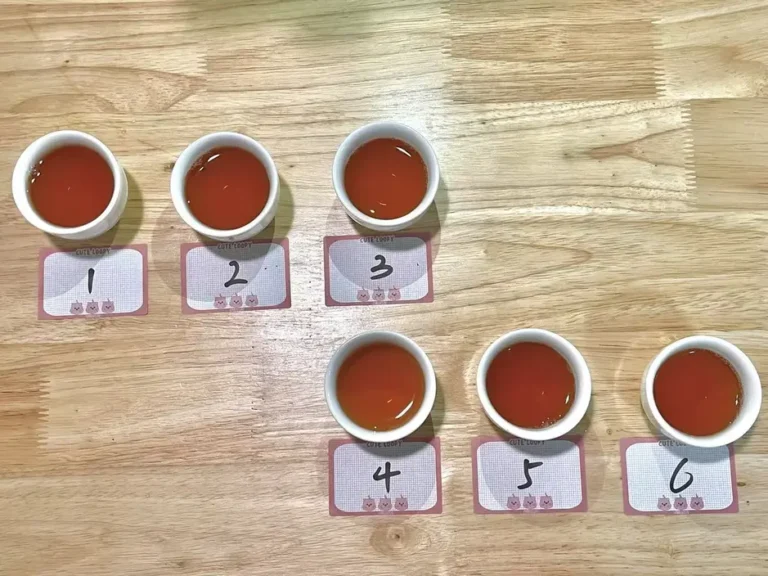
The trajectory most drinkers describe runs from fresh and grassy, through a honeyed middle period, toward dried fruit, wood and a resinous note in old examples. The liquor darkens from pale gold to amber to copper as storage pigments accumulate.
Those descriptors are sensory conventions, not measurements, and they vary with storage quality. The more useful skill is telling aged character from spoilage.
In Chinese the two are distinguished as 陈香 (aged fragrance — clean, woody, like old timber or dried herbs, with jujube sweetness) and 陈腐 (stale decay — musty, dusty, cellar-like, sour or fermented). The difference is not intensity; it is whether the smell is clean. A faint cellar note that blows off is one thing. A musty smell that persists, or visible mould, or leaf that feels damp and sticky, means the cake is spoiled.
And there is no rescue. Airing, sun-drying, roasting, rinsing and boiling do not remove mould toxins. A spoiled cake is discarded, not treated.
Brewing Aged Shoumei
Aged Shoumei wants more heat and more time than the young, bud-heavy grades. The leaf is denser, often compressed, and its more accessible compounds have already been extracted by time.
Start with 5 g per 110 ml at 95–100 °C and 20–30 seconds for the first infusion, adding time each round. Young Shoumei can be brewed like White Peony; anything five years or older responds better to the hotter end of the range. Mature aged leaf can also be simmered — 5 g in 500 ml, brought to a boil and held just below for a few minutes.
If you are breaking up a cake, loosen it into pieces roughly the size of a thumb nail rather than crumbling it. Fine fragments extract too fast and make the first steeps harsh.
Full vessel-by-vessel instructions, including the simmering method, are in how to brew white tea.
And a note on honesty in this category. Aged white tea is the part of the market where unverifiable claims do the most commercial work, and where the gap between what a seller can prove and what a buyer can check is widest. Everything on this page that is measured has a citation; everything that is inference is labelled as inference. We would rather the article be less exciting and correct.
Frequently Asked Questions
Is aged white tea always better than fresh?
No. Aged white tea softens and sweetens, but it also loses the catechins that give fresh tea its brightness. A study of cakes from 2 to 19 years found four years scoring best on sensory evaluation, not the oldest sample.
How should aged white tea be stored?
Aged white tea needs sealed, dark conditions at 25 °C or below and 50% relative humidity or below — the same limits as any white tea. Keep cakes whole where you can, so less surface is exposed to air.
What does aged white tea taste like?
Aged white tea moves from fresh and grassy toward dried fruit, wood and a resinous note, with the liquor darkening from pale gold to amber to copper. Good aged white tea is clean; a musty smell is spoilage.
How old must white tea be to count as aged?
Five years of natural aging, per the industry standard. Aged white tea sold at three years is using the term outside its defined meaning.
Does aged white tea have less caffeine?
No. Caffeine is among the most stable compounds in stored tea. Aged white tea is not a low-caffeine drink, and a strong boiled cup can carry more than a light fresh one.
Sources & References
Standards
- GB/T 22291-2017 — White tea product standard. §3.4 defines Shoumei; moisture ≤8.5%.
- GB/T 30375-2013 — Tea storage. White tea at ≤25 °C and ≤50% relative humidity.
- T/CSTEA 00021-2021 — Aged white tea. Five years or more; three style types, three grades each.
Peer-Reviewed Research
- Zhou, Q. et al. (2014). 不同年份白茶的主要生化成分分析 [Main biochemical components of white tea stored for different years]. 食品工业科技 2014(09):351–354. DOI:
10.13386/j.issn1002-0306.2014.09.068(Chinese-language) - Shen, Y. & Zhu, H. (2025). 仓储 1~8 年间政和白牡丹茶感官品质及理化成分变化 [Sensory and physicochemical changes in Zhenghe Bai Mu Dan over 1–8 years of storage]. 食品工业科技. DOI:
10.13386/j.issn1002-0306.2024090170(Chinese-language) - Xie, K. et al. (2024). Changes in the main chemical components of white tea cakes of different vintages. 中国食品学报 24(1):252–262. (Chinese-language)
- Xie, K. et al. (2019). Age-related changes in white tea volatiles and non-volatiles. PMID 31554114.
- Wang, P.-F. et al. (2025). Optimization of storage conditions for Zhenghe white tea: effects of temperature and humidity on sensory and physiochemical qualities over one-year storage. Journal of Agriculture and Food Research 24:102448. DOI:
10.1016/j.jafr.2025.102448 - Tian, X. et al. (2025). Discrimination of white tea vintages using hyperspectral imaging combined with electronic tongue, electronic nose and GC-IMS. Food Research International 199:115394. DOI:
10.1016/j.foodres.2024.115394
What this page does not claim
We do not claim that older Shoumei is always better, that aging reliably raises flavonoid content, or that a specific year is optimal for everyone. Where the studies disagree, we say they disagree. Where a claim is inference rather than measurement, we label it.
Related reading: the four types of white tea, Silver Needle vs White Peony, and Shouning white tea. how shoumei tea changes with age.
Shop the teas in this guide
The grades described above, sold directly from our own stock. Prices are for the smallest size; every listing states the harvest, the county and the size options.
- 2015 Jianyang Xiaobai Shou Mei cake, 350 g — $54.90
- 2014 Shouning Shou Mei dragon pearls — $16.90
- 2020 Shouning Shou Mei cake, 300 g — $45.90
- 2019 Shouning Shou Mei cake, 350 g — $49.90
- 2019 Shouning Bai Mu Dan dragon pearls — $19.90
- 2024 Shouning Bai Mu Dan cake, 300 g — $55.90
- 2023 Shouning Bai Mu Dan cake, 100 g — $19.90
Editorial note
This guide is written by Steve Wood and reflects both published research and our own brewing. Where evidence is thin or contested, we say so rather than filling the gap. We sell white tea, which is a conflict of interest we disclose rather than hide.


12 Comments