
Shouning White Tea: County Guide, GI Status and Tea Gardens
Shouning is the county we buy from, which makes this the one page on the site where we have an obvious interest in the answer. So it is worth saying plainly what Shouning is and is not.
Shouning white tea is made in a mountainous county in northern Fujian, with substantial white tea production and a notable concentration of old population-variety bushes. It is not a geographical indication product area, and we will come back to why that matters.
Table of Contents

Where Shouning Is
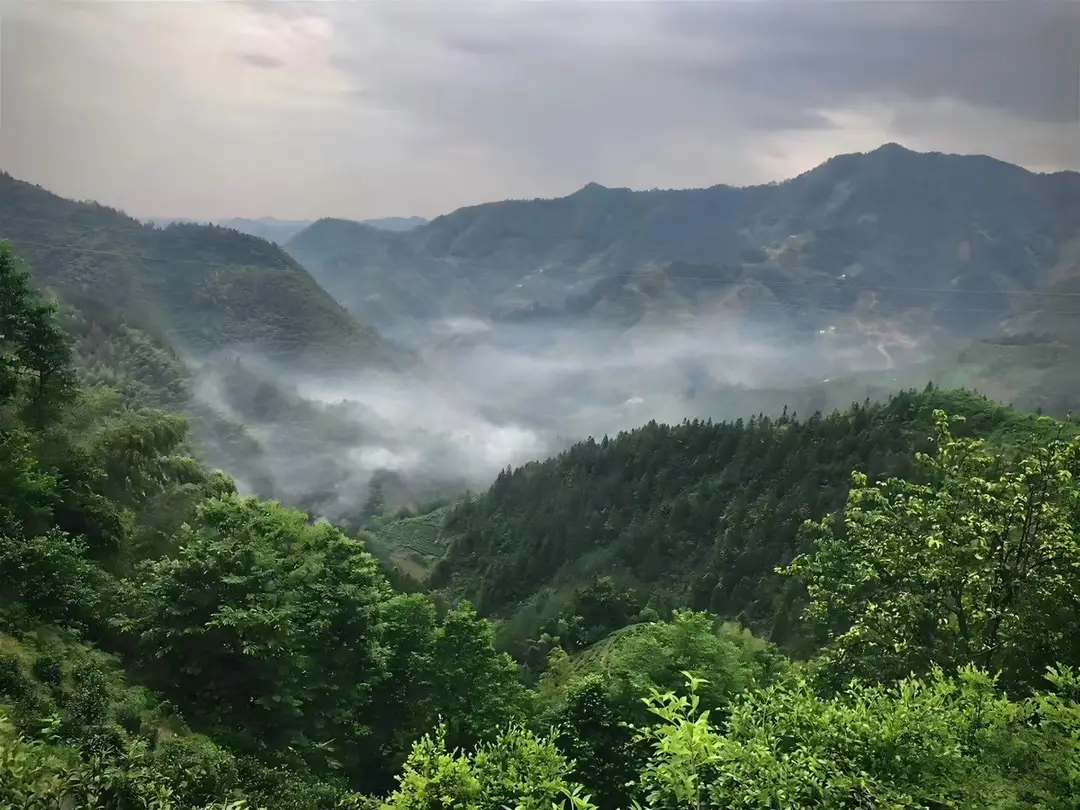
Shouning white tea comes from a county in the northeast of Fujian, in the Donggong mountain range, bordering Zhejiang to the north. It is a highland county — much of the tea grows at elevation, on terraced slopes that catch morning mist and drain quickly.
The climate is the familiar northern Fujian pattern: cool, humid, cloudy for much of the spring, with a diurnal temperature swing that slows the growth of spring buds. That combination is generally considered favourable for white tea, because slower growth concentrates flavour compounds rather than diluting them with water.
It is not Fuding, and it is not Zhenghe. Both of those names carry more weight in the export market, and both hold geographical indication status that Shouning does not. What Shouning has instead is landrace material and scale.
What the County Figures Say
The official numbers, as published by the county tea industry centre, are these:
| Metric | Figure |
|---|---|
| Tea garden area | 179,900 mu (about 12,000 hectares) |
| Total tea output | 23,000 tonnes |
| White tea output | 2,500 tonnes |
| Cai Cha (population variety) area | 12,000 mu (about 800 hectares) |
Read those numbers carefully, because the ratio is the story. White tea is roughly 11% of Shouning’s total tea output — the county grows far more tea than it makes into white tea. The rest goes to green tea and other categories.
That matters for buyers: “Shouning white tea” describes a real and substantial output (2,500 tonnes is not a boutique quantity), but it is a smaller share of the county’s agriculture than the marketing might suggest. Shouning is a tea county that makes white tea, not a white tea county that happens to grow other things. For what to check before buying any of it, see buying white tea.
Is Shouning White Tea a Geographical Indication?
No. This is the point most worth being precise about, because the answer is different for its neighbours.
Fuding white tea has held national geographical indication protection since 2009 (Announcement No. 32). Zhenghe white tea has held it since 2007 (Announcement No. 55). Both are protected-product designations, which carry legal weight and a defined production area.
Shouning holds no white tea GI. Its usual self-description is 「小白茶特色产区」 — a distinctive small-leaf white tea producing area. That phrase is an industry title conferred by the China Tea Marketing Association in November 2024, not a government designation, and it carries no legal protection.
There is a related distinction worth understanding. Some producing areas hold a geographical indication certification trademark rather than protected-product status. A certification trademark is a private mark administered by an association; protected-product status is a government designation. They are not equivalent, and marketing copy frequently blurs them. As far as we can establish, Shouning holds neither for white tea.
One related point worth getting straight. Shouning does hold a geographical indication — but for 「寿宁高山茶」, a general high-mountain tea designation registered as an agricultural GI in 2014 and converted to protected-product status in 2025. That is not a white tea designation, and it does not make “Shouning white tea” a protected name.
What this means for you: a Shouning white tea cannot claim origin protection specific to white tea, so the county name on a packet is a statement of provenance by the seller rather than a certified claim. That is true of most tea sold worldwide, but it is worth knowing where you stand.
The Cai Cha Story
Shouning’s most distinctive asset is its 菜茶 — 12,000 mu of sexually reproduced population varieties, the landrace material that predates the named cultivars.
These are not a single cultivar. They are genetically diverse populations grown from seed over generations: small-leaved, late-sprouting, lower-yielding than the named 大白 cultivars, and consequently largely displaced elsewhere during the twentieth century as growers switched to clonal material.
Their importance changed with the 2017 standard. Since GB/T 22291-2017, Gongmei must be made from 群体种 — population varieties only. That makes the survival of plantings like Shouning’s a prerequisite for the category existing at all.
The industry summary attributed to Zhang Tianfu puts the sequence plainly: 「先有小白,后有大白,再有水仙白」 — first small-leaf white, then large-leaf white, then Narcissus white. 菜茶 is the oldest layer of white tea, and Shouning retains more of it than most places.
For what that means in the cup, see Gongmei versus Shoumei.
What Grows There
Three cultivar groups dominate Shouning’s tea gardens:
- Fuding Daibai and Dahao — the named large-leaf cultivars, widely planted for white tea and green tea. Large buds, heavy down, the raw material for Silver Needle and White Peony.
- Shuixian — the crossover cultivar, used for oolong elsewhere and for white tea here. Distinctive aromatic profile.
- 菜茶 — the population varieties, the only permitted material for Gongmei.
That combination is what makes Shouning interesting: it can produce all four standardised white tea categories, including the one that requires landrace material.
How It Compares With Fuding and Zhenghe
All three are northern Fujian counties making white tea, and the differences between Shouning white tea and its neighbours are matters of emphasis rather than category.
| Fuding | Zhenghe | Shouning | |
|---|---|---|---|
| Position | Coastal, northeast | Inland, higher | Highland, far north |
| Withering tradition | Sun withering | Indoor withering | Mixed in practice |
| GI status for white tea | Yes (2009) | Yes (2007) | No |
| Distinctive strength | Volume, export recognition | Depth of flavour | Population-variety plantings |
The stylistic generalisation is that Fuding tea tends brighter and more floral, Zhenghe rounder and deeper, and Shouning somewhere between — but this is a tendency, not a rule, and the producer’s withering practice matters more than the county line.
What is not a generalisation is the landrace resource. Shouning’s 12,000 mu of 菜茶 is a genuine differentiator in a category where that material is now a regulatory requirement for one of the four grades.
Why a Highland County Grows Good White Tea
The case for highland white tea is not marketing mysticism; it is a set of conditions that slow the plant down.
At elevation, spring arrives later and nights stay cool. The buds grow more slowly, and slower growth means the plant accumulates flavour compounds over a longer period rather than diluting them with water taken up during rapid growth. Cloud cover reduces direct sun, which in turn affects how the leaf develops its aromatics.
Drainage matters as much as altitude. Terraced slopes shed water quickly, so the bushes are never waterlogged, and the roots develop deeply in search of moisture. A well-drained highland garden produces leaf with more concentration than a valley floor with heavy soil.
None of this is unique to Shouning white tea — the same argument applies across northern Fujian. What is somewhat more distinctive is the combination: highland conditions plus a substantial stock of population-variety bushes, which most counties gave up on decades ago in favour of higher-yielding clones.
The practical point for a buyer is that “high mountain” is a description of conditions, not a certification. It is a reasonable indicator of quality potential and no guarantee of it. A poorly managed highland garden will produce worse tea than a well-managed lowland one.
What Shouning White Tea Tastes Like
There is no single Shouning flavour, because the county makes all four grades, and the grade determines the cup far more than the county does. But there is a tendency worth describing.
Shouning white teas are often characterised as sitting between the Fuding and Zhenghe styles: a little floral lift from the sunnier coastal approach, a little depth from the highland leaf. The population-variety material adds something distinct — a slightly more complex, less uniformly sweet profile that drinkers often describe as more “tea-like” than the named cultivars.
Within that, the grades behave as the standard says they should. Silver Needle from Shouning is delicate and sweet with prominent down fragrance. White Peony is fuller, with a faint fruit note behind the florals. Shou Mei is rounder and sweeter, with visible stem. Gongmei, when made from the county’s 菜茶, carries the aromatic complexity that population varieties are valued for.
Aged Shou Mei from Shouning is where the county’s material shows most clearly: the stem-heavy leaf has enough structure to transform over years, and the highland growing conditions give it a density that holds up. What actually changes over those years — and where the evidence disagrees — is in aged white tea.
What none of this means is that Shouning always tastes better. Producer practice varies enormously within every county, and a well-made tea from a modest garden will beat a poorly made one from a famous slope every time.
Which Teas We Source From Shouning
Most of our white tea comes from Shouning: our Bai Mu Dan, our Baihao Yinzhen, our Shou Mei, and the aged Shou Mei cakes. We buy there because of the landrace plantings and because we have a working relationship with the producers, not because the county is objectively better than its neighbours.
Two honest caveats. First, we cannot claim GI status for these teas, and we do not. Second, “from Shouning” describes where the leaf was grown and processed; it does not guarantee a grade, a harvest date or a quality level. Those are separate claims, and we make them separately.
If you want to know what those grades are and how they differ, see the four types of white tea.
How to Read Origin Claims
Origin language in tea is a spectrum, and knowing where a claim sits tells you how much weight to give it.
Protected designation. The strongest claim. A defined production area, a government designation, and legal consequences for misuse. Fuding white tea (2009) and Zhenghe white tea (2007) both hold this. If a packet invokes one of these, the mark should be present and verifiable.
Certification trademark. A private mark administered by an association or cooperative. It signals membership and adherence to that body’s rules, not a government-protected origin. Several producing areas use this route, and marketing sometimes presents it as equivalent to a protected designation. It is not.
Promotional description. Terms like “core producing area”, “high mountain tea area” or Shouning’s own 「小白茶特色产区」. These are descriptive and unregulated. They may be entirely accurate and still carry no legal weight.
Bare county or province name. “Fujian” tells you almost nothing — it is a province of 40 million people and dozens of tea regions. A county name is more informative, and a village or mountain name more informative still, but neither is verified unless a designation attaches to it.
For a buyer the practical rule is simple: a protected designation is a checkable fact, and everything else is a claim by the seller. Both can be honest. Only one can be verified independently.
What we would suggest is not becoming a specialist in designation law, but asking a simpler question: can the seller tell you where the leaf was grown, who processed it, and in what year? A precise answer is more useful than any mark on the packet.
Frequently Asked Questions
Is Shouning white tea a geographical indication?
No. Shouning holds no white tea geographical indication protection. Fuding (2009) and Zhenghe (2007) do. Shouning’s official self-description is a distinctive small-leaf white tea producing area, which is a promotional description rather than a protected designation.
How much white tea does Shouning produce?
Around 2,500 tonnes of white tea a year, out of total tea output of about 23,000 tonnes, from 179,900 mu of tea gardens. White tea is roughly 11% of the county’s tea production.
What is Cai Cha and why does it matter?
Cai Cha are the sexually reproduced population varieties of northern Fujian — genetically diverse landraces rather than named cultivars. Since the 2017 standard, Gongmei must be made from them, so plantings like Shouning’s 12,000 mu are what keep that category in existence.
Is Shouning tea better than Fuding or Zhenghe tea?
No. The three counties have different emphases — Fuding has volume and export recognition, Zhenghe a reputation for depth, Shouning a concentration of population-variety plantings. Producer practice matters more than the county line.
Where is Taimushan?
Taimushan is a mountain area in Fuding, not in Shouning. The two are sometimes confused in tea marketing because both are in northern Fujian.
Sources & References
Official and Industry Sources
- 寿宁县茶产业中心 — county tea garden area, total output, white tea output and Cai Cha area.
- 国家质量监督检验检疫总局, 2009年第32号公告 — geographical indication protection for Fuding white tea.
- 国家质量监督检验检疫总局, 2007年第55号公告 — geographical indication protection for Zhenghe white tea.
Standards
- GB/T 22291-2017 — White tea product standard. §3.3 restricts Gongmei to 群体种. The standard text is published on the national standards portal.
Industry Sources
- 张天福 (Zhang Tianfu), 1963. 「先有小白,后有大白,再有水仙白」 — an industry summary of cultivar succession.
What this page does not claim
We buy from Shouning, and we have said so. We do not claim Shouning tea is superior to Fuding or Zhenghe tea, that the county holds any geographical indication it does not hold, or that origin alone determines quality. The figures above are the county’s own; we have not independently audited them.
Shop the teas in this guide
The grades described above, sold directly from our own stock. Prices are for the smallest size; every listing states the harvest, the county and the size options.
- Bai Mu Dan, 2026 Shouning, loose leaf — $11.90
- Bai Hao Yin Zhen, 2026 Shouning, loose leaf — $12.90
- Shou Mei with stem, 2025 Shouning, loose leaf — $9.90
- Jasmine Dragon Pearl, 2026 Shouning — $16.90
Editorial note
This guide is written by Steve Wood and reflects both published research and our own brewing. Where evidence is thin or contested, we say so rather than filling the gap. We sell white tea, which is a conflict of interest we disclose rather than hide.


