Wuyi Rock Tea Prices: Why They Range from $30 to $30,000
Wuyi Rock Tea is reported to range from about $30 to $30,000 per pound, and the spread is not a scam — it is the direct result of geology, labor, and a harvest window measured in weeks. Cliff terroir cannot be scaled, charcoal roasting takes months, and single-bush Zhengyan is genuinely scarce. Price tracks those three constraints.
We have seen a buyer pay four figures for a single jin, convinced it was a mistake, and come back six months later for the same harvest. That is the paradox of the category: a leaf that refuses commodity logic.
Reported Wuyi Rock Tea prices swing between $30 and $30,000 per pound — a 1000x spread that shocks newcomers. This guide explains the structural reasons behind that spread, how to verify what you are buying, and why seasoned drinkers eventually stop reading labels altogether.
We have tasted Zhengyan harvests with certified masters, walked the cliff gardens, and sat through annual tea king bidding. Everything below comes from those first-hand encounters. For the wider picture of the category, start with our rock tea collection.
What Makes Wuyi Rock Tea Different From Regular Oolong?
Most Western buyers assume Yancha is simply a roasted oolong. The label on the tin usually confirms it. But the leaves inside tell a different story — one written by mineral cliffs, low cloud cover, and centuries of roasting craft.
We once tasted an everyday commercial blend beside a four-figure Zhengyan single-bush harvest. Both qualified as Wuyi Rock Tea. Yet one delivered flat roasted notes, while the other opened with stone fruit, smoked plum, and a long mineral finish. The category name means far less than the origin story.
Five structural pillars separate this leaf from ordinary oolong:
- Terroir: vines grow in crevices in weathered Danxia sandstone and conglomerate, not deep fertile soil
- Roasting: months of low-temperature charcoal work, not oven minutes
- Plucking: hand-read bushes, not machine strips
- Oxidation: precise mid-stage fermentation, not green or full
- Craft lineage: certified master-roasters, not factory shifts
Why the Cliff Geometry Matters
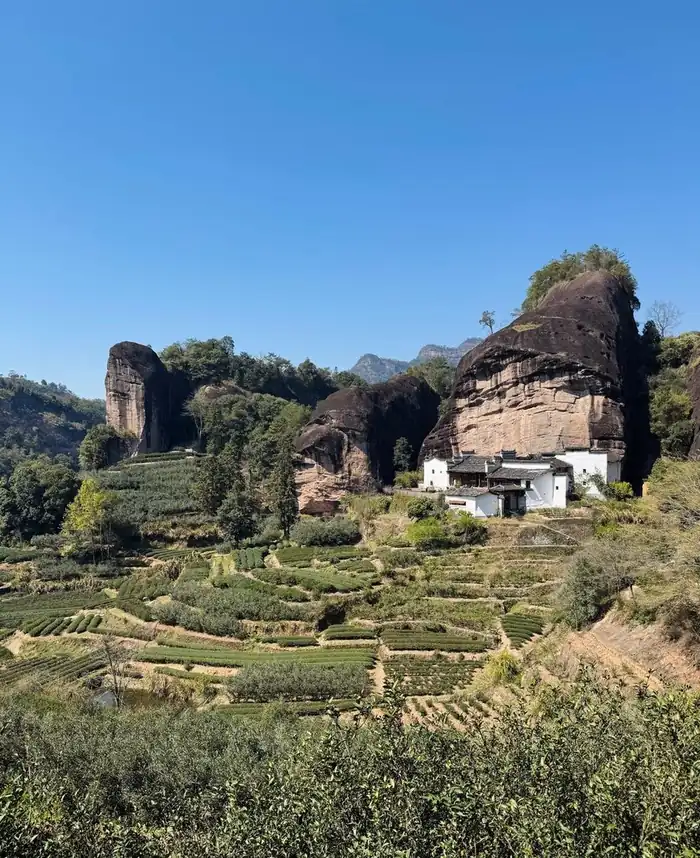
The Wuyi gorge forces roots into cracks between weathered red sandstone and conglomerate — Danxia landform, in a Danxia landform. The vines feed on slow-released minerals instead of fertile topsoil. Each bush produces only a few hundred grams of finished Yancha per year — never more.
This unique geography cannot be expanded, transplanted, or scaled. The inner Zhengyan core zone is small — small enough that much of the category’s most expensive tea comes from a handful of named gullies. That is the structural reason for the price spread, and it is a claim about geology and scale rather than an official boundary. See the Ministry of Agriculture and Rural Affairs overview for how the region and its growing areas are described officially.
First published October 19, 2026 · Last updated November 9, 2026 · By the Min Tea Shop team · Reading time: ~9 minutes
Commercial disclosure: Min Tea Shop sells the teas linked on this page and earns revenue when readers buy them. We only list lots we have brewed and tasted ourselves. This guide is educational and is not financial or investment advice.
How Does Zhengyan Terroir Create the Famous Yan Yun?
“Yan Yun” literally translates as “rock rhyme” or “rock charm.” It refers to a layered mouthfeel: mineral weight, gentle astringency, returning sweetness, and a long cool finish. Many drinkers mistake Yan Yun for simple bitterness. In reality, it is the opposite: a structured vibration across the tongue.
Three elements create this signature — and only one of them can be found outside the core:
- Mineral weight — the density on the palate that comes from cliff-rooted vines. This is the element that does not travel. We have tried to replicate the mineral signature in flat commercial gardens, and the structured finish simply does not arrive.
- Returning sweetness (回甘, hui gan) — the sweetness that rises after you swallow, built up by long charcoal roasting rather than by sugar or additives.
- Long cool finish — the cooling vibration that lingers at the back of the throat, the “hui gan” sensation drinkers use as the real test of a well-made leaf.
See our Yan Yun mouthfeel — full sensory guide for readers new to this concept, and the Rou Gui beginner’s guide for how the five structural components of Yan Yun break down in a single cultivar.
The current benchmark for this depth is single-cliff Zhengyan like the Mituoyan Da Hong Pao single-harvest 2026, drawn from one of the most mineral-concentrated cliff faces in the gorge.
Why Does Rock Tea Require Months of Charcoal Roasting?
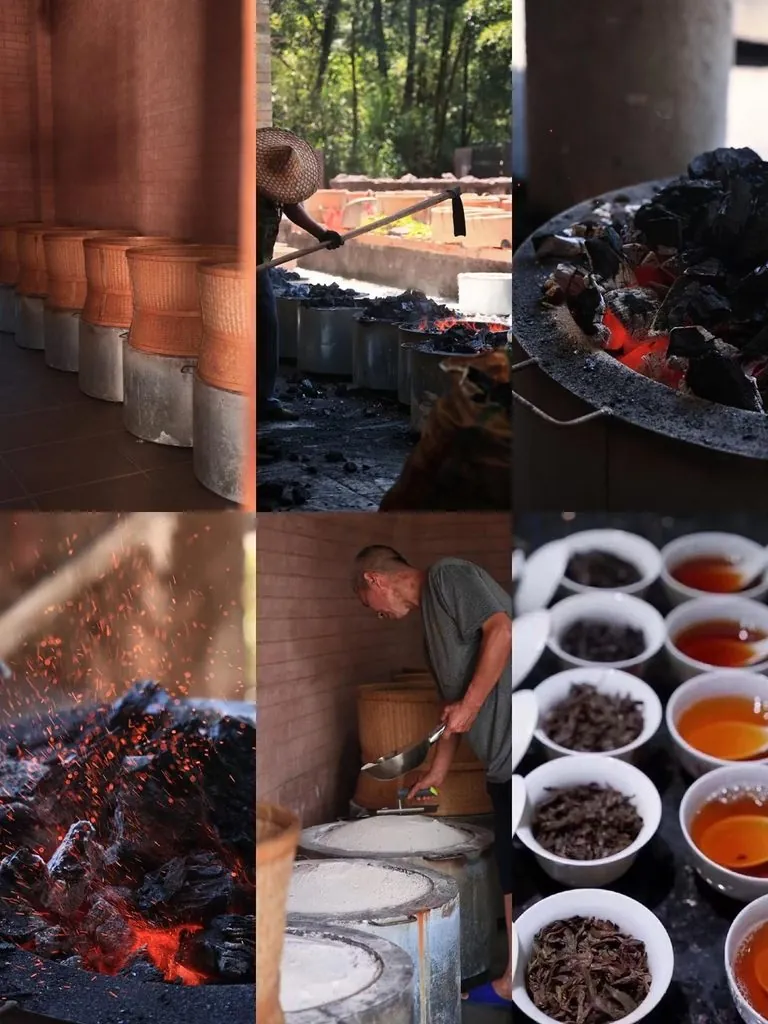
Charcoal roasting — bei huo — is what most drinkers never see. Fresh leaves go through repeated rounds over glowing hardwood ash pits. Each round lasts 8 to 12 hours, and a single Zhengyan Da Hong Pao may rest under charcoal for 90+ days before reaching drinking condition.
This craft is officially honored as part of China’s National Intangible Cultural Heritage and inscribed on UNESCO’s Representative List of Traditional Tea Processing Techniques and Associated Social Practices. The number of people who can run a charcoal roast well is small, and it is not growing quickly — the work is seasonal, hot and hard to learn. That shortage is one of the largest single costs in a Zhengyan tin, even though the labor itself is invisible in the cup.
Bei huo is not optional. It performs five distinct functions:
- Removes residual moisture unevenly to preserve aroma layers
- Deepens volatile compounds into long-lasting roasted notes
- Stabilizes the leaf for years of patient aging
- Creates the signature cocoa, caramel, and stone fruit undertones
- Cannot be rushed — heat spikes destroy the leaf within minutes
The Hidden Cost of Patience
Master roasters monitor each pit by hand every four hours during a roast cycle. One misstep scorches an entire season’s harvest. The holding cost, the wage bill, and the risk premium all flow into the final price per jin — which is why well-roasted cliff harvests like the Jiulongke Rougui 2026 command a premium even before age enters the picture.
What Does the Annual Harvest Actually Involve?
We once followed a picking team into the cliff zone at 5 a.m. The lead picker spent 20 minutes reading a single bush before touching it. She assessed leaf maturity, morning humidity, vine vigor, and last year’s stress markers. Each decision is taken every hour.
The spring window lasts roughly three weeks. Miss it, and the leaves quickly become coarse and lose their refined character. This fleeting harvest window is a major reason genuine Wuyi Yancha is so scarce, and the annual Wuyi tea-king competition is where that scarcity becomes visible: the lots that reach the auction stage are measured in jin, not in tonnes. See China News Service coverage of the annual Wuyi tea competition.
From Leaf to Cup: The Five Stages
- Plucking — hand-read mature leaves during the spring window
- Wilting & tossing (zuo qing) — outdoor withering, then rhythmic edge-bruising
- Fermentation — precise mid-oxidation to develop aroma
- Kill-green — brief pan heating to halt enzymatic activity
- Charcoal roasting (bei huo) — repeated low-temperature roasts over months
Each stage is judged by sight, smell, and feel — never by timer alone. Factory tea skips or compresses steps three through five. The depth gap is what you taste in the cup.
How Can Buyers Verify Wuyi Rock Tea?
The price tag alone proves nothing. Counterfeit tins fill global shelves. A government geographic indication for Wuyi rock tea protects the category’s origin; it does not certify a named cliff or a Zhengyan boundary, because Zhengyan is not a statutory grade. What a serious seller can document is the producer, garden, elevation, harvest date, roast level, and batch record.
| Check | What to ask for | Red flag |
|---|---|---|
| Origin documentation | Producer, garden, elevation, harvest date, roast level, batch record | A “Zhengyan certificate” with no named issuer |
| Producer trail | Roaster name, year, and pit logs | Refuses to name the producer |
| Leaf shape | Twisted, partially green-brown strips | Black, chopped, or dusty leaf |
| Wet-leaf aroma | Roasted mineral and stone fruit | Bitter char or no aroma |
| Yan Yun finish | Cooling mineral vibration and returning sweetness | A single sharp note that disappears fast |
If a vendor refuses origin documents for premium Yancha, walk away. The category attracts fraud precisely because the average buyer cannot tell. Our Zhengyan vs non-Zhengyan explained — visual identification guide walks through what to look for on the leaf itself.
What the Price Tiers Actually Look Like
The figures below are the ones we have handled ourselves, plus auction prices reported at the annual Wuyi tea-king bidding. The top of that range is a reported market extreme, not something we have paid, and we are not telling you that a $30,000 pound exists in our shop — it does not. Pricing moves with season and batch; treat any single number as a snapshot, not the market.
| Tier | What you are buying | Reported price | Where the figure comes from |
|---|---|---|---|
| Mass-market blend | An everyday drinking blend of mixed rock-tea leaf | tens of dollars per pound | Our own shelf pricing |
| Entry single-site | The floor of the real category | low hundreds per pound | Our own shelf pricing |
| Zhengyan single-bush | A single-cliff, single-bush harvest | four figures per pound | What we have paid producers |
| Auction lots | Lots sold on provenance and ceremony | four figures per pound | Reported 2025 auction results |
| Category ceiling | The top of the reported market | up to $30,000 per pound | Reported market extremes, not prices we have paid |
A note on units: a Chinese jin is 500 g. The 2018 top-end reporting of RMB 240,000/kg is roughly $15,000 per pound, not per jin. Convert any jin quote before comparing it with a per-pound ceiling; the two are not the same number.
The Three Geographic Tiers
| Tier | Where it grows | What it means for price |
|---|---|---|
| Zhengyan | Named cliffs and gullies inside the core rock zone | Highest; smallest supply and the deepest mineral finish |
| Banyan | Edge of the core zone with partial rock influence | Mid-priced; less mineral depth |
| Waishan | Outer hills and ordinary soil | Everyday pricing; low mineral signature |
Is Expensive Wuyi Rock Tea Worth the Price?
After 20 cups, most drinkers stop looking at the label altogether. They reach for whichever tin feels right that morning. That shift — from label-chasing to leaf-listening — is the real value the cliff offers.
For buyers seeking irreproducible terroir, historical resonance, and master craftsmanship, premium Wuyi Yancha delivers value beyond commodity tea. For buyers who only want a daily caffeine drink, an everyday commercial blend does the job.
There is no universal answer. The honest question is: what do you want from the cup? Price is a proxy for craft, scarcity, and origin — but only if those things matter to you.
For drinkers ready to start tasting that proxy in real cups, three beginner-friendly 2026 harvests cover most of the spectrum: the Sanyang Peak Rougui 2026 (mineral clarity), the Mazhenfeng Rougui 2026 (clean spring profile), and the Yanzi Ke Rougui (the iconic Rougui cultivar baseline).
Seven 2026 Harvests Worth Knowing
The list below covers seven 2026 harvests that map cleanly onto the structural reasons explained above. We do not accept paid placements, and the order follows the structural logic of this guide rather than our margin. Note that we may earn a commission on qualifying purchases.
- Mituoyan Da Hong Pao, Zhengyan 2026 — the benchmark for mineral depth; a Zhengyan cliff-face Da Hong Pao single harvest.
- Jiulongke Rougui, Zhengyan 2026 — a textbook keng jian lot from Jiulong Ke, one of the core “two nests.”
- Matouyan Rougui, Zhengyan 2026 — a clean Zhengyan Rougui entry point, useful as a mid-tier reference.
- Sanyang Peak Rougui, Zhengyan 2026 — a mineral-clarity style Rougui drawn from the peak’s cliff rock.
- Xiao Niu Rou Rougui, Zhengyan 2026 — a small-batch Zhengyan Rougui for comparing batch-to-batch variance.
- Wu San Di Old Bush Shuixian, Zhengyan 2026 — the non-Rougui side of the category, for comparing a softer old-bush profile.
- Lingyang Pass (Xuntao) Rougui 2026 — a high-slope lot at 1,140 m that sits outside the cliff core, showing what good yancha looks like without the core-zone premium.
Current shop policy: every order includes a complimentary comparison sample of non-Wuyi rock tea so you can contrast the core Zhengyan terroir at home. Ask customer service if a sample has not arrived with your parcel.
Frequently Asked Questions About Wuyi Rock Tea
Below are the six questions buyers ask most often. Each answer reflects firsthand experience rather than vendor copy.
What does Yan Yun actually taste like in Wuyi Rock Tea?
Yan Yun is not a single flavor — it is a layered mouthfeel. Expect mineral weight on the tongue, gentle astringency that recedes quickly, and returning sweetness across the finish. The signature element is a long cool vibration, often called “hui gan,” that lingers 30+ seconds after the sip. New drinkers often mistake Yan Yun for bitterness; with several cups, the structure becomes unmistakable.
Is Wuyi Rock Tea the same as Tieguanyin?
No — they are both oolong, but produced in different regions and styles. Wuyi Rock Tea (Yancha) is a strip-rolled oolong oxidised to roughly the middle of the range and then charcoal-roasted for months, grown on the rock of northern Fujian. Tieguanyin is grown in Anxi, oxidised less, and traditionally roasted lighter. The mouthfeel, aroma profile, and aging behavior of the two diverge significantly.
How long can Wuyi Rock Tea be aged, and does it improve?
Properly roasted Zhengyan Yancha can age 10 to 20+ years if stored cool, dark, and airtight, away from strong odors. With age, roasted notes soften into dried fruit, wood resin, and medicinal depth — a profile prized in Hong Kong and Taiwan collector markets. Young Wuyi Rock Tea (under 1 year) often tastes sharp or “fire-heavy,” which is why most premium harvests are rested 6–12 months before release.
What is the difference between Zhengyan, Banyan, and Waishan tea?
Zhengyan tea grows within the core rock zone, rooted directly into cliff rock — the highest tier and most expensive. Banyan (semi-rock) sits at the zone’s edge with partial mineral influence, mid-priced. Waishan (outer mountain) is grown in regular soil further out — abundant, lower-priced, and lacking the deep mineral signature that defines well-made Wuyi Rock Tea. One caveat: these three tiers are traditional commercial and sensory categories rather than statutory grades with audited national boundaries, so treat any “Zhengyan” label as a claim to be verified with origin documents.
Why is Da Hong Pao the most expensive Yancha?
The original Da Hong Pao mother bushes — fewer than 6 surviving — were harvested for imperial tribute since the Ming Dynasty and have never been picked commercially since 2006. Modern “Da Hong Pao” is a blend, and the word covers two different things. A blend built on cuttings of the mother-tree cultivars — Beidou, Qidan and Queshe — is one style. A commercial blend built on Rougui and Shui Xian is another, and it is the more common one on an everyday shelf. Neither is a fake; what no one can sell you is leaf from the six mother bushes, which have not been picked commercially since 2006. Imperial lineage, scarcity, and cultural cachet all inflate the value of any tin labeled Da Hong Pao — which makes origin verification critical.
How much Wuyi Rock Tea should I use for gongfu brewing?
Our working ratio is 8 g of leaf per 110 ml porcelain gaiwan. Use water at a full boil, steep the first infusion 0–3 seconds and drink it — do not pour it away. Then 5–10 seconds for the second, adding 5–10 seconds a round. See our first-steep guide for why we do not rinse loose-leaf rock tea. Six to ten infusions are typical for a quality Zhengyan Rougui — sometimes more for rested aged harvests, which open up slowly across many steeps.
Related Reading
If you’ve finished this guide, these articles go deeper on each direction:
- Rock Tea Buying Myths — the pricing traps and “ancient tree” scams we run into weekly.
- Rou Gui for Beginners — a focused dive into the aroma champion.
- Your First-Steep Brewing Guide — gaiwan setup, water temperature, infusion timing.
- Beginner’s Guide to Wuyi Rock Tea — broader buying-oriented companion piece.
- Five Wuyi Rock Tea Profiles — walk you through those five categories.
Sources & Further Reading
- Permanent Mission of China to UN Agencies for Food and Agriculture, “岩岩有茶,非岩不茶” (2020). cnafun.moa.gov.cn
- Fujian Provincial People’s Government, “什么是武夷岩茶的’岩韵’?” (2023). fujian.gov.cn
- UNESCO, “Traditional tea processing techniques and associated social practices in China,” Representative List of the Intangible Cultural Heritage of Humanity. ich.unesco.org
- China News Service, coverage of annual Wuyi tea competition rankings (2026). chinanews.com.cn
- Wikipedia, “Si Da Ming Cong Tea.” en.wikipedia.org
- Min Tea Shop, Wuyi Rock Tea Beginner’s Guide
- Min Tea Shop, Rou Gui Wuyi Rock Tea: A Beginner’s Guide to Bold Flavor
- Min Tea Shop, Wuyi Oolong Tea Brewing Guide: Should You Pour Out the First Steep?
- Min Tea Shop, Rock Tea Buying Myths
- Min Tea Shop, Rock Tea Collection
Disclosure
This article is educational. Tea flavor perception is subjective, and the chemistry and production details reflect published research and first-hand observation available as of 2026 — new research may revise the picture.
Affiliate disclosure: some links in this article point to products sold by Min Tea Shop (minteashop.com), an online Chinese tea retailer based in Fuzhou, Fujian; the author may earn a commission on qualifying purchases. Product recommendations reflect the terroir and cultivar framing in the article rather than promotional arrangement. Affiliate relationships do not influence the sourcing, citations, or conclusions above.
Pricing note: the price figures quoted on this page are observations from specific harvests and sales, not a live price list. Market prices move with season, batch, and vendor; verify current pricing directly with the seller before purchase.
Health note: Wuyi Rock Tea is a caffeinated beverage. It is not a treatment for any condition and cannot replace medical advice. If you are pregnant, have a medical condition, or are sensitive to stimulants, speak to a qualified healthcare provider before changing how much tea you drink.
Non-affiliation: this article is not affiliated with UNESCO, the Fujian Provincial People’s Government, the Ministry of Agriculture and Rural Affairs, China News Service, or any other body whose publications are cited for reference.


