
5 Best Wuyi Rock Tea Profiles (Da Hong Pao & Beyond)
If you’ve ever stood in front of a tea shelf thinking “Da Hong Pao — is that black tea?”, you’re not alone. We field this question three times every weekend at our Fujian tasting bench. After hundreds of pours alongside first-time drinkers, one pattern shows up: once newcomers understand the five categories of Wuyi yancha, every label on the shelf starts to make sense.
Today we’ll walk you through those five categories, then zoom in on the three you’ll meet first — Da Hong Pao, Rou Gui, and Shui Xian. By the end, you should be able to taste any one of them blind.
What Is Wuyi Rock Tea — and Why Does It Cost So Much?
Wuyi yancha (武夷岩茶, literally “Wuyi cliff tea”) is one of China’s six major tea classes. It is a semi-oxidized oolong, sitting between green and black tea on the oxidation spectrum. China officially classifies it under a “three red, seven green” (三红七绿) semi-oxidation framework — a qualitative target rather than a fixed percentage.[^1][^2]
Two things separate authentic yancha from any other tea:
1. Strict geography. Only tea grown within the administrative boundary of Wuyi Mountain City (武夷山市), Fujian, qualifies as true yancha. Make the same tea a few counties over in Northern Fujian, and you’ve produced Northern Fujian oolong — respectable tea, but no yan yun.[^1][^2]
2. Yan Gu Hua Xiang (岩骨花香) — “rock bone and floral fragrance.” The liquor feels weighty, almost chewy, and the aroma sinks into the body of the soup rather than floating on top. Old drinkers call this sensation yan yun (“rock rhyme”) — a sensory construct shaped by terroir plus craft, not by any single molecule.[^3][^17]
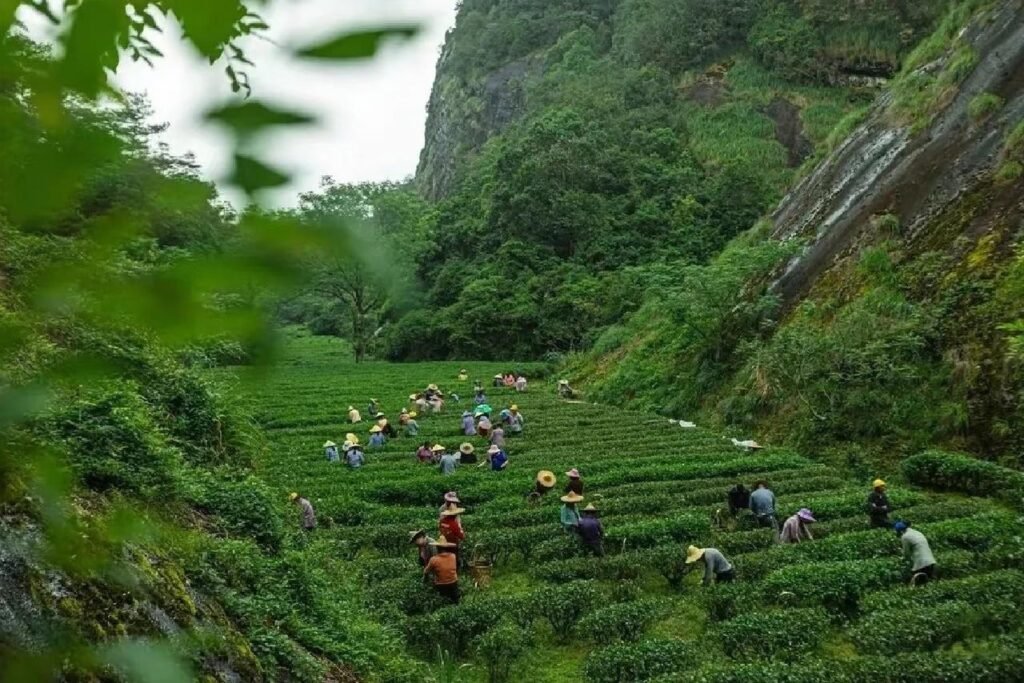
Inside the protected zone, the traditional “Three Pits and Two Streams” (三坑两涧) — Niulankeng, Huiyuan Pit, and Niutou Ling (the three pits), plus Liuxiang Stream and Tongyou Stream (the two streams) — are the classic core sites that produce trophy lots. Niulankeng’s core tea area, for example, covers only about 20–30 mu, with an annual harvest of roughly 500 kg.[^19][^18]
Aerial view of Wuyi Mountain tea gardens between rocky cliffs
What Are the 5 Official Categories of Wuyi Rock Tea?
China’s national standard GB/T 18745 — currently the 2006 edition, with a 2026 revision that takes effect 1 April 2027 — divides Wuyi yancha into exactly five categories: Dahongpao, Shuixian, Rougui, Mingcong, and Qizhong. Dahongpao, Shuixian, Rougui and Mingcong are vegetatively propagated, while Qizhong is seed-propagated.[^1][^2][^3]
( External link: [[link:anchor:national standard GB/T 18745 (current 2006 edition) | target: https://openstd.samr.gov.cn/bzgk/std/newGbInfo?hcno=C5934A7695C7A0E1ED8B6803F814C6B0]] )
| Category | Status | Best for |
|---|---|---|
| Da Hong Pao | Mainstream, market leader | Beginners wanting a complete classic profile |
| Rou Gui | Mainstream, rising star | Lovers of bold aroma and structure |
| Shui Xian | Mainstream, century-old classic | Drinkers who prefer mellow, gentle cups |
| Mingcong | Niche, premium | Collectors and seasoned drinkers |
| Qizhong | Niche, mostly industrial | Blending material and breeding stock |
If you’re just starting out, focus on the first three. Browse the full rock tea collection → for a sense of price spread.
What Is Da Hong Pao — and Why Is It So Famous?
Da Hong Pao is the most famous tea from the region, and the most confusing one — because it actually exists in three forms. Knowing which one is in your cup is the difference between paying $20 and paying tens of thousands of dollars a kilogram.
Mother Tree Da Hong Pao
Six ancient bushes at Jiulongke (九龙窠), more than 360 years old by modern Wuyi local reporting.[^4][^16] On 13 May 2006 the Wuyishan municipal government placed them under “stop harvesting and conserve” (停采留养) protection.[^5] The last documented harvest happened on 3 May 2005, producing about 20 g of tea. In 2007 that final 20 g batch was donated to the National Museum of China, where it is now held as a cultural relic.[^6]
If you ever take the trip to Wuyi, the Jiulongke cliff path is the single must-see tea pilgrimage — and our Jiulongke Rou Gui → comes from the same valley stretch.
Close-up of three ancient Mother Tree Da Hong Pao bushes on the cliff face at Jiulongke
Pure-Strain Da Hong Pao
The phrase “pure-strain Da Hong Pao” (纯种大红袍) needs careful handling. The term covers two genetically distinct lines derived from the mother-tree population:[^7][^8][^9]
- Qidan (奇丹) — the clonal line that genetic testing by Fujian Agriculture and Forestry University tied to mother-tree plants No. 2 and No. 6 at Jiulongke. Most Chinese sources treat Qidan as the authentic “pure-strain” line.[^7][^8][^9]
- Beidou No. 2 (北斗二号) — another mother-tree-derived line propagated by cuttings, but genetically distinct from Qidan. Commercial “pure-strain” Da Hong Pao is often Beidou No. 2.[^7][^8]
Both produce refined, restrained tea. Their flavor profiles are remarkably similar, which is why the distinction is mostly academic — but if a vendor claims authenticity, ask which line they’re using.
Commercial Da Hong Pao
What you’ll find in roughly 90% of tea shops. This is a skilled blend of Shui Xian, Rou Gui, Qizhong, and other lots, built to a Da Hong Pao “house style” — fuller aroma, balanced body, a recognizable signature. Blending is not cheating here; it’s a centuries-old craft, and the reason your $30 starter tin tastes “Da Hong Pao-shaped.”
A solid entry point is our Mituoyan (弥陀岩) Da Hong Pao → da-hong-pao-mituoyan-2026 — a core-area blended lot that hits every key flavor marker (osmanthus, baked depth, returning sweetness) without breaking four figures per kilo.
Why It’s Called “Big Red Robe”
The popular story — and it is folklore, not verified history — names the scholar as Ding Xian (丁显), said to have passed as zhuangyuan (top imperial-examination graduate) in 1385 during the Ming Hongwu era. After recovering from illness thanks to a monk’s tea at Tianxin Temple, he supposedly draped his imperial-red robe over the bush in gratitude — hence “Big Red Robe.”[^10][^11] A competing botanical theory attributes the name to the reddish-purple spring shoots, which look like a robe thrown over the tree.[^11] Either way, the name stuck by the late Ming dynasty.
What Makes Rou Gui the “Aroma Champion” of Rock Tea?
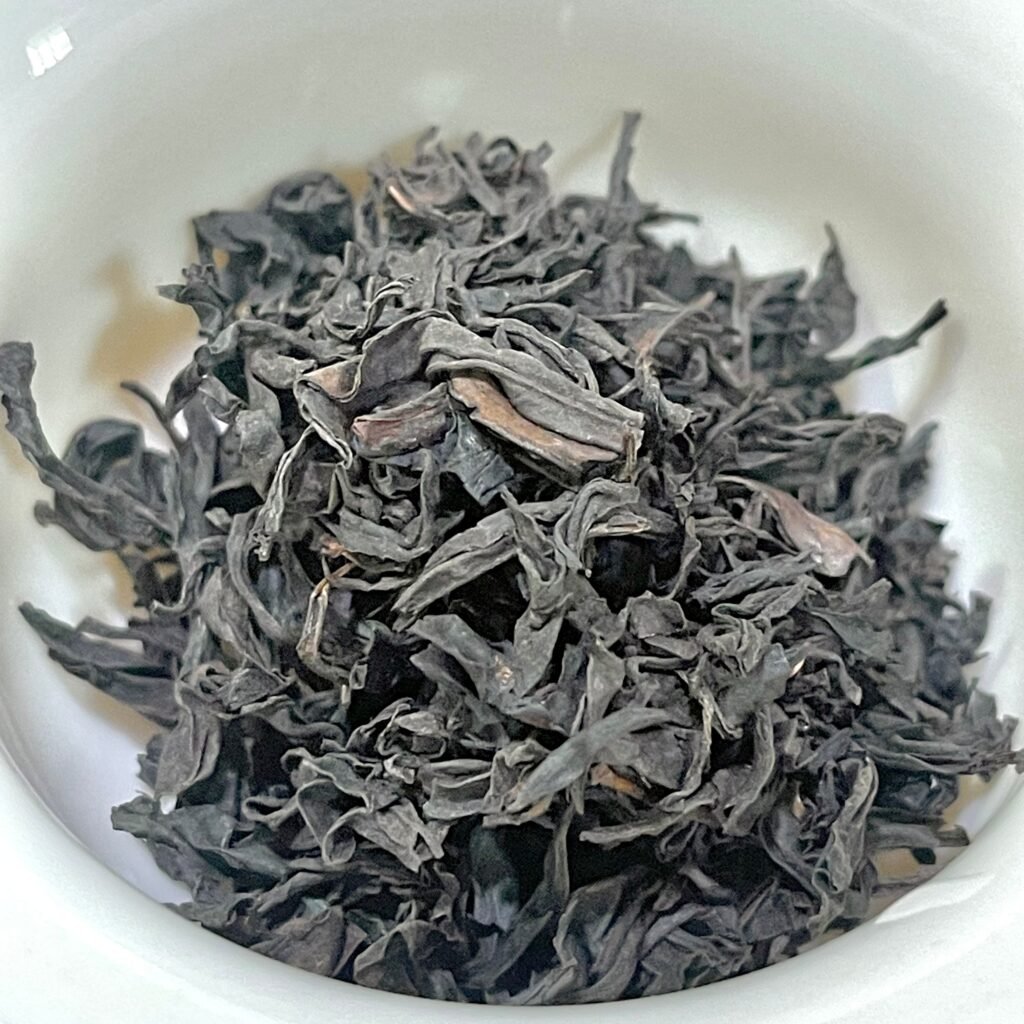
Rou Gui (肉桂, “cinnamon”) is the cultivar we reach for when we want our tea to wake up. The Cantonese saying “无肉桂不岩茶” — “no Rou Gui, no yancha” — captures how the trade has come to see this cultivar.
So what’s behind the signature aroma?
Key Characteristics
- Penetration you can smell across the room. The cinnamon-spice note is unmistakable. Top-shelf Rou Gui also shows secondary floral, ripe-fruit, or cream aromas that layer as the cup cools.
- Forceful palate. Strong astringency, pronounced structure, immediate impact. The spiciness hits first, then a quick returning sweetness, then yan yun anchors it all.
- Terroir signatures. Two mountain sites produce trophy lots: Niulankeng Rou Gui (“Beef” / 牛肉) and Matouyan Rou Gui (“Horse Meat” / 马肉). These are valley and peak names inside the Wuyishan scenic area, not village names, and the trade nicknames circulated widely from the mid-2010s onward.[^18][^19]
Want to compare side by side? Our Matouyan Duboling Rou Gui → is a core-site horse-meat example, and the Six Micro-Terroirs collection → lets you taste the terroir effect across Niulankeng, Yan Zi Ke, San Yang Feng, and three other pits in one set.
Niulankeng valley tea garden where premium Rou Gui is grown
Who’s Winning Rou Gui Right Now
The clearest recent benchmark is the 2024 Third Zhenxing Cup Wuyi Yancha Competition (1,585 entries). The Rou Gui Tea King was Zhong Jian (钟健) of Honghe Valley Tea Factory, who also collected two other Rou Gui Tea King titles that year across separate competitions. The Da Hong Pao Tea King went to Cao Jia (曹佳), a former Wuyi tea master who also won Rou Gui Tea King back in 2019.[^12]
What does that mean at retail? A March 2025 auction of 150 g of Niulankeng Rou Gui sold for RMB 5,520 — roughly RMB 36,800/kg (around USD 5,100/kg) — a collectible auction benchmark, not a general wholesale price.[^13] For branded retail, 2018 reporting ranged from RMB 4,000–6,000/kg for ordinary “Niulankeng-area” tea to RMB 200,000–240,000/kg for trophy-branded lots.[^19] Pricing has moved further upward since then; treat any single number as a snapshot, not the market.
Why Is Shui Xian Called the “Gentle Gentleman” of Rock Tea?
Where Rou Gui throws punches, Shui Xian (水仙, “water fairy”) pours a slow, weighted cup. “无水仙不岩茶” applies here for the same reason as Rou Gui — different corner of the same mountain, different personality.
Where Shui Xian Comes From
Shui Xian is documented as originating in Dahu, Shuiji, Jianyang — specifically associated with Zhutaoxian Cave (祝桃仙洞) on Yancha Mountain, Jianyang. The original historical citation is the Daoguang-era Ouning County Gazetteer (道光《瓯宁县志》), which records a tea worker transplanting an aromatic tea-like tree from the cave and propagating it by layering.[^14]
The introduction to Wuyi Mountain is far less precisely dated. Reputable sources say only that Shui Xian arrived “around the Guangxu period” (1875–1908) of the Qing Dynasty, roughly a century or more before the 2020s. No primary source gives an exact calendar year.[^14]
( External link: [[link:anchor:Ouning County Gazetteer reference | target: https://blog.udn.com/tea520/183587727]] )
Age Classifications — Industry Convention, Not National Law
Many readers ask about the difference between Gaocong Shui Xian (高丛水仙) and Laocong Shui Xian (老丛水仙). Be careful here: these age thresholds are not codified in GB/T 18745. They are trade conventions:[^15]
| Term | Common usage | Important caveat |
|---|---|---|
| Gaocong | Often trees 30–60 years old | Informal trade usage. Some producers use “gaocong” for any unpruned older bushes. |
| Laocong | Often 60+ years; a 2026 Wuyi University study uses ≥ 50 years instead. | The 30/60-year rule is not in the GB/T 18745 standard. |
Our Wu San Di Lao Cong (悟三地老丛) → wu-san-di-lao-cong-wuyi-oolong-tea-2026 sits firmly in the Laocong bracket and shows the woody, mossy, porridge-thick character older trees give the liquor. For a daily drinker without the price tag, the High Mountain Shui Xian → shows the same gentleness from younger trees.
Why It Feels So “Mellow”
- Restrained, elegant aroma. Orchid, bamboo leaf, and (in older trees) soft mossiness — quiet rather than showy.
- Rich, gentle palate. Soft, smooth, low-astringency, with a long sweet finish.
- The older the tree, the more pronounced the “cong” character. Aged Laocong lots turn viscous, almost like rice porridge.
Shui Xian is the right pick for anyone who finds strong tea “too much” or wants to taste what age does to a tea bush.
How Do Da Hong Pao, Rou Gui, and Shui Xian Differ in Flavor?
The question we get most often — here’s the cheat sheet we’d write on a napkin:
| Da Hong Pao | Rou Gui | Shui Xian | |
|---|---|---|---|
| Aroma | Full, rounded, classic | Bold cinnamon, explosive | Orchid, bamboo leaf, quiet |
| Body | Thick, balanced | Forceful, structured | Soft, dense, smooth |
| Best for | Beginners & collectors | Aroma lovers | Mellow-cup drinkers |
| Astringency | Medium | High | Low |
| Returning sweetness | Steady | Quick, spiky | Long, gentle |
| Yan yun | Complete | Forward, dominant | Hidden in the depth |
A practical home test: brew all three side by side at 8 g per 100 ml, boiling water, 10-second infusions. After three infusions the personality gap becomes obvious. Our first-steep brewing guide → walks through the exact setup if you’d like a printable routine.
Side-by-side comparison of brewed Da Hong Pao, Rou Gui, and Shui Xian tea liquor
What’s Actually Behind “Yan Yun”
A 2024 Food Chemistry metabolomics study compared Rougui from core-rock (Zhengyan), semi-rock (Banyan), and outside-mountain (Waishan) zones. The “rock bone and floral fragrance” intensity tracked with the volatile dehydrolinalool plus the non-volatiles ECG, EGC, EGCG, caffeine, theanine, soluble sugars, and sweet/bitter amino acids — not with mineral content from the rocks themselves.[^17] In plain English: yan yun is a terroir-plus-craft flavor signature — geology and microclimate influence the leaf, and withering, oxidation, and roasting shape the final balance.
What Is Qizhong (Wuyi Caicha) and Why Does It Matter?
Qizhong (奇种), also called Wuyi Caicha (武夷菜茶), is the original seed-propagated landrace-type population of the Wuyi Mountains — the genetic baseline that every named variety came from.[^11_of_qizhong]
Because these plants reproduce sexually, each bush is genetically unique. Different Qizhong bushes produce wildly different wild-mountain flavors. Most named Mingcong — including Da Hong Pao, Tie Luohan, Shui Jingui, Bai Jiguan, and Ban Tian Yao — were selected from this variable Qizhong population as superior individual bushes, then maintained by vegetative propagation.[^11_of_qizhong]
Today, most Qizhong goes into commercial blending. Pure single-bush Qizhong is rare, and when you find it, expect earthy, woody, mineral-forward cups with very clean aftertaste.
What Are Mingcong, and Which Four Are the Most Famous?
Mingcong (名枞) are individually named superior bushes — the “star vintages” of the tea world.
The “Four Famous Mingcong” Problem
There is no single canonical historical list. Two competing compositions appear in Chinese sources:[^21][^22]
- Modern trade formulation: Tie Luohan, Shui Jingui, Bai Jiguan, Ban Tian Yao
- Older encyclopedic listing: Dahongpao, Tie Luohan, Bai Jiguan, Shui Jingui
The variation is partly terminological: Da Hong Pao became its own category under the protected geographic-indication framework, so most modern guides leave it out. Ban Tian Yao has multiple traditional written forms (半天腰, 半天夭, 半天鹞, 半天妖), with the name dating back to the Ming Yongle era.[^21]
For practical purposes, this guide uses the modern trade list — but read any classic Chinese tea book and you’ll likely see Da Hong Pao in the Four instead.
Quick Tasting Notes on the Four
- Tie Luohan (铁罗汉, “Iron Arhat”) — heavy, mineral structure; historically called the first of the Mingcong.
- Shui Jingui (水金龟, “Water Golden Turtle”) — bright floral, lingering sweet aftertaste.
- Bai Jiguan (白鸡冠, “White Cockscomb”) — light, creamy texture, famously yellow-tinted leaf and liquor.
- Ban Tian Yao (半天妖, “Half-Sky Monster”) — balanced, famously complex; cliff-side origin on Sanhua Peak.
If you’ve worked through mainstream Da Hong Pao, Rou Gui, and Shui Xian for a year and want to dig deeper, Mingcong is where the rabbit hole opens up. We currently stock one of the lesser-known Mingcong, Su Xin Lan (素心兰), which showcases the gentle wild-floral side of the category → su-xin-lan-rock-tea-2026.
Display of the four famous Wuyi Mingcong teas with name cards
Frequently Asked Questions
Is Da Hong Pao a black tea?
No. It’s an oolong. The translation trap is that what English speakers call “black tea” is “red tea” (红茶) in Chinese. Da Hong Pao is semi-oxidized — well into the oolong middle of the spectrum.
Which one should I try first?
Start with commercial blended Da Hong Pao. It was designed to showcase a balanced classic profile, so it’s the friendliest first cup. If you find it too “complete,” try Rou Gui next for contrast. Our Mituoyan Da Hong Pao is what we’d hand a first-timer.
Why is good yancha so expensive?
Core mountain gardens produce tiny harvests, traditional charcoal roasting is labor-intensive, and skilled masters are a shrinking profession. A 2025 auction of 150 g of Niulankeng Rou Gui cleared RMB 5,520 (~RMB 36,800/kg) — and that’s at auction, not retail.[^13]
What does “light fire” / “medium fire” / “full fire” mean?
These are the three refined-roasting levels formally defined in the upcoming GB/T 18745-2026 standard (effective 1 April 2027): light fire (轻火) preserves high florals; medium fire (中火) balances aroma with body; full fire (足火) gives the deepest, most ageable cup.[^20] “Heavy fire” (重火) is trade slang for very strongly roasted tea, but it isn’t a codified roasting grade.[^20]
Can I brew all three the same way?
Yes — gaiwan or small Yixing pot, 8 g per 100 ml, boiling water, short infusions. The personality gap will reveal itself.
What should I look for when buying yancha online?
Three things: the specific garden or peak name (Niulankeng beats “Wuyi mountain” on the label every time), the harvest year (Spring 2026 lots are entering shelves now), and a seller with a real Fujian or Wuyi source connection. If you can’t get a straight answer on origin garden and harvest date, walk away.
Where to Start Shopping
If this guide made you ready to taste rather than read, here’s a short list we put together from our own shelves. Pick one of the three profiles and work from there.
For the classic “complete” cup — Start here → Mituoyan Da Hong Pao · 2026 Spring A core-scenic-area blended Da Hong Pao that hits every textbook marker (osmanthus, baked depth, returning sweetness) without trophy-lot pricing.
For the aroma lover — Go loud → Jiulongke Rou Gui · 2026 Spring A premium single-garden Rou Gui from the same valley as the Da Hong Pao mother trees. Cinnamon-spice aroma that fills the room, then settles into returning sweetness.
For the mellow-cup drinker — Go quiet → Wu San Di Lao Cong Shui Xian · Aged Bush Woody, mossy, porridge-thick liquor from old tea bushes — exactly the “cong” character that makes Shui Xian famous.
For the curious — See the range → Rou Gui Six Micro-Terroirs Set Six Rou Gui samples from different mountain gardens in one box. Best way to understand why terroir matters more than cultivar in rock tea.
→ Browse the full rock tea catalog →
Related Reading
If you’ve finished this guide, these articles go deeper on each direction:
- Rock Tea Buying Myths — the pricing traps and “ancient tree” scams we run into weekly.
- Rou Gui for Beginners — a focused dive into the aroma champion.
- 5 Honest Truths About Cinnamon Rock Tea — what the trade doesn’t tell you about cinnamon-spice aroma.
- Your First-Steep Brewing Guide — gaiwan setup, water temperature, infusion timing.
- Beginner’s Guide to Wuyi Rock Tea — broader buying-oriented companion piece.
About Min Tea Shop
Min Tea Shop is an online Chinese tea store based in Fuzhou, Fujian, China, three hours from the Wuyi Mountain growing region. We source directly from farms in Wuyishan (rock tea), Shouning in Ningde (white tea), and other tea-growing counties in Fujian, and we ship worldwide. Our catalog covers white, red, rock, green, and pu’er teas — though this guide is Wuyi-only because that’s where most newcomers get lost.
Practical info at a glance:
- 🌏 Worldwide shipping via DHL, FedEx, and a dedicated Europe line (most parcels arrive in 7–15 business days); standard post via China Post / Cainiao arrives in 9–25 days.
- 💳 Payments: Visa, Mastercard, JCB, PayPal; bank transfer and Western Union on request.
- 🕐 Customer service: 24/7 online support for order questions, brewing help, and pre-purchase advice.
- 📦 Order handling: 24–48 hours for picking, packing, and quality check before dispatch.
- 🔁 Returns: 7 calendar days from delivery on store-fault items (wrong item, damage on arrival); photo or video proof speeds up resolution.
- 📍 Address: Fuzhou, Fujian, China (full address on our Contact page).
For full shipping rates, payment policies, and refund terms, see our Shipping & Policies page →.
Sources & Further Reading
All facts in this article are drawn from the following primary and authoritative sources:
Standards & Official Government Records
- GB/T 18745-2026 record (effective 1 April 2027): https://openstd.samr.gov.cn/bzgk/std/newGbInfo?hcno=1615AFAC076C2D8E3D979AFE6C6F7BFD
- GB/T 18745-2006 (current edition, with No. 1 modification): https://openstd.samr.gov.cn/bzgk/std/newGbInfo?hcno=C5934A7695C7A0E1ED8B6803F814C6B0
- GB/T 18745-2006 Baidu Baike entry (Five Categories): https://baike.baidu.com/item/GB%2FT%2018745-2006/67601749
Mother Trees & 2006 Ban 4. Wuyishan local reporting, mother trees over 360 years (2026): https://www.greatwuyi.com/bdxw/content/202605/24/c1586001.html 5. Wuyishan government stop-harvest decision, 13 May 2006: https://finance.sina.cn/sa/2006-05-14/detail-ikknscsi3360833.d.html 6. Last 20 g harvest (3 May 2005) donated to National Museum 2007: https://www.wuyishantea.com/xingweng/xingweng/1175.htm
Cultivar Lineages & Folklore 7. Rednet summary of 1990 Fujian Agriculture & Forestry University genetic study on mother-tree No. 2, No. 6 and Qidan: https://moment.rednet.cn/content/2021/06/16/9537442.html 8. UDN blog on Qidan vs Beidou No. 2 genetic distinction: https://blog.udn.com/tea520/181457325 9. Baidu Baike entry on Da Hong Pao (cultivar lineage): https://baike.baidu.com/item/大红袍/688032 10. CCTV folklore account of the Ding Xian / Hongwu 1385 story: http://www.cctv.com/brand/special/C14706/20050919/102136.shtml 11. Wuyishantea.com folklore overview: https://www.wuyishantea.com/detail.asp?id=204
Competitions & Market Prices 12. 2024 Third Zhenxing Cup Wuyi Yancha Competition winners: http://tea.hxnews.com/clmp/202411/24/2182522.shtml 13. 2025 Niulankeng Rou Gui auction (150 g at RMB 5,520): https://www.polypm.com.cn/auction/product_details.html?oldData=false&zcId=7986949710814375936 14. Daoguang-era Ouning County Gazetteer on Shui Xian origin in Jianyang: https://blog.udn.com/tea520/183587727
Age Classifications & Cultivation 15. Wuyi University 2026 study proposing ≥ 50-year Laocong threshold: https://www.greatwuyi.com/info/content/202607/23/c1592685.html 16. Wuyishan official description of mother trees over 360 years (heritage): https://www.millenniumhotels.com/zh-tw/attractions/wuyishan/dahongpao-seed-tea-bushes/
Chemistry & Sensory Science 17. Jiangnan University summary of 2024 Food Chemistry metabolomics study on Zhengyan vs Banyan vs Waishan Rougui: https://futurefoods.jiangnan.edu.cn/info/1072/2115.htm
Terroir & Trade 18. Sohu summary of “Three Pits and Two Streams” core Zhengyan sites: https://www.sohu.com/a/470286767_121123696 19. Xinhua 2018 investigation of Niulankeng prices and trade structure: https://www.xinhuanet.com/politics/2018-04/12/c_1122673037.htm
Roasting & Standards 20. GreatWuyi summary of GB/T 18745-2026 refined-roasting three-level classification: https://www.greatwuyi.com/info/content/202605/08/c1584388.html
Mingcong Lists 21. Sohu historical note on Ban Tian Yao name variations (Ming Yongle references): https://www.sohu.com/a/353582730_120046680 22. Baidu Baike entry on “Wuyi Four Famous Mingcong” (alternative listing): https://baike.baidu.com/item/武夷四大名枞/2561234
Disclosure: This article is for educational purposes only. Some links in this article are affiliate links — we may earn a small commission at no extra cost to you if you make a purchase. Our tasting notes and recommendations are independent and based on first-hand sourcing trips to Wuyi Mountain. This article does not constitute medical or health advice.
