
Black Tea 2026: A Beginner’s Guide to a Gentler Daily Brew
Black tea for beginners is mostly a question of where to start, and black tea is the most drunk tea in the world — about 53% of global tea production, and 70% to 75% of the tea that crosses borders. It is also the one most often brewed badly, because the same leaf that makes a superb cup turns harsh if you leave it in the water.
This page is a starting point for black tea for beginners: what it actually is, what it tastes like, how to brew it without bitterness, and how to choose a first one that you will actually finish. If you have only ever had tea from a bag with milk, most of what follows will be new.
Table of Contents
What Black Tea Actually Is
Under China’s tea classification standard, black tea is leaf made by withering, rolling or cutting, oxidation and drying. That is the whole definition, and the important word is oxidation.
One correction worth making immediately, because it is repeated everywhere: black tea is not “fully fermented”. Fermentation is a microbial process — the one that makes pu-erh and kombucha. Black tea is enzymatically oxidised: the leaf’s own enzymes, released when the cells are bruised by rolling, react with oxygen in the air. No microbe is involved. The Chinese term for the category is 红茶, “red tea”, named for the colour of the liquor; the English name refers to the colour of the dry leaf.
The reason the distinction matters is practical. Oxidation is stopped by heat at a chosen point, and where it is stopped determines whether the cup is bright and brisk or round and heavy. A tea stopped early is lighter; one taken further is darker and deeper. That single variable explains more about why two black teas taste different than the country of origin does.
How It Is Made, in Brief
Four steps, and each one has a visible endpoint rather than a fixed clock:
- Withering — the leaf loses moisture until it is soft and pliable. Target moisture is 60% to 64% for strip-style teas.
- Rolling or cutting — the leaf is bruised, which releases enzymes and starts oxidation. Strip teas are rolled; broken teas are cut.
- Oxidation — the bruised leaf rests in humid air, typically 22 to 32 °C at 90% humidity or above, for three to six hours. The endpoint is visual: when 70% to 80% of the leaf surface has turned red-yellow, it is judged done.
- Drying — heat stops oxidation and fixes the flavour. A first pass at 110 to 130 °C brings moisture down to about 20%, and a second at 80 to 100 °C finishes at 6% to 8%.
The full detail, including the Souchong smoke-finishing step, is in how black tea is made.
What It Tastes Like
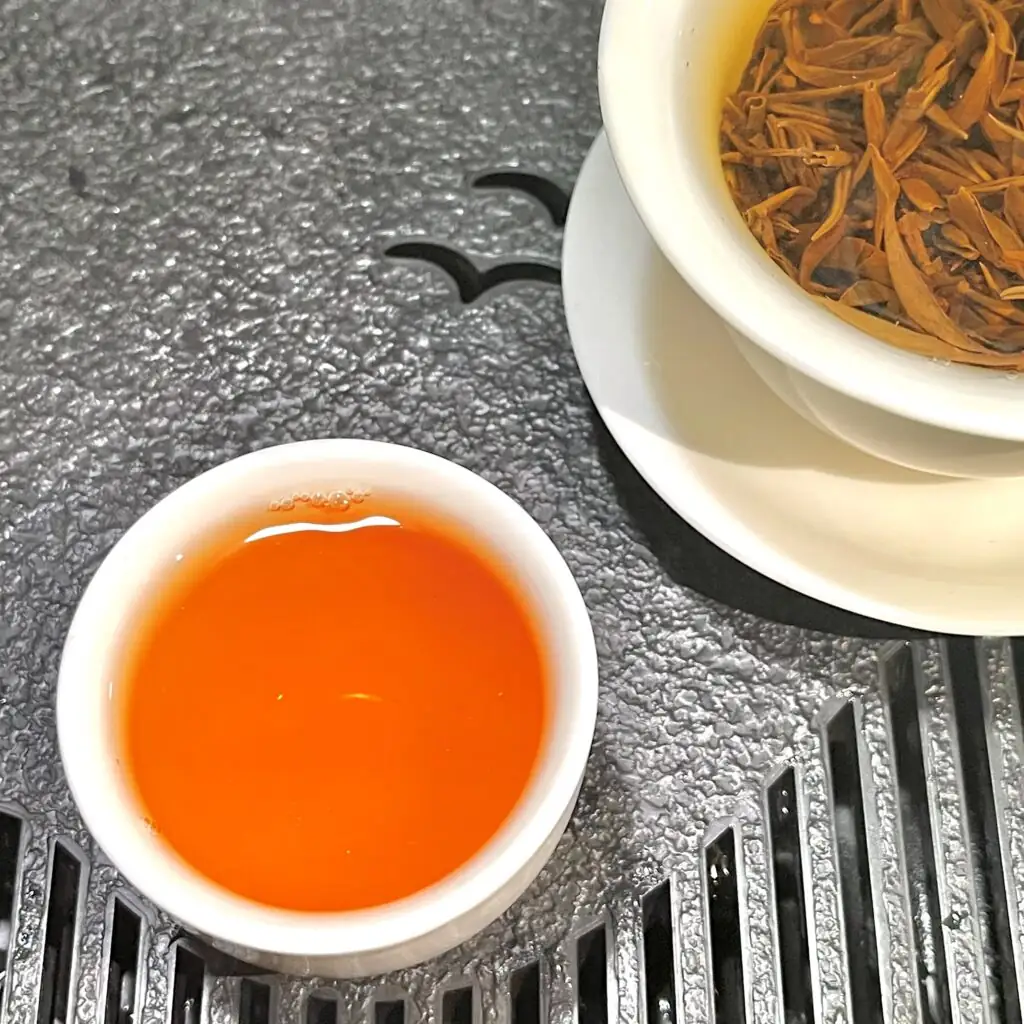
Malty, and this is the word that separates black tea from every other type. Malt comes from the same kind of browning reactions that give bread crust and beer their character. Around it you will find dried fruit, cocoa, sometimes rose or honey, and in smoked Souchong, pine.
Three things vary more than beginners expect:
Astringency. Black tea can grip the tongue. That is the catechins that survived oxidation, and it is why over-steeping turns the cup harsh rather than merely strong.
Body. Large-leaf teas from Yunnan and Assam give a heavy, coating cup that takes milk. Small-leaf Chinese Gongfu teas give a finer, lighter structure that milk would bury.
Brightness. The theaflavins formed early in oxidation give a brisk, clear quality. It is the thing that makes a good cup feel alive rather than flat, and it is the first thing lost to over-oxidation.
Which One to Start With
The named teas fall into three manufacturing categories — Gongfu, broken and Souchong — and then into styles by origin. For a first purchase, four are worth knowing:
- Keemun — cocoa and dried fruit with a rose-like aroma, medium body, no milk. The most refined entry point.
- Dianhong — malty and smooth, forgiving to brew, takes milk. The most comfortable entry point.
- Assam — bold and strong, built for milk. If you come from coffee, start here.
- Ceylon — bright and brisk, works hot or iced. The most versatile.
The full set, including Jin Jun Mei, Lapsang Souchong, Darjeeling and the grading systems, is in types of black tea.

How to Brew It Without Bitterness
Three variables, in order of how much damage they do. This is the part of black tea for beginners that is worth learning properly, because it costs nothing and changes the cup more than the leaf does.
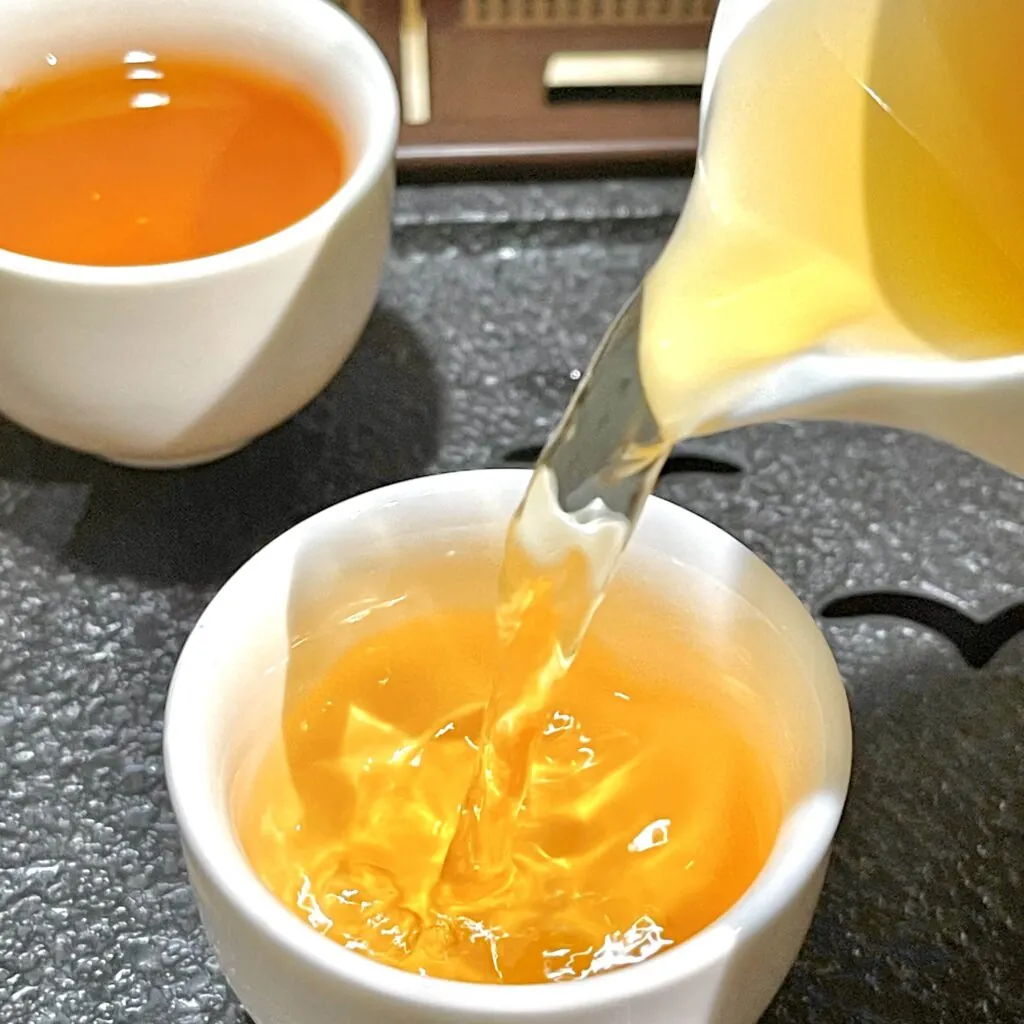
Time. This is the one that ruins cups. Black tea extracts fast, and the difference between a 2-minute and a 5-minute steep is the difference between bright and bitter. Start at 2 to 3 minutes for Western brewing and adjust from there.
Temperature. 90 to 95 °C is the working range for most black tea. Boiling water is fine for Assam and Dianhong; for Keemun and Jin Jun Mei it drives off the aromatics you paid for.
Ratio. About 2 g per 200 ml for Western brewing, or 5 g per 110 ml for gongfu. Too much leaf is a common beginner error, because it makes the tea strong and bitter at the same time.
One habit worth forming: take the leaf out, or pour the whole infusion off. Black tea left sitting in water keeps extracting, and the second cup from a forgotten pot is always worse than the first.
Methods, timings and the gongfu approach are in how to brew black tea; the chemistry behind bitterness is in why black tea tastes bitter.
How Much Caffeine
For black tea for beginners the useful answer is a range rather than a number: between 14 and 61 mg per serving across commercial products, according to the study that measured twenty of them — and it found no consistent difference between black, green and white tea. That often surprises people who assume the darker tea is the stronger one.
The figure moves far more with how you brew than with which tea you bought: more leaf, hotter water and longer steeping all raise it. A bag steeped for five minutes can carry several times the caffeine of the same bag steeped for one.
For reference, a cup of drip coffee is roughly 95 mg. Full figures are in black tea caffeine.
Choosing Your First Tin
Four things to check, none of which requires expertise. This is the part of black tea for beginners that pays for itself fastest, because it stops you buying a large amount of something you will not drink.
- The grade. Chinese Gongfu black tea runs from special grade down to sixth. The grade is on the packet and it tells you what tier of leaf you are buying.
- The leaf. Whole strips or granules, fairly even in size. A lot of dust at the bottom of the bag means the leaf was handled roughly.
- The smell. Malty and clean. Flat or dusty means it is old.
- The date. Black tea is not a tea to age. Buy it fresh and drink it within a year.
What you cannot tell from the packet is whether the grade claim is honest. That is what buying from a seller who will answer questions is for.
Storing It
Sealed, dark, dry, away from strong smells, at 25 °C or below and 50% relative humidity or below. Those are the limits the storage standard sets for black tea, and they apply to black tea for beginners as much as to anything expensive.
The practical risks are odour pickup and staleness, not spoilage. Black tea does not improve with age — the aromatics fade and the cup flattens. The idea that old black tea becomes more valuable is a marketing story with no evidence behind it.
More in how to store black tea.
Three Mistakes Worth Avoiding
Steeping too long. By far the most common mistake in black tea for beginners. Set a timer for the first few cups until you know your leaf.
Using boiling water on everything. Fine for Assam, wasteful for Keemun. If your black tea tastes flat and vaguely bitter, temperature is the first thing to change.
Believing the health claims. Black tea is a pleasant drink with a modest evidence base, not a treatment. The honest picture is in black tea benefits — including the parts where the research does not support the marketing.
Is Black Tea the Right Place to Start?
Black tea for beginners has one real advantage over green or white tea: it is forgiving. The leaf has already been oxidised, so there is less of the vegetal sharpness that turns bitter when green tea is brewed too hot, and the flavour is strong enough to register on the first sip.
It also has one disadvantage: it is easy to over-steep. Green tea punishes heat, black tea punishes time. If you are the kind of person who walks away from the mug, that matters.
Two honest signals that black tea is the right starting point. You already drink coffee and want something with comparable weight. Or you drink tea with milk and want a tea that still tastes of something underneath it. If you want something delicate and floral, start elsewhere — white tea or a light oolong will suit you better.
If you are still deciding between categories, black tea vs green tea sets the two side by side.
Frequently Asked Questions
Which black tea is best for beginners?
Dianhong, for most people. It is malty, smooth, forgiving of brewing error, and takes milk if you want it. Keemun is the better choice if you already drink your tea plain and want something more refined. Both are covered in types of black tea.
Is black tea for beginners too strong?
Only if it is brewed too long. Black tea for beginners is usually made too strong because the leaf is left in the water, not because the leaf itself is overpowering. Halve the steep time and the same tea becomes mild.
How much caffeine is in a cup of black tea for beginners?
Between 14 and 61 mg per serving, depending on the leaf and the brew — roughly a third to two thirds of a cup of coffee. Black tea is not higher in caffeine than green tea in any consistent way, despite what is often said.
Do I need special equipment?
No. A mug and a way to remove the leaf is enough. A basket infuser costs little and makes loose leaf practical. Everything else — gaiwan, scale, thermometer — improves consistency but is not required to make a good cup.
Should I add milk?
With Assam, Dianhong or a strong Ceylon, yes. With Keemun, Jin Jun Mei or Darjeeling, no — you would be covering the aromatics that make those teas worth buying. The rule of thumb is that milk suits teas with weight and malt, not teas with perfume.
Is loose leaf worth it for a beginner?
It is worth trying, because it lets you see what you are buying and it usually brews a better cup than dust in a bag. It is not a prerequisite. A good bag of black tea is better than badly stored loose leaf.
How long does an open tin keep?
About a year, if it is sealed and stored away from light and smells. Black tea does not improve with age, so there is no reason to save it.
What a First Order Should Look Like
The single most useful piece of advice for black tea for beginners is to buy small and buy two. One tin of something malty and forgiving, one of something finer and more aromatic, and drink them in the same week. The comparison teaches you more about your own taste than any description can.
A sensible pair: Dianhong and Keemun. They sit at opposite ends of the weight scale, both are widely available, and neither is expensive enough to make the experiment feel risky. If the malty one wins, you have found your daily tea. If the refined one wins, you know to explore Darjeeling and Jin Jun Mei next.
Fifty grams of each is enough for ten to fifteen cups. That is enough to learn to brew them properly, which matters more than the choice itself — a badly brewed good tea tastes worse than a well-brewed ordinary one.
Buy from a seller who states the grade and the harvest. Not because a high grade guarantees quality, but because a seller who volunteers details is usually a seller who expects to be held to them. The rest is taste.
Once you have a preference, the buying decision gets easier and the brewing decisions get more interesting. That is the point at which most people stop thinking of themselves as black tea for beginners and start thinking about which one to open next.
Related reading: types of black tea, how to brew black tea, black tea caffeine, black tea benefits.
Shop the black teas in this guide
Sold directly from our own stock. Every listing states the harvest, the county and the size options.
- Jin Mu Dan 2026, Shouning — $19.90
- High Mountain Smoked Black Tea 2026 — $19.90
Not sure which one? Browse the full black tea collection — or start with the guides above.
Sources & References
Standards
Standard numbers and dates can be verified at China’s national standards platform: std.samr.gov.cn.
- GB/T 30766-2014 — Tea classification. §2.10 defines black tea as leaf made by withering, rolling or cutting, oxidation and drying.
- GB/T 35810-2018 — Technical specification for black tea processing. Withering, rolling, oxidation and drying parameters.
- GB/T 13738.2-2017 — Gongfu black tea. Six grades.
- GB/T 30375-2013 — Tea storage. Black tea at ≤25 °C and ≤50% relative humidity.
Peer-Reviewed Research
- Chin, J.M. et al. (2008). Caffeine content of brewed teas. Journal of Analytical Toxicology 32(8):702–704. DOI:
10.1093/jat/32.8.702 - Tanaka, T. & Matsuo, Y. (2020). Production mechanisms of black tea polyphenols. Chemical and Pharmaceutical Bulletin 68:1131–1142. DOI:
10.1248/cpb.c20-00295
What this page does not claim
We do not claim black tea is healthier than other teas, that a higher grade guarantees a better cup, or that old black tea improves. Where the evidence is thin, we say so rather than filling the gap.

