
Black Tea Types Explained: Taste, Caffeine & How to Brew
“Black tea” is not one product. The types of black tea on a shelf cover leaf processed three different ways, grown across a dozen countries, and sold under names that sometimes describe a manufacture method and sometimes a village.
This page sorts that out in the order that actually helps: first the three categories the Chinese standard defines, then the named teas you will meet on a shelf, then the grading systems — including the one most often misread.
Table of Contents
The Three Categories the Standard Defines
Start with the system a buyer can actually check. China’s national standard GB/T 13738 divides the types of black tea into three products by manufacturing method, and each has its own part of the standard:
| Category | Standard | What defines it |
|---|---|---|
| Gongfu black tea (工夫红茶) | GB/T 13738.2-2017 | Rolled into strips; whole-leaf product |
| Broken black tea (红碎茶) | GB/T 13738.1-2017 | Cut and torn into granules or fragments |
| Souchong black tea (小种红茶) | GB/T 13738.3-2012 | Strip product finished over a pine-smoke fire |
The terms come from GB/T 30766-2014, the tea classification standard, which defines black tea itself as leaf made by withering, rolling or cutting, oxidation and drying. Gongfu tea is the strip product; broken tea is the granular one; Souchong is the strip product that has been smoked.
Two things follow that are worth holding onto. First, “broken” is a manufacturing description, not a quality judgement — most of the world’s tea bags are filled with broken black tea, and most of the world’s black tea by volume is made this way. Second, Souchong is defined by the smoke, which is why the same leaf smoked and unsmoked are treated as different products under the standard.
Why the Styles Taste Different
Two variables explain most of the differences between the types of black tea, and neither is the country.
The cultivar. Chinese Gongfu teas are made mostly from small and medium-leaf cultivars; Assam and Yunnan are large-leaf. Large-leaf material carries more of the compounds that become theaflavins and thearubigins during oxidation, which is why it produces a heavier, maltier cup that survives milk. Small-leaf material gives a finer, more aromatic result.
The oxidation. Black tea is fully oxidised — that is the definition — but “fully” is a target rather than a switch. The compounds that matter are theaflavins, which form early and give brightness and briskness, and thearubigins, which form later and give body and colour. A tea stopped early is brighter and thinner; one taken further is rounder and darker. Premium black tea tends to sit around a theaflavin-to-thearubigin ratio of about 1:9.
Over-oxidising pushes both in the wrong direction: theaflavins fall, and the cup loses brightness and strength together. That is why the standard’s processing parameters specify a visible endpoint rather than a fixed time — when 70% to 80% of the leaf surface has turned red-yellow, oxidation is judged complete.
Everything else — smoke, roast, cultivar choice, elevation — sits on top of those two variables.
How Many Grades Each Category Has
Grade counts differ by category, and this trips people up when they compare the types of black tea against each other:
- Gongfu black tea — six grades: special, then first through sixth
- Zhengshan Souchong — four grades: special, then first through third
- Smoked Souchong — five grades: special, then first through fourth
A special-grade Gongfu tea and a special-grade Souchong are not comparable objects. They are different products, each ranked inside its own category, the same way a first-grade White Peony is not “better” than a second-grade Shoumei.
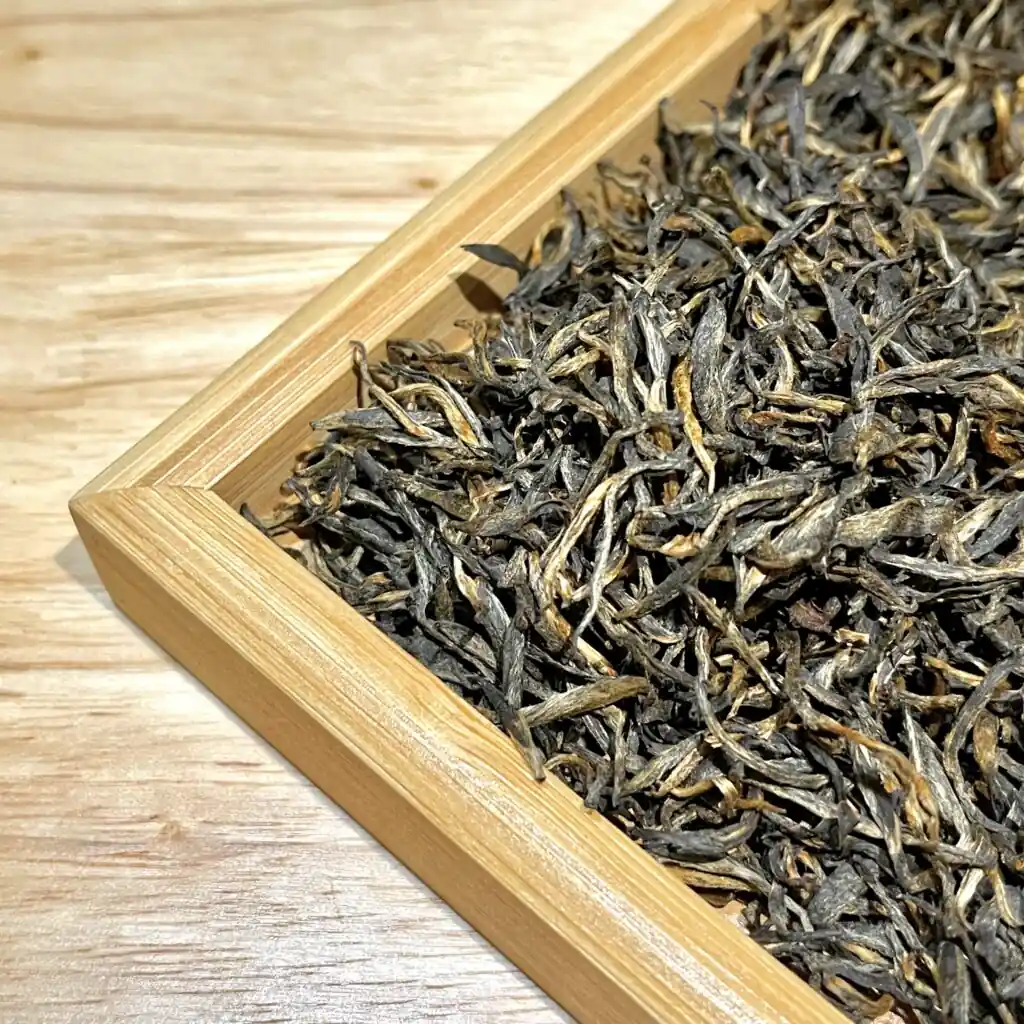
The standard’s own sensory language for special-grade large-leaf Gongfu tea gives a sense of what the top tier is meant to look like: buds tight and stout with plenty of tips, a dark brown glossy surface with visible golden hairs, a sweet and intense aroma, a fresh, strong, mellow taste, bright red liquor, and a tender leaf base with many buds.
The Chinese Types of Black Tea Worth Knowing
What follows is about the cup: what each named tea tastes like and how it is graded. If you want the geography behind these names — which province, what terroir, and which names carry geographical protection — that is the subject of Chinese black tea regions, and this page does not repeat it.
Keemun (祁门红茶)
Anhui province, and the reference point for what the Chinese types of black tea can be. Created in 1875 by Yu Ganchen and Hu Yuanlong, who modelled the process on Fujian black tea. Its signature — “Keemun aroma” — has a measurable basis: an unusually high content of geraniol, which reads as rose, supported by linalool, benzyl alcohol and phenylethanol.
In the cup it is cocoa and dried fruit with a floral lift, and it is one of the few black teas that is arguably better without milk. Qimen holds a collective trademark registered in 2024 and was approved to use the geographical indication mark in 2026 — a long and contested process that is itself a useful reminder of how GI status works in Chinese tea.
Lapsang Souchong (正山小种)
From Tongmu Village in the Wuyi Mountains, and generally treated as the original black tea. The leaf is finished over a pine-smoke fire, which is what produces the characteristic aroma — the compound responsible is longifolene, present at the highest level, alongside longicyclene, guaiacol, 4-methylguaiacol and 4-ethylguaiacol.
Since the 2000s an unsmoked style has become common, and the standard now separates the two: Zhengshan Souchong and smoked Souchong are different products. If you buy “Lapsang Souchong” expecting campfire and get dried longan instead, you have probably bought the unsmoked style.
Jin Jun Mei (金骏眉)
Made in 2005 by a team led by Jiang Yuanxun at Zhengshantang, with Liang Junde producing the first batch. It uses single buds from a defined area around Tongmu Village, and it is a branch of the Souchong family rather than a separate category.
One thing to be clear about: Jin Jun Mei is not a legal geographical indication. In 2013 the Beijing High Court treated the name as generic, and it is now defined by an industry standard, GH/T 1118-2015. Many sellers describe it as protected; it is not.
Dianhong (滇红)
Yunnan, from large-leaf cultivars. Feng Shaoqiu developed it in 1938 and the Shunning experimental factory began volume production in 1939. Fengqing, Lincang and Menghai are the main areas, and “Fengqing Dianhong” holds a geographical indication certification trademark. Large-leaf material gives the malty, chocolatey weight that makes Dianhong one of the most forgiving black teas to brew and one of the few that genuinely improves with milk.
Yingde (英德红茶)
Guangdong. First released in 1959, process standardised by 1964. The defining cultivar is Yinghong No. 9, selected as a single plant between 1961 and 1986 and approved provincially in 1988. Yingde black tea became a national geographical indication product in 2006 and was included in the first China-EU GI list.
The Minhong Gongfu trio
Three Fujian Gongfu teas that share a province and little else:
- Tanyang Gongfu (Fuan) — from 1851
- Bailin Gongfu (Fuding) — from the 1850s
- Zhenghe Gongfu (Zhenghe) — mid-nineteenth century, switched to large-leaf material in 1875
Others
Yihong Gongfu (Yichang and Enshi, Hubei, mid-nineteenth century, with a Yidu GI), Chuanhong Gongfu (Yibin, Sichuan, 1950s, with a Gaoxian GI), and Ninghong Gongfu (Xiushui, Jiangxi, 1821–1850, an agricultural GI since 2011 and a national GI product since 2025).
The International Types of Black Tea
Darjeeling
India, and the only tea commonly called “the champagne of teas” without embarrassment — the comparison is about the muscatel character, which comes from the cultivar and the high-altitude growing conditions. India’s first registered geographical indication, in 2004. Total output is small: about 6.6 million kilograms in 2022, which is why it costs what it costs.
Assam
India’s volume producer. Roughly 700 million kilograms in 2022, about 52% of Indian output. Bold, malty, and the backbone of most English Breakfast blends. The protected name is “Assam Orthodox Tea”.
Nilgiri
Southern India, high grown, and generally lighter and more aromatic than Assam. Protected as “Nilgiri Orthodox Tea”.
Ceylon
Sri Lanka. The growing districts — Uva, Dimbula, Nuwara Eliya — produce bright, brisk tea that takes citrus and works well iced. Ceylon is also the source of the grading system most often misread, covered below.
Kenya
East Africa, 500,000 to 570,000 tonnes a year, overwhelmingly CTC broken tea, and the world’s largest exporter of black tea. You have almost certainly drunk it without knowing: it is the base of many commercial blends.
Turkey
246,000 tonnes in 2022, almost all consumed domestically. Turkey has the highest per-capita tea consumption in the world and is essentially self-sufficient — a useful corrective to the assumption that black tea means China, India and Sri Lanka.
CTC and Orthodox: Two Ways to Make Broken Tea
Not all broken black tea is made the same way, and the difference is visible in the cup.
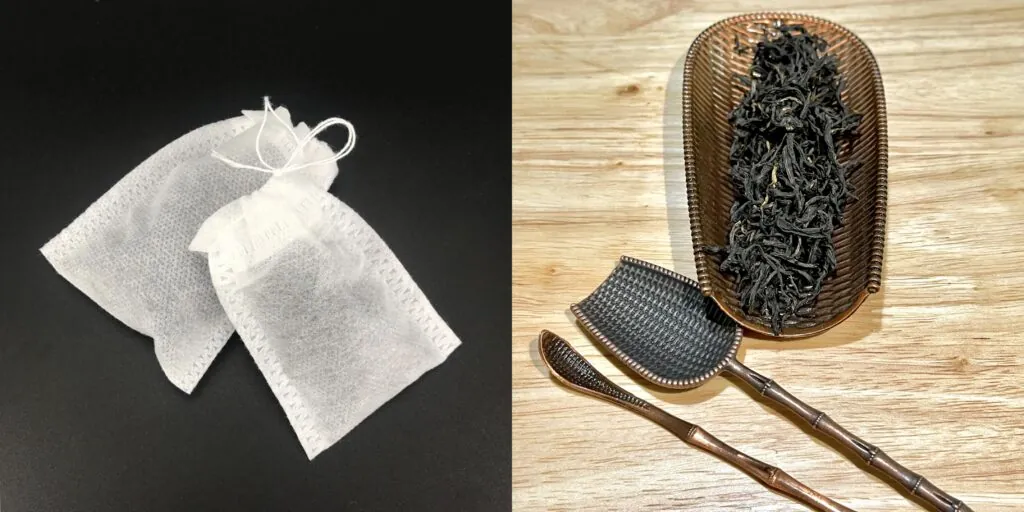
Orthodox manufacture rolls the leaf between rollers to shape and bruise it, then oxidises and dries. The result is a whole or large-piece leaf that brews slowly, gives a layered cup, and can be re-steeped. Most Chinese Gongfu tea and most premium Indian and Ceylonese tea is orthodox.
CTC — crush, tear, curl — passes the leaf through serrated rollers that shred it into small hard granules. Oxidation is fast and thorough, extraction is fast, and the cup is strong and one-dimensional. It is the standard method for tea bags and for most Kenyan production.
Neither is a quality ranking. CTC exists because it delivers consistent strength per gram at low cost, which is exactly what a tea bag needs. Orthodox exists because a layered cup is worth paying for. The confusion arises when “broken” is read as “inferior” — a CTC tea and an orthodox broken tea are both broken; they are simply built for different jobs.
The Grading System Most People Misread
Sri Lankan and Indian broken teas are graded with abbreviations like OP, BOP, BOPF, FBOP and so on. These are appearance grades — they describe leaf size and wholeness, not quality.
OP stands for Orange Pekoe, and the “orange” has nothing to do with citrus or flavour; the origin of the term is obscure. A large-leaf OP and a small broken BOPF can come from the same field on the same day. The grade tells you how the leaf was sorted, and therefore how fast it will brew and how it will look in the cup. It does not tell you which tastes better.
Chinese Gongfu and Souchong grades work differently: they are quality grades tied to sensory requirements in the standard, not size grades. Confusing the two systems is the single most common error in black tea writing.
A Note on Flavoured Black Tea
Earl Grey, black currant, vanilla, chai — these are types of black tea plus something, and the “something” is doing most of the work. They are perfectly legitimate drinks. They are not tea categories, and the leaf underneath is usually a mid-grade broken tea chosen for how well it carries flavour rather than for how it tastes alone.
If you want to taste the tea rather than the flavouring, buy unflavoured leaf — but it is worth trying the plain versions of the types of black tea above first, so you know what the base tastes like. If you want bergamot, buy Earl Grey. The confusion only becomes a problem when flavoured products are presented as though they were grades of the tea itself.
Choosing Between Them
The main types of black tea sort by what you actually want from the cup:
- Delicate and aromatic, no milk — Keemun, Darjeeling first flush, Jin Jun Mei
- Malty and forgiving, takes milk — Assam, Dianhong, Yingde
- Smoky and savoury — smoked Souchong
- Bright and brisk, good iced — Ceylon, Nilgiri
- Everyday volume, blend base — Kenya CTC, Assam
One caveat applies across all the types of black tea: the name on the packet tells you origin and style, not grade. A Keemun can be special grade or fifth grade, and both are legally Keemun. That is what the grade and the price are for.
The Types of Black Tea at a Glance
| Tea | Origin | Character | Serve |
|---|---|---|---|
| Keemun | Anhui, China | Cocoa, dried fruit, rose (geraniol) | Plain |
| Jin Jun Mei | Tongmu, Fujian | Honey, sweet florals, long finish | Plain, small cups |
| Zhengshan Souchong (smoked) | Tongmu, Fujian | Pine smoke, longan (longifolene) | Plain |
| Dianhong | Yunnan, China | Malt, chocolate, weight | Plain or milk |
| Yingde | Guangdong, China | Malty, bright, full | Plain or milk |
| Darjeeling | West Bengal, India | Muscatel, floral, light | Plain |
| Assam | Assam, India | Bold, malty, strong | Milk |
| Nilgiri | Tamil Nadu, India | Light, aromatic, brisk | Plain or iced |
| Ceylon | Sri Lanka | Bright, citrusy, brisk | Plain or iced |
| Kenya CTC | Kenya | Strong, straightforward | Blends, milk |
Read the “serve” column as a starting point rather than a rule. A well-made Assam is worth drinking plain; a cheap Darjeeling will disappoint whatever you do to it.
Related reading: black tea for beginners, how black tea is made, chinese black tea regions, jin jun mei tea.
Shop the black teas in this guide
Sold directly from our own stock. Every listing states the harvest, the county and the size options.
- Jin Mu Dan 2026, Shouning — $19.90
- Xiao Cai Cha 2026, Shouning — $19.90
Not sure which one? Browse the full black tea collection — or start with the guides above.
Frequently Asked Questions
What are the main types of black tea?
Three by manufacture — Gongfu, broken and Souchong — and within those, named styles by origin. The named teas most people meet are Keemun, Jin Jun Mei, Lapsang Souchong, Dianhong, Yingde, Assam, Darjeeling and Ceylon.
How many grades does black tea have?
It depends on the category. Gongfu black tea has six grades, Zhengshan Souchong has four, and smoked Souchong has five. They are ranked inside their own category and are not comparable across categories.
Is all black tea the same leaf?
It is the same species, and often the same cultivar, processed differently. Oxidation is what makes it black tea rather than green or oolong — see how black tea is made.
What is the difference between black tea types and grades?
A type is what the tea is — Keemun, Assam, Souchong. A grade is where a specific batch sits inside that type. Two Keemuns can be six grades apart and both are legally Keemun.
Sources & References
Standards
Standard numbers and dates can be verified at China’s national standards platform: std.samr.gov.cn.
- GB/T 13738.1-2017 — Broken black tea. Product classification and grade requirements.
- GB/T 13738.2-2017 — Gongfu black tea. Six grades; sensory tables 1–2; physical and chemical limits in table 3.
- GB/T 13738.3-2012 — Souchong black tea. Separates Zhengshan Souchong (four grades) from smoked Souchong (five grades).
- GB/T 30766-2014 — Tea classification. §2.10 defines black tea; §4.2.1–4.2.3 define the three categories.
Peer-Reviewed and Industry Sources
- Tanaka, T. & Matsuo, Y. (2020). Production mechanisms of black tea polyphenols. Chemical and Pharmaceutical Bulletin 68:1131–1142. DOI:
10.1248/cpb.c20-00295 - Yao, S. et al. (2005). Characterisation of the key aroma compounds in Lapsang Souchong. Journal of Agricultural and Food Chemistry 53:8688–8693. DOI:
10.1021/jf058059i - Food and Agriculture Organization (2022). World tea production and trade figures.
- China Tea Marketing Association (2025). 2024 Chinese black tea output: 510,300 tonnes.
Published Dates and Rulings
- Keemun created 1875; collective trademark registered 2024; GI mark approved 2026.
- Jin Jun Mei created 2005; Beijing High Court generic-name ruling 2013; industry standard GH/T 1118-2015.
- Dianhong developed 1938, volume production 1939. Yingde released 1959; national GI 2006.
- Darjeeling GI 2004. Assam and Nilgiri GI names as stated.
What this page does not claim
We do not claim one origin is superior to another, that a higher grade guarantees a better cup, or that appearance grades indicate quality. Where the historical record is contested — the exact decade of black tea’s origin, the etymology of “Lapsang” — we say so rather than picking the tidiest version.




8 Comments