
How to Brew Green Tea: Temperature, Time & Varieties
If you want to brew green tea without bitterness, use water at 75–80 °C, not boiling, with 3 g of loose leaf per 150 ml, and steep for 1–2 minutes. Strain the leaves fully, then re-steep two or three times, adding 10–15 seconds per round.
First published: June 7, 2026 · Last updated: November 9, 2026 · By Steve Wood, founder and head tea buyer
Disclosure: This guide contains links to MinTeaShop products. We recommend teas we cup and brew ourselves. Health information is educational, not medical advice.
Brew Green Tea: What Is Green Tea? The Fixation Step
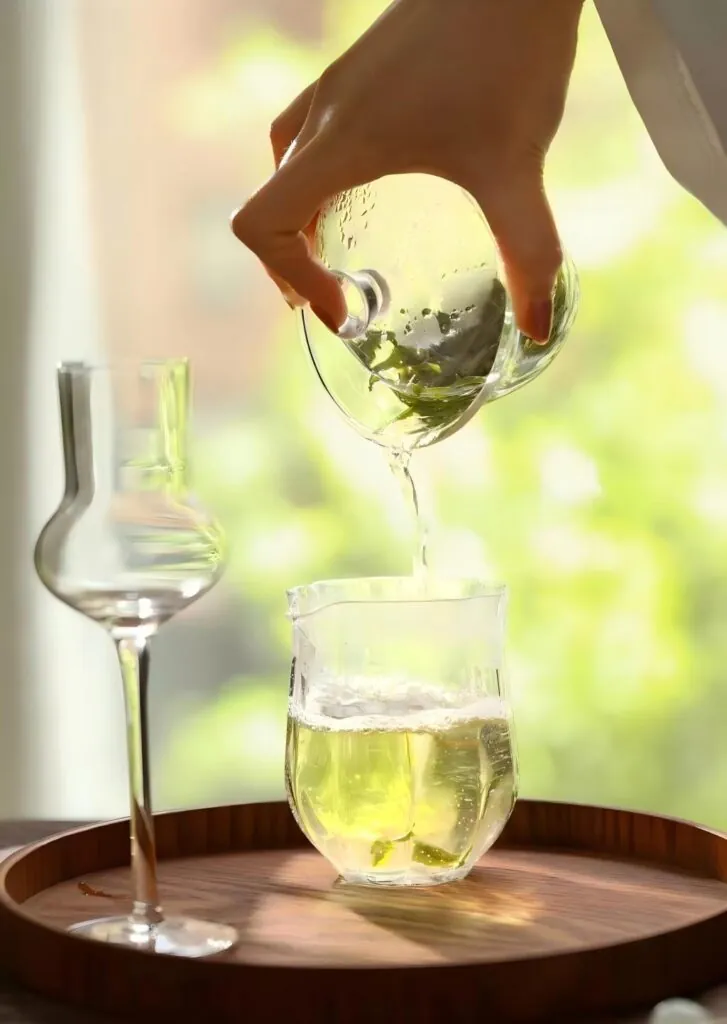
Green tea is a non-oxidised tea made from Camellia sinensis. The leaves are heated within hours of plucking, a step called fixation (杀青), which deactivates the enzyme polyphenol oxidase. That is what keeps the leaf green and the liquor fresh instead of turning it into black tea.
The process has three stages:
- Fixation (杀青) — heat stops oxidation and locks in colour and aroma.
- Rolling (揉捻) — the leaf is shaped and lightly bruised so compounds reach the surface.
- Drying (干燥) — moisture is driven off so the tea keeps its aroma and does not spoil.
Fixation is the step that makes the style green tea at all. Without fixation, the same leaves would become black tea.
China’s national standard for green tea is GB/T 14456.1-2017. It defines green tea as leaf processed by fixation, rolling and drying — exactly the sequence above. If a seller cannot tell you which standard their tea is graded under, that is worth knowing before you pay.
Brew Green Tea: Chinese Green Tea Varieties: Four Benchmarks
Four protected origins do most of the work on our shelf. They are not the only Chinese green teas, but they are a useful way to learn the style.
| Variety | Origin | Profile | Steeps |
|---|---|---|---|
| Longjing (Dragon Well) | Zhejiang | Flat, roasted chestnut, buttery | 5–7 |
| Dongting Bi Luo Chun | Jiangsu | Floral, curled snail-spring buds | 6–8 |
| Huangshan Maofeng | Fuxi, Anhui (~800 m) | Spring green, tender tips | 5–7 |
| Meitan Que She | Guizhou | Clean, high-elevation character | 5–7 |
We once toured a small Longjing estate in Hangzhou during the pre-Qingming harvest. The farmer refused to sell us leaves harvested after 9 a.m., claiming the morning dew had dried and the leaves had already lost their “honey soul.” Whether myth or fact, this obsession with freshness is exactly what makes Chinese green tea the best green tea to drink for connoisseurs.
If you want the longer buying and storage notes, they now live in our green tea storage guide.
How to Brew Green Tea: Temperature and Time
Quick Answer: Heat water to 75–80 °C, use 3 g of loose leaf per 150 ml, and steep for 1–2 minutes. Strain fully and re-steep two or three times.
If you remember nothing else, remember this: never use boiling water on green tea. This single rule fixes most bad cups.
| Parameter | Setting |
|---|---|
| Water temperature | 75–80 °C (167–176 °F) — never boiling |
| Leaf ratio | 3 g per 150 ml |
| First steep | 1–2 minutes |
| Re-steeps | 2–3 infusions |
| Extra time per round | Add 10–15 seconds |
| Water quality | Filtered or spring water, not chlorinated tap |
| No thermometer? | Boil water, then leave the lid off for 3–4 minutes → about 80 °C |
No thermometer? Boil water, then leave the lid off for 3–4 minutes. The temperature drops to approximately 80 °C.
Brew Green Tea: Brewing Times by Variety
| Tea | Origin | Leaf | First steep | Infusions |
|---|---|---|---|---|
| Pre-Qingming Longjing | Zhejiang | 3 g / 150 ml | 1–2 min | 5–7 |
| Huangshan Maofeng | Fuxi, Anhui (~800 m) | 3 g / 150 ml | 1–2 min | 5–7 |
| Dongting Bi Luo Chun | Jiangsu | 3 g / 150 ml | 1–2 min | 6–8 |
| Meitan Que She | Guizhou | 3 g / 150 ml | 1–2 min | 5–7 |
How to Brew Green Tea: Step by Step
- Warm the vessel. Pour hot water into a cup or gaiwan, swirl, and discard.
- Measure the leaf. Use 3 g of green tea per 150 ml of water.
- Cool the water. If it has just boiled, wait 3–4 minutes with the lid off.
- Pour and steep. Use 75–80 °C water and steep for 1–2 minutes.
- Strain fully. Remove all leaves so they do not keep extracting.
- Re-steep. Add 10–15 seconds per round for two or three more infusions.

Prefer something chilled? Our cold brew tea guide covers the 1 g per 100 ml ratio and the 4–12 hour fridge method.
Brew Green Tea: Loose Leaf vs Tea Bags
Whole leaf gives you more control: you can see the leaf, adjust the dose, and re-steep it. Bagged tea is cut small, so it extracts fast and often turns bitter before the aroma arrives. That is a general pattern, not a law — some pyramid bags use whole leaf and brew well.
A 2023 comparison of commercial green teas found that a loose-leaf gunpowder sample had higher phenolic content than most bagged samples, but the gap varied by brand. Buy loose leaf when you want to taste the difference; keep bags for travel and offices.
10 Common Green Tea Brewing Mistakes
| Mistake | What happens | Fix |
|---|---|---|
| Boiling water | Leaf tastes cooked and bitter | Cool to 75–80 °C |
| Steeping over 3 minutes | Tannins take over | Use a timer; stop at 1–2 minutes |
| Too much leaf (more than 3 g per 150 ml) | Thick, harsh cup | Return to 3 g per 150 ml |
| Too little leaf (less than 2.5 g per 150 ml) | Weak, watery cup | Use a kitchen scale, not a spoon |
| Wrong teapot material (Yixing clay) | Yixing absorbs delicate oils | Use glass or porcelain |
| Old or stale tea | Flat, dusty cup | Buy small batches and store cool |
| Chlorinated tap water | Dull aroma | Use filtered or spring water |
| Water below 70 °C | Thin, under-extracted cup | Aim for 75 °C minimum |
| No progressive steeping | Later cups taste empty | Add 10–15 seconds per round |
| Leaving leaves in water | The cup keeps getting bitter | Drain fully after each pour |
The Yixing point is worth repeating. An unglazed zisha pot holds aroma in its wall, which is why it suits rock tea and aged pu-erh — and why it is the wrong pot for delicate green tea. If green tea is half your routine, use glass or porcelain and keep the zisha for the teas it suits. See our De Zhong zisha teapot for the teas that pair with clay.
Safety, Caffeine and Pregnancy
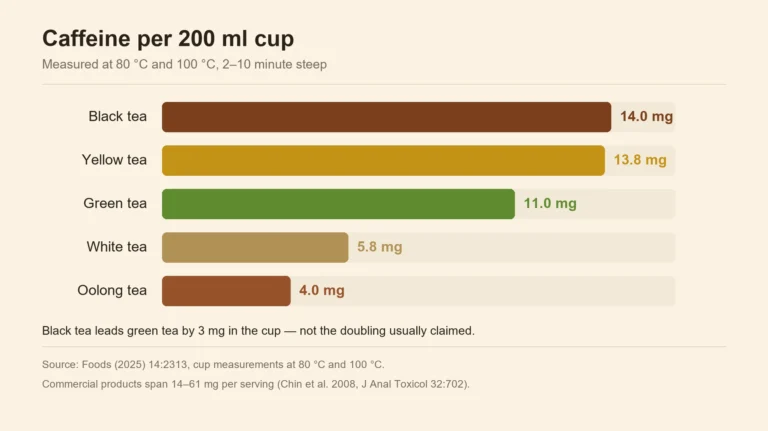
Brewed green tea usually contains about 20–30 mg of caffeine per 250 ml, depending on leaf and steep time. Mayo Clinic puts the general adult limit at 400 mg a day. ACOG and EFSA both advise keeping total caffeine under 200 mg a day during pregnancy, which is a limit rather than a target.
If you are pregnant, nursing, taking medication, or sensitive to caffeine, talk to your clinician rather than working it out from a tea page. Our green tea caffeine and EGCG guide covers the evidence, the limits and the supplement caveats in more detail.
Frequently Asked Questions
What temperature should I use for green tea?
75–80 °C for most Chinese green teas. Delicate Japanese gyokuro is often brewed cooler, around 55–60 °C, but 75–80 °C is the safe starting point for Longjing, Bi Luo Chun and Huangshan Maofeng.
How much green tea should I use per cup?
3 g of loose leaf per 150 ml. That is roughly one rounded teaspoon for most leaf styles, but a scale is more reliable because leaf size varies.
How many times can I re-steep green tea?
Two or three times for most Chinese green teas. Add 10–15 seconds to each round. Whole-leaf teas usually hold up better than bagged dust.
Why does my green tea taste bitter?
Usually boiling water, too much leaf, or too long a steep. Fix one variable at a time: cool the water first, then shorten the time, then reduce the leaf.
Can I brew green tea in a Yixing pot?
Not if you also use that pot for oolong or pu-erh. Unglazed zisha holds aroma, and green tea is too delicate for a pot seasoned with a heavier tea. Use glass or porcelain.
Final Thoughts
Learning how to brew green tea is mostly a matter of subtraction. Cool the water, use less leaf than you think, and stop the steep before the tannins take over. The right move is more cups at lower temperatures, not stronger cups.
Start with one change this week: swap your boiling water for 80 °C water and taste the difference. If you want to go deeper, read our green tea vs matcha comparison, our decaf green tea guide, or our jasmine green tea guide.
Sources and disclosure
- GB/T 14456.1-2017, Green tea — Part 1: Basic requirements
- Mayo Clinic — Caffeine
- ACOG — Moderate caffeine consumption during pregnancy
- EFSA — Caffeine
Author and reviewer disclosure
This page was written by the founder and head tea buyer at MinTeaShop, who has bought and cupped tea directly from growers for eight years. The brewing ratios are the ones we use in our own kitchen. The standard and caffeine limits are linked above. This page contains no sponsored content or paid placements.

6 Comments