
Decaf Green Tea: How It Is Made and What Remains
Decaf green tea is made by removing caffeine from the leaf before it is dried and packed. It keeps most of the tea’s catechins and L-theanine, but it is not completely caffeine-free, and the exact retention depends on the process.
First published: November 9, 2026 · Last updated: November 9, 2026 · By Steve Wood, founder and head tea buyer
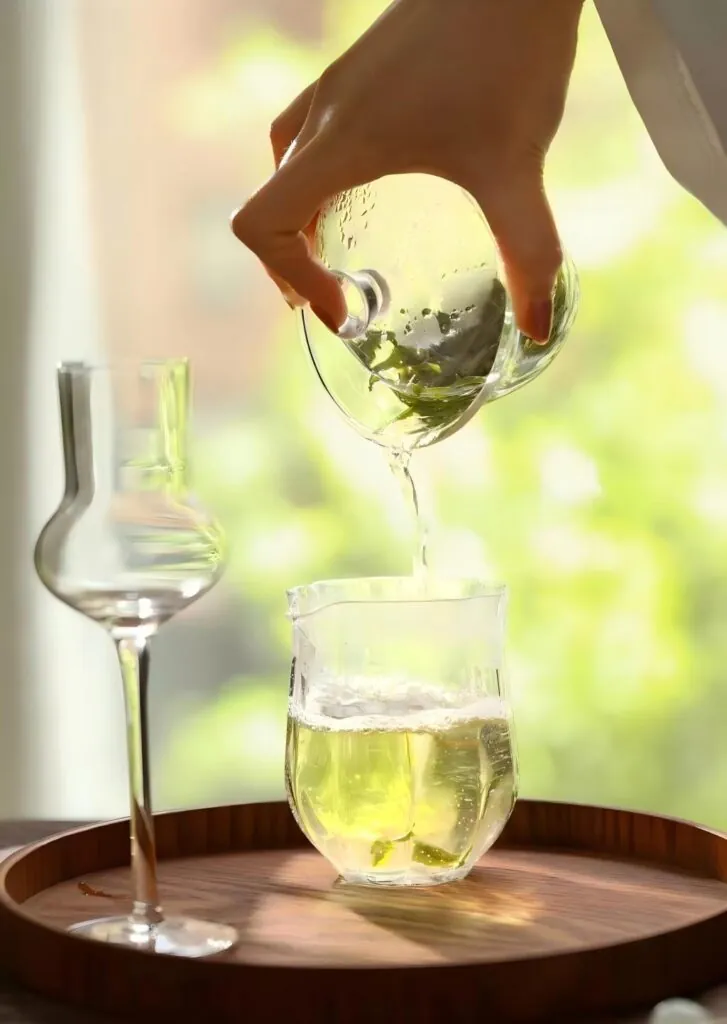
How Decaf Green Tea Is Made
Two methods dominate:
- CO₂ process: pressurised carbon dioxide pulls caffeine from the leaf. It is gentle on aroma and is often used for premium decaf.
- Water process: the leaf is soaked in hot water, the caffeine is removed from that water, and the leaf is dried again. It uses no chemical solvent, but some aroma compounds move with the water.
Both methods aim to leave the catechins behind. In practice, caffeine removal is never total. Most decaf green tea contains a small amount of caffeine — often a few milligrams per cup — so it is not the same as a caffeine-free herbal infusion.
What Stays in Decaf Green Tea
Decaf green tea still contains EGCG and other catechins, though levels vary by leaf, process and brew strength. It also retains L-theanine, the amino acid associated with the savoury, calm side of tea. The flavour is usually softer and less brisk than the caffeinated version, especially after the water process.
What it does not do is remove the need to read the label. If you are avoiding caffeine for medical reasons, check the decaf method and the stated caffeine content, and ask the seller for the batch specification if it matters.
Who Decaf Green Tea Suits
It is a sensible choice if you like green tea in the evening, if caffeine makes you anxious or disrupts sleep, or if you are reducing caffeine during pregnancy under medical advice. It is also useful for people who want the taste and ritual without the stimulant.
It is not a licence to drink unlimited cups during pregnancy. ACOG and EFSA still advise keeping total caffeine under 200 mg a day, and decaf contributes a small amount. Count coffee, chocolate, cola and supplements as well.
Does Decaf Green Tea Help With Weight Loss?
No. The weight-loss research on green tea is mostly animal work or small human trials with inconsistent results, and the human effects are modest at best. The large percentages reported in animal studies do not transfer to people. If you like decaf green tea, drink it for the taste and the ritual, not as a weight-loss method.
How to Brew Decaf Green Tea
Use the same approach as regular green tea: 75–80 °C water, 3 g of leaf per 150 ml, and a 1–2 minute first steep. Decaf leaf can taste softer, so start at 2 minutes if you want more body rather than adding more leaf. Re-steep two or three times.
For a cold version, use 1 g per 100 ml and steep in the fridge for 4–8 hours. Our cold brew guide has the full method.
The Four Decaffeination Methods
Decaffeination happens on the leaf, before drying, and the method used explains most of the difference in flavour between two decaffeinated teas of the same grade. There are four processes in commercial use.
| Method | How it works | Effect on flavour |
|---|---|---|
| Carbon dioxide (CO₂) | Leaf is moistened and treated with pressurised CO₂, which becomes a solvent for caffeine at high pressure; the gas is then released and the caffeine recovered. | Lightest touch, most of the aroma survives. The most expensive method and the one most often used for premium decaf. |
| Swiss Water Process | A water-based, chemical-free approach: green coffee/tea is soaked in water saturated with flavour compounds but not caffeine, so caffeine diffuses out while the flavour stays put. | Very clean. Slightly muted top notes. |
| Ethyl acetate | A solvent that occurs naturally in fruit is used to strip caffeine, then the leaf is steamed to remove residue. | Cheaper; often leaves a flatter, less floral cup. |
| Methylene chloride | The traditional solvent method, effective and inexpensive. | Most flavour loss of the four; solvent residues are regulated and typically negligible, but many buyers avoid it on principle. |
No method removes 100% of the caffeine, and none is required to. Note which one appears on the packaging; if the label does not say, the tea is most likely solvent-decaffeinated.
What “Decaffeinated” Is Allowed to Mean
The label is regulated, and the thresholds are useful to know when comparing products.
- US (FDA): decaffeinated tea must have had at least 97% of its caffeine removed.
- EU: decaffeinated tea must contain no more than 0.1% caffeine by dry weight.
Both allow a small residue, which is why a strong cup of decaf is not caffeine-free. For someone drinking several cups, the difference between “reduced” and “none” is worth taking seriously.
The Flavour Cost of Decaffeination
Caffeine is bitter, so removing it takes away some of the structure a green tea normally has. That has a practical consequence: the decaffeinated leaf often tastes thinner and slightly sweeter, and a brewer’s instinct is to steep it longer and hotter to compensate. That instinct is usually wrong, because longer and hotter extraction pulls out the astringent compounds that the caffeine used to balance.
Three adjustments make decaffeinated green tea taste markedly better:
- Use slightly more leaf, not more time. Going from 3 g to 4 g per 150 ml restores body without inviting bitterness.
- Keep the water cooler. 70–75 °C rather than 80 °C.
- Shorter steeps, more of them. Two minutes, then a second infusion rather than one long one.
Who Actually Benefits
Decaffeinated green tea is the sensible choice for a narrow, well-defined group: people who are pregnant or breastfeeding, people with genuine sleep disruption from afternoon caffeine, those on medication that interacts with caffeine, and anyone who simply wants a hot drink in the evening. The catechins and L-theanine largely survive decaffeination, so the tea is still worth drinking for its flavour and its composition.
It is not a fix for anything. If someone drinks decaf to avoid the effects of six coffees a day while still consuming six coffees a day, the tea is not the variable that matters.
Reading a Decaf Label
Three things are worth finding on the packet:
- The method — CO₂ and Swiss Water are the two worth paying more for.
- The residue figure, if stated. “97% removed” and “0.1% maximum” are both meaningful; “caffeine-free” is not a legal claim and should be read as marketing.
- The base leaf. A good decaf is built on a leaf worth drinking. Decaffeination on a low-grade base produces something with neither body nor aroma, and no brewing adjustment saves it.
If the leaf is described only by its decaffeination, not by origin or grade, that tells you where the money went.
Does Decaf Still Deliver the Catechins?
Mostly, yes. Decaffeination removes caffeine selectively and leaves the polyphenols largely intact, so a decaffeinated green tea still contains EGCG and the other catechins, along with L-theanine. The exact retention varies by method — the gentler processes preserve more — but decaf is not a catechin-free drink.
What it is not, is a way to get the same effect as a full-strength tea at a lower dose. It is a different drink with a similar composition, and the honest way to think about it is “green tea, minus most of the caffeine” rather than “green tea with a bonus”.
Decaf in Cold Brew, Lattes and Iced Tea
Decaffeinated green tea is the one green tea that makes sense to drink late, which makes the cold and milky preparations more relevant than usual.
Cold brew suits decaf particularly well. Use about 1 g per 100 ml of cold water and leave it in the fridge for six to eight hours. Cold extraction pulls little bitterness, and because decaffeination has already flattened the leaf a little, the resulting drink is sweet and mild — closer to a light iced tea than to green tea. It keeps two to three days refrigerated.
Lattes work with decaf green tea the same way they work with any green tea: brew stronger than you would to drink plain — around 5 g per 100 ml — then combine roughly one part tea with two parts hot milk. Green tea and milk is an unusual pairing in China but a normal one elsewhere; the milk suppresses the astringency and makes the drink rounder.
Iced tea is the simplest option: brew at double strength, cool quickly by pouring over ice rather than letting it sit, and drink within a day. A squeeze of citrus is worth considering not just for flavour — the vitamin C also helps keep the catechins stable in solution, which is why commercial bottled green teas so often contain ascorbic acid.
A Note on Pregnancy and Breastfeeding
Decaffeinated green tea is often chosen by people who are pregnant or breastfeeding, on the reasonable assumption that it is caffeine-free. It is not: both the US and EU standards permit a small residue, and a strongly brewed decaffeinated cup can still carry a measurable amount.
That residue is small — considerably less than the same cup made with ordinary green tea — and for most people it is well within accepted daily limits. If you have been advised to keep caffeine intake low, the sensible sequence is to check the actual limit with your clinician, then count decaffeinated tea honestly towards it rather than treating it as zero. The caffeine and EGCG guide covers the per-cup figures and the published limits in more detail.
This is general information, not medical advice. Restrictions during pregnancy or breastfeeding come from your own clinician, not from a tea merchant’s product page.
Frequently Asked Questions
Is decaf green tea completely caffeine-free?
No. Most decaf tea contains a small amount of caffeine. If you need zero caffeine, choose a herbal infusion instead.
Does decaf green tea still have antioxidants?
Yes. It retains catechins, including EGCG, though the amount varies with the decaffeination method and the brew.
Is decaf green tea better for you than regular?
It is better if caffeine bothers you. Otherwise, regular green tea is fine for most healthy adults within the 400 mg daily limit.
Can I drink decaf green tea while pregnant?
It can fit within a 200 mg total caffeine limit, but it is not caffeine-free. Ask your clinician, especially if you also drink coffee or take supplements.
Related guides
Read our green tea brewing guide for temperature and time, or our caffeine and EGCG guide for the evidence.
Author and reviewer disclosure
This page was written by the founder and head tea buyer at Min Tea Shop. It contains no sponsored content or paid placements. Health information is educational, not medical advice.
Sources: Mayo Clinic’s caffeine chart; EFSA on caffeine intake; ACOG on caffeine in pregnancy.



3 Comments