
How Black Tea Is Made: 4 Steps, and Why Not Fermented
How black tea is made comes down to four steps, and every difference between a Keemun and an Assam starts in one of them. The steps themselves are simple. What makes them difficult is that each one has a visual or tactile endpoint rather than a fixed clock, which is why two factories using the same standard can produce very different tea.
This page sets out how black tea is made according to China’s technical standard, then explains what each step does to the cup — and why the same standard still produces tea that tastes completely different from one factory to the next.
Table of Contents
The Definition, and One Correction
China’s tea classification standard defines how black tea is made: leaf made by withering, rolling or cutting, oxidation and drying. That is the whole legal definition, and it is worth noting what is not in it: there is no fermentation step.
This matters because the phrase “fully fermented tea” is everywhere in English-language tea writing, and it is wrong. Fermentation is a microbial process — the one that turns fresh leaf into pu-erh, or cabbage into sauerkraut. Black tea involves no microbes at all.
What actually happens is enzymatic oxidation. When the leaf is rolled or cut, its cells rupture and release polyphenol oxidase and peroxidase, enzymes that were previously kept separate from their substrates. In the presence of oxygen, those enzymes convert the leaf’s catechins into larger, darker molecules. The factory controls how far that reaction runs by choosing when to apply heat.
So the accurate phrasing is “fully oxidised”, and even that needs a caveat: “fully” is a target rather than a switch, which is what the next four steps are about.
Step One: Withering
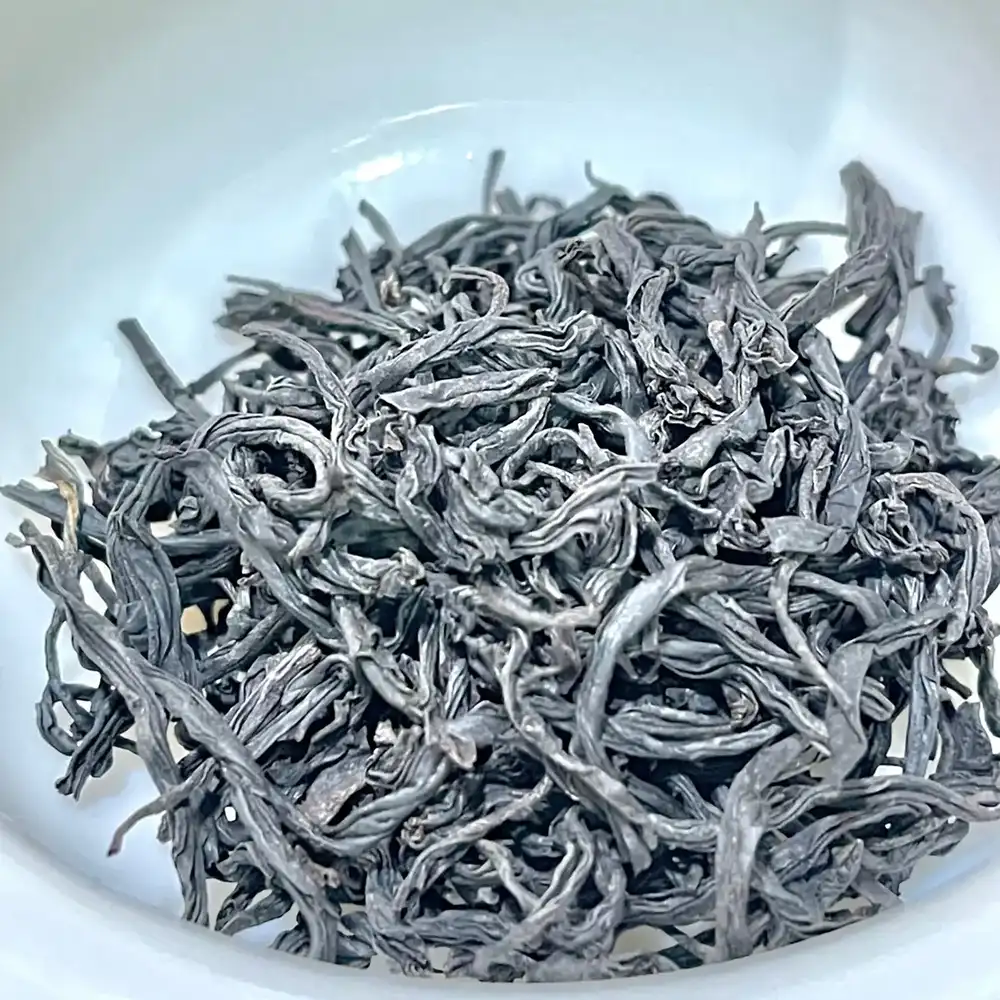
Fresh leaf is spread out and allowed to lose moisture. The aim is not drying but softening — the leaf has to become pliable enough to roll without shattering. Everything that follows in how black tea is made depends on that judgement: leaf that is too dry shatters in the roller, and leaf that is too wet will not oxidise evenly.
For strip-style teas such as Gongfu and Souchong, the standard gives two routes. Natural withering runs 12 to 24 hours at 20 to 28 °C, or 8 to 16 hours with warmed air entering at 25 to 35 °C. Sun withering, where it is used, keeps the leaf temperature below 30 °C. The endpoint is a moisture content of 60% to 64%, judged by the leaf losing its surface sheen, turning a duller green, and a stem that bends without snapping.
Broken tea is withered faster and harder: 8 to 12 hours with inlet air at 35 to 38 °C for small and medium leaf, below 35 °C for large leaf. Target moisture varies by the machine that will cut it — 58% to 62% for disc rollers, 58% to 64% for rotor machines, 62% to 68% for CTC.
Withering is chemically active, not just physical. Proteins break down into amino acids during this stage, which is where a good part of the eventual sweetness comes from. A factory that withers too fast gets leaf that rolls badly and tastes thin.
Step Two: Rolling or Cutting
This is the step that starts oxidation, because it is the step that breaks cells — and in the story of how black tea is made, it is the point where styles diverge permanently.
For strip teas, rolling is done in stages: ten to fifteen minutes without pressure first, so the leaf takes shape without being crushed, then alternating light, heavy and light pressure. The traditional description of the goal is leaf that is twisted into strips with a high proportion of unbroken cells.
For broken teas, the leaf is cut rather than rolled — 30 to 40 minutes, with the pressure sequence light, heavy, light again, aiming for a strip formation rate above 80% before the final cut. CTC takes this furthest: serrated rollers shred the leaf into hard granules in a single pass.
The choice between rolling and cutting is the choice between two products, not two quality levels. Rolled leaf keeps its structure, brews slowly and gives a layered cup. Cut leaf exposes far more surface area, oxidises faster and brews fast and strong. That trade-off is why tea bags use cut leaf.
Step Three: Oxidation
This is the step that makes black tea black tea, and in any account of how black tea is made it is the one most carefully controlled. Get it wrong in either direction and the cup cannot be rescued later.
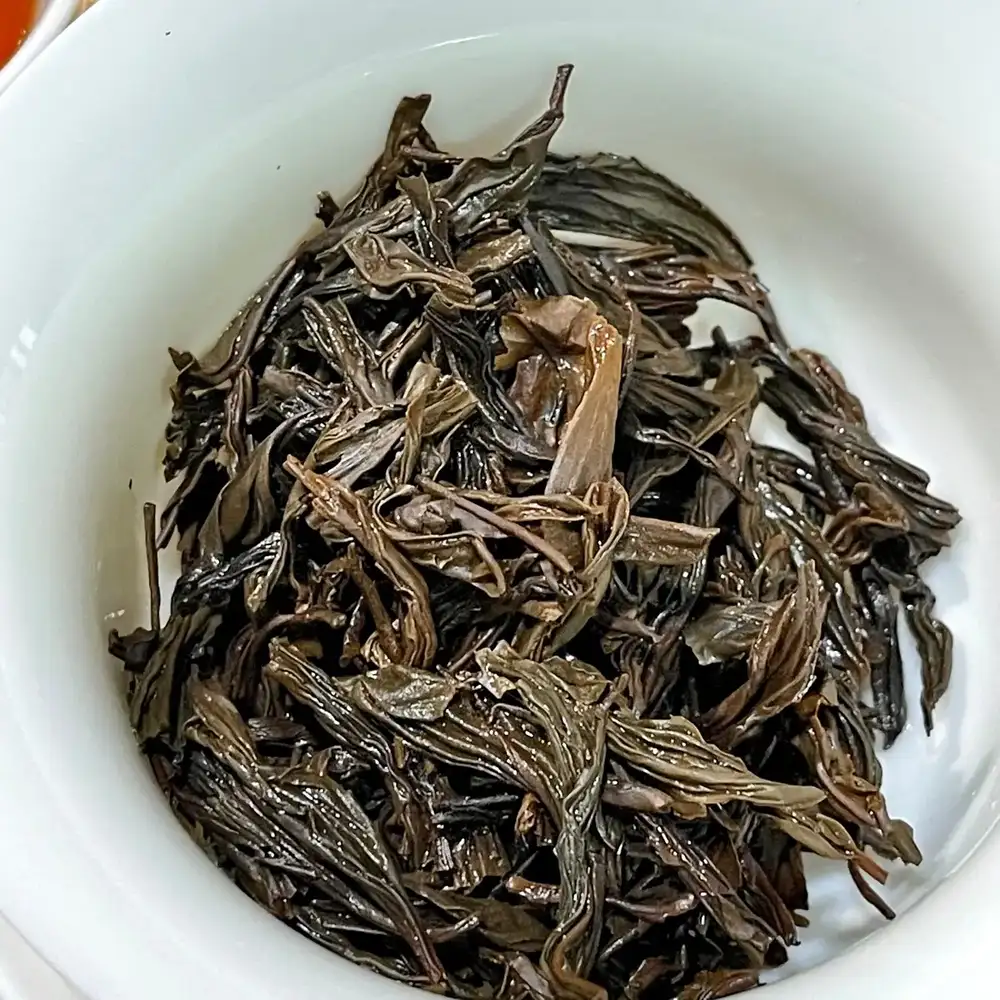
The standard’s parameters for strip teas: 22 to 32 °C, relative humidity at or above 90%, leaf piled 6 to 20 cm deep, for three to six hours. The endpoint is visual — when 70% to 80% of the leaf surface has turned red-yellow to yellow-red, and the raw grassy smell has given way to a fruity or floral one, oxidation is judged complete.
Broken tea runs faster: 30 to 60 minutes at 22 to 28 °C for large leaf or 25 to 30 °C for small leaf, also above 90% humidity.
Understanding how black tea is made chemically means understanding this stage, because everything that distinguishes a good cup from a flat one happens here. What is happening is a sequence with a clear shape. The catechins — the bitter, astringent compounds that dominate green tea — are being consumed. Early in the reaction they form theaflavins, relatively small molecules with a bright orange-red colour that give the cup its briskness and clarity. Later they form thearubigins, larger and darker, which give body and depth.
The ratio between the two is the single best predictor of cup quality. Research on well-made black tea finds a theaflavin-to-thearubigin ratio around 1:9, and the same work shows that over-oxidising pushes the ratio the wrong way: theaflavins fall, and brightness and strength decline together.
Temperature matters here too. Studies comparing fermentation temperatures find that 15 to 20 °C produces better quality than higher temperatures, and that fermenting hot for too long raises thearubigins while lowering theaflavins and brightness.
Step Four: Drying
Heat stops the enzymes and fixes the flavour. It is usually done in two passes, and it is the least discussed stage of how black tea is made despite setting much of the final aroma.
For strip teas, the first pass (毛火, “rough fire”) runs at 110 to 130 °C for 10 to 15 minutes, bringing moisture down to about 20%. The second (足火, “sufficient fire”) runs at 80 to 100 °C, finishing at 6% to 8% moisture. Broken tea uses similar logic at slightly different numbers: 110 to 120 °C to about 18% to 20%, then 100 to 110 °C to 4% to 6%.
Drying is the last of the four steps in how black tea is made, and it is not just preservation. The heat drives aroma chemistry — Maillard reactions and the breakdown of carotenoids and lipids — which is where much of the final aromatic character is set. Research on Keemun identifies more than a hundred volatiles in the dried tea, with trans-β-ionone, linalool, geraniol, phenylacetaldehyde and theaspirane among the key contributors.
The final moisture target matters more than it looks. The standard sets a maximum of 7.0% for all three black tea categories, and tea above that will deteriorate in storage regardless of how well it is kept.
The Extra Step: Smoking
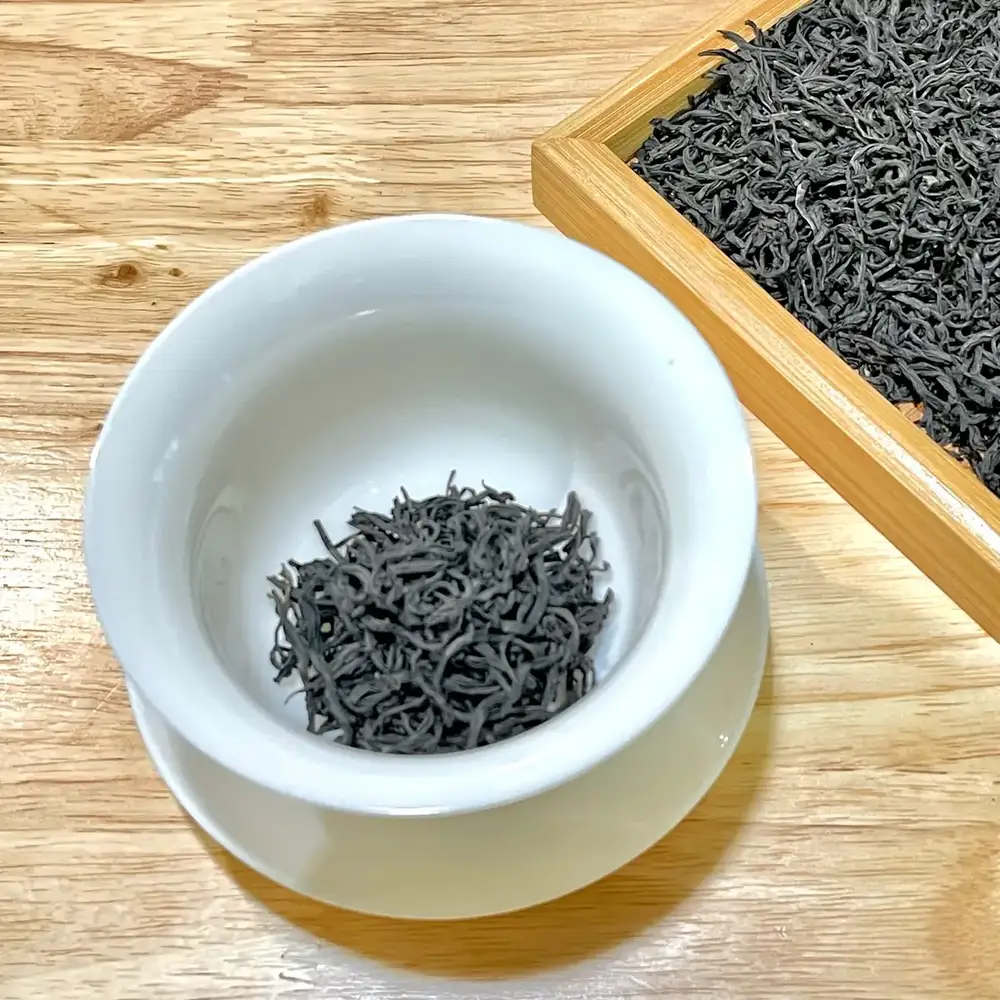
Souchong black tea has a fifth step. After rolling and before or during drying, the leaf is finished over a pine-wood fire — traditionally at around 70 °C for 6 to 12 hours — which is what gives the style its smoke.
The chemistry is specific. The compounds responsible are longifolene, present at the highest level, along with longicyclene and the guaiacols: guaiacol, 4-methylguaiacol and 4-ethylguaiacol. These are not present in unsmoked black tea at anything like the same concentration, which is why smoked and unsmoked Souchong are treated as different products under the standard rather than as variations of one.
Since the 2000s, an unsmoked version has become common — the style that Jin Jun Mei belongs to. Both are Souchong-family products; only one has the fire.
What Each Step Does to the Cup
Reading a black tea backwards through the process of how black tea is made explains what you taste, and it is the fastest way to learn to diagnose a cup.
- Thin and grassy — under-withered or under-oxidised leaf
- Bright and brisk — good theaflavin formation, oxidation stopped at the right point
- Flat and dark — over-oxidised; theaflavins lost
- Harsh and drying — residual catechins, often from leaf that oxidised unevenly
- Bready and sweet — amino acids from withering and Maillard products from drying
- Smoky — the pine fire, and nothing else
None of these is a defect of the leaf itself. They are the signature of decisions made in a factory, and knowing which decision produced which result is most of what makes tasting black tea interesting.
Why the Same Standard Produces Different Tea
The standard gives ranges rather than fixed values, and that is deliberate. How black tea is made depends on the leaf in front of the maker: its moisture, its thickness, the weather that week, and the cultivar.
A thick, large-leaf Yunnan cultivar holds water differently from a thin small-leaf Fujian cultivar. The same 12-hour withering that suits one will over-wither the other. The same three-hour oxidation that produces a bright Keemun will produce a dull cup from leaf that arrived at the factory already warm.
This is why experienced makers talk about reading the leaf rather than following a recipe. The parameters in the standard describe what a correctly processed batch looks like at each stage — 60% to 64% moisture, 70% to 80% colour change — rather than prescribing exactly how to get there.
The consequence for a buyer is that grade and origin tell you less than you would hope. Two factories working to the same standard, in the same county, in the same season, can produce tea at opposite ends of the quality range. The difference is in how carefully each endpoint was judged.
Small Factory and Industrial Process
The descriptions above fit a workshop making strip tea in batches. Most of the world’s black tea is not made that way, and it is worth knowing how the industrial version differs.
An orthodox factory rolls whole leaf in batches, oxidises it in shallow beds or on trays, and dries it in two passes. A batch might be a few hundred kilograms, and a skilled maker adjusts the timing by hand.
A CTC line runs continuously. Leaf enters at one end, is withered, chopped, oxidised on a moving bed and dried without ever stopping. Output is measured in tonnes per hour and consistency is the goal rather than character.
Neither is dishonest and neither is automatically worse. CTC produces a strong, uniform, cheap product that is exactly what a tea bag needs. Orthodox produces a leaf with structure and variation that is exactly what a loose-leaf buyer wants. The error is treating the industrial method as a debased version of the traditional one — they are answering different questions about how black tea is made.
Frequently Asked Questions
Is black tea fermented?
No, and this is the most common error in how black tea is described. It is enzymatically oxidised — leaf enzymes react with oxygen. No microorganism is involved, unlike pu-erh or kombucha.
In how black tea is made, how long does oxidation take?
Three to six hours for strip teas at 22 to 32 °C, and 30 to 60 minutes for broken teas. The endpoint is judged by colour and smell rather than by the clock.
Why is the leaf dried twice when making black tea?
The first pass stops oxidation and removes most of the water; the second finishes the job slowly so the leaf does not scorch. Splitting it also lets the second stage develop aroma rather than just remove moisture.
Does how black tea is made affect caffeine?
Barely. Caffeine is stable through processing and is not created or destroyed by oxidation. What changes the caffeine in your cup is how much leaf you use and how long you steep it.
What makes smoked Souchong smoky?
Finishing the leaf over a pine-wood fire. The characteristic compounds are longifolene, longicyclene and the guaiacols, and they are not present at those levels in unsmoked black tea.
Related reading: types of black tea, black tea history, chinese black tea regions.
Shop the black teas in this guide
Sold directly from our own stock. Every listing states the harvest, the county and the size options.
- High Mountain Smoked Black Tea 2026 — $19.90
- Xiao Cai Cha 2026, Shouning — $19.90
Not sure which one? Browse the full black tea collection — or start with the guides above.
Sources & References
Standards
Standard numbers and dates can be verified at China’s national standards platform: std.samr.gov.cn.
- GB/T 30766-2014 — Tea classification. §2.10 defines black tea; §4.2.1–4.2.3 define broken, Gongfu and Souchong.
- GB/T 35810-2018 — Technical specification for black tea processing. Withering, rolling, oxidation and drying parameters cited above.
- GB/T 13738.1-2017 / .2-2017 / .3-2012 — Product standards for broken, Gongfu and Souchong black tea. 7.0% moisture maximum.
Peer-Reviewed Research
- Tanaka, T. & Matsuo, Y. (2020). Production mechanisms of black tea polyphenols. Chemical and Pharmaceutical Bulletin 68:1131–1142. DOI:
10.1248/cpb.c20-00295 - Obanda, M. et al. (2001). Changes in theaflavin composition and astringency during fermentation. Food Chemistry 75:395–404. DOI:
10.1016/S0308-8146(01)00223-0 - Food Chemistry (2001) 75:319–327. DOI:
10.1016/S0308-8146(00)00232-6— fermentation temperature effects on theaflavin and thearubigin content. - Yao, S. et al. (2005). Key aroma compounds in Lapsang Souchong. Journal of Agricultural and Food Chemistry 53:8688–8693. DOI:
10.1021/jf058059i - Food Chemistry: X (2026). DOI:
10.1016/j.fochx.2026.104531— volatile profile of Keemun black tea during drying.
What this page does not claim
We do not claim one processing method produces better tea than another, that the standard’s numbers are the only correct ones, or that a defect in the cup always traces to a specific factory decision. The parameters are the reference; the leaf and the season decide how they are applied.

One Comment