
Black Tea Caffeine: 14–61 mg a Cup, and Why
Black tea caffeine is the question people ask second, right after how to brew it. The honest answer is a range, not a number, and it is narrower and lower than most people expect.
What follows is the measured data behind black tea caffeine, what moves the number up and down, and the two claims about it that are simply wrong. If you are looking for a single figure, there is not one — but there is a defensible range and a set of levers you control.
Table of Contents
How Much Caffeine Is in Black Tea
The most-cited measurement of black tea caffeine content comes from a study that bought twenty commercial teas and brewed each according to its own package instructions. The range across all of them was 14 to 61 milligrams per serving, on either 6 or 8 ounce cups depending on the product.
The same study found no consistent trend between tea types. Black, green and white teas overlapped across that range. What predicted caffeine better than the type of tea was the brewing instruction on the packet — how much leaf, how long.
A second line of evidence points the same way. Measured as dry leaf extracted over three infusions, black tea yielded 32.8 mg per gram, green tea 36.6 and oolong 23.8. On that basis black tea is not the strongest of the three; green tea is.
Where the higher figures come from
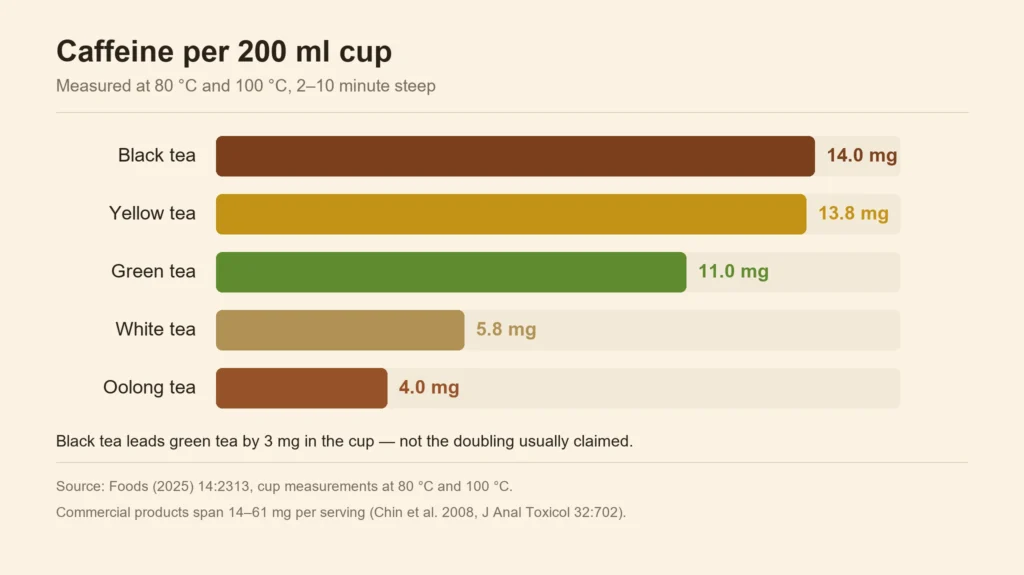
A 2025 study measured caffeine in the cup across tea types under controlled conditions — 80 °C and 100 °C, steeping 2 to 10 minutes. It found black tea at 14 mg per 200 ml, ahead of yellow tea at 13.8, green at 11, white at 5.8 and oolong at 4.
That result is real, and it does show black tea coming out highest under those specific conditions. It also shows how much the numbers move: the same teas, brewed differently, produce a different ranking. Neither study is wrong; they are measuring different things.
The practical conclusion is that “black tea caffeine” does not have a single value. It has a range of roughly 14 to 61 mg per cup, and where in that range your cup sits depends mostly on you.
What Actually Changes the Number
Five variables, in rough order of influence:
How much leaf you use. Caffeine dose scales with leaf mass almost linearly. Doubling the leaf roughly doubles the caffeine, which is why gongfu brewing at 5 g per 110 ml delivers more per cup than a 2 g Western brew — even though each individual steep is short.
Steeping time. Extraction continues while the leaf is in water. A bag steeped for five minutes carries substantially more than the same bag steeped for one. This is the variable people control least and it matters most.
Water temperature. Hotter water extracts caffeine faster. The difference between 80 °C and 100 °C is measurable but smaller than the effect of time.
Leaf grade and particle size. Broken leaf and tea bag dust extract faster than whole leaf because there is more surface area. Given identical brewing, a tea bag will deliver its caffeine sooner and more completely.
Whether you drink the first steep. Caffeine is highly water-soluble and most of it comes out early. If you discard a rinse, you discard a meaningful fraction — which is why the “rinse to reduce caffeine” advice works, and also why it wastes flavour.
Black Tea Caffeine vs Coffee
An 8 ounce cup of brewed coffee is roughly 95 mg of caffeine. A cup of black tea at the middle of its range is around 40 mg. So a cup of black tea is typically less than half a cup of coffee, and at the low end of the range it is closer to a third.
This is why tea is often described as gentler, though it is worth being precise about what that means. The caffeine dose is lower, and it is absorbed over a slightly longer period because the liquid is consumed more slowly and the volume is smaller. The “gentle lift” is mostly a smaller dose, not a different pharmacology.
One caution about the comparison: coffee strength varies far more than most people realise, from about 60 mg to over 150 mg per cup depending on the bean, the roast and the brew method. The 95 mg figure is a reference point, not a constant.
Two Claims About Black Tea Caffeine That Are Wrong
“Black tea has more caffeine than green tea”
This is the most common caffeine claim in tea writing, and the evidence does not support it as a general rule. The dry-leaf data has green tea marginally ahead. The 2025 cup data has black tea ahead under its specific conditions. Neither supports a blanket statement that black tea is stronger.
The reason the myth persists is a plausible-sounding story: darker, more processed tea must be stronger. Oxidation does not work that way. It converts catechins into theaflavins and thearubigins; it does not create caffeine. Caffeine content is set by the plant and the leaf, and it barely changes during processing.
“Decaf black tea has no caffeine”
Decaffeinated tea is not caffeine-free. The standard for decaffeinated tea requires the caffeine to be substantially reduced, not eliminated, and the study above found decaffeinated products under 12 mg per serving rather than at zero.
How to Reduce Caffeine in Black Tea
If you want the flavour and less of the stimulant, these work, roughly in order of effectiveness. Each one changes black tea caffeine content by acting on a different variable, so they stack.
- Use less leaf. The most direct lever. Caffeine scales with leaf mass.
- Shorten the steep. A 90-second steep extracts noticeably less than a four-minute one.
- Discard the first infusion. Most of the caffeine leaves in the first 30 seconds. You lose some flavour with it, which is the trade.
- Brew cooler. 80 °C extracts less than 95 °C.
- Drink it earlier. Does not change the dose, but changes whether it costs you sleep.
What does not work: switching from black to green tea. The difference is not reliable enough to be a strategy.
Caffeine and Health Limits
Two reference points worth knowing when you are working out how much black tea caffeine you are actually taking in.
Pregnancy. The American College of Obstetricians and Gynecologists advises keeping total caffeine below 200 mg per day during pregnancy. That is roughly four to five cups of black tea at the middle of the range, or fewer if your cups are strong. The European Food Safety Authority uses the same 200 mg figure for pregnancy and adds a single-dose limit of 200 mg.
General adult intake. EFSA sets an upper limit of 400 mg per day and 200 mg in a single dose for healthy adults. Measuring against black tea, that is a generous allowance — you would need a lot of strong cups to approach it.
Sleep. A controlled study found that 400 mg of caffeine taken 0, 3 or 6 hours before bedtime impaired sleep quality in all three conditions. The dose matters more than the timing; a single cup in the afternoon is a small fraction of that.
If you are sensitive to caffeine, the individual variables — leaf, time, temperature — matter more than the category of tea. A lightly brewed black tea can carry less caffeine than a heavily brewed green tea.
Caffeine by Style and Grade
Within black tea, the spread is wider than the difference between tea categories. Two black teas brewed the same way can differ by a factor of three, and the reason is mostly grade.
Bud-only teas. Jin Jun Mei and similar are made from buds, which are lower in total soluble solids by weight than mature leaf. Brewed at the light ratios the style calls for, they deliver comparatively little caffeine per cup — one of the reasons a bud tea can be drunk late in the day when a strong Assam cannot.
Whole-leaf Gongfu teas. Keemun, Dianhong and similar give a moderate figure at a 2 to 3 g Western dose, and a much higher one at a 5 g gongfu dose, because the leaf mass per cup goes up even though each steep is short.
Broken and CTC teas. Tea bag material and CTC granules extract fast and completely, which means a five-minute steep delivers close to everything the leaf has. A bag steeped for five minutes can carry several times the caffeine of the same bag steeped for one.
The pattern worth remembering: grade and format change the caffeine in your cup more than the colour of the tea does.
Timing the Cup Around Caffeine
Because a cup of black tea is a modest dose — often under half a cup of coffee — the timing question is less fraught than it is with coffee. Two practical points.
Caffeine’s half-life in the body is around five hours on average, with a wide individual spread. A 40 mg cup at 3 pm leaves roughly 20 mg by 8 pm in an average metaboliser, and considerably more in a slow one. If you are sensitive, that is enough to matter.
The other point is that tea is usually drunk slower and in smaller volume than coffee. A cup sipped over twenty minutes delivers its caffeine more gradually than a coffee drunk in five, which changes how it feels even when the dose is the same.
Frequently Asked Questions
How much black tea caffeine is in one cup?
Between 14 and 61 mg per serving across commercial products, with the middle of the range around 40 mg. Where your cup falls depends on leaf quantity, steep time and leaf grade rather than on the type of tea.
Is black tea caffeine higher than in coffee?
No. An 8 ounce cup of brewed coffee is roughly 95 mg, so black tea is typically less than half. Very strong, long-steeped black tea can approach a weak coffee, but that is the exception.
Does black tea caffeine keep you awake?
It can, at higher doses or in sensitive people. A single afternoon cup is a small dose relative to the amounts shown to disrupt sleep in controlled studies, but individual sensitivity varies widely.
Is decaffeinated black tea safe in pregnancy?
Decaffeinated tea is lower in caffeine but not free of it. If you are counting against the 200 mg daily limit, decaffeinated products still contribute a small amount.
Does adding milk affect caffeine?
No. Milk does not bind caffeine in a way that changes absorption.
Why does black tea caffeine vary so much between brands?
Because brands differ in every variable that controls it: how much leaf is in the bag, whether the leaf is whole or dust, and what the brewing instruction tells you to do. Two bags of the same weight can deliver very different amounts. The measured range of 14 to 61 mg per serving is largely a measure of how differently products are built, not how differently the plant grows.
Does cold-brewed black tea have less caffeine?
It extracts more slowly, so a short cold brew carries less than a hot steep of the same leaf. Over eight hours, though, cold water extracts a substantial fraction — the cup is gentler in flavour rather than reliably lower in caffeine.
Does the first steep contain most of the caffeine?
Most of it, yes. Caffeine is highly water-soluble and the majority extracts within the first minute or so. Discarding a rinse removes a meaningful fraction, at the cost of some flavour.
Related reading: black tea benefits, black tea vs green tea, how to brew black tea.
Shop the black teas in this guide
Sold directly from our own stock. Every listing states the harvest, the county and the size options.
Not sure which one? Browse the full black tea collection — or start with the guides above.
Sources & References
Peer-Reviewed Research
- Chin, J.M. et al. (2008). Caffeine content of brewed teas. Journal of Analytical Toxicology 32(8):702–704. DOI:
10.1093/jat/32.8.702— 20 commercial teas, 14–61 mg per serving, no trend between types. - Hicks, M.B. et al. (1996). Caffeine and theobromine content of teas. Food Research International 29:325–330. DOI:
10.1016/0963-9969(96)00038-5— dry leaf: black 32.8, green 36.6, oolong 23.8 mg/g. - Foods (2025) 14:2313. DOI:
10.3390/foods14132313— cup measurements at 80/100 °C: black 14, yellow 13.8, green 11, white 5.8, oolong 4 mg per 200 ml. - Astill, C. et al. (2001). Factors affecting the caffeine content of brewed tea. Journal of Agricultural and Food Chemistry 49:5340–5347. DOI:
10.1021/jf010759+ - Drake, C. et al. (2013). Caffeine effects on sleep taken 0, 3 or 6 hours before bed. Journal of Clinical Sleep Medicine. DOI:
10.5664/jcsm.3170
Clinical Guidance
- ACOG Committee Opinion (2010). Moderate caffeine consumption during pregnancy — under 200 mg per day. DOI:
10.1097/AOG.0b013e3181eeb2a1 - EFSA (2015). Scientific opinion on the safety of caffeine — 400 mg/day adult, 200 mg single dose, 200 mg/day pregnancy. DOI:
10.2903/j.efsa.2015.4102
What this page does not claim
We do not claim a single caffeine figure for black tea, that black tea is stronger or weaker than other teas as a rule, or that decaffeinated means caffeine-free. The range is real and the variables are within your control.

2 Comments