
How White Tea Is Made: Withering, Drying and What Is Missing
White tea is defined less by what is done to the leaf than by what is left out. There is no kill-green, no rolling, no shaping, no firing, no scenting. What remains is withering, drying and sorting — three steps that take anywhere from a day and a half to three days and depend almost entirely on weather.
That minimalism is why white tea tastes the way it does, and it is also why it is harder to make consistently than it looks.
Table of Contents
The Three Steps the Standard Names
GB/T 22291-2017, the Chinese national standard for white tea, describes the process in one line: the leaf is made by 萎凋 (withering), 干燥 (drying) and 拣剔 (sorting). That is the whole definition. Anything beyond those three steps moves the product outside the standard’s definition of white tea.
The three steps are not equally difficult. Sorting is labour. Drying is a controlled finish. Withering is where the tea is effectively made, and it is the step that separates a good white tea from a forgettable one.
Withering: The Numbers
GB/T 32743-2016, the technical code for white tea processing, gives parameters that most tea writing omits:
| Parameter | Specification |
|---|---|
| Withering temperature, spring leaf | 15–25 °C |
| Withering temperature, summer and autumn leaf | 25–35 °C |
| Heated withering temperature | 25–35 °C |
| Withering duration | 36–50 hours natural; 30–40 hours heated or combined |
| Moisture of withered leaf | 20% or below is the target |
The spring/autumn split is not arbitrary. Cool spring weather slows water loss and gives the leaf more time to transform before it dries; warm autumn weather speeds water loss, so the temperature is allowed to run higher to keep the process moving.
The duration is the part that surprises people. White tea is not a quick tea: natural withering runs 36 to 50 hours, while heated or combined withering is faster at 30 to 40. Through that time the leaf loses most of its water and undergoes substantial chemical change, and the rate of that change is what determines whether the finished tea tastes fresh, floral, flat or sour.
What Happens Inside the Leaf
Withering looks passive — leaf on a tray, air moving over it — but the leaf is chemically busy for the whole 36 to 50 hours.
Three processes run at once. Water is evaporating, which concentrates everything dissolved in the remaining cell fluid. Enzymes that were held apart from their substrates in the living leaf begin to act as membranes lose integrity. And new aroma compounds form as amino acids and lipids are transformed.
The water loss is what eventually stops the process. As long as the leaf is moist, enzymes remain mobile and reactions continue. As moisture falls toward the low teens, enzyme activity declines sharply — not because the enzymes are destroyed, as they would be by kill-green heat, but because there is no longer enough water for them to work in. The leaf effectively dries itself to a halt.
This is the crucial difference from green tea. Kill-green stops the process instantly and completely, at a chosen moment. Withering lets the process run until the leaf’s own water content stops it. The producer’s control is indirect — temperature, humidity and airflow shape how fast the leaf dries, and therefore how long the chemistry has to run.
That also explains why withering is the step that decides quality. Drying too fast leaves the leaf with unformed aroma and a raw, grassy edge. Drying too slowly, in still humid air, invites the wrong organisms and a sour or musty result. The window is not wide.
Sun, Indoor, or Both
Within the standard’s envelope, producers divide into two broad traditions.
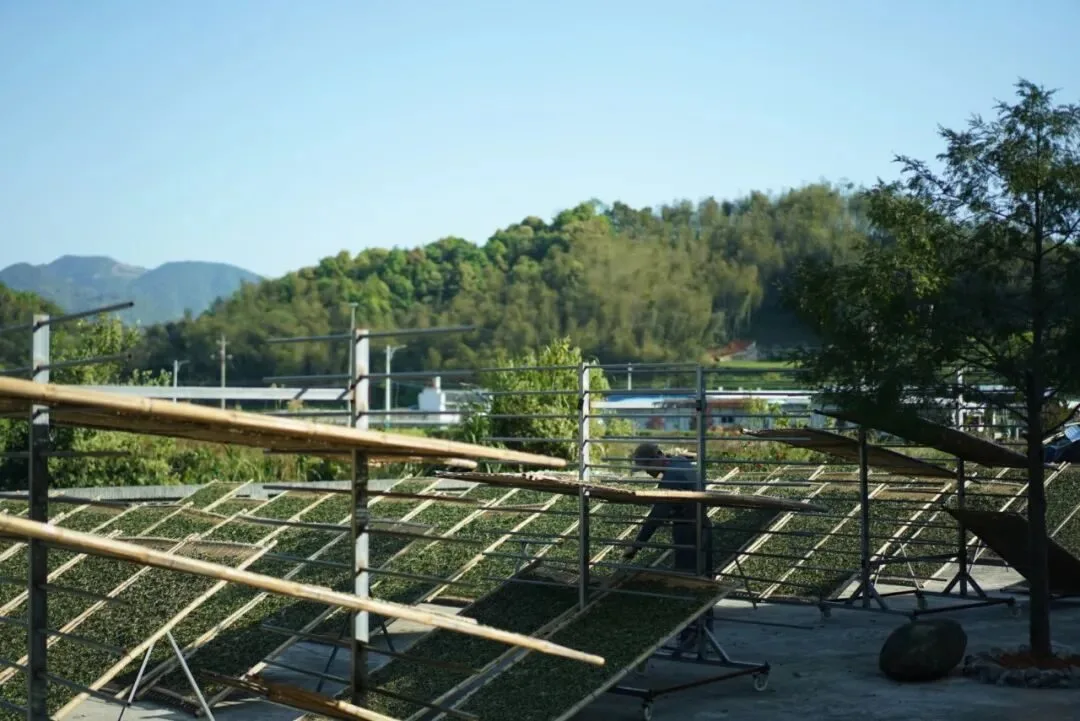
Fuding, on the coast, is associated with sun withering — spreading leaf outdoors in thin layers and turning it regularly, then finishing indoors. The traditional saying is “sun to eighty or ninety per cent dry, then slow-dry over low heat.” Sunlight is not just a heat source; it is part of what produces the bright, floral character Fuding white tea is known for.
Zhenghe, further inland and at higher elevation, traditionally favours indoor withering — leaf spread on bamboo racks in a ventilated room for two days or more, sometimes with a short period outdoors depending on weather. The result is typically a rounder, deeper cup with less of the high floral note.
Most commercial production now uses combined withering (复式萎凋): a period outdoors when weather permits, then completion indoors under controlled conditions. This is partly practical — you cannot schedule rain — and partly quality control, because indoor finishing is more consistent batch to batch.
Which is better is not settled. Sun withering has been associated with higher levels of certain floral aroma compounds, but controlled indoor withering produces more stable results and fewer spoiled batches. A producer choosing between them is trading peak quality against consistency, not good against bad.
What Is Not Done: No Kill-Green
Green tea is fixed (杀青) with heat — pan-fired, steamed or baked — within hours of picking. The purpose is to destroy the polyphenol oxidase enzymes that would otherwise oxidise the catechins and turn the leaf dark.
White tea skips this entirely. The enzymes stay active.
That single omission explains most of the difference between the two categories. Green tea is a snapshot: enzyme activity is stopped at the moment of fixing, so the leaf keeps its green colour and its fresh, vegetal character. White tea is a slow exposure: enzymes keep working through a withering period measured in days, and their activity only declines as the leaf dries out.
Gene-expression work on withering leaf supports the picture: genes involved in catechin synthesis are down-regulated during withering, while genes associated with oxidation are up-regulated. The leaf is not simply drying — it is actively running down one pathway and up another.
One important qualification: because the leaf is never rolled, the enzymes and their substrates are not brought into intimate contact the way they are in an oolong. The cells stay largely intact, so oxidation is limited not by enzyme activity but by access. That is why white tea oxidises far less than an oolong despite having active enzymes throughout.
What Is Not Done: No Rolling
Rolling (揉捻) does two things in other tea types: it shapes the leaf, and it ruptures cell walls so that enzymes meet substrates.
White tea does neither. The leaf is left whole — a bud, or a bud with one or two leaves, in the shape it grew. Cells remain largely intact through withering and drying.
This has a practical consequence for brewing. Whole, unbroken leaf gives up its contents slowly, which is why white tea tolerates repeated short steeps and why bud-heavy Silver Needle extracts so much more slowly than compressed or rolled tea. It also means the leaf resists over-extraction to a degree that broken-leaf tea does not.
What “Light Fermentation” Actually Means
White tea is routinely described as lightly fermented or lightly oxidised, usually with a figure of roughly 5 to 15 per cent. The wording causes confusion because “fermentation” in tea does not mean what it means in food.
In dark tea and pu-erh, fermentation is microbial — bacteria and fungi transform the leaf. In oolong and black tea, “fermentation” is enzymatic oxidation of catechins, with no microorganisms involved. White tea belongs firmly in the second category: its “light fermentation” means the catechins have been only partially oxidised, not that anything has been fermented by microbes.
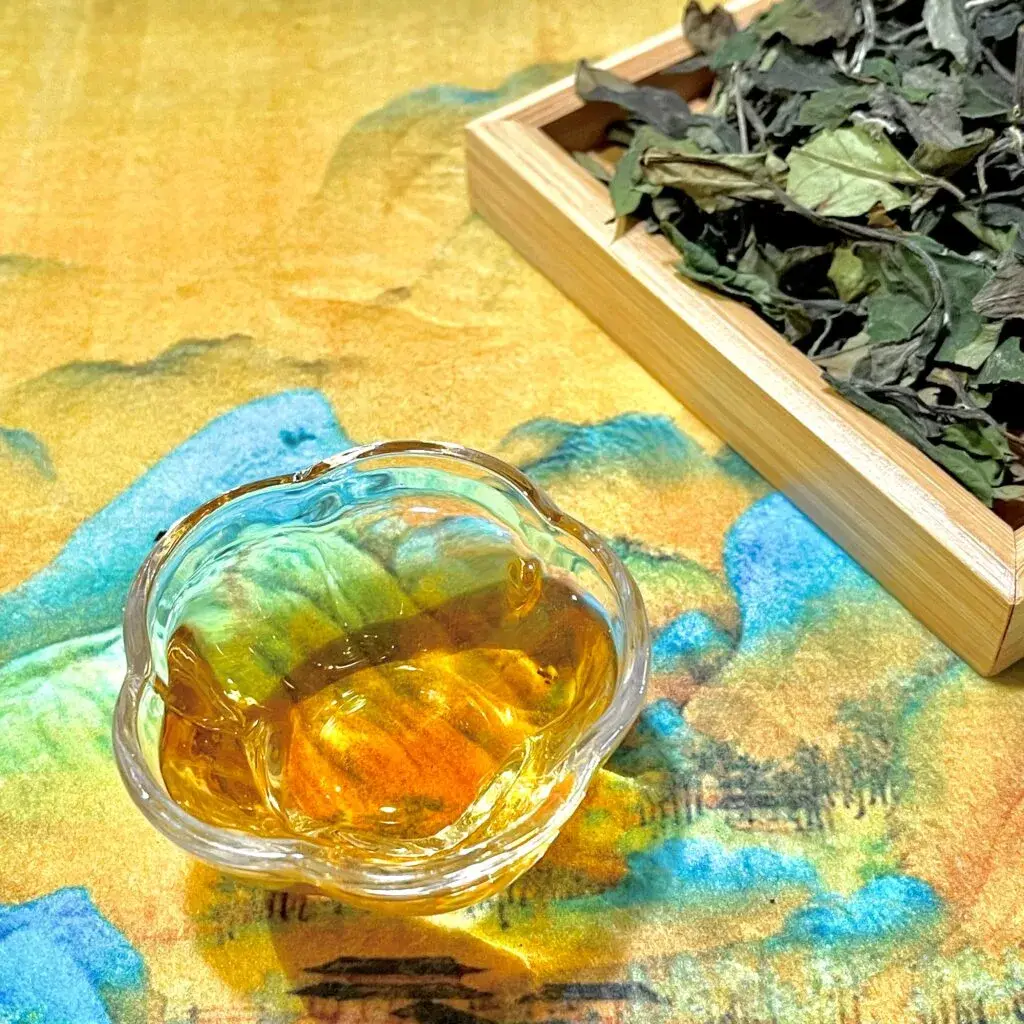
You can see the result in the cup. Black tea’s oxidation products give it a red liquor and malty depth; white tea’s limited oxidation gives it a pale gold liquor and a fresh, hay-sweet character.
Drying and Sorting
After withering, the leaf is dried to stop the process and reach a stable moisture content. The product standard requires finished tea at 8.5% moisture or below. In practice, producers typically dry further than the minimum — commonly to somewhere in the 5–7% range — because lower moisture gives more storage margin. That is industry practice, not a standard requirement.
Drying temperature matters. Too cool and the leaf stays damp and risks spoilage; too hot and you drive off the delicate aroma compounds the withering just built. The usual approach is a relatively gentle finish rather than an aggressive bake.
Sorting (拣剔) removes stems, yellowed leaf, broken pieces and foreign matter, and separates grades. It is unglamorous and largely determines whether a batch can be sold as Silver Needle, White Peony or a lower grade, because the grade definitions in GB/T 22291-2017 are about raw material — buds, or buds plus leaves — and sorting is how that separation is enforced.
A Note on “New Process” White Tea
You may encounter the term 新工艺白茶, usually translated as new-process white tea. It is worth knowing what it is and is not.
It is not one of the four categories in GB/T 22291-2017. The national white tea standard recognises only Baihao Yinzhen, Baimudan, Gongmei and Shoumei. New-process white tea is defined instead in a Fujian provincial standard, DB35/T 1633-2016, which describes a process that adds a light rolling step after withering.
The effect of that rolling is exactly what the chemistry predicts: ruptured cells mean more oxidation, so the leaf is darker, the liquor more orange, and the taste fuller and less delicate than traditional white tea. It is a legitimate product, but a shop describing it as a national-standard white tea category is using the standard’s name for something the standard does not cover.
Why Consistency Is Hard
Most tea categories are made in factories with controlled inputs. White tea is made substantially outdoors, in weather.
A producer cannot schedule a sunny week. When rain arrives during a sun-withering batch, the leaf comes in, and the decision to finish indoors changes the character of that batch relative to the one before it. This is why white tea from the same garden and the same cultivar can differ noticeably year to year, and occasionally batch to batch within a year.
Two consequences for buyers. First, vintage matters more for white tea than for most categories — not because older is better, but because the year genuinely tasted different. Second, a producer who tells you every year is identical is telling you something about their marketing, not their tea.
The flip side is that white tea rewards attention to origin more than most categories. A producer with good withering practice and a reliable indoor finishing room will produce consistent, clean tea; one without will produce tea that varies unpredictably. That difference usually shows up in the cup long before it shows up on a certificate.
Why the Process Matters to a Drinker
Three practical consequences follow from all of the above.
First, white tea is a weather-dependent product, so vintage variation is real. Two White Peony cakes from consecutive years can differ more than two from the same year in different regions. That is not inconsistency in the bad sense; it is what unforced processing produces.
Second, the absence of rolling means the leaf’s physical form carries information. Intact buds and unbroken leaves indicate careful handling; a high proportion of broken leaf suggests rough sorting or rough storage.
Third, because the leaf is whole and the enzymes stayed active, white tea is the tea category best suited to long storage — the process leaves material in the leaf that can keep changing. How that change proceeds is a storage question, which we cover separately in how to store white tea.
For what the resulting grades are and how they differ, see the four types of white tea. For how to brew a leaf that was never rolled, see how to brew white tea. For where this process came from, see white tea history.
Frequently Asked Questions
What makes white tea processing different?
White tea processing omits two steps that define other teas: there is no kill-green and no rolling. Only withering, drying and sorting happen, which is why the leaf stays close to its picked state.
How long does white tea processing take?
Natural withering runs 36 to 50 hours; heated or combined withering takes 30 to 40. White tea processing is slow by design, because the chemical change during withering is what develops flavour.
Does white tea processing involve oxidation?
Yes, but uncontrolled. White tea processing allows slow oxidation during withering rather than the timed, deliberate oxidation used for oolong or black tea, and drying stops it before it goes far.
Why is there no rolling in white tea processing?
Because rolling ruptures cells and releases enzymes that drive oxidation. Leaving it out is what keeps white tea pale, low in astringency and slow to extract. The one exception is new-process white tea, which adds a light roll.
What temperature is used in white tea processing?
Ambient during withering — 15 to 25 °C for spring leaf, 25 to 35 °C in summer and autumn. Drying is finished at low heat, typically well below the pan-firing temperatures used for green tea.
Does white tea processing affect caffeine?
Only indirectly. White tea processing does not add or remove caffeine, but the absence of rolling means the leaf gives it up more slowly, which is why bud-only grades measure lower in the cup.
How does white tea processing differ from green tea?
Green tea is pan-fired or steamed to stop oxidation immediately; white tea processing lets oxidation proceed slowly during withering and stops it at drying. That single difference produces most of the flavour gap.
Sources & References
Standards
- GB/T 22291-2017 — White tea product standard. Defines the four categories and the withering–drying–sorting process; moisture ≤8.5%.
- GB/T 32743-2016 — Technical code of practice for white tea processing. Withering temperatures, duration and target leaf moisture.
- DB35/T 1633-2016 — Fujian provincial standard defining new-process white tea (withering with light rolling).
Peer-Reviewed Research
- Chen, Y. et al. (2022). Transcriptomic and chemical analysis of white tea withering. Journal of Integrative Agriculture. DOI:
10.1016/S2095-3119(21)63785-1
What this guide does not claim
We do not claim that sun withering is inherently superior to indoor withering, that a specific drying temperature is required outside the standard’s limits, or that new-process white tea is inferior. The standard sets the envelope; producers work inside it; the cup is the judge.
Shop the teas in this guide
The grades described above, sold directly from our own stock. Prices are for the smallest size; every listing states the harvest, the county and the size options.
- Bai Hao Yin Zhen, 2026 Shouning, loose leaf — $12.90
- Shou Mei with stem, 2025 Shouning, loose leaf — $9.90
Editorial note
This guide is written by Steve Wood and reflects both published research and our own brewing. Where evidence is thin or contested, we say so rather than filling the gap. We sell white tea, which is a conflict of interest we disclose rather than hide.


2 Comments