
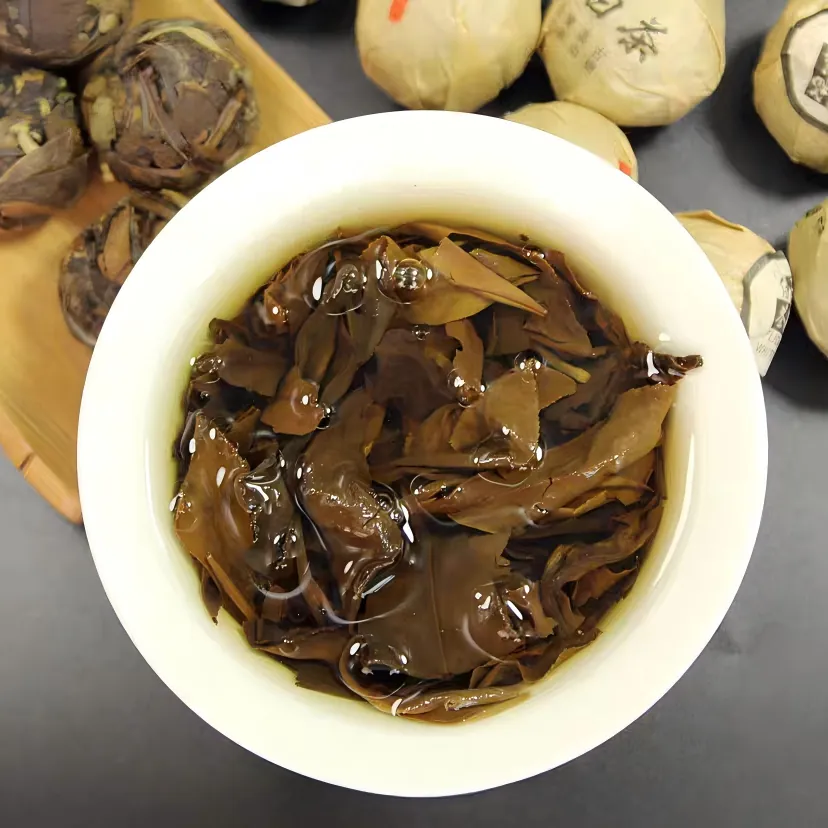
2014 Shouning Aged Shou Mei Dragon Pearl, 5g
Price range: $16.90 through $69.90
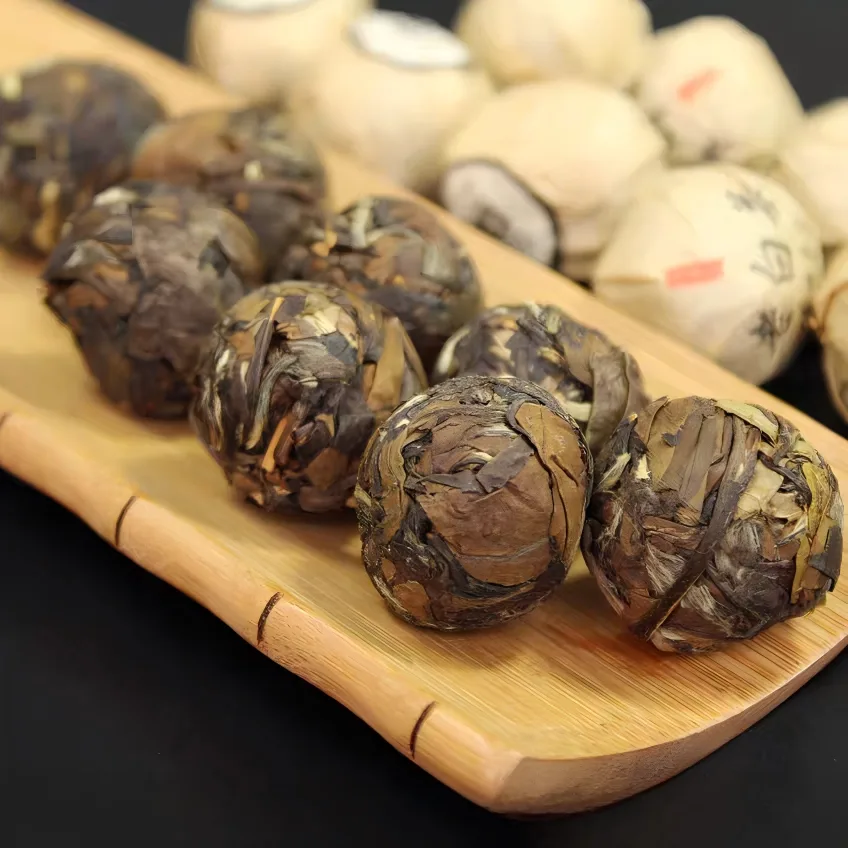
A 2014 Shouning Shou Mei pressed into 5 g dragon pearls and aged twelve years in dry storage. Warm aged wood, sweet red dates and dark wild honey, with the convenience of one pearl per dose. Sold by weight, so no scale is needed.
Description
First published: 6 July 2026 · Last updated: 2 November 2026
This 2014 shouning shou mei dragon pearl is a hand-rolled 5 g ball of aged white tea from Shouning county, Fujian, picked in 2014 and dry-stored for twelve years. The cup has moved past hay into warm aged wood, red date and dark wild honey, with a thick body and no astringency at all. It suits drinkers who want an aged white tea they can simmer, thermos or forget about, and anyone who finds young white tea too grassy.
What is a 2014 shouning shou mei dragon pearl?
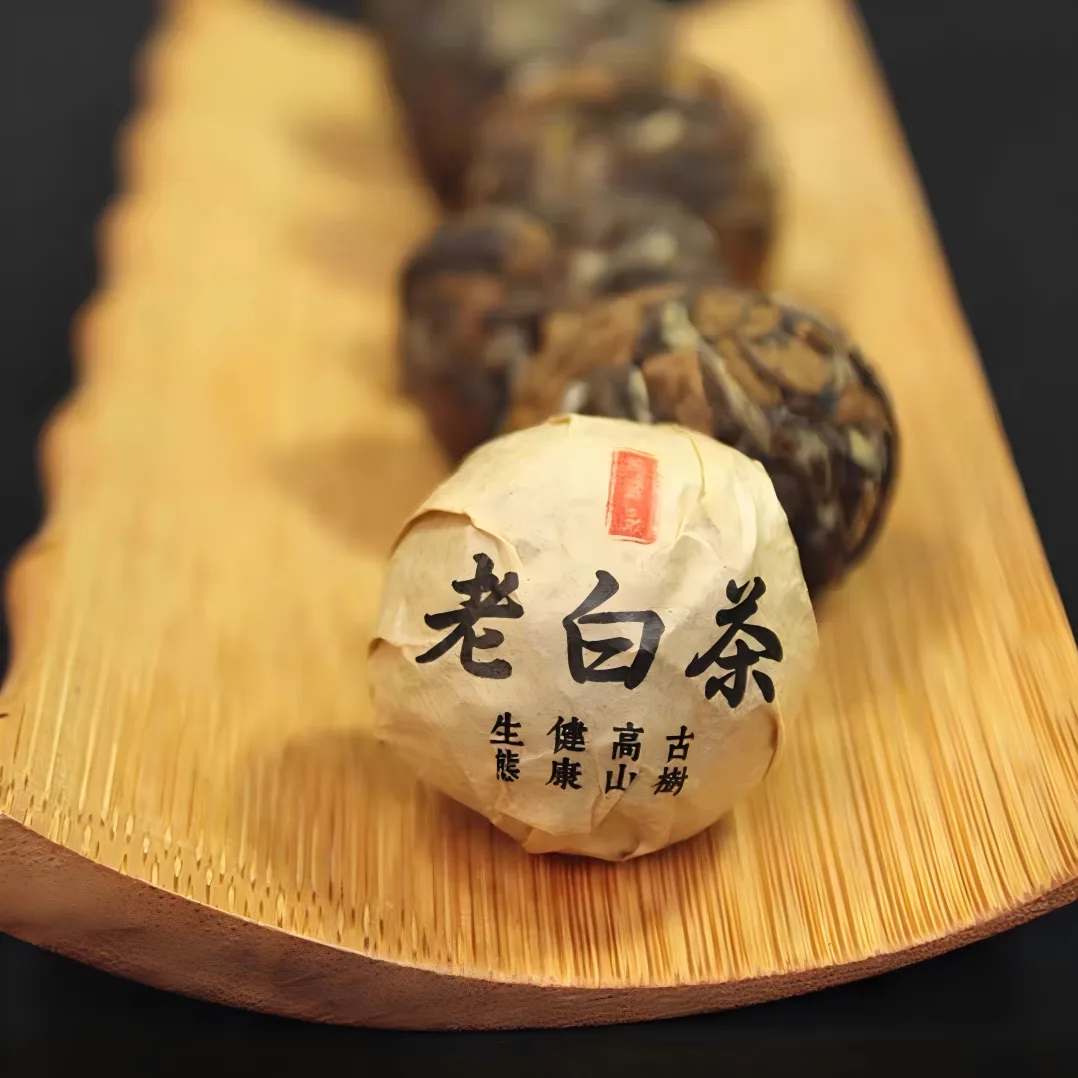
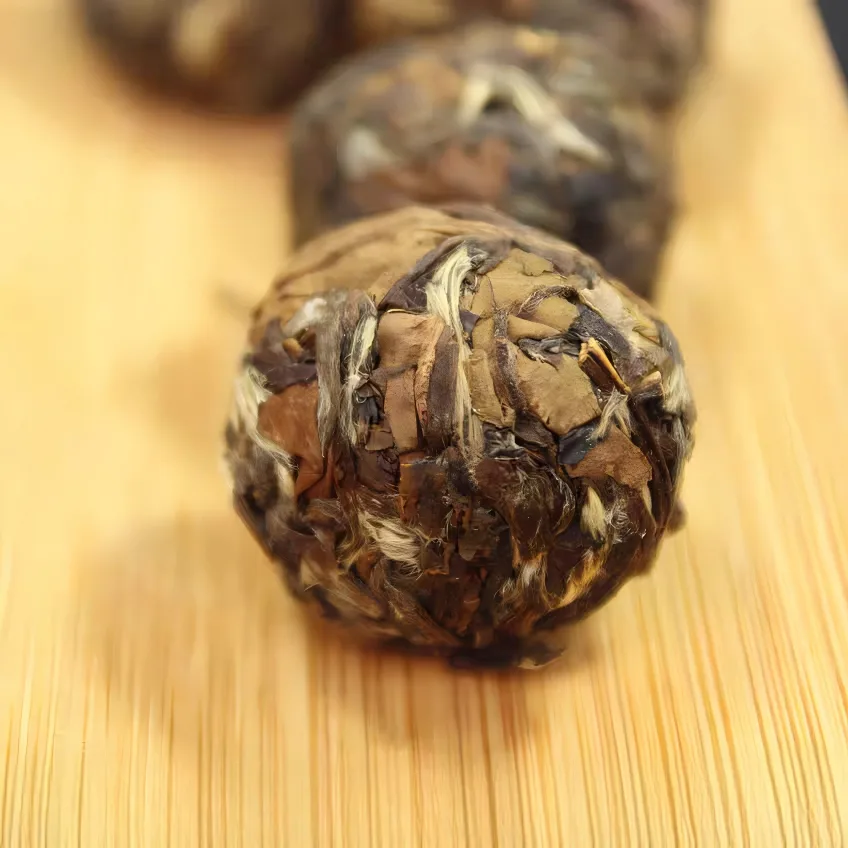
It is aged Shou Mei rolled by hand into 5 g balls, one ball per pot, and this lot has been in dry storage since 2014.
Shou Mei means longevity eyebrow. It is the leafiest grade of Chinese white tea, made from the later open leaves with the stem still attached — most producers describe it as the third and fourth leaves rather than a bud-and-two-leaves pick, though the exact standard varies and the standard itself only says shoots and leaf. That is why it costs less than Silver Needle and why it ages into something closer to a dark tea than a green one.
Worth putting on the record, because the name covers more than one product. GB/T 22291-2017 , the national standard for white tea, lists four products, not three: Silver Needle from single buds, Bai Mu Dan from a bud with one or two leaves, Gong Mei from the tender shoots of population-variety bushes, and Shou Mei from the shoots and leaf of Da Bai Cha, Shu Xian or population bushes.
Shou Mei and Gong Mei are separate categories in the standard and separate teas in the cup, Gong Mei being the finer and the more expensive, but the two get labelled interchangeably all over the place. This is Shou Mei — the leaf-and-stem grade, which is also why the stem question above is worth asking.
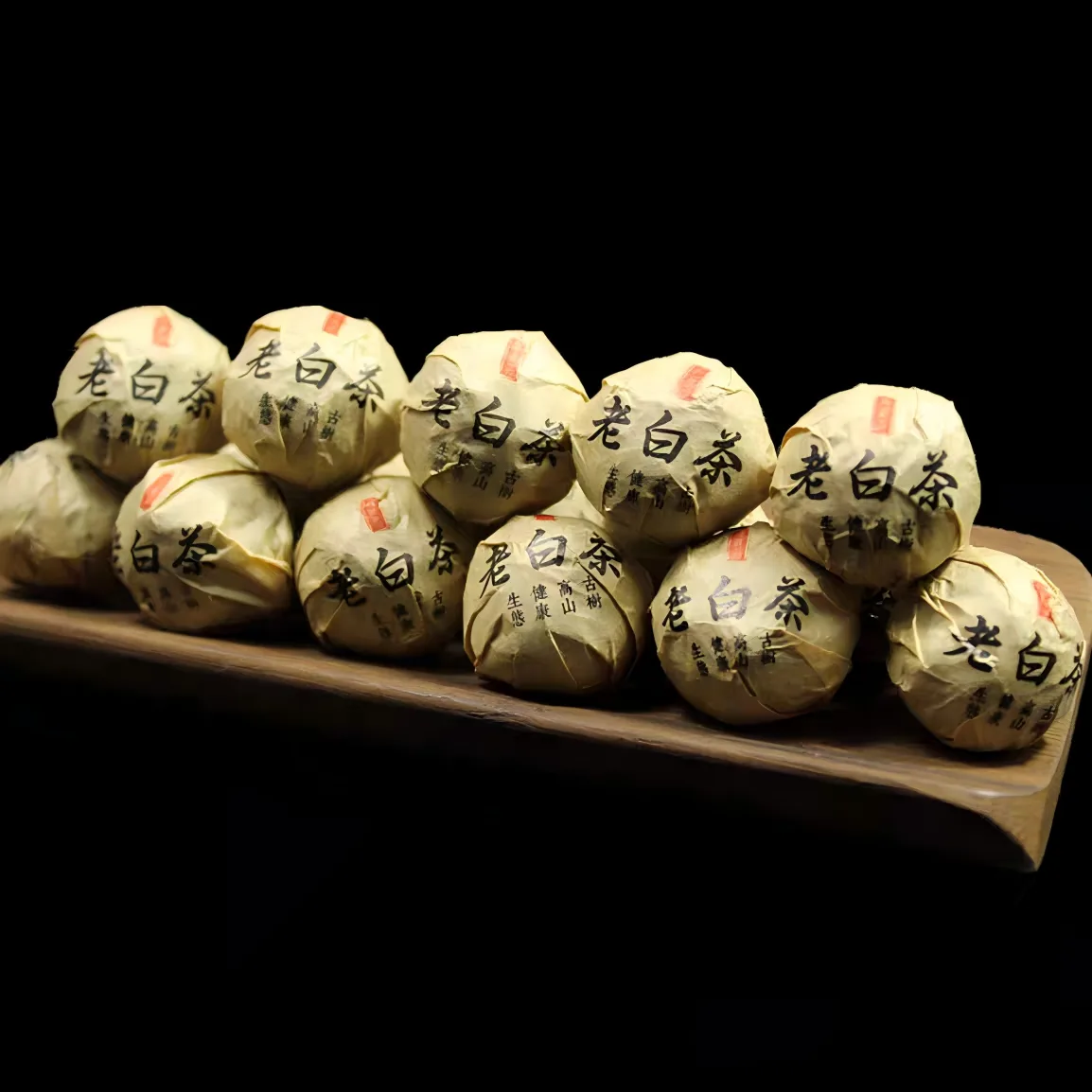
The pearl is the format: the finished leaf is shaped by hand into 5 g balls. That shape changes two things. It makes dosing foolproof, one ball per pot, and it slows air exchange in storage, so the tea changes more slowly and more evenly than the same leaf kept loose.
Where does it come from?
From Shouning county in northeastern Fujian, on mountain land between 500 and 1,200 m — our Shouning white tea guide has the county figures, the climate and soil data, the geographical indication status and the geography in one place. This lot came from a block at 914 m, about 3,000 ft. We have not been able to document a fog-day count or a thousand-year history for this particular garden, so we are leaving both out rather than repeating them. The block name and picking dates are not in a form we can publish, and the county range and official figures are what we can stand behind.
Why does the stem matter?
Because Shou Mei keeps it, and the stem is not dead weight.
Most white tea grades separate the stem from the leaf. Shou Mei is the grade that keeps them together, and for years that was treated as a sign of lower grade. The research says otherwise. A 2024 study from the Fujian Academy of Agricultural Sciences and the Chinese Academy of Sciences examined what the stem does during white tea withering and found it is metabolically active, contributing to the flavour metabolites that shape the finished tea rather than simply passing water upward. The Food Chemistry paper is the source for that.
In practical terms: the stem is part of why Shou Mei has body, and part of why it ages well. Bud-only teas are delicate and fade; leaf-and-stem teas have more material to transform.
We would rather not put specific compound percentages on that, because the paper’s detail is finer than a product page needs and we are not going to paraphrase numbers we cannot check.
How is it made?
Wither in sun, dry, roll by hand, then leave it in a cellar for twelve years.
The leaf is spread on bamboo trays and withered in sun and air for two to three days until it turns pale brown and feels dry. Then it is hand-rolled into 5 g balls, wrapped, and stacked in a cool dark room. Ours has been in dry storage since 2014, and the tin is opened each spring to check the aroma. The exact pressing date and storage log are not digitised, so we are not going to invent a month.
That is the whole process. What separates a twelve-year pearl from a two-year one is not a technique but the absence of one: nobody interfered for a decade.
What does twelve years taste like?
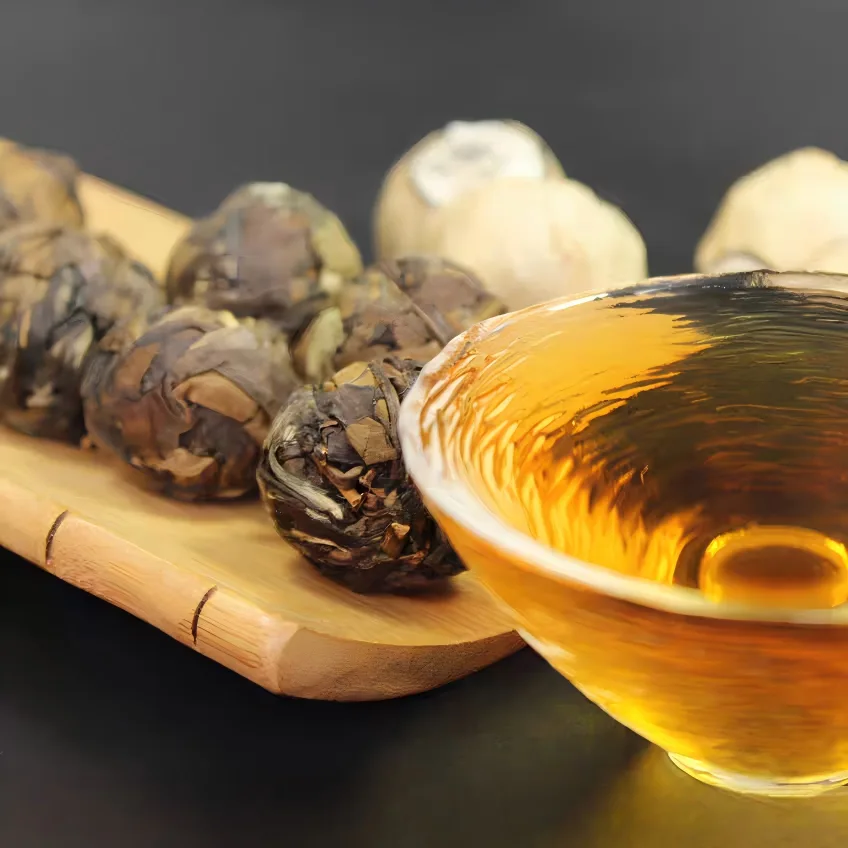
Warm aged wood, red date and dark wild honey, in a garnet-amber cup with a thick body and no astringency.
| Young Shou Mei (under 2 years) | This 2014 lot | |
|---|---|---|
| Aroma | Cut hay, dried longan | Aged wood, red date, faint cocoa |
| Liquor | Light gold | Amber moving to garnet |
| Body | Light, crisp | Thick, almost dark-tea weight |
| Astringency | Slight | None |
| Simmered | Thin and sweet | Brown sugar and jujube skin |
Worth placing on a curve, because twelve years means different things for different grades. Our Bai Mu Dan pearl , which is the buddier grade, is at its best somewhere between years seven and twelve and then turns woodier rather than sweeter. Shou Mei is the leaf-and-stem grade and it travels further: most of the change happens in the first three to five years, after which it slows, and a well-stored cake stays interesting for fifteen to twenty years.
This lot is at twelve, which is late in the good part of the curve rather than at the end of it. The fruit and honey are fully arrived and the woody note that comes later has not taken over yet. The far end is coming, and when it does this tea will taste like wood and dried herbs rather than like honey — some drinkers prefer that stage, others do not. Taste one every year or two and decide for yourself where you want to stop.
The 2014 shouning lot gave a six-steep tasting in October 2024 at 95°C. The first steep was still surprisingly young: pale green-amber, hay, a little fresh lotus leaf. By the third steep the aged layer arrived, old tangerine peel and a sweet resinous note. By the fourth, simmered three minutes in a glass kettle, the liquor went garnet and tasted of brown sugar and jujube skin.
One accident worth reporting. On the first steep the gaiwan lid was left off and the water hit a full boil. I expected burnt notes and got a thicker jujube layer instead. This is one of the most forgiving teas I have brewed.
The chemistry behind the change is documented. Work on stored white tea reports catechins and amino acids declining as the leaf ages, while theabrownins and thearubigins accumulate, which is why the liquor darkens and the body rounds out. A 2024 Food Chemistry study tracks the flavonoid and amino-acid side of that, and the 2026 Journal of the Science of Food and Agriculture paper covers the dark-polymer side. A separate study of compressed white tea over long storage records the aroma moving from sweet and floral toward woody and herbal. The 2022 Frontiers in Nutrition paper is useful on that point.
How do you brew twelve-year-old pearls?
Three ways, and the simmer is the one that gets the most out of them.
| Method | Dose | Water | Time |
|---|---|---|---|
| Western | 1 pearl (5 g) per 250 ml | 95°C (200°F) | 3–4 minutes, then 3–4 re-steeps adding 30 seconds |
| Gongfu | 1 pearl per 100 ml gaiwan | 90°C (195°F) | 15 seconds, adding 5–10 seconds, 7–9 infusions |
| Simmer | 1 pearl per 500 ml | Full boil, then low | 5–8 minutes, re-simmer 2–3 times |
Pour out the full infusion every time, even after a five-second steep. Water sitting on the leaf turns it bitter faster than heat does.
The simmer is not a shortcut, it is the best method for this tea. After six or eight gaiwan rounds the leaf still holds stem sugars that steeping will not reach, and five minutes at a low boil pulls them into a darker, thicker cup. If you want it cold, simmer first and chill the liquor; cold-brewing the dry pearl gives you very little.
A 110 ml porcelain gaiwan is the friendliest vessel if you are new to this, because porcelain takes no flavour from the leaf and gives none back.
Is it high in caffeine?
Per cup it is at the low end for tea, and twelve years of storage does not turn it into a caffeine-free drink.
Mayo Clinic’s caffeine chart puts brewed green tea at 28 mg and brewed black tea at 47 mg per 8 oz, with brewed coffee at 96 mg, and it notes that caffeine in tea varies with leaf weight and brew time. A pearl brewed in 250 ml sits in that green-tea range; simmering the same pearl for eight minutes extracts more.
On the aging question, we will be straight with you: published work on stored white tea reports declines in catechins and free amino acids, but caffeine is a more stable molecule and we have not found a study that quantifies a decline in aged Shou Mei. So we are not going to promise one. What we can say is that this tea feels gentler in the evening than a young sheng, and that is an impression, not a measurement.
If you are pregnant, ACOG recommends keeping total caffeine under 200 mg a day, which is a limit rather than a target. Ask your own clinician.
How should you store it?
Sealed, dark, dry and cool, and it will keep changing for another three to eight years.
| Horizon | What to do |
|---|---|
| Under three months | Food-grade tin with a tight lid, away from the kitchen |
| Years | Tin inside a sealed bag inside a box, in a dark cupboard at 15–25°C and under 70% humidity |
| Never | The fridge, vacuum sealing, sunlight, spices or soap |
The layering is our own practice rather than an official standard, and we should be clear about that: there is no single official method, and anyone who tells you otherwise is describing a habit.
Do not vacuum-seal it. White tea needs a little air exchange to keep changing, and a vacuum bag stops the process you are paying for. Check the tin every six months; if it smells musty, air it out for an hour and check your humidity. Mould is the real risk, and mould comes from moisture, not from time.
Who is this pearl for?
For people who want an aged white tea on the counter rather than in a display case, and for anyone who drinks tea late in the evening.
It is the easiest aged tea we sell. One pearl, one pot, no scale, no thermometer discipline, and it survives being forgotten for ten minutes. It is also the one to buy if you want to try simmering, because the stem-heavy leaf rewards it more than a bud tea does.
The 2014 shouning pearls are $16.90 for 100 g, $28.90 for 200 g and $69.90 for 500 g. The entry price is low, but it is the wrong buy if you want brightness and florals, or if you want a tea that shows off a delicate picking standard at the table. On price per 100 g it is worth being precise: the 500 g tin runs to $13.98 against $14.26 for our 2019 Shou Mei cake, so on pure value per gram the larger tin of this one is in fact the cheaper buy — what you give up is the cake format, not the price.
Our 2019 Bai Mu Dan dragon pearl is the buddier pearl from the same county, the 4 types of white tea guide explains the grades, and the Shou Mei aging guide goes deeper on how leaf and stem change over time.
Two more worth knowing. Our 2020 Shou Mei cake is the same style six years fresher, in a 300 g press you can open and use up. The Shou Mei collection has the other vintages, and our white tea collection has the rest of the category.
Frequently Asked Questions
Can I brew a pearl in a thermos?
Yes, and it works better than most teas do. One pearl in a 500 ml thermos of just-boiled water, lid on, twenty minutes. You lose some of the aroma you get from simmering, and you gain a cup that stays warm for hours.
Does twelve-year aged white tea expire?
Not the way food does, as long as it stays dry. Keep it sealed, dark and under 70% humidity and it will keep changing for another three to eight years. Mould is the real risk, and mould comes from moisture, not from time.
Why pearls instead of loose leaf?
Because the dose is decided for you. One ball, one pot, nothing to weigh. The trade-off is that compression slows air exchange, so a pearl ages more slowly than the same leaf kept loose; we used to say the opposite on this page and it was wrong.
Is this the same as pu-erh?
No. Pu-erh is microbially fermented, mostly in Yunnan, and ripe pu-erh goes through wet piling. This is white tea, withered and dried in Fujian and aged dry. The two can taste closer as they get older, but the processes have nothing in common.
Is it safe during pregnancy?
It contains caffeine. ACOG recommends keeping total caffeine under 200 mg a day during pregnancy. One pearl brewed in 250 ml sits well under that; a long simmer session adds up. Talk to your own clinician.
Why is Shou Mei cheaper than Silver Needle?
Because of what is picked. Silver Needle is buds only, picked one at a time in a short window. Shou Mei is the larger open leaves with the stem, which gives far more weight per bush and a much lower price. It is not a lower grade of the same thing; it is different plant material, and it ages better precisely because of that.
How should I store an opened pearl?
Finish it within ninety days. Once the foil is open, the pearl starts losing aroma to the air. Keep it in a small sealed tin between sessions and it will hold well enough for daily drinking.
Author and reviewer disclosure
This page was written by the founder and head tea buyer at Min Tea Shop, who has bought tea directly from Fujian farmers for eight years. The 2014 pearls described above were cupped and selected from our own dry storage, and the tasting notes come from our sessions in 2024 and 2026.
Statements about aging chemistry and caffeine are general, and are sourced to the published research cited above. They are not medical advice. No sponsored content, no paid placements, and no affiliate links appear on this page, and we do not sell or share your personal data — see our privacy policy for details. If a specification on this page is wrong, tell us and we will correct it.
Additional information
| Weight | 0.1 kg |
|---|---|
| gram | 100g, 200g, 500g |
Related products
-

-
Wuyi Rock Tea Shui Xian: 38-Year Old Bush Reserve 2026
Price range: $9.90 through $106.90Select options This product has multiple variants. The options may be chosen on the product page -
Dragon Balls Blooming Tea, Yunnan High Mountain Rose
Price range: $11.90 through $55.90Select options This product has multiple variants. The options may be chosen on the product page -
Panxi Shou Mei White Tea, Fuding Spring 2026 Harvest
Price range: $9.90 through $55.90Select options This product has multiple variants. The options may be chosen on the product page


Reviews
There are no reviews yet.