
Shoumei Tea: What It Is, How to Brew It & How It Ages
Shoumei tea (also written Shou Mei) is the leaf-and-stem white tea from Fujian. It is the fourth of the four white tea types, and the one picked latest in spring. Where Silver Needle is all bud and White Peony is bud plus leaf, Shoumei tea is the fully opened leaf with its stem still attached. That makes it darker, sweeter and more robust than the bud teas, and it is the most forgiving white tea to brew.
It is also the grade most often brewed badly, for a specific reason: the loose, bulky leaf looks like it needs less tea and cooler water than it does. The result is a thin cup that gets blamed on the tea. This guide covers what shoumei tea actually is, four reliable ways to brew it, the three mistakes that ruin it, and what changes when it ages.
Table of Contents
What Is Shoumei Tea?
Shoumei tea is one of the four categories defined in China’s national white tea standard, GB/T 22291-2017, which replaced the 2008 edition in May 2018. The standard defines Shou Mei as a product made from the young shoots or leaves of Da Bai (大白茶), Shui Xian (水仙) or heirloom cultivars, processed by withering, drying and sorting. (Standard)
Shou Mei was formally added as a defined product in that 2017 revision; the 2008 edition did not list it separately. So the thick stems in the leaf are not a defect or filler. They are part of the specification.
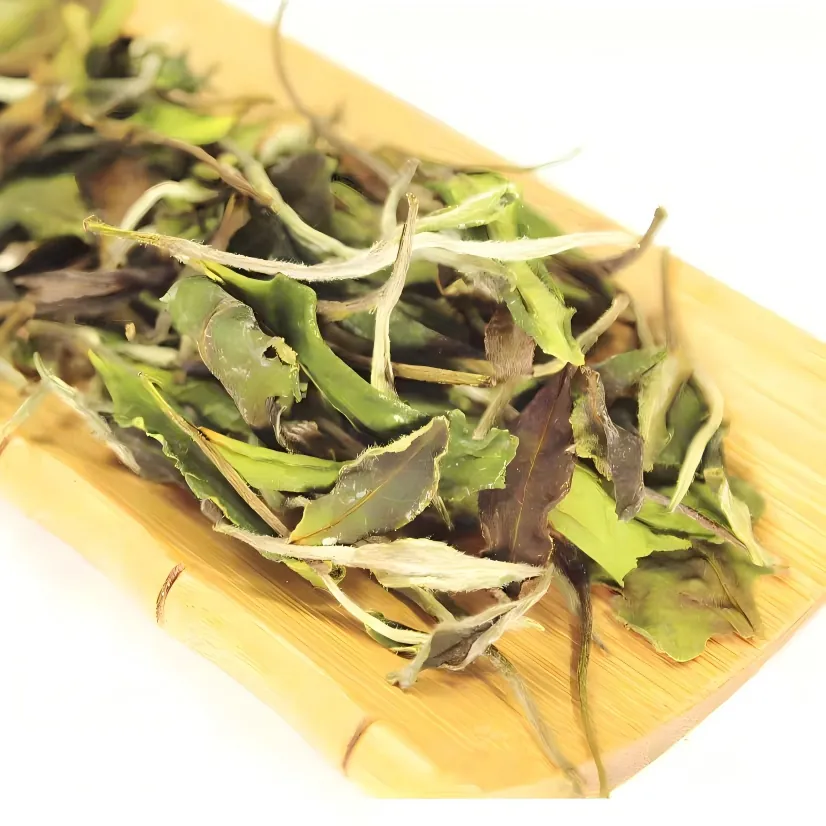
A 2024 study in Food Chemistry showed the stems are chemically active during withering rather than inert. In the stems, protein hydrolysis raises free amino acids, theanine falls and GABA rises, and phenylacetaldehyde, a major aroma contributor, increases mainly there. (PubMed 38593722)
That is the best available explanation for why it tastes rounder and sweeter than its coarse appearance suggests.
Where It Grows
Shoumei tea is made across northern Fujian, with Fuding and Zhenghe as the traditional centres. High-mountain gardens, where cooler nights and morning mist slow growth, tend to give a denser leaf and a more concentrated cup. Shouning County, where our white tea comes from, sits in that band: county records put its tea land at 500 to 1,200 m, with roughly two thirds of the county above 800 m.
Two things are worth knowing when you see “high mountain” on a label. First, it is a description of growing conditions rather than a certification. No standard fixes what elevation qualifies. Second, elevation is a proxy: what actually matters is the slower growth it produces, and a well-managed lowland garden can beat a badly managed highland one. Treat the claim as a starting point rather than a guarantee.
How Shoumei Tea Differs from the Other White Teas
The four types are defined by raw material, not by quality ranking, which is the single most useful thing to understand before comparing them.
| Type | Raw material | Cup | Ages well? |
|---|---|---|---|
| Silver Needle (Baihao Yinzhen) | Bud only | Pale, floral, delicate | Yes, slowly |
| White Peony (Bai Mudan) | One bud, one to two leaves | Softer, hay and melon | Yes |
| Gongmei | Population-variety leaf, minimal bud | Earthier, more body | Yes |
| Shoumei tea | Fully opened leaf and stem | Sweet, darker, date-like when aged | Best of the four |
Metabolomic profiling of the four subtypes shows the difference is chemical as well as visual. The grades separate on both metabolite profile and taste quality, not only on how the leaf looks (Food Research International, 2018).
The reason this grade ages best is structural. Stem and mature leaf carry more of the polysaccharides and amino acids that transform during storage, and less of the delicate aromatics that fade. Silver Needle is the opposite: its charm is volatile, so time takes more from it than it gives.
The standard’s definition of each grade is in the four types of white tea. For the boundary case that confuses most buyers, population-variety leaf versus named cultivars, see gongmei vs shoumei.
How to Brew Shoumei Tea: Four Methods
All four methods below start from the same principle: shoumei tea wants more leaf by volume and hotter water than the bud teas. The leaf is bulky and weighs little, so a scoop that looks generous is often only 3 g.
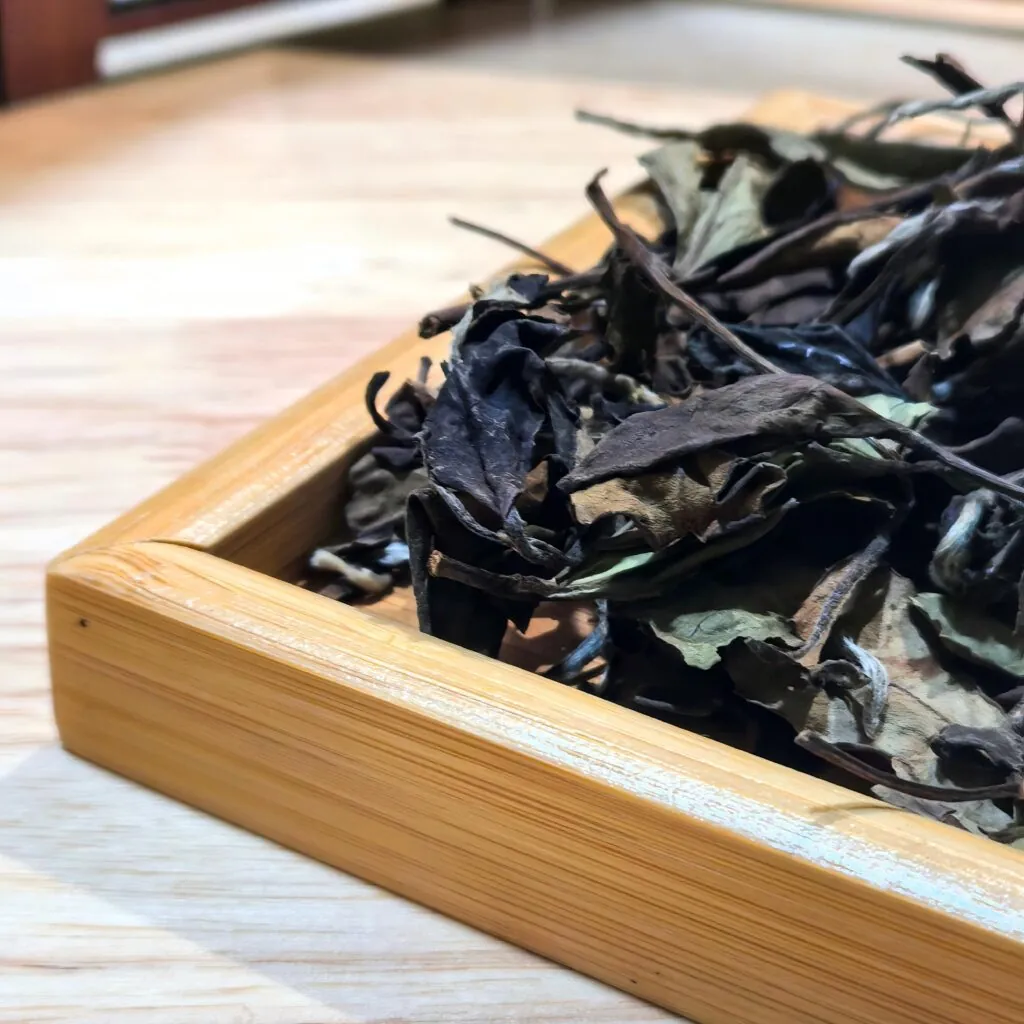
Method 1: Gaiwan steeping
The default, and the best way to taste what you bought.
Warm the gaiwan, fairness pitcher and cups with boiling water. Cold porcelain drops the temperature of the first pour, and you lose the aroma. Use 5 to 6 g in a 110 ml gaiwan; 6 to 7 g if you want it stronger. Give the leaf a quick rinse with boiling water and discard it after 30 seconds. Then pour boiling water from a height and decant the first infusion after 10 to 15 seconds, adding 5 to 10 seconds each round.
Expect six to eight infusions. Research on eighty commercial white teas found 98 °C for seven minutes gave both the highest polyphenol extraction and the best sensory scores (Food Chemistry, 2018). That is a diagnostic brew rather than a drinking recipe, but the direction holds: this grade tolerates heat and time in a way Silver Needle does not.
Method 2: Direct boiling
The traditional method for aged leaf, and the one that gets the most out of a cake or an older loose lot.
Put 5 g in 500 ml of cold water and bring it to a boil, then hold just below boiling for two to three minutes. The result is darker and rounder than a gaiwan brew, closer to a light herbal infusion than to a delicate white tea. This is a poor method for young leaf, which goes flat and slightly bitter, and a good one for anything three years or older.
Method 3: Steep first, then boil
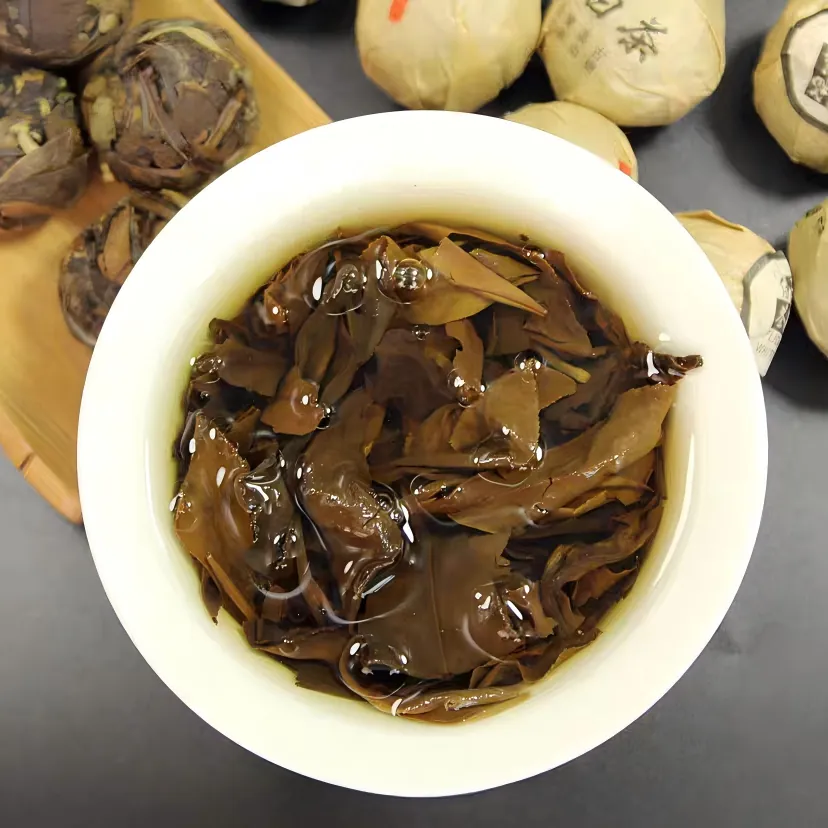
Brew the leaf in a gaiwan for four or five infusions as in method one, then transfer the spent leaf to a pot and simmer it. The later boils pull out what steeped extraction cannot reach, and the two stages give noticeably different cups from the same 5 g.
This is the method to use when you want to understand a tea rather than just drink it. The boiled stage from a good aged lot is often the more interesting of the two.
Method 4: Thermos
5 g in a 500 ml thermos, filled with boiling water, drunk over the following hours. It is the least precise method and the most practical one at a desk.
Two notes. Use less leaf than you think. A thermos keeps extracting for hours, so a gaiwan-sized dose turns bitter. And do not use this method for young leaf; the long hold flattens it.
How long does brewed shoumei tea last?
Drink it the same day. Brewed tea is a growth medium once it cools, and the aromatic compounds that justify the effort are gone within a few hours. Refrigerated, it keeps about 24 hours, but the cup is noticeably flatter.
Three Mistakes That Ruin Shoumei Tea
Using a Yixing clay pot
Yixing teapots are excellent vessels, and the wrong one for white tea. Research on zisha clay has confirmed that a lipophilic layer of tea compounds coats the inner wall with use. This is what “seasoning” means, and why the same pot is prized for oolong and pu-erh (PubMed 28911448). A separate study comparing teapot materials found measurable differences in what is extracted into the infusion (PubMed 28675436).
A seasoned pot is built to hold and re-release aroma, which suits roasted and aged teas. This grade is the opposite case: its appeal is a fresh, layered aromatic release, and a pot that has been brewing oolong for a year will colour it. Use porcelain or glass, and keep the clay for teas that want it.
Teaware that is too small
Shoumei tea is bulky. A 100 ml gaiwan packed with 5 g of it is mostly leaf, leaving little room for water and no room for the leaf to expand. A 130 to 150 ml vessel suits the grade better than the 110 ml you would use for Silver Needle.
Water that is not hot enough
The most common mistake, and the one that produces the “leaf water” complaints. Advice written for Silver Needle, 80 to 85 °C to protect the buds, does not transfer to this grade. Thicker leaf and stem need heat to give up what they have. Use boiling water, or 95 °C at the lowest. If your cup tastes thin and slightly sweet with no depth, the water was too cool.
Does Shoumei Tea Improve with Age?
Yes, and the change is well documented rather than folklore.
Research on stored white tea found that caffeine does not fall dramatically over short periods, though it trends downward over longer storage. Polyphenols, free amino acids and soluble sugars decline gradually, while flavonoids rise slightly.
The cup changes accordingly. The fresh, grassy edge gives way to date, dried longan and brown sugar, and the body softens. It is a rebalancing rather than a simple loss.
| Age | What changes | Best use |
|---|---|---|
| 1–2 years | Fresh bamboo, light honey, a grassy edge | Gaiwan |
| 3–7 years | Date, dried longan, brown sugar, softer body | Gaiwan or short boil |
| 10+ years | Woody, medicinal, deep sweetness | Boil |
Storage conditions decide whether aging helps or simply degrades the leaf.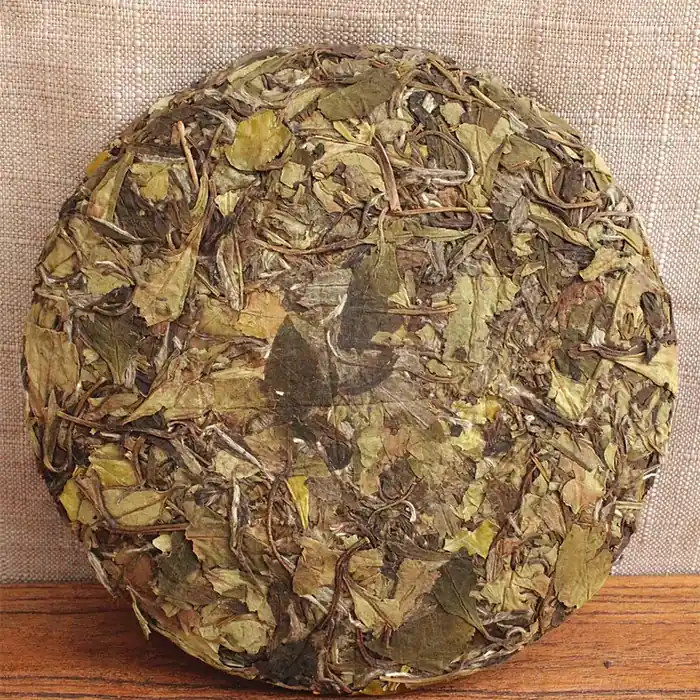
What Shoumei Tea Tastes Like
Young shoumei tea is fresh bamboo, light honey and a faint grassy note, with a sweetness that arrives late. Between three and seven years the profile turns to red date, dried longan and brown sugar, with a coating, slightly sticky texture that drinkers often describe as rice-like. Past ten years it moves toward wood and medicine, closer to a light pu-erh than to a fresh white tea.
Professional evaluation separates leaf, liquor colour, aroma, taste and infused leaf, and it is worth doing at home when comparing two lots. The single most useful comparison is the same tea brewed at 85 °C and at 100 °C: the difference tells you more about the leaf than any description.
How to Choose Shoumei Tea
Four things separate a good lot of shoumei tea from an ordinary one, and only the last requires experience.
The leaf, not the dust. A good lot is a mix of whole leaves and stems, loose and intact. If the bag holds mostly broken fragments, the leaf was handled roughly or the bottom of a batch was bagged.
Colour. Fresh leaf is a mix of olive, grey-green and brown, with visible white hairs on some leaves. Uniform dark brown suggests either age or over-drying, and bright green suggests the leaf was not properly withered.
Smell. The dry leaf should smell of hay, dried fruit or light honey. A flat or dusty smell means it has been stored badly, and mustiness will not come out in the cup.
Cake or loose leaf. Neither is better. Cakes are compressed for storage and transport and age more slowly and evenly; loose leaf is easier to inspect and to brew from. If you plan to age a tea for a decade, a cake is the practical format. If you want to taste it this month, loose leaf is simpler.
What you cannot judge from the packet is whether the aging claim is honest. Tea sold as ten years old should look it: darkened leaf, muted aroma, a cake with visible oxidation at the edges. If it looks fresh and is priced as vintage, ask why.
Frequently Asked Questions
Is shoumei tea the same as Shou Mei?
Yes. Shoumei tea and Shou Mei are two romanisations of 寿眉, the same grade. Both spellings appear on packaging; they are not different products.
What is the best way to brew shoumei tea?
A gaiwan at 5 to 6 g per 110 ml with boiling water, 10 to 15 seconds for the first infusion. For aged leaf, boiling it directly in a pot gives a rounder cup.
How much shoumei tea per cup?
5 to 6 g per 110 ml for gongfu brewing, or about 5 g per 500 ml for Western brewing. The leaf is bulky, so weigh it the first few times rather than judging by eye.
What water temperature for shoumei tea?
Boiling, or 95 °C at the lowest. Unlike Silver Needle, shoumei tea has the leaf structure to take full heat, and cooler water produces a thin cup.
Can you boil shoumei tea?
Yes, and for aged shoumei tea it is the better method. Young leaf goes flat when boiled; anything three years or older improves.
Should you use a Yixing teapot for shoumei tea?
No. Seasoned clay holds and re-releases aroma, which suits roasted and aged teas. Use porcelain or glass so the leaf’s own aromatics come through.
Does shoumei tea contain caffeine?
Yes, like all true tea. Mature leaf and stem are not caffeine-free. The amount in the cup depends more on how much leaf you use and how long you steep than on the grade. Measured figures are in white tea caffeine.
Shop the shoumei tea in this guide
Sold directly from our own stock. Every listing states the harvest, the county and the size options.
- Shou Mei 2025, Shouning, loose leaf with stem — $9.90
- 2020 Shouning Shou Mei cake, 300 g — $45.90
- 2014 Shouning Shou Mei dragon pearls — $16.90
Not sure which one? Browse the full white tea collection.
If you are new to the category entirely, start with white tea for beginners; if you want the county behind the leaf, Shouning white tea covers the geography.
Sources & References
Standards
- GB/T 22291-2017 — White tea. Defines Shou Mei and the other three grades; replaced GB/T 22291-2008 in May 2018.
- GB/T 32743-2016 — Technical specification for white tea processing.
- Standard numbers and dates can be verified at openstd.samr.gov.cn.
Peer-Reviewed Research
- Xiang, L. et al. (2024). Positive contributions of the stem to the formation of white tea quality-related metabolites during withering. Food Chemistry. PMID 38593722
- Yang, C. et al. (2018). Metabolomics profiling of metabolites and taste quality across white tea subtypes. Food Research International. PMID 29580004
- Pérez-Burillo, S. et al. (2018). Effect of brewing time and temperature on antioxidant capacity and phenols of white tea. Food Chemistry. PMID 29329833
What this page does not claim
We do not claim shoumei tea is the best white tea grade, that older is always better, or that any single brewing method is correct. The grade is defined by raw material; what you prefer inside that definition is a matter of taste.

7 Comments