
What Is White Tea Good For? 2026 Benefits & Caffeine Guide
⚠️ Affiliate Disclosure: This article contains affiliate links to MinTeaShop products. We only recommend teas we personally brew daily.
⚠️ Health Disclaimer: The wellness information here reflects current peer-reviewed research and is not medical advice. White tea is a beverage, not a treatment. If you’re pregnant, caffeine-sensitive, or managing a health condition, please consult a healthcare provider.
Quick Answer
White tea is one of the most gentle teas you can drink. The leaves go through very little processing — just withering and drying, with only a touch of natural oxidation (about 5–15%). That light touch gives the cup a soft, slightly sweet flavor.
The honest answer to “what is white tea good for” comes down to three things:
- A clean, smooth taste — light floral notes, no bitter edge.
- Moderate caffeine — usually lower than black tea, similar to many green teas.
- Real antioxidants — catechins, polyphenols, and flavonoids, in levels close to green tea.
Keep your expectations honest. It’s a great daily drink, not a medicine. For most people, Bai Mu Dan (White Peony) is the easiest place to start — and our 2026 spring White Peony is currently in stock.
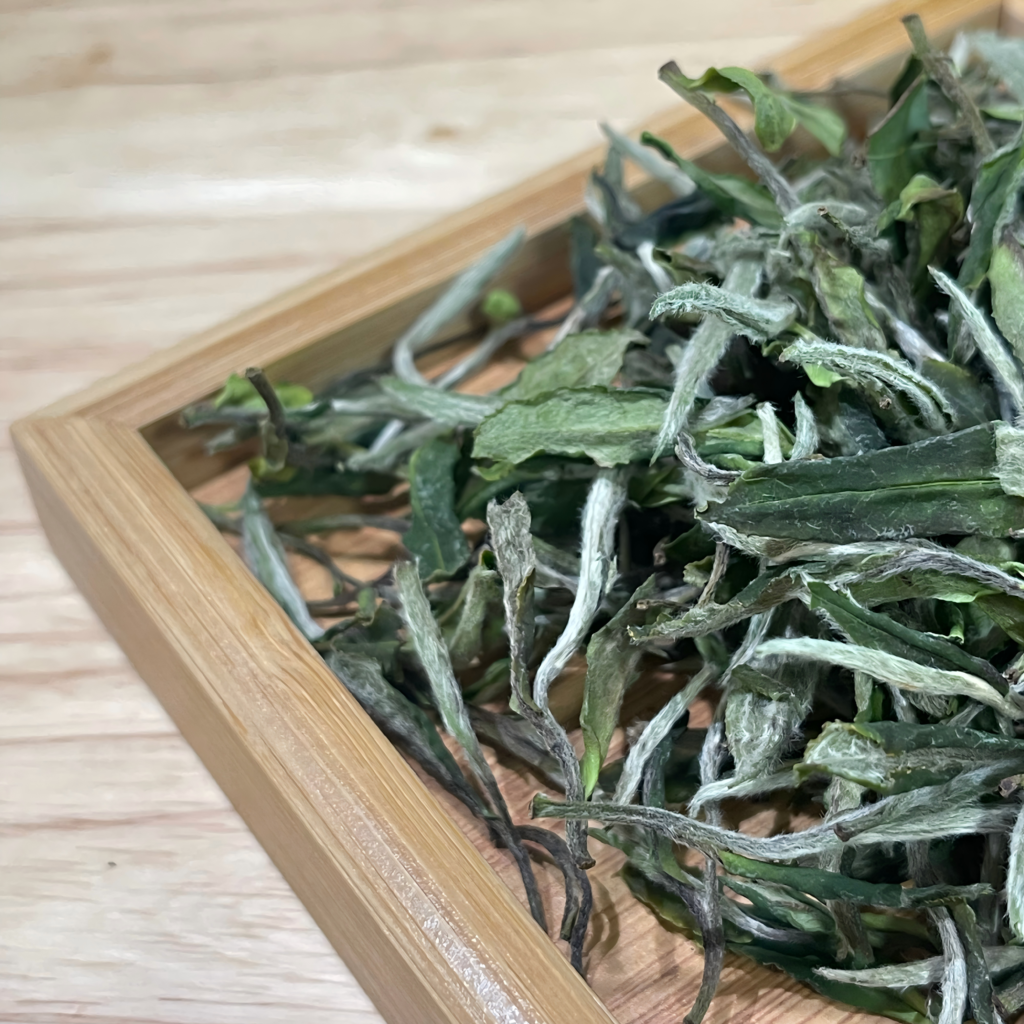
Is White Tea Right For You?
It isn’t for everyone, but it’s a smart fit if you:
- Are switching from coffee and want a gentler lift without the crash
- Want a low-to-moderate caffeine option for a relaxed daily routine
- Are looking for an easy, forgiving brew that doesn’t turn bitter
👉 If that sounds like you, our Bai Mu Dan (White Peony) — 2026 Spring Harvest is the easiest place to start. For a deeper look at this specific tea, see our White Peony tea guide.
What Are the Main Benefits?
When people ask what this tea is actually good for, the honest answer is more interesting than the marketing claims. White tea sits at a quiet crossroads — centuries of Chinese brewing tradition meeting modern wellness curiosity.
Most buyers I talk to research it for three reasons:
- Gentle, smooth taste — light floral notes, no harsh astringency
- Moderate caffeine — typically lower than black tea, similar to many green teas
- Naturally rich in antioxidants — catechins, polyphenols, and flavonoids
Here’s what the research actually shows:
Antioxidant activity is real but comparable to green tea. Peer-reviewed studies find that white and green tea have overlapping polyphenol and catechin content. Green tea often has slightly more total catechins, but white tea can match or exceed it in some antioxidant assays (Tan et al. 2017, J. Food Composition and Analysis; PMC 10563719 (2023 review)).
Glycemic and metabolic effects are the most-supported human findings. A 2011 review by Han reported that continuous white-tea drinking significantly improved symptoms in diabetic patients — including reduced thirst, lower fasting and 2-hour post-meal plasma glucose, and increased insulin secretion. The reported effective rate for glucose lowering was 48%. This was a small human trial with limited published details, so the evidence is suggestive rather than conclusive (PubMed 22279681).
Animal evidence supports the metabolic story. In prediabetic Wistar rats, daily white-tea consumption improved glucose tolerance and insulin sensitivity (Nunes et al. 2015, British Journal of Nutrition, PMID 25716141).
The strongest evidence is in laboratory and animal models. Human clinical trials on white tea specifically are still limited compared with green tea.
👉 Keep expectations realistic: white tea is a clean, natural beverage that fits a healthy lifestyle — it is not a medical treatment.
What Does Peer-Reviewed Research Show? (Catechin and Caffeine Numbers)
We get many questions along the lines of “how much caffeine is actually in white tea?” and “how do the catechins compare between Silver Needle and White Peony?” — so we pulled together the most rigorous published numbers we could find, all from third-party HPLC studies.
Catechins and Caffeine in Bai Mu Dan Across Three Chinese Regions
The cleanest dataset we found is from Ma et al. (2022), Food Chemistry: X 16:100504, DOI: 10.1016/j.fochx.2022.100504. The study analysed commercial Bai Mu Dan samples produced in spring 2020. Values are mg/g of processed dried tea, mean ± SD for 6 samples per region, each measured in triplicate.
| Region | Total catechins (mg/g) | EGCG (mg/g) | Caffeine (mg/g) |
|---|---|---|---|
| Fuding, Fujian | 122.87 ± 4.67 | 50.44 ± 5.33 | 41.36 ± 1.90 |
| Lincang & Pu’er, Yunnan | 150.32 ± 12.83 | 55.60 ± 6.25 | 42.97 ± 1.92 |
| Xinyang, Henan | 125.79 ± 15.82 | 51.51 ± 10.10 | 37.48 ± 3.34 |
Total catechins = sum of C, EC, EGC, GC, ECG, EGCG, GCG and CG. Method: Agilent 1200 HPLC with Poroshell 120 EC-C18 column.
What This Tells Us
- Bai Mu Dan from Yunnan is highest in both catechins and caffeine. That said, “high” is relative — these are still moderate levels compared with green tea.
- Fujian Bai Mu Dan sits in the middle of the range. This is the variety most of our customers brew daily.
- There is meaningful variation across regions and processing styles. Two teas labelled “Bai Mu Dan” can differ by 20% or more in catechin content.
A Note on Shou Mei and Silver Needle
We also wanted a complete “three-tea” comparison, but the published evidence is thinner than it should be:
- Shou Mei: Wang et al. (2022), Sci. Tech. Food Industry reports an average of 32.66 mg/g total catechins for Shou Mei in its abstract. We were unable to independently verify the full HPLC table, so take this as a single source.
- Silver Needle: Tan et al. (2017), in a 58-sample survey, found Silver Needle had higher catechins, theanine, and caffeine in the leaf than late-spring White Peony — partly because Silver Needle is plucked earlier in the season when young buds concentrate these compounds. The same study reported a Silver Needle leaf caffeine of 4.71% and White Peony 4.14%.
👉 Bottom line: the leaf and the cup can tell different stories. Brewing pulls compounds out of the leaf in proportions that depend on temperature, leaf shape, and time — which is why our next section matters.
Does It Help With Fat Burning?
You’ve probably seen claims online. They’re usually tied to catechins and the modest caffeine content.
A more honest picture, based on current research:
- Catechins and caffeine together may modestly increase fat oxidation and energy expenditure (Hursel et al., Obesity Reviews; PMC 4991829).
- The effect is modest. It varies from person to person.
- A 2012 Cochrane review of green tea (not white) found no statistically significant weight-loss effect from catechin-caffeine mixtures in overweight or obese adults (Cochrane CD008650 / PMC 8406948).
A New Human White Tea Study Worth Knowing About
In 2024, Akyildiz et al. published a small Turkish study (registered as NCT06357273) that did look at white tea and weight specifically. The setup:
- 91 adults with obesity, 12-week programme
- 2 cups of brewed white tea per day, 7-minute steep, plus participants ate the brewed leaves
- All groups also followed a calorie-restricted diet and an exercise plan
- 54 people completed the study (14 in the white tea group)
Reported outcomes in the white tea group vs. the diet-and-exercise-only group (Akyildiz et al., Medicina 2024;60(10):1568):
| Outcome | White tea + diet/exercise | Diet/exercise only |
|---|---|---|
| Body weight change | −14.65 kg | −5.3 kg |
| Waist circumference change | −15.25 cm | −5 cm |
| BMI change | −5.37 kg/m² | −1.97 kg/m² |
The white tea group lost more. But: the small completion numbers, the simultaneous diet and exercise programme, the inconsistent description of how participants were assigned, and the lack of a “white tea alone” comparison mean we cannot conclude that white tea by itself causes weight loss. The honest reading is that white tea may add to a structured weight-management programme, but the evidence is not yet strong enough to recommend it as a stand-alone solution.
👉 It’s a supportive habit, not a stand-alone solution. For real, sustainable results, calorie balance, diet quality, and movement still matter far more.
Caffeine: How Much Is in Your Cup?
Most people expect white tea to be nearly caffeine-free. It isn’t. But the actual number is lower than you’d think — and it depends on four things:
- Leaf grade (buds vs. leaves)
- Brewing time and water temperature
- Tea-to-water ratio
- Harvest season
What’s Actually in the Leaf vs. What’s in the Cup
This is where it gets interesting — and where the marketing claims get muddled.
Pan et al. (2018), Food Science and Biotechnology 27(5):1311–1318 brewed 3 g of Fuding white tea in 150 mL of water for 5 minutes at different temperatures and measured caffeine by HPLC. The full-text quote from their Results section:
“Caffeine levels increased with increasing infusion temperature, and reached a maximum of 386.58 ± 19.33, 610.96 ± 30.55, and 555.76 ± 27.79 mg/L in Bai Hao Yin Zhen, Bai Mu Dan, and Shou Mei at 100 °C, respectively.”
Translating into a typical 150 mL cup at 100 °C:
| Tea type | Caffeine concentration (mg/L) | Caffeine per 150 mL cup |
|---|---|---|
| Bai Hao Yin Zhen (Silver Needle) | 386.58 ± 19.33 | 58.0 ± 2.9 mg |
| Bai Mu Dan (White Peony) | 610.96 ± 30.55 | 91.6 ± 4.6 mg |
| Shou Mei | 555.76 ± 27.79 | 83.4 ± 4.2 mg |
The authors’ ranking: Bai Mu Dan > Shou Mei > Bai Hao Yin Zhen. The difference is significant — in their setup, White Peony’s cup had about 58% more caffeine than Silver Needle’s. This is not a slight edge.
So why do people think Silver Needle is “high caffeine”? Because, as Tan et al. (2017) showed, Silver Needle leaves actually have higher caffeine content by dry weight (4.71% vs. White Peony’s 4.14%). But Silver Needle’s whole buds are tightly rolled and harder to extract from — so less caffeine makes it into the cup under typical brewing.
Caffeine in the leaf ≠ caffeine in the cup. When you read “Bai Mu Dan has less caffeine than Silver Needle,” check whether the source is talking about leaf chemistry or brewed caffeine. They disagree.
Typical Ranges Across Tea Types (Brewed, 8 oz / 250 mL)
Based on a 2008 Journal of Analytical Toxicology study of 14 teas (PubMed 19007524):
Caffeine at a Glance:
- 🍃 White tea: 6–55 mg per 8 oz · typical ≈ 25 mg
- 🌿 Green tea: 30–70 mg per 8 oz · typical ≈ 40 mg
- ☕ Black tea: 47–90 mg per 8 oz · typical ≈ 60 mg
Note: Rendered as a definition list (
<dl>) for clean mobile display; see end of article for HTML markup.
A cup of Bai Mu Dan brewed gently (75–80 °C, 3–4 min) typically delivers about 30–60 mg of caffeine — less than Pan et al.’s 100 °C maximum, and in the range many people find comfortable as a daily drink.
If you’re sensitive to caffeine, our guide to storing White Peony also covers how freshness affects caffeine levels.
Three white tea samples measured in clear glass cups at 8 oz each showing different liquor colors: pale silver (Silver Needle), golden (White Peony), amber (Shou Mei) .
Caption: Side-by-side cup test — Silver Needle (left), White Peony (center), Shou Mei (right).
What Is Bai Mu Dan Tea?
Bai Mu Dan (白牡丹), also called White Peony, is one of the most widely enjoyed traditional white teas from Fujian, China.
China’s national white-tea standard, GB/T 22291-2017, defines Bai Mu Dan as:
“Using one bud and one or two leaves of Dabai or Shuixian tea-tree cultivars as the raw material.”
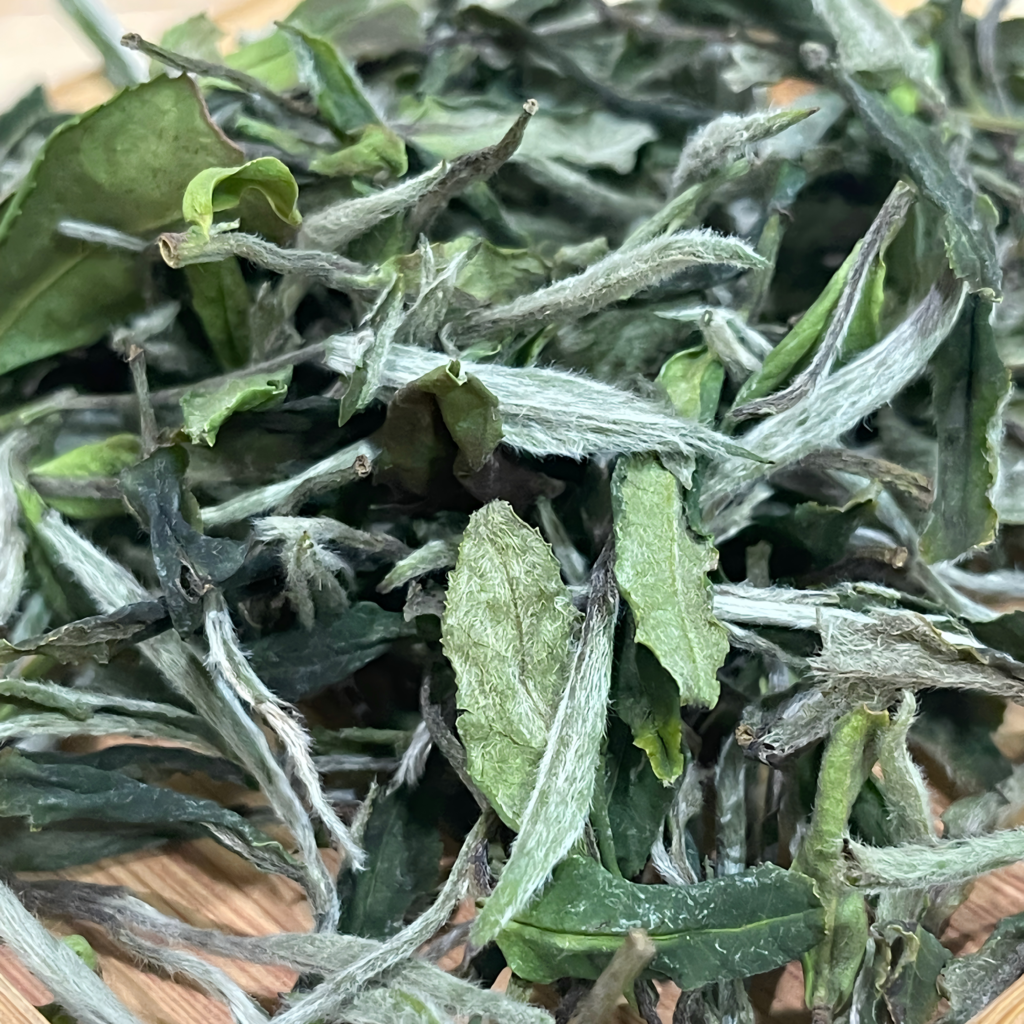
So authentic Bai Mu Dan is one bud + one leaf or one bud + two leaves — both are permitted under the national standard. Silver Needle, by contrast, must be made from single buds of the same two cultivars.
Bai Mu Dan White Peony tea leaves with visible silver buds and young green leaves spread on a white porcelain surface Caption: Bai Mu Dan leaves — silver buds with light green young leaves, hand-plucked one bud + two leaves.
In Fujian, the traditional processing follows a gentle sequence: hand plucking → sun or shade withering → brief piling (for slight oxidation) → final drying or baking. The goal is to keep the leaf structure intact throughout, with oxidation kept at around 5–15%.
Among all the grades you’ll see online, single-origin mountain harvests are the most prized. Want to understand how this compares to other varieties? Read our full breakdown of the 4 types of white tea.
That gives White Peony its balanced character:
- More body than Silver Needle — the Pan et al. (2018) study found White Peony infusions contained roughly 2× the water-extractable solids of Silver Needle at 90 °C (3.95 vs. 1.88 mg/mL), supporting a fuller mouthfeel.
- More complexity than lower-grade options
- Flavor profile: light floral aroma, gentle sweetness, smooth and slightly fuller mouthfeel
For a deeper look at this specific tea, see our White Peony tea guide.
Bai Mu Dan vs Silver Needle: Which Should You Buy?
If you’re choosing between the two most popular styles:
Silver Needle (Bai Hao Yin Zhen)
- Made only from unopened buds of Dabai or Shuixian cultivars
- Light, delicate cup — melon, hay, and subtle honey notes
- Higher caffeine in the leaf, lower caffeine in the cup (buds are harder to extract from)
- Higher price per gram
- 👉 Shop our 2026 Silver Needle →
Bai Mu Dan (White Peony)
- Made from one bud + one or two leaves of Dabai or Shuixian cultivars
- Fuller flavor, more body, more depth
- Better value for daily drinking
- Significantly more caffeine per cup when brewed at 100 °C (about 92 mg vs. 58 mg per 150 mL serving, per Pan et al. 2018)
- 👉 Shop our 2026 White Peony →
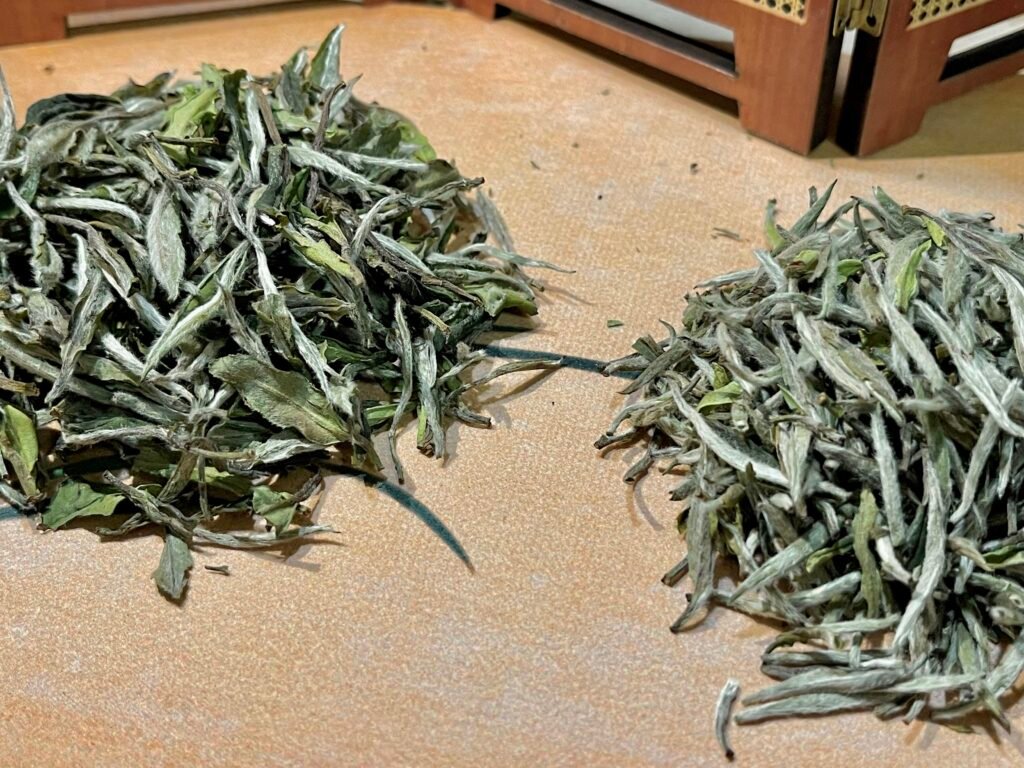
👉 Want to try the Silver Needle? Our 2026 spring Silver Needle harvest is now in stock.
Side-by-side comparison of Bai Mu Dan (left) and Silver Needle (right) white tea leaves showing different bud sizes and shapes Caption: Bud-to-leaf ratio — Silver Needle (left, all buds) vs Bai Mu Dan (right, bud + leaves).
The leaf-vs-cup distinction is the most-misunderstood point in this comparison. If you’re comparing by dry weight, Silver Needle wins on catechins and caffeine. If you’re comparing by what’s actually in your mug, White Peony usually wins on both — and on body.
How Does Fujian’s Climate Change the Flavor?
Not all white teas taste the same. Fujian’s mountainous growing conditions play a huge role — and this is where our story begins at MinTeaShop.
Our White Tea Source: Shouning, Northern Fujian
Our white teas come from Shouning (寿宁) county, in Ningde prefecture, northern Fujian. Shouning has a documented tea-growing history of more than 300 years in its Xiadang Village, and tea has since become a pillar industry for the region. The county sits in the Jiufeng Mountain range, with its county seat at about 880 m — the highest in Fujian province (China Daily Fujian feature).
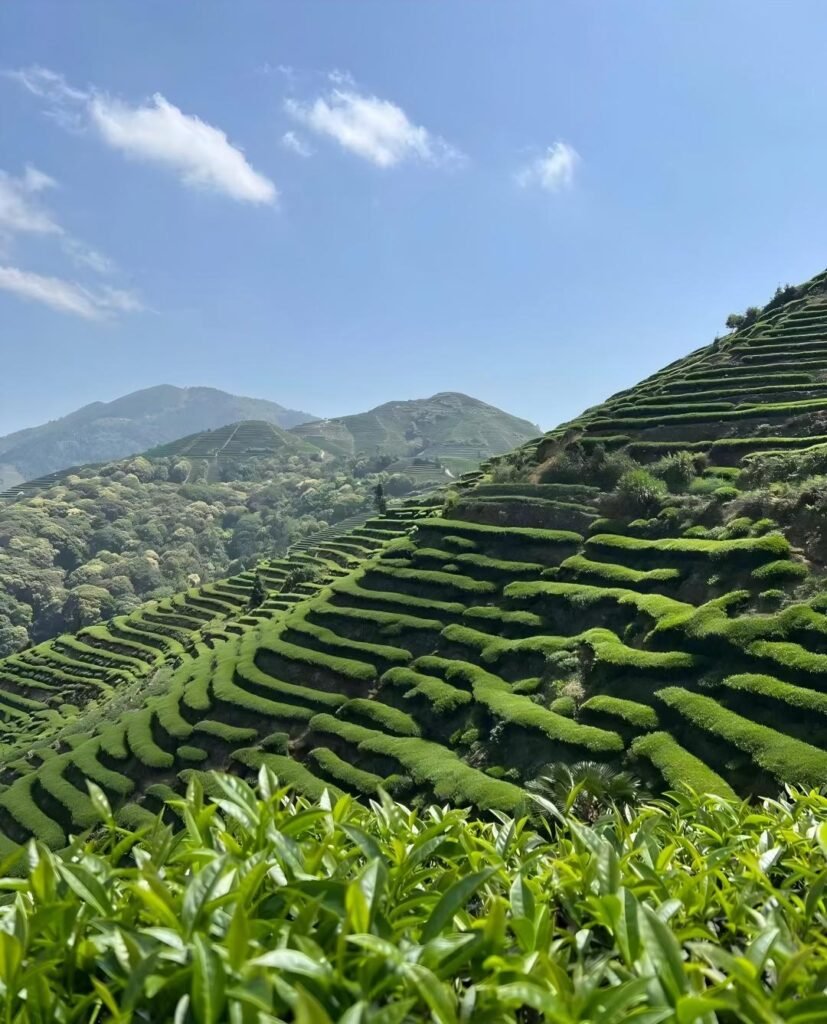
Misty high-altitude Shoumei tea garden in Shouning County, northern Fujian, source region for premium aged white tea. Caption: Shouning’s high-mountain tea gardens sit between 500 and 1,200 m — cool air, slow growth, sweet leaf.
⚠️ Pending verification: The specific climate numbers below (annual temperature range 13–19 °C, rainfall ~1,911 mm, sunshine ~1,760 hours) are attributed to “Fujian Provincial Agricultural Report 2023” but were not independently verified in our source-checking pass. Run Perplexity Prompt 2 before publishing.
A Quick Word on Our Other Fujian Sources
Fujian is famous for more than just white tea. Our MinTeaShop collection also includes:
- Wuyi rock tea (Yancha / 岩茶) from Wuyi Mountain in Nanping — the home of Da Hong Pao and the famous “rock rhyme” (yan yun) minerality
- Black tea (Hong Cha / 红茶) including Zhengshan Xiaozhong (Lapsang Souchong) from Tongmu Village, also in Wuyi
- Green tea and Pu’er from other established Chinese growing regions
If you’ve enjoyed this article on white tea and want to explore those categories, we ship them under the same fast, tracked shipping. More on that below.
Back to Shouning
That elevation matters. According to Fujian’s provincial agricultural reports, Shouning’s tea-growing zones sit between 500 and 1,200 m, with nearly two-thirds of the county above 800 m. The combination of elevation, climate, and soil is what the French call terroir:
- Climate: average 13–19 °C, ~1,911 mm annual rainfall, ~1,760 hours of sunshine, with frequent cloud cover in spring and summer ⚠️ pending verification
- Soil: yellow and red mountain soils, pH 5.0–5.5, organic matter around 2–3%, with pockets of selenium- and zinc-rich earth
- Atmosphere: cool nights, humid air, and diffused mountain light
These three factors work together:
Slow growth deepens the flavor. Cool mountain air keeps bitterness low. Diffused light helps the leaves build more aroma.
That’s what makes mountain teas so distinct.
New to the category? Our beginner’s guide to the 4 types of white tea walks you through everything else.
👉 Learn more about Fujian’s traditional tea processing on Wikipedia.
Is White Peony the Best Starter Tea?
If you’re new to this category, White Peony has a practical advantage: it’s easier to brew than very delicate teas, more forgiving in flavor, and well-balanced on quality vs. price.
Here’s why we point new drinkers to it:
White Peony has the softness of a white tea, but enough body to keep the cup interesting. It’s the one we’d drink if we could only keep one tea on the shelf.
That’s why it’s the default recommendation across our team. To see it in action, start with our 2026 White Peony — Spring Harvest..
How to Brew White Tea (Simple Guide)
White tea is best brewed gently. Use water that’s hot but not boiling, and steep for 3 to 5 minutes for White Peony. Lower temperatures and shorter steeps preserve natural sweetness; hotter water and longer steeps pull out more body.
The best evidence-based brewing reference we have is Pan et al. (2018), which measured exactly how temperature and time change caffeine and catechin extraction from Silver Needle, White Peony, and Shou Mei.
Brewing by Variety
- Silver Needle Water: 80 °C / 175 °F · Steep: 2–3 min · Leaf: 2–3 g per 6 oz (Lower temp keeps the delicate buds from over-extracting)
- Bai Mu Dan Water: 75–80 °C / 167–176 °F · Steep: 3–5 min · Leaf: 3 g per 6 oz (The everyday classic. Add more leaves, not more time, for a stronger cup.)
- Shou Mei Water: 90–96 °C / 195–205 °F · Steep: 2–5 min · Leaf: 3–4 g per 6 oz (Riper leaf; can take hotter water without turning bitter.)
Note: Rendered as cards (
<details>) for clean mobile display; see end of article for HTML markup.
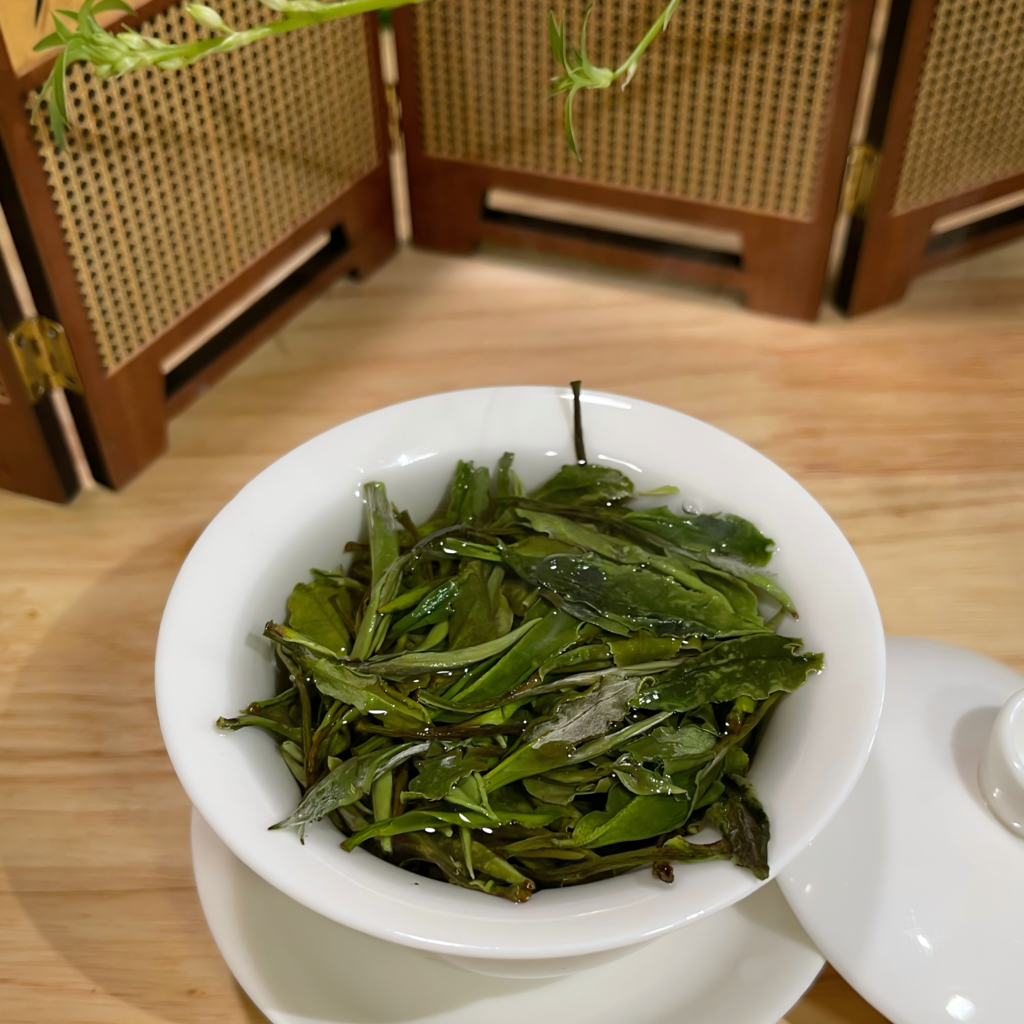
Brewing white tea with loose leaves in a clear glass teapot at low water temperature around 175 degrees showing pale golden color Caption: Bai Mu Dan brewing at 175 °F — pale golden liquor.
For Shou Mei lovers, we have a dedicated Shou Mei brewing guide with ratio and timing tips. For aged cakes, check our Shou Mei aging guide and the Shou Mei stem aging guide — older leaves open up differently than fresh ones.
Brewing White Peony Specifically
White Peony is more forgiving than many others. A good starting point:
- Water temperature: 75–80 °C (167–176 °F)
- Steep time: 3 minutes (extend to 4–5 for a fuller cup)
- Leaf amount: about 3 grams per 6 oz (around 1.5 teaspoons of dried leaves)
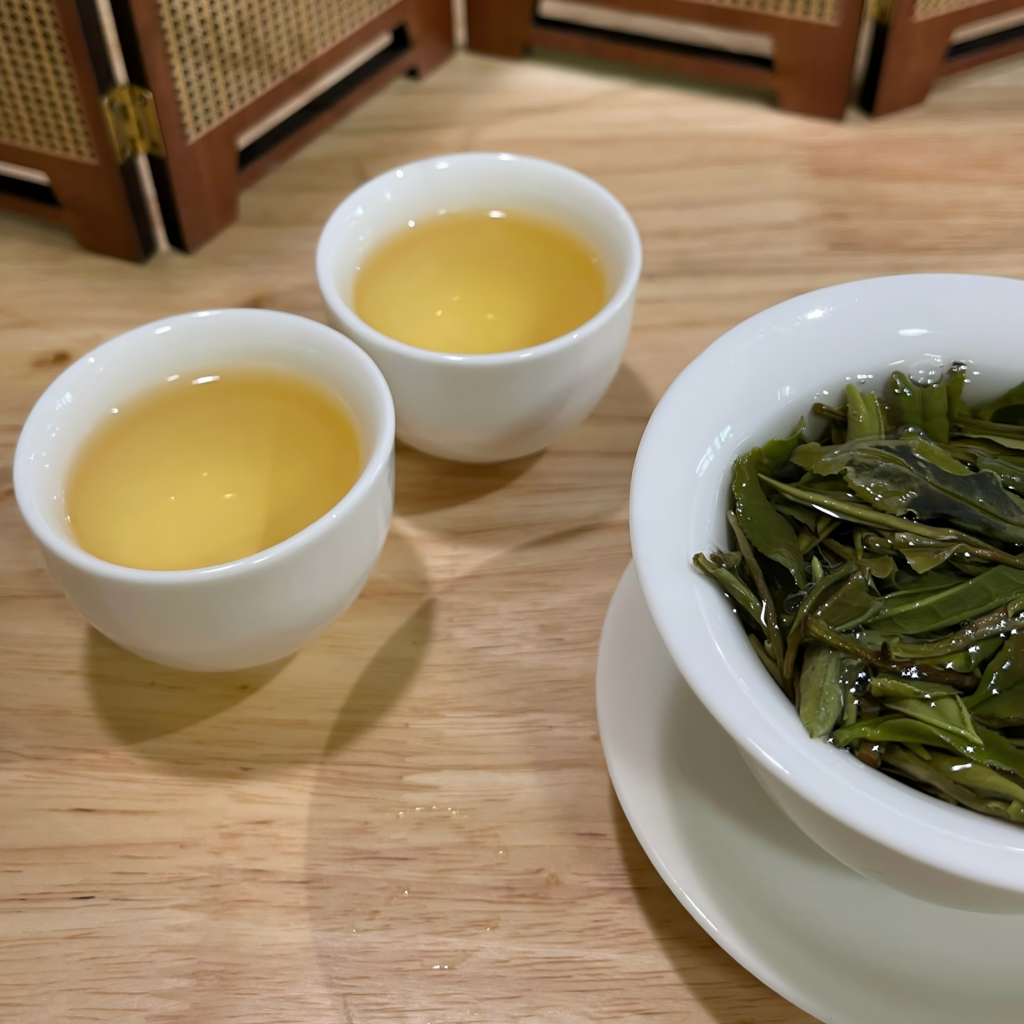
White Peony Bai Mu Dan tea brewed in glass teapot showing light golden yellow liquor color with visible tea leaves Caption: White Peony liquor — light golden yellow, soft and clean.
If you want a stronger cup, add more leaves rather than steeping longer. For a complete walkthrough, our White Peony brewing guide goes deeper into multi-steep technique and water ratios.
👉 High-mountain White Peony, like ours from Shouning, performs especially well with gentle brewing — it preserves the natural aroma and smooth finish.
How to Choose a Good White Tea
A great cup will deliver everything we’ve covered — but only if you pick the right one. Here’s the checklist we use before stocking anything:
- Origin — Fujian is the most traditional and respected region for white tea; specific sub-regions (Shouning, Fuding, Zhenghe) have distinct character
- Harvest freshness — newer harvests give brighter flavor; aged leaves give depth
- Leaf quality — intact leaves with visible buds and minimal breakage
- Processing — minimal oxidation (5–15%), no added flavorings
- Standards — look for tea graded under the national standard GB/T 22291-2017 for verified authenticity
For longer-term storage tips, see our White Peony storage guide — bad storage is the fastest way to ruin a good leaf. Quick tip: store your tea in a dry, cool place away from sunlight and strong odors. Properly stored, white tea can age gracefully for years.
Why Buy From MinTeaShop?
We’re a small, specialist team based in Fuzhou, Fujian. We don’t run a marketplace or resell other vendors’ tea. Every leaf we ship comes from documented Chinese growing regions — and we focus on Fujian in particular because that’s where the country’s most famous white, black, and rock teas are made.
Where our tea comes from:
- Ningde prefecture (Shouning county) — our white tea (Bai Mu Dan, Silver Needle, Shou Mei). 300+ years of tea history in the region.
- Nanping prefecture (Wuyi Mountain) — our rock tea (Da Hong Pao and other Yancha) and Zhengshan Xiaozhong black tea.
- Other established Chinese growing regions — for our green tea and Pu’er selections.
What You Get When You Order
🚚 Fast, tracked shipping worldwide
- Express options (DHL, FedEx, or our Europe dedicated line): 7–15 days to most countries.
- Standard options (China Post, Cainiao): 9–25 days, for those who’d rather save on shipping.
- Tracking number + carrier website sent by email as soon as your order ships.
- Note: severe weather (blizzards, typhoons, earthquakes) and customs can occasionally delay delivery — we appreciate your patience.
⏱️ Order processing time
- We pick, pack, and hand-check every order in 24–48 hours before shipping. Thanks for understanding — quality control is a real step, not a checkbox.
💳 Safe, flexible payment
- PayPal
- Credit & debit cards — Visa, MasterCard, JCB
- Western Union (contact our team first)
- Direct bank transfer (contact our team first)
🤝 7×24 after-sales support
- Questions about your order, your brew, or your refund? Our service team replies any time, day or night.
- Email us for any issue with your order, and we’ll make it right.
📦 Easy returns & exchanges
- You have 7 calendar days from the date you receive your order to request an exchange or return.
- We cover the cost when the issue is on us: defective product, wrong item shipped, or our error.
- Buyer covers the cost when: you simply don’t like the tea, the item was damaged after delivery, or the tea isn’t to your taste. (Please inspect the package and contents right away when it arrives.)
- Please store your tea in a dry, cool place once opened.
💸 Refunds
- Processed via your original payment method, in 3 to 30 business days, after both sides confirm the refund. We aim to be much faster than that on our end.
👉 Browse our full tea collection, or keep scrolling for our 2026 spring harvest picks.👉 Browse our full white tea collection here.
Our 2026 Spring Harvest Picks
This spring we brought in four limited harvests from Shouning’s high-mountain plots, plus a fresh Fuding Shou Mei. Each one has a different personality.
Person drinking white tea in a calm and relaxing morning setting with sunlight through a window, white porcelain cup on wooden table Caption: A calm morning cup — White Peony in a porcelain cup, sunlight through the window.
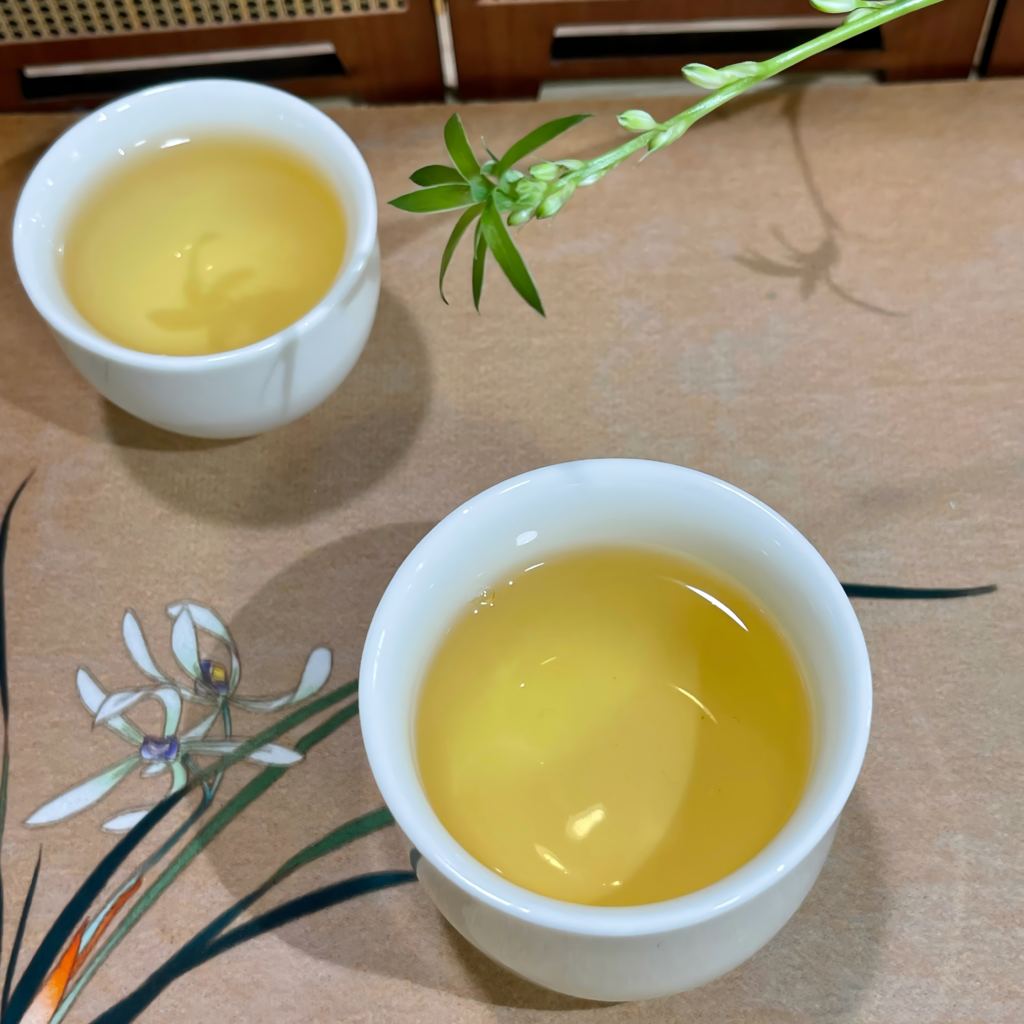
Fresh-picked 2026 spring teas
- White Peony (Bai Mu Dan) — 2026 Spring Harvest] — the everyday classic, our top recommendation
- Silver Needle (Bai Hao Yin Zhen) — 2026] — pure buds, very delicate
- Dragon Pearl Jasmine Tea — 2026] — hand-rolled pearls scented with fresh jasmine
- Fuding Shou Mei — 2026] — fuller body, more roasted depth
- Shou Mei — 2025] — carrying over from last autumn’s harvest
Aged and cake-pressed options (for collectors)
- White Peony Cake — 2023] — three years of slow aging
- Bai Mu Dan Tea Cake — 2024] — still developing
- Shou Mei Cake — 2020] — five years on, with emerging honey and dried-fruit notes
- Shou Mei Dragon Pearl — 2014] — deeply aged, complex
- Shou Mei — 2019] — for serious aged-tea drinkers
- Bai Mu Dan Dragon Pearl — 2019] — pearled format of aged Peony
- Aged White Tea Shou Mei — 2015] — another step deeper into aged territory
What makes these stand out:
- Small-batch, never mass-produced
- High-mountain origin with natural sweetness
- Minimal processing for a clean, floral finish
- Single-origin traceability — every tea is traceable to a specific village in Fujian
👉 Not sure which to pick? Read our 4-types-of-white-tea guide for help choosing.
Final Thoughts
White tea isn’t about intensity. It’s about balance, clarity, and the simple pleasure of a good cup. Among all the varieties we carry, White Peony (Bai Mu Dan) is the most approachable and rewarding place to start — whether you’re new to tea or simply looking for something lighter and more refined.
Our 2026 spring harvest is limited. Try it while it’s still available and taste the difference high-mountain Shouning makes.
👉 Start with our 2026 White Peony — Spring Harvest, or browse the full collection.
Drinking white tea in a calm and relaxing setting
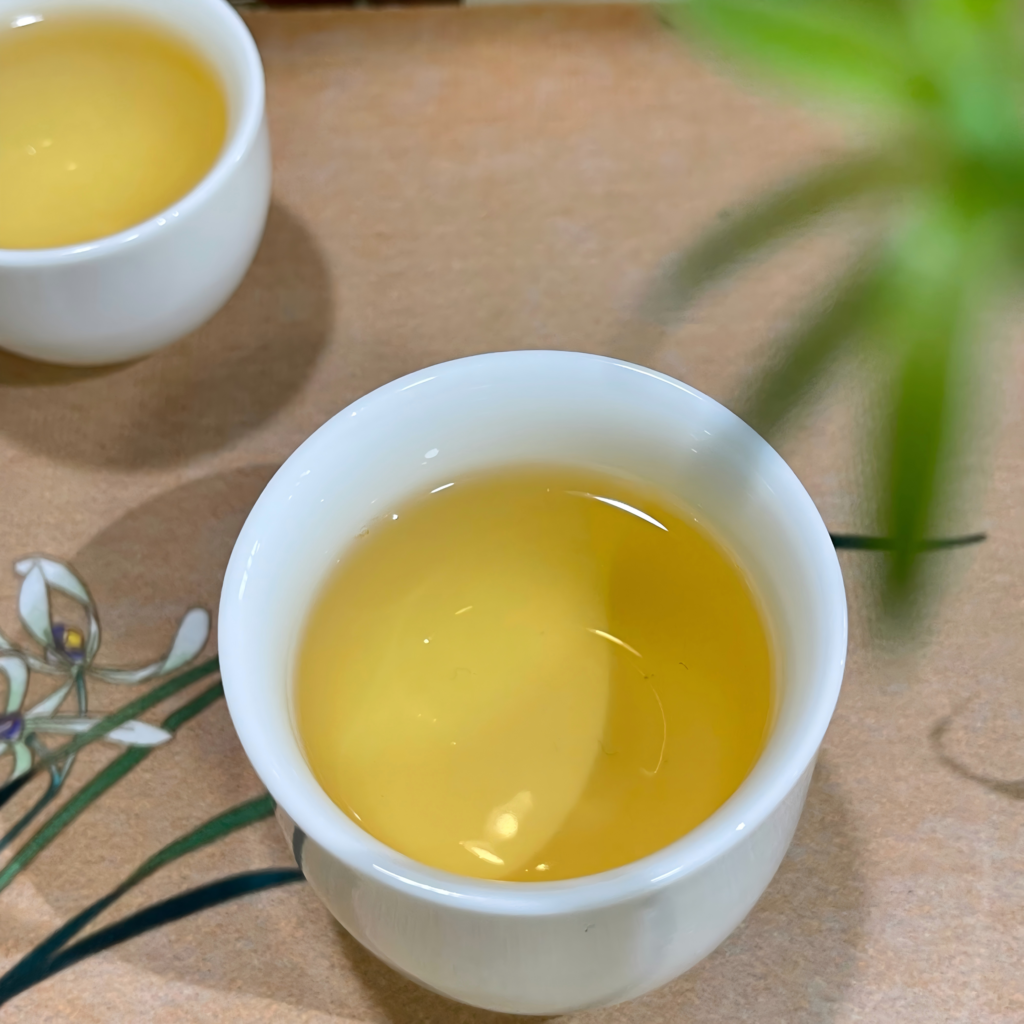
Browse Our Other Teas (Not Just White)
White tea is our specialty, but we ship from the same Fuzhou warehouse and source the same way. If you’d like to explore the rest of the Chinese tea world, we also carry:
- Rock tea (Yancha / 岩茶) — Wuyi Mountain Da Hong Pao and the famous “rock rhyme” mineral character. A natural next step if you enjoy the body of aged white tea.
- Black tea (Hong Cha / 红茶) — including the legendary Zhengshan Xiaozhong (Lapsang Souchong) from Tongmu Village, with its pine-smoke heritage.
- Green tea — fresh, vegetal Chinese green teas for everyday brewing.
- Pu’er — both raw (sheng) and ripe (shou) styles, including aged cakes.
👉 Visit the MinTeaShop main collection to see what’s currently in stock.
✅ FAQ
u003cstrongu003eWhat are the actual health benefits of white tea?u003c/strongu003e
White tea is rich in catechins, polyphenols, and flavonoids, with antioxidant activity comparable to green tea. The best-supported human findings relate to blood sugar regulation and modest antioxidant support. Most stronger claims (anti-aging, weight loss, cancer prevention) are based on lab or animal studies, not large human trials.
u003cstrongu003eHow does white tea compare to green tea in terms of caffeine?u003c/strongu003e
White tea is u003cemu003eusuallyu003c/emu003e lower in caffeine than black tea, but the comparison with green tea is not consistent. A strong white tea can have more caffeine than a weak green tea, and vice versa. Typical brewed cup values: white ~25 mg, green ~40 mg, black ~60 mg.
u003cstrongu003eIs white tea good for weight loss?u003c/strongu003e
There’s no strong clinical evidence that white tea alone causes weight loss. Catechins and caffeine may modestly boost fat oxidation, but the effect is small and not a substitute for diet and exercise.
u003cstrongu003eIs Bai Mu Dan good for beginners?u003c/strongu003e
Yes — White Peony is one of the most beginner-friendly teas. It brews more easily than Silver Needle, has a fuller flavor than most green teas, and is well-balanced on quality vs. price.
u003cstrongu003eWhat does White Peony taste like?u003c/strongu003e
Bai Mu Dan has a light floral aroma, gentle sweetness, and a smooth, slightly fuller body than Silver Needle. With age, it develops honey, dried fruit, and soft wood notes.
u003cstrongu003eHow do I brew White Peony properly?u003c/strongu003e
Use water at about 75–80 °C (167–176 °F), steep 3 grams of leaves per 6 oz cup for 3–5 minutes, and add more leaves rather than longer time if you want a stronger cup.
u003cstrongu003eHow should I store white tea?u003c/strongu003e
Keep it in an airtight container, away from light, moisture, and strong odors. A cool, dry cupboard works well. Properly stored, white tea can age gracefully for years.
📚 Sources & References
Peer-Reviewed Research
- Ma, C. et al. (2022). Geographical origin identification of Chinese white teas, and their differences in tastes, chemical compositions and antioxidant activities among three production regions. Food Chemistry: X 16:100504. DOI:
10.1016/j.fochx.2022.100504. — PMC 9743341 - Pan, J. et al. (2018). Comparison of the main compounds in Fuding white tea infusions from various tea types. Food Science and Biotechnology 27(5):1311–1318. DOI:
10.1007/s10068-018-0384-3. — PMC 6170294 - Tan, J. et al. (2017). Flavonoids, phenolic acids, alkaloids and theanine in different types of authentic Chinese white tea samples. Journal of Food Composition and Analysis 57:8–15. DOI:
10.1016/j.jfca.2016.12.011 - Wang, R. et al. (2022). Comparison of Catechins, Aroma Components and Sensory Quality of Different Types of White Tea. Science and Technology of Food Industry. — spgykj.com
- Han, C. (2011). [Studies on tea and health]. Wei Sheng Yan Jiu 40(6):802–805. — PubMed 22279681
- Nunes, A. R. et al. (2015). Daily consumption of white tea (Camellia sinensis (L.)) improves the cerebral cortex metabolic and oxidative profile in prediabetic Wistar rats. British Journal of Nutrition 113(5):832–842. — PubMed 25716141
- Akyildiz, K. et al. (2024). White Tea Consumption Alleviates Anthropometric and Metabolic Parameters in Obese Patients. Medicina 60(10):1568. DOI:
10.3390/medicina60101568. — PMC 11509830 · Registered as NCT06357273 - Jurgens, T. et al. (2012). Green tea for weight loss and weight maintenance in overweight or obese adults. Cochrane Database of Systematic Reviews. — PMC 8406948
- Chin, J. M. et al. (2008). Caffeine content of brewed teas. Journal of Analytical Toxicology. — PubMed 19007524
Reviews & Institutional References
- White tea polyphenol review (2023). — PMC 10563719
- Linus Pauling Institute — Tea. Oregon State University. — lpi.oregonstate.edu/mic/food-beverages/tea
- Harvard T.H. Chan School of Public Health — The Nutrition Source: Tea. — nutritionsource.hsph.harvard.edu/food-features/tea/
- Catechins and fat oxidation. — PMC 4991829; Hursel et al., Obesity Reviews
- GB/T 22291-2017 — China national standard for white tea. — openstd.samr.gov.cn
Geographic & Industry References
- Wikipedia — White tea & Baimudan. — en.wikipedia.org/wiki/White_tea; en.wikipedia.org/wiki/Baimudan
- China Daily Fujian — Shouning regional reporting. — chinadaily.com.cn
- People’s Daily English — Fujian tea industry feature. — peopleapp.com
- FAO — Tea Markets and Trade. — fao.org/markets-and-trade/commodities-overview/beverages/tea/en
- IMARC — White Tea Market (commercial research estimate: USD 1.9 B in 2025, forecast USD 3.4 B by 2034). — imarcgroup.com/white-tea-market

4 Comments