
Green Tea Caffeine: The Numbers and the Myths
Put two green teas on a scale and the bud-heavy one can carry more caffeine per gram than mature leaf, even though both are green tea. The label gives you the type; the picking standard gives a better clue about the number.
This page sets out the measured figures, the variables that move them, and the safety limits that matter.
Table of Contents
Green Tea Caffeine: The Measured Numbers
Green tea caffeine in dry leaf runs 3 to 6 percent by weight, the same band as every other tea type. That range is not a category difference; it is a range within every category, driven by which part of the plant was picked and when.
For green tea specifically, the figure sits inside that band. A well-made green tea from young spring leaf will be toward the top of it; a coarse late-season green tea will be toward the bottom.
What reaches the cup from that leaf is a different question entirely, and it depends on four things: how much leaf you use, how hot the water is, how long you steep, and how many infusions you take.
Green Tea Caffeine Versus Black Tea
Green tea versus black tea is the comparison everyone makes and the one that tells you least.
Caffeine is a stable xanthine alkaloid. It is not destroyed by the oxidation that turns green leaf into black tea, and it is not destroyed by firing or roasting. Research following tea through processing has found the xanthine alkaloids essentially unchanged while other compound classes are being consumed or transformed.
So two teas made from the same leaf, one processed green and one processed black, contain roughly the same caffeine. The difference people taste is real, but it comes from the other compounds — the catechins in green tea, the theaflavins in black — not from caffeine.
What does change caffeine dramatically is which leaves were picked. Caffeine concentration is highest in the growing bud and declines as the leaf matures. A green tea made from buds and the first leaf is therefore likely to carry more caffeine than a black tea made from coarser leaf, and the reverse is also easy to find.
This is the correction that matters most. The old claim that young buds contain less caffeine than mature summer leaf has it backwards. It is the mature leaf that carries less.
That also explains a pattern across the site: rock tea, made from open mature leaf, measures 18 to 23 mg per gram, while green tea from young leaf runs higher. The difference is the picking standard, not the processing.
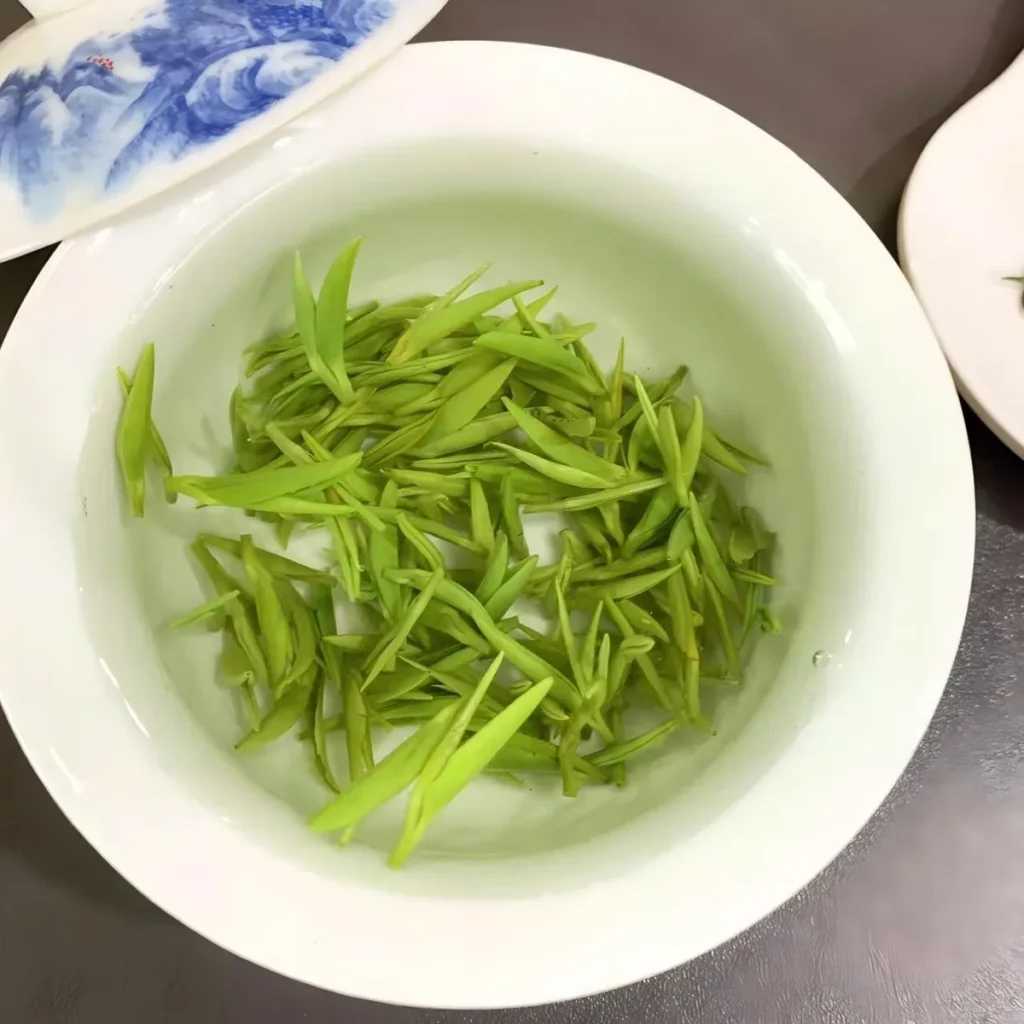
Green Tea Caffeine in the Cup
Dry-leaf percentages are not what you drink. Extraction is a separate calculation.
For a typical green tea brewing at 3 g per 150 ml, the leaf holds roughly 90 to 180 mg of caffeine in total, depending on where in the 3 to 6 percent band that particular tea sits. Of that, the first infusion extracts a large share and later infusions taper.
The variables that shift the number, in order of effect:
- Leaf quantity. Caffeine scales roughly linearly with how much leaf you use. Doubling the leaf roughly doubles the dose.
- Water temperature. Hotter water extracts caffeine faster, the same as it extracts everything else faster.
- Steep time. Longer contact means more extraction, with most of it happening early.
- Number of infusions. Each round extracts more, though the later ones contribute less.
The practical consequence is that you control the dose far more than the tea does. A lightly brewed green tea can carry less caffeine than a strongly brewed one from the same tin.
Why Leaf Grade Drives Green Tea Caffeine
If you want to reduce caffeine and you are choosing between green teas, the useful distinction is not the tea name but the picking standard.
A single-bud tea such as a Que She, or a bud-heavy tea such as Biluochun at its top grades, is made from the plant part with the highest caffeine concentration. That does not make it a strong cup — the leaf is light and the infusions are short — but per gram of leaf it sits at the high end.
A coarse-leaf green tea, picked later with more open leaves, sits at the low end. It also tastes different: more astringent, less sweet, lower in amino acids. You are trading flavour for a modest reduction in stimulant, which is worth knowing before you make the trade.
For a genuinely lower-caffeine option, see decaf green tea, where the caffeine is removed, not diluted.
Matcha and Green Tea Caffeine
Matcha changes the calculation because you consume the whole leaf instead of steeping and discarding it.
A steeped green tea leaves most of the leaf behind, so only the soluble fraction reaches you. Matcha is whisked into the water and drunk entire, which means the full caffeine content of the powder is ingested.
That makes matcha the highest-caffeine way to drink green tea per serving, not because the leaf is different but because the delivery is complete. A 2 g serving of matcha delivers roughly the caffeine of the whole 2 g of leaf, whereas 2 g of leaf steeped and discarded delivers a fraction.
Direct quantitative comparison studies between whole-leaf and steeped delivery were not found in the literature reviewed here, so treat the arithmetic as a calculation, not a measurement.
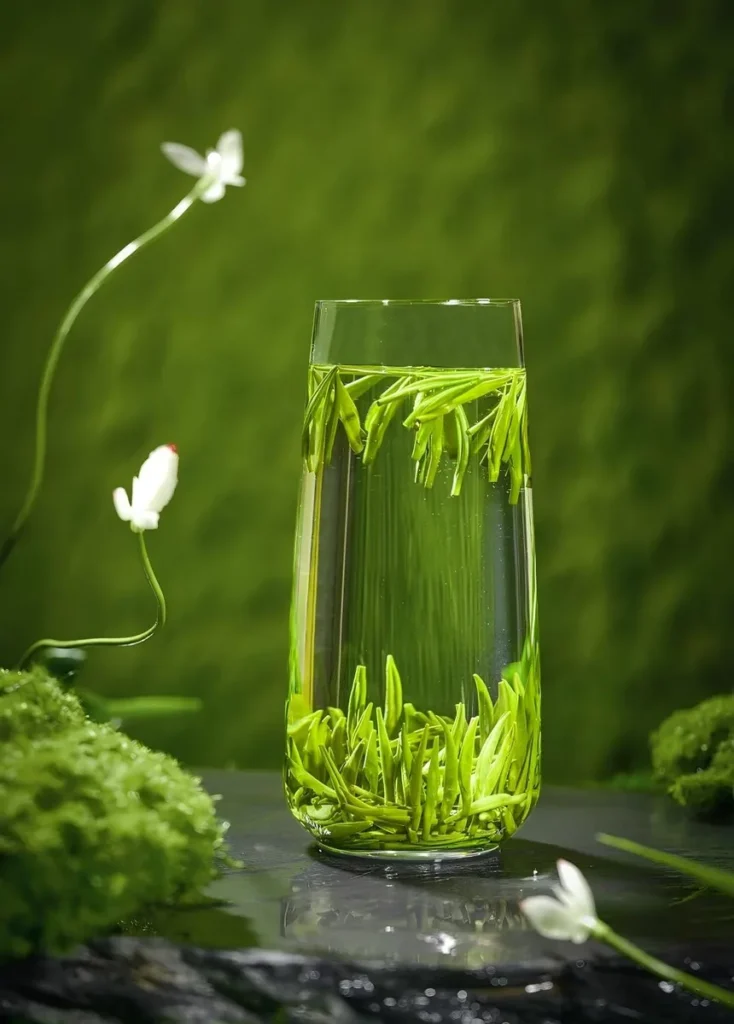
Green Tea Caffeine by Type
Because the four green tea types differ in leaf grade more than in processing, green tea caffeine varies more between grades than between types.
Pan-fired tea covers the widest range, because Longjing, Biluochun and a coarse late-pick pan-fired tea are all in the same manufacturing family. A bud-heavy Biluochun at the top grade sits high; a late spring pan-fired leaf sits low.
Baked tea such as Huangshan Maofeng is usually made from bud and one or two leaves, which puts it in the middle to high part of the range.
Steamed tea is not systematically different in caffeine. The steaming process changes catechins and aroma far more than it changes xanthines, which are stable through processing.
Sun-dried green tea, made from large-leaf Yunnan material picked relatively mature, tends to sit at the lower end per gram — the same mature-leaf effect that makes rock tea measure 18 to 23 mg per gram.
The useful conclusion for green tea caffeine is that the tea name tells you less than the picking standard does. A seller who states the grade and the harvest date is giving you more information about the dose than one who states the mountain.
Green Tea Caffeine Versus Decaf
Decaffeinated green tea is a genuinely different product, and the comparison is worth stating precisely because the labelling is confusing.
In the United States, a tea labelled decaffeinated must have had at least 97 percent of its caffeine removed. That leaves up to 3 percent, which is not zero. In practice a decaffeinated green tea carries a small fraction of the original load, not none.
How the caffeine is removed matters for what else goes with it. Solvent-based methods can strip more than caffeine, and water-based methods, while cleaner in principle, can carry off catechins along with the xanthines. The published quantitative comparisons are thin, so the honest position is that decaffeination reduces caffeine substantially and affects other compounds to an extent that varies by method.
Decaf green tea covers the processes in detail.
Where the limits come from
Two reference points are worth knowing, because they are the ones regulators actually publish.
The European Food Safety Authority sets an upper limit of 400 mg of caffeine per day for healthy adults, and 200 mg in a single dose. For pregnancy it advises 200 mg per day.
Against those numbers, a green tea session at 3 g per 150 ml is modest — typically well under 100 mg across two or three infusions. A large matcha serving plus a morning coffee plus an afternoon green tea gets closer to the limit without anyone noticing.
The genuinely important safety distinction in the green tea literature is not about the drink at all. The European Food Safety Authority concluded in 2018 that EGCG at 800 mg per day or more in supplement form may be associated with raised transaminases, a marker of liver stress. That is a finding about concentrated green tea extract capsules, not about brewed tea. A cup of green tea contains tens of milligrams of EGCG, not hundreds, and the two should never be conflated.
Green tea as a drink has a long safety record. Green tea extract as a supplement is a different product with a different risk profile, and the difference is concentration.
Green Tea Caffeine, Timing and Sensitivity
Caffeine has a half-life of roughly five hours in most people, with wide individual variation. That means an afternoon cup still has a measurable fraction in your system at bedtime.
If you are sensitive, three adjustments work and one does not.
Working: reduce the leaf, shorten the first infusion, and stop after the second infusion. Because caffeine extracts early, the first cup carries most of the dose and the later ones taper.
Not working: switching to a different green tea type in the hope that it is weaker. The leaf grade matters far more than the processing style, and the variation within a category is larger than the average difference between categories.
Three things to remember
- Dry leaf typically carries 3–6% caffeine by weight; the cup depends on dose and brewing.
- Green tea is not reliably lower in caffeine than black tea.
- Extract-supplement findings do not describe brewed tea.
Frequently Asked Questions
How much caffeine is in green tea?
Caffeine in dry green tea leaf runs 3 to 6 percent by weight, the same band as other tea types. What reaches the cup depends on leaf quantity, water temperature, steep time and how many infusions you take.
Does green tea have less caffeine than black tea?
Not reliably. Caffeine is stable through processing, so green and black tea from the same leaf carry similar amounts. The real variable is leaf grade: buds and young leaves carry more than mature leaf.
Does green tea have less caffeine than coffee?
Usually, per serving. An 8 oz coffee carries roughly 95 mg. A green tea brewed at 3 g per 150 ml across two infusions is typically well under that, though a strong brew of bud-heavy leaf can approach it.
Is matcha higher in caffeine?
Per serving, yes, because you consume the whole leaf instead of discarding it. The leaf itself is not special; the delivery is complete.
Is green tea extract safe?
That is a different product from brewed tea. EFSA concluded that EGCG at 800 mg per day or more in supplement form may raise liver enzymes. A cup of brewed green tea contains tens of milligrams of EGCG, not hundreds.
Does green tea caffeine change with brewing method?
Yes, substantially, and more than the leaf does. The same tin brewed at 3 g in 150 ml for ninety seconds and at 5 g in 150 ml for three minutes produces very different doses. Cooler water and shorter steeps both reduce green tea caffeine, and they reduce it without changing which tea you bought.
Can I drink green tea before bed?
Depends on your sensitivity and your total intake. Caffeine has a half-life of about five hours, so an evening cup is still partly active at bedtime. A short session of a lightly brewed tea carries little.
Compare leaf grades. Shouning High Mountain Green Tea lists mature leaf; Shifeng Pre-Qingming Longjing is bud-heavy. Brew both at the same leaf weight and water temperature to compare the cup. Shouning green tea · Shifeng Longjing.
- Shouning High Mountain Green Tea, $19.90
- Shifeng Pre-Qingming Longjing, $14.90
Or browse the full green tea collection.
Read next
For brewing parameters, see how to brew green tea. For leaf styles, see the green tea types guide. Also worth opening: the category as a whole, what the health evidence shows, brewing and extraction and the decaf option. For the opposite case, mature-leaf rock tea measures 18–23 mg/g.
Sources & References
Peer-Reviewed Research
- Critical Reviews in Food Science and Nutrition (1997). Caffeine at 3–6% of dry leaf weight; catechins 30–42%. DOI:
10.1080/10408399709527797 - Food Chemistry (2021). Xanthine alkaloids stable through tea processing while other compound classes change. DOI:
10.1016/j.foodchem.2021.130624 - RSC Advances (2020). Caffeine in rock tea at 18–23 mg/g across roast levels, lower than green tea because of mature leaf. DOI:
10.1039/d0ra09703a
Regulatory Guidance
- EFSA (2015). 400 mg per day for healthy adults; 200 mg single dose; 200 mg per day in pregnancy. DOI:
10.2903/j.efsa.2015.4102 - EFSA (2018). EGCG at 800 mg per day or more in food supplements may raise transaminases. DOI:
10.2903/j.efsa.2018.5239
Boundary of this page: We do not claim green tea is low in caffeine, that green tea is weaker than black tea, or that brewed tea carries the risks associated with concentrated extract supplements. Where the evidence concerns supplements, not drinks, the page separates them.

7 Comments