
Chinese Green Tea: What the Standard Defines
Almost every green tea on a shelf is a leaf that was heated within hours of picking. Stopping the enzymes before the leaf oxidises is what makes the category green, and it explains most of what the cup tastes like.
This page covers what the standard defines about Chinese green tea, the four processing styles, where flavour comes from, and how to read a label without being misled by shape or colour.
Table of Contents
What the Standard Defines as Chinese Green Tea
Chinese green tea is governed by a national standard with six parts. The core text is GB/T 14456.1-2017, which sets the basic requirements; parts 2 through 6 cover large-leaf green tea, small-and-medium-leaf green tea, gunpowder, eyebrow tea and steamed green tea respectively.
The definition of Chinese green tea is short and specific: it is made from the buds, leaves and tender stems of the tea plant, processed by kill-green, rolling and drying. Three operations. That is the whole legal description.
Grade is a separate matter. GB/T 14456.1 sets basic requirements and does not divide the category into grades. Grading happens in the individual product standards. Longjing, for instance, is graded from special grade down to grade five under GB/T 18650-2008, six tiers in total. A package that claims a grade without naming the product standard is telling you less than it appears to.
The Step That Makes It Green
The Chinese term is sha qing, kill-green. A processing terminology standard defines it precisely: applying heat so that the temperature of the fresh leaf rises quickly, destroying enzyme activity and preventing the stem and leaf from reddening.
The enzyme being targeted is polyphenol oxidase, along with peroxidase. Leave them active and the leaf oxidises, which is what happens in black tea and oolong. Heat them past their working temperature and oxidation stops, which is why the leaf stays green.
This is where the common description goes wrong. Saying green tea is “unfermented” implies a fermentation that simply does not occur. The accurate statement is that green tea is processed without a fermentation step, and that the kill-green stage actively prevents the enzyme-driven oxidation that would otherwise happen. The distinction matters because it explains why the leaf must be heated within hours of picking, and why that urgency shapes the economics of every green tea region.
The chemistry is a little more complicated than “enzymes off.” A study on steamed green tea found peroxidase was almost entirely inactivated, around 99 percent, while polyphenol oxidase was only partly inactivated, at most about 34 percent under the conditions tested. That partial survival is one reason green tea can still darken over time. It is also a reminder that kill-green is a temperature-and-time problem, not a switch.
The Four Styles of Chinese Green Tea
The standard divides Chinese green tea by processing into four types. The difference is the heating medium for kill-green and, in three of the four cases, the drying method.
| Type | What defines it | Representative teas |
|---|---|---|
| Pan-fired (炒青) | Kill-green in a hot wok or drum, then dried by pan-firing | Longjing, Biluochun, Xinyang Maojian |
| Baked (烘青) | Same kill-green, dried entirely by baking | Huangshan Maofeng, Taiping Houkui |
| Sun-dried (晒青) | Pan kill-green, then dried in sunlight | Dianqing, the raw material for raw pu-erh |
| Steamed (蒸青) | Kill-green with steam | Enshi Yulu |
Two things about this table surprise people. First, sun-dried green tea is the raw material for raw pu-erh, which means a tea most drinkers think of as a separate category begins life inside the green tea standard. Second, steamed green tea is nearly extinct in China. Enshi Yulu in Hubei is the representative surviving example, a needle-shaped tea with roots in the Kangxi period. Steaming is the norm in Japan, not China.
Liu’an Guapian is a useful edge case. It is pan-fired to shape the leaf and then finished with a heavy baking stage, so published sources classify it inconsistently as pan-fired or baked. Describing it as sitting between the two is more honest than forcing it into one box.
Where Chinese Green Tea Flavour Comes From
Three groups of compounds explain most of what Chinese green tea tastes like, and processing sets all three.
Catechins are the largest group, making up 30 to 42 percent of dry weight. Within that, EGCG accounts for roughly half of the total catechin content, with EGC and ECG at around 9 to 12 percent each and EC at 5 to 7 percent. Catechins read as astringent and slightly bitter, and they are the reason green tea can turn harsh when over-brewed.
L-theanine sits at 1 to 2 percent of dry weight and is the source of the savoury, brothy quality the trade calls umami. It is not a taste the tongue has a dedicated receptor for in the ordinary sense, the response comes through the T1R1 and T1R3 receptors working together, which is also why the sensation is described as mouth-filling, not located on a specific part of the tongue.
Aroma compounds are where processing becomes visible in the cup. A controlled study drying green tea at four temperatures found a clean progression: 90 °C produced a fresh, green aroma; 110 °C produced chestnut; 140 °C produced a cooked-bean note; 160 °C produced a high-fire character. Ninety-five volatile compounds were identified across the set. That is the chemistry behind the fact that Longjing is described as chestnut and bean, while a low-fired tea is described as fresh and grassy.
The same research explains the difference between pan-fired and steamed tea. Comparing the same fresh leaf processed both ways, pan-fired tea came out higher in amino acids (41.47 against 33.79 mg per gram) and lower in catechins (111.36 against 139.68 mg per gram). Pan-fired tea was dominated by esters, which read as fruity and sweet; steamed tea by alcohols, which read as green and floral. Neither is better. They are two different targets.
The Chinese Green Teas to Know
Chinese green tea is not one product with regional variations. It is a set of named teas with protected origins, each tied to a specific place and often to a specific cultivar.
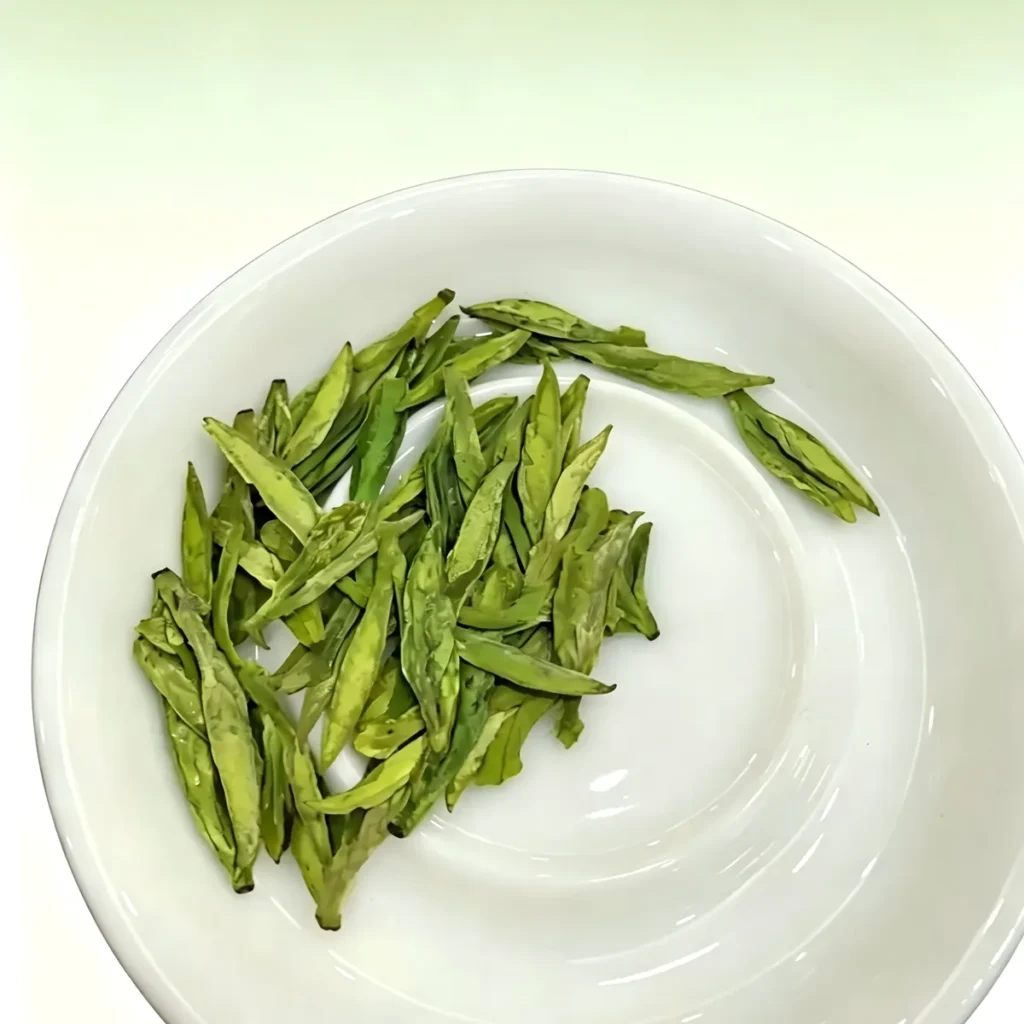
Longjing from Hangzhou is the most famous, flat-pressed and pan-fired, with a chestnut-and-bean aroma. The geographical indication covers 18 counties across four prefecture-level cities, divided into West Lake, Qiantang and Yuezhou production zones; only the West Lake zone carries the name most buyers recognise.
Biluochun from the Dongting hills near Suzhou is the opposite shape, tiny, curled, bud-heavy, and is one of the most delicate teas in the category.
Huangshan Maofeng from the Yellow Mountain region is baked, not pan-fired, with a softer, sweeter profile than Longjing.
Anji Bai Cha deserves a note because its name misleads. It is a green tea, not a white tea. The “white” refers to a cultivar, Bai Ye No. 1, whose leaves turn pale during a cold-induced albino phase in early spring. The leaf is picked during that phase and processed as green tea. Nothing about the manufacturing is white-tea method.
Taiping Houkui is the outlier in shape, with large flat leaves pressed between cloth, and Xinyang Maojian is the reference needle-shaped green tea of the north.
Green tea types covers the four processing styles and the named teas in more detail.
The Market in Numbers
Chinese green tea is not a niche product, and the scale matters for judging what you are buying.
In 2024, China produced 3.50 million tonnes of dry rough tea, of which green tea was 2.06 million tonnes, 58.9 percent of the total. Exports were 324,000 tonnes worth 1.07 billion US dollars, accounting for 86.6 percent of China’s tea export volume and 75.6 percent of export value, at an average of 3.31 dollars per kilogram.
The export profile is worth knowing because it explains the price gap between what leaves China and what Western buyers pay. The five largest destinations, Morocco at 80,500 tonnes, then Ghana, Uzbekistan, Mauritania and Senegal, take around 54 percent between them. That is North and West African tea-drinking, supplied at commodity prices. The tea sold in Western specialty shops is a small, high-value slice of the same harvest.
What to Look For
Four pieces of information about Chinese green tea tell you more than the mountain name on the front of the tin.
The processing style. Pan-fired and baked green teas taste different and keep differently. A seller who does not say which is not giving you enough to buy on.
The harvest date. Green tea is a fresh product. Pre-Qingming leaf commands a premium because early spring growth is scarce, under 20 percent of annual output, and because cool weather slows growth and concentrates amino acids. That is a real difference, but the premium is also driven by gift demand.
The product standard. A named tea should map to a standard: Longjing to GB/T 18650, Biluochun to GB/T 18957, Huangshan Maofeng to GB/T 19460. That is checkable in a way that a garden claim is not.
The storage situation. Green tea degrades faster than any other category. Buy in quantities you will finish, and see how to store green tea.
Three things to remember
- Green tea is defined by heat stopping oxidation, not by “unfermented”.
- Four manufacturing styles cover almost every Chinese green tea sold.
- Shape and colour are not reliable guides to processing.
Frequently Asked Questions
Is green tea unfermented?
Not in any meaningful sense. Chinese green tea is processed without a fermentation step, and the kill-green stage uses heat to stop the enzyme-driven oxidation that would otherwise turn the leaf dark. Saying “unfermented” implies a process that does not happen.
Is green tea the same as matcha?
No. Matcha is made from tea grown under shade, steamed, dried without rolling, and ground to powder, then consumed whole. Green tea is steeped and the leaf discarded. The shading changes the leaf chemistry before processing even starts.
Is Anji Bai Cha a white tea?
No, it is a Chinese green tea. The name refers to the pale colour of a specific cultivar during its spring albino phase. It is picked then and processed by the green tea method.
Does green tea have more caffeine than black tea?
Not reliably. Caffeine in the dry leaf runs 3 to 6 percent across tea types, and what reaches the cup depends far more on leaf quantity, water temperature and steep time than on which category the tea belongs to. Green tea caffeine has the measured figures.
Why is green tea brewed cooler than other teas?
Because heat degrades the catechins the category is valued for. A study found water at 80 °C for 20 minutes recovered 97 percent of catechins, while 95 °C for 10 minutes recovered 90 percent. Cooler water also extracts less of the astringency. See how to brew green tea.
Start with the processing, not the name. A pan-fired Longjing and a baked Shouning green tea will show you the difference the heating step makes; brew both at 80 °C. Shifeng Longjing · Shouning green tea.
- Shifeng Pre-Qingming Longjing, $14.90
- Dongting Biluochun, $19.90
- Huangshan Pre-Qingming Maofeng, $19.90
Or browse the full green tea collection.
Read next
For the processing sequence itself, read how green tea is made. For brewing, see how to brew green tea. Also worth opening: the four manufacturing styles, Longjing in depth, how to brew it and the caffeine numbers, jasmine green tea, and how scenting works, matcha, and why shading comes before processing, decaf green tea, and what decaffeination costs, the health evidence, graded and green tea vs matcha side by side.
Sources & References
Standards
- GB/T 14456.1-2017, Green tea, Part 1: Basic requirements. Published 2017-11-01, effective 2018-02-01; replaces the 2008 edition and modifies ISO 11287:2011.
- GB/T 14456.2-2018 through GB/T 14456.6-2016, Large-leaf, small-and-medium-leaf, gunpowder, eyebrow and steamed green tea.
- GB/T 30766-2014, Classification of tea.
- SB/T 10034-92, Terminology for tea processing; kill-green defined at 4.1.4.
- GB/T 18650-2008, Geographical indication product: Longjing tea.
Peer-Reviewed Research
- LWT (2015). Steamed green tea: peroxidase ~99% inactivated, polyphenol oxidase only partly; 3-minute steaming best. DOI:
10.1016/j.lwt.2015.07.068 - Foods (2022). Same-batch pan-fired versus steamed comparison: amino acids 41.47 vs 33.79 mg/g, catechins 111.36 vs 139.68 mg/g. DOI:
10.3390/foods11111582 - LWT (2022). Drying temperature and aroma: 90/110/140/160 °C map to fresh/chestnut/bean/high-fire; 95 volatiles identified. DOI:
10.1016/j.lwt.2022.113394 - Critical Reviews in Food Science and Nutrition (1997). Catechins 30–42% of dry weight; EGCG 48–55% of total catechins; caffeine 3–6%. DOI:
10.1080/10408399709527797 - Trends in Food Science & Technology (1999). L-theanine at 1–2% of dry weight. DOI:
10.1016/S0924-2244(99)00044-8
Market Data
- 2024 China dry rough tea 3.50 million tonnes, green tea 2.06 million tonnes (58.9%); exports 324,000 tonnes, 1.07 billion USD.
- Reference standard for mushroom-shaped and other protected teas: State Administration for Market Regulation standards platform.
Boundary of this page: We do not claim green tea is caffeine-free, that “unfermented” is a meaningful description, or that Anji Bai Cha is a white tea. Where the standard is silent, on grades, on shelf life, on “bean aroma” as a defined term, the page says so.

