Longjing Tea: Zones, Cultivars and the Shape Myth
Longjing is pan-fired flat, and that flat leaf is the clearest visual record of how it was made. Behind the shape sit three production zones, a set of cultivars, and a harvest calendar that starts before the Qingming festival.
This page covers the zones, the cultivars, the shaping step, where the name comes from, and how to judge a tin.
Table of Contents
What Longjing Tea Is
The national standard, GB/T 18650-2008, defines Longjing tea as a flat-shaped green tea made from fresh leaf picked within the protected area, from specified cultivars, processed by the traditional method, and carrying four qualities: colour green, aroma rich, taste mellow, shape beautiful.
Four characters, four claims. Every one of them is a quality the standard asks the tea to have, and three of them are things a buyer can check in the cup. That is more useful than most tea definitions.
The grade structure runs from special grade down to grade five, six tiers in total. A package claiming a grade without naming the standard it is graded under is giving you a number with nothing behind it.
The Three Zones
Longjing’s geographical indication is not a small area, and the name most buyers think they are paying for covers only a fraction of it.
The protected region spans 18 counties across four prefecture-level cities: Hangzhou, Shaoxing, Jinhua and Taizhou. Within that, production divides into three zones.
| Zone | Where | What it means |
|---|---|---|
| West Lake (西湖) | Hangzhou’s West Lake district, including the scenic area | The zone the name evokes; smallest and most expensive |
| Qiantang (钱塘) | Hangzhou’s other districts | Same city, outside the historic core |
| Yuezhou (越州) | Shaoxing, Jinhua, Taizhou | Largest by volume; least expensive |
All three can legally be sold as Longjing tea. Only the first can be sold as West Lake Longjing. That distinction is the single most consequential fact about buying this tea, and it is the one most often blurred in descriptions.
The West Lake zone has its own regulatory layer: the Hangzhou municipal regulation on protecting West Lake Longjing tea took effect on 1 March 2022, and the “West Lake Longjing” name is a registered geographical indication certification mark dating from August 2011.
The Cultivars
The standard names the cultivars permitted for Longjing tea instead of fixing a single plant: Longjing population variety, Longjing 43, Longjing Changye, Yingshuang and Jiukeng, plus other approved varieties suitable for processing Longjing.
The two that matter commercially are the population variety and Longjing 43, and they are different teas.
Longjing population variety is the traditional plant of the West Lake area, a mixed, seed-grown population shaped by long selection. It sprouts later, generally from late March, and produces a tea the trade describes as fuller in aroma and thicker in the mouth, with more variation between bushes.
Longjing 43 is a clonal selection from that population, and its history is unusually well documented. In spring 1960, researchers at the Chinese Academy of Agricultural Sciences’ Tea Research Institute selected individual bushes from old Longjing population gardens around Yunqi in the West Lake area. The selections were numbered by year and sequence, and the one that became Longjing 43 was recorded as Longjing 6043 — the 43rd plant selected in 1960. From 1962 it was shortened to Longjing 43. It received a national science conference award in 1978 and was registered as a national variety in 1987.
What Longjing 43 offers is uniformity and earliness. It sprouts seven to ten days earlier than the population variety and buds densely, which means more picking days in the premium window and a more consistent leaf. What it can lose is the bush-to-bush variation that gives population-variety tea its depth. Most West Lake Longjing sold today is Longjing 43; population-variety tea commands a premium among drinkers who prefer it.
Zhongcha 108 is a later development, selected from irradiated Longjing 43 cuttings, sprouting a few days earlier again. It is being promoted but is not yet the reference.
The Shape and How It Is Made
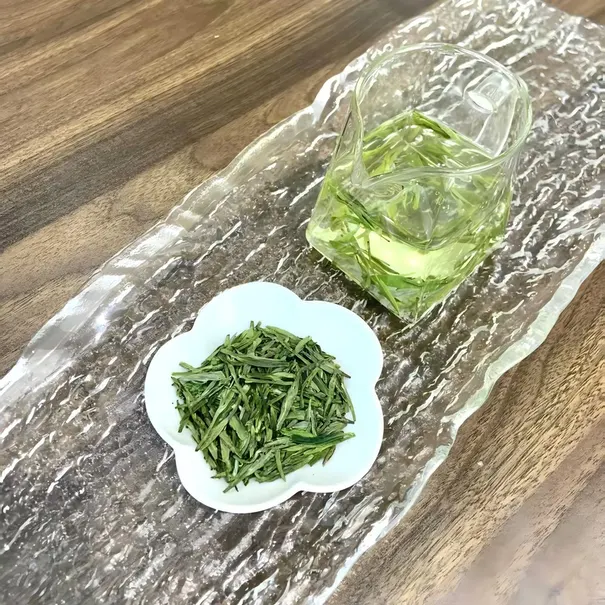
Longjing’s flat, pressed leaf is the result of pan-firing by hand, and the standard describes the traditional method as a sequence of ten hand movements: grab, shake, press down, flatten, knead, push, button, flick, polish and press.
Those movements do two things at once. They keep the leaf in contact with the hot surface long enough to kill the enzymes, and they press it flat while it is still pliable. The result is the shape the tea is named for and the colour the standard calls green, though in practice good Longjing is closer to a pale yellowish-green than to the vivid green that some buyers expect.
Machinery can reproduce the shape, and most Longjing is now machine-processed. That is not automatically worse; the question is whether the firing curve was right. The chemistry is the same one that governs all pan-fired green tea: drying temperature determines the aroma, with roughly 110 °C producing chestnut and 140 °C producing a cooked-bean note. Longjing’s characteristic chestnut-and-bean profile is a firing outcome, not a cultivar property.
Where the Name Comes From
The earliest documented use of “Longjing” as a tea name is a Yuan dynasty poem by Yu Ji, from the fourteenth century, which mentions pan-frying golden buds and advises not picking after Grain Rain.
The popular story is different: that the Qianlong emperor visited the area, picked tea himself, and had the leaves pressed flat inside his sleeve. It is a good story and it explains the shape conveniently. It has no documentary support.
A second story that circulates widely is that Longjing won a gold medal at the 1915 Panama-Pacific Exposition. According to the Chinese delegation’s own published record, China took 21 gold medals at that exposition, including Keemun black tea, Taiping Houkui, Yunhe Huiming and Xinyang Maojian. Longjing is not on the list. The claim is marketing, not history.
Inside West Lake: Shifeng and the Sub-Areas
Even within the West Lake zone, the trade distinguishes villages and slopes, and one of those names has acquired its own standard.
Shifeng, Lion Peak, is the most celebrated of the West Lake production areas. It has a group standard of its own, T/XHS 001-2018, which narrows the permitted cultivars to three: Longjing population variety, Longjing 43 and Longjing Changye. That is a stricter list than the national Longjing standard, which allows five.
The practical significance is that a Shifeng claim is checkable in a way that a general West Lake claim is not. If a seller names Shifeng, the cultivar question has a defined answer, and the tea should be one of three plants.
Other well-known West Lake areas include Meijiawu and Longjing village itself. These names carry market weight but do not all have separate standards, so the claim rests on the seller instead of on a document.
What none of this changes is the underlying limit: the West Lake zone is small, and the volume of tea sold under West Lake names exceeds what it produces. The sub-area names add specificity without solving the verification problem.
Pre-Qingming and the Harvest Calendar
Longjing is sold by harvest date, and the date matters more than in most tea categories.
Pre-Qingming leaf is picked before the Qingming solar term in early April. Cool weather means slow growth, small yields and leaf high in amino acids, and the result is the most expensive grade. Pre-Grain Rain leaf, picked between Qingming and Grain Rain in late April, is cheaper, larger and stronger.
Neither term has a national standard definition. They are Jiangnan seasonal labels, widely used and widely understood, but not legally fixed. What is legally fixed is the cultivar list and the origin.
The economics behind the premium are documented. Early spring tea is under 20 percent of annual output but contributes more than 60 percent of spring revenue, because scarcity, tenderness and gift demand all push in the same direction. That does not mean pre-Qingming tea is always better; it means it is always scarcer.
Judging What You Are Buying
Longjing is the most counterfeited green tea in China, and the documented methods are worth knowing.
Flat leaf from outside the protected area. Because any leaf can be pressed flat, early spring leaf from other provinces is routinely processed into a Longjing-like shape and sold as pre-Qingming Longjing. The geographical indication covers 18 counties in Zhejiang; leaf from outside them cannot legally carry the name.
Old tea sold as new. In 2024 a tea merchant was fined 20,000 yuan for advertising 2023 “Hangzhou Longjing” as 2024 “West Lake Longjing new tea”. Green tea fades, and a faded tea can be re-fired to look fresher than it is.
Resold anti-counterfeit labels. The authentication marks attached to protected West Lake Longjing have themselves become a traded commodity.
What you can do is limited but not nothing. Check whether the label says West Lake, Qiantang or Yuezhou instead of just Longjing. Check the harvest date against the season. And treat a very low price for a West Lake claim as a signal instead of a bargain: media reporting puts pre-Qingming West Lake Longjing at several thousand yuan per 500 g, with the Qiantang zone at roughly 2,000 to 3,000 and ordinary grades around 600.
Brewing Longjing Tea
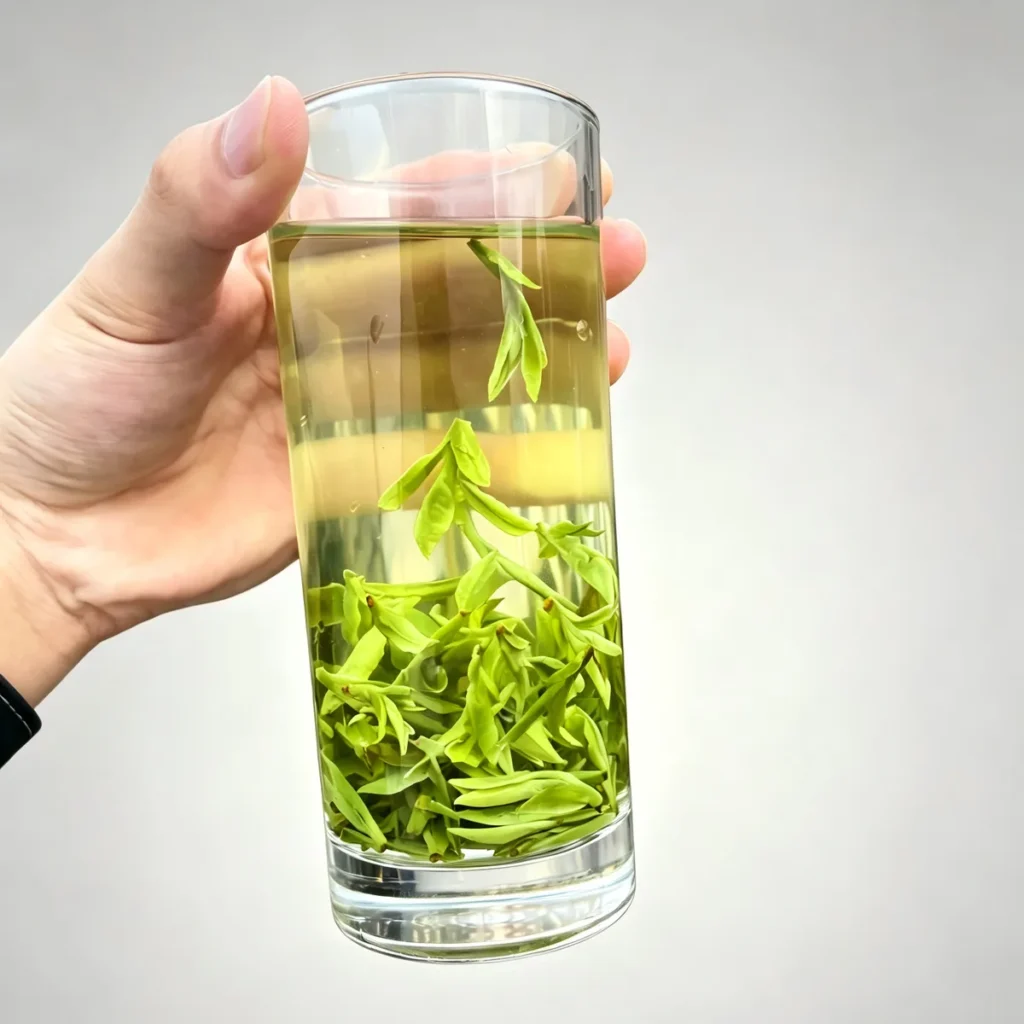
Longjing is usually brewed in a glass, which is a modern habit, not an old one but has the practical advantage of showing the leaf unfurl.
Use 3 to 4 g in 150 ml of water at 80 to 85 °C. Hotter water extracts the catechins faster and turns the cup astringent; a study on catechin extraction found 80 °C for 20 minutes recovered 97 percent while 95 °C for 10 minutes recovered only 90 percent, which is the chemistry behind the usual advice. Steep for one to two minutes on the first infusion and lengthen slightly after that.
The leaf will give two or three good infusions. Longjing is a bud-and-tender-leaf tea, not a rolled oolong, and it does not have the structure for a long session. How to brew green tea covers the wider method.
Three things to remember
- The flat shape comes from pressing the leaf against a heated pan.
- Pre-Qingming picking is the earliest and most expensive window.
- Brew at 80 to 85 °C; the leaf is delicate and bruises easily.
Frequently Asked Questions
Is all Longjing tea from West Lake?
No. The geographical indication covers 18 counties across four cities, divided into West Lake, Qiantang and Yuezhou zones. Only West Lake zone tea can be sold as West Lake Longjing.
What is the difference between Longjing 43 and the population variety?
Longjing 43 is a clonal selection made in 1960 from West Lake population gardens, sprouting seven to ten days earlier and producing more uniform leaf. The population variety sprouts later and gives more variation between bushes, which some drinkers prefer.
Is Longjing a pan-fired tea?
Yes. It is pan-fired and pressed flat during firing, using a documented sequence of ten traditional hand movements. It is one of the reference pan-fired green tea types.
Did Longjing win a gold medal at the 1915 Panama Exposition?
Not according to the Chinese delegation’s published record, which lists 21 gold medals including Keemun, Taiping Houkui, Yunhe Huiming and Xinyang Maojian. The Longjing claim is not supported by that record.
Why is pre-Qingming Longjing so expensive?
Scarcity and tenderness. Early spring leaf is under 20 percent of annual output but contributes over 60 percent of spring revenue, and gift demand concentrates on the earliest pick.
Compare zones, not just grades. Shifeng Pre-Qingming Longjing is the top-zone reference; brew at 80 to 85 °C in a glass.
- Shifeng Pre-Qingming Longjing, $14.90
- Shouning High Mountain Green Tea, $19.90
Or browse the full green tea collection.
Read next
Read Biluochun, is the other hand-rolled green tea worth tasting beside it. Also worth opening: the category as a whole, the four styles and brewing Longjing.
Sources & References
Standards
- GB/T 18650-2008 — Geographical indication product: Longjing tea. Cultivar list at 5.2.1; grades special through five; traditional hand-processing movements described in the text.
- GH/T 1115-2015 — West Lake Longjing tea.
- T/XHS 001-2018 — Shifeng Longjing tea.
- GB/T 14456.1-2017 — Green tea, Part 1: Basic requirements.
Variety Records
- Longjing 43: selected in spring 1960 from Longjing population gardens near Yunqi, West Lake; recorded as Longjing 6043; renamed Longjing 43 in 1962; national science conference award 1978; registered as a national variety 1987.
- Zhongcha 108: selected from irradiated Longjing 43 cuttings.
Peer-Reviewed Research
- Food Chemistry (2005). Catechin extraction: 80 °C/20 min recovers 97%, 95 °C/10 min recovers 90%. DOI:
10.1016/j.foodchem.2005.03.015 - LWT (2022). Drying temperature and aroma: 110 °C chestnut, 140 °C cooked bean. DOI:
10.1016/j.lwt.2022.113394
Boundary of this page: We do not claim the Qianlong story is history, that Longjing won a Panama medal, or that pre-Qingming tea is always better. Where a claim is marketing, not record, the page says so.