Da Hong Pao: The Mother Trees and What You Can Buy
Da Hong Pao is the most famous name in Chinese tea and the most misunderstood. It refers to six specific bushes on a cliff, to a legal product category that is by definition a blend, and to a marketing story that has almost nothing to do with either.
The three are worth separating. What follows covers the mother trees, the legal category, the name and the tin, in that order.
Table of Contents
The Mother Trees
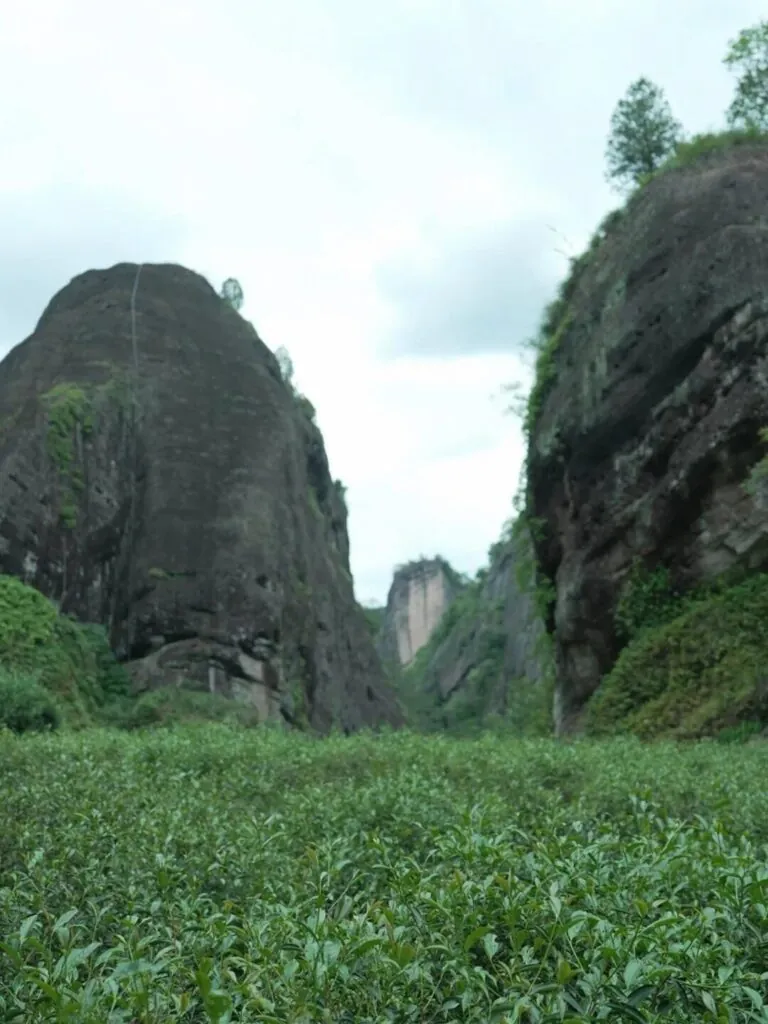
Six tea bushes grow on a rock face in Jiulongke, a gorge in the Wuyi scenic area. They are the original Da Hong Pao plants, and their age is usually given as around 350 years — an estimate rather than a documented figure, since nobody recorded the planting.
They are no longer picked. The final harvest took place on 3 May 2005, and from May 2006 the bushes were placed under permanent protection and left to grow. The 20 grams produced by that last picking was placed in the National Museum of China in 2007.
That single fact disposes of most of the market. Any tea sold as mother-tree Da Hong Pao today is either mislabelled or referring to something else. In 2018 a video circulated claiming to show the mother trees being picked; it was officially clarified that the material was being taken for research, not production.
Historic auction figures are sometimes quoted to establish the value of the name. Reports put 20-gram lots at 156,800 yuan in 1998, 180,000 yuan in 2002, 166,000 Hong Kong dollars in 2004 and 198,000 yuan in 2005. These come from media coverage rather than an official register, and the figures vary slightly between sources, so treat them as indicative rather than exact.
What the Standard Actually Defines
Here is the part that surprises almost everyone. Under the national standard, Da Hong Pao is a blend.
The 2006 edition of GB/T 18745 lists Da Hong Pao as one of five product categories without defining its contents, which allowed the name to drift toward an implied single-bush meaning it never legally had. The 2026 revision, published in March 2026 and effective 1 April 2027, removes the ambiguity: Da Hong Pao is made from the semi-finished leaf of several clonally propagated cultivars, bulked and blended.
That is not a downgrade or a loophole. Blending is how a producer builds a consistent product from variable harvests, in the same way a whisky blender combines casks to hold a house style steady. The category exists precisely because the alternative — depending on one bush, or on one season’s leaf — cannot supply a market.
What the blend contains varies by producer. Rougui and Shui Xian are common components, chosen because they contribute aroma and body respectively. A skilled blender adjusts the proportions to hit a target profile, and the target is balance rather than any single distinctive note.
Pure-Strain Da Hong Pao
Separate from the blended category there is pure-strain Da Hong Pao, grown from a single clonal line. The best-known is Qidan, a cultivar propagated from the mother trees’ lineage and registered as a provincial variety in 2012.
Pure-strain Da Hong Pao is a genuine single-cultivar tea and it is worth drinking. What it is not is the standard’s Da Hong Pao category. A producer selling Qidan as “pure Da Hong Pao” is describing the plant honestly; a producer selling a blend as pure-strain is not.
In the cup the difference is usually visible in consistency. The blend is balanced and repeats from tin to tin. Pure strain is more specific, sometimes more awkward, and varies more between seasons — the same trade-off you meet in any single-cultivar product.
Where the Name Came From
The popular story is that a scholar travelling to the capital fell ill, was cured by tea from these bushes, and later returned to drape red robes over the plants in gratitude. It is a good story, it explains the name, and it has no documentary basis.
The version usually told was collected in the 1970s as oral history. What can be dated is much later. The earliest documented reference to “red robe” tea is from 1839, in Zheng Guangzu’s Yibanlu, which notes that “red robe” and “Jianqi” had been current in Fujian for about fifty years. That places the name’s circulation in the late Qianlong period, not the Ming dynasty.
The 350-year age attributed to the mother trees is likewise an estimate. It may well be right; it is not a record.
What Da Hong Pao Tastes Like
Because it is a blend, there is no single answer — and that is the point. A well-made Da Hong Pao is balanced: aroma present but not dominant, body present but not heavy, roast present but integrated rather than sitting on top.
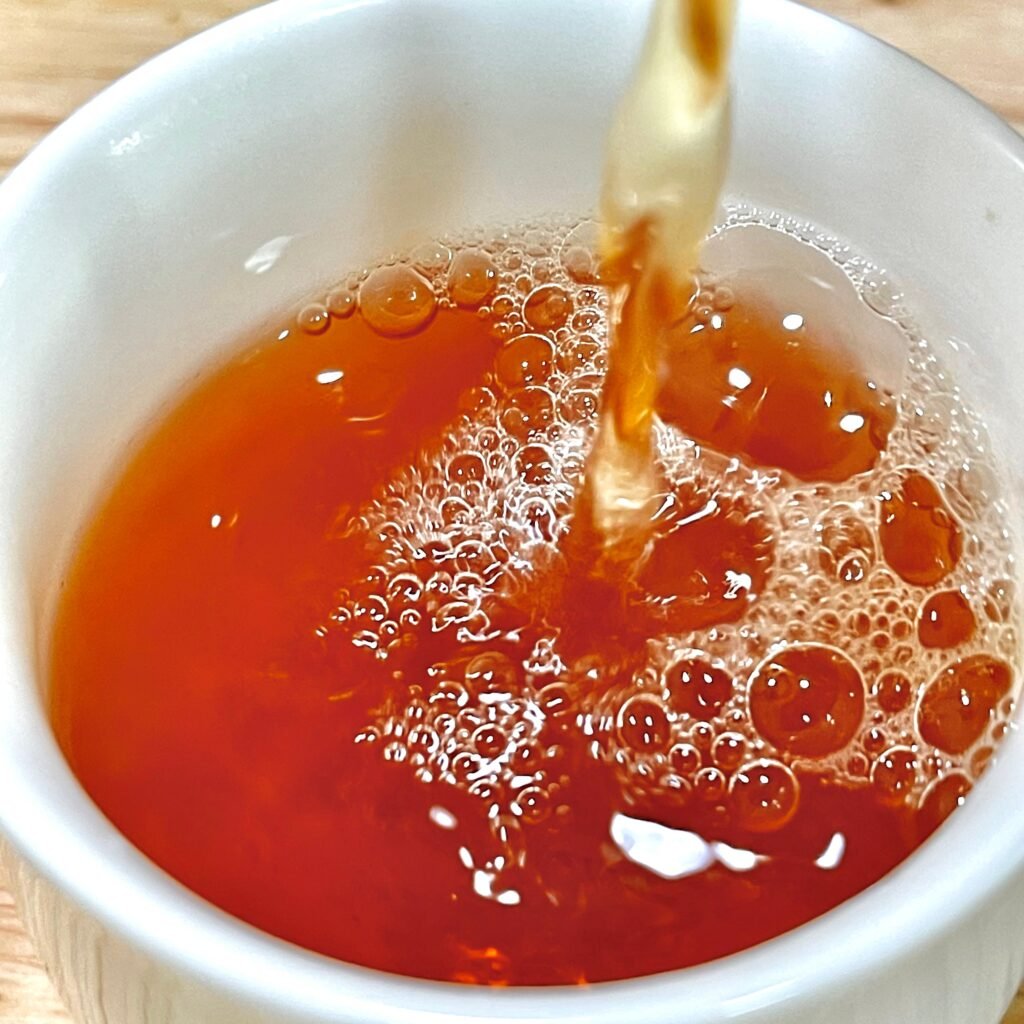
The standard’s sensory language for the top grade describes tight, stout, slightly twisted strips, a lustrous colour, a sharp and long-lasting aroma, a mellow taste with sweetness after the swallow and rock rhyme evident, a clear bright deep-orange liquor, and a soft bright leaf base with red edges. Those descriptors are the closest thing to an official description of the target.
What most commercial Da Hong Pao actually delivers is a mid-weight roasted oolong with stone fruit, a light char note and moderate length. It should not be harsh, and it should not be thin. If it is either, the blending or the roasting went wrong rather than the name.
How Da Hong Pao Is Made
The production process is the same as for any Wuyi rock tea, and the blend is assembled at the end rather than the start.
Leaf is withered, then alternately shaken and rested through several rounds over most of a day until the edges redden and the raw green smell turns to fruit and flowers. It is then fired to stop oxidation, rolled, and dried. Only after that does the charcoal roasting begin, usually in two or three passes with the final low-temperature pass running for hours.
The blending happens in the refined stage. Semi-finished leaf from different cultivars and different gardens is combined, bulked until uniform, and then roasted to a common target. That sequencing matters: you cannot blend finished tea and get a coherent result, because each component would carry its own roast character. Blending before the final fire lets the roast unify the mixture.
This is also why the category can absorb a poor harvest in one cultivar without the product collapsing. The blender adjusts proportions. A single-cultivar tea has no such buffer, which is the structural trade-off between the two approaches.
What the Name Is Worth
Da Hong Pao carries the largest reputation premium in the category, and the premium is only loosely connected to what is in the tin.
The mechanism is straightforward. The name is the one rock tea that non-Chinese drinkers have heard of, so it is the one that sells without explanation. That makes it the easiest product to put on a shelf and the easiest to overprice. A vendor does not need the tea to be exceptional; the label does the work.
The consequence for a buyer is that Da Hong Pao is the category where price signals least reliably. A mid-priced blended Da Hong Pao from a producer who states the components is often better value than an expensive one whose only distinction is the name on the front. This is not an argument against the category. It is an argument for reading the rest of the label before the first three words.
How to Brew It
Da Hong Pao is brewed like any rock tea: a gaiwan, boiling water, high leaf-to-water ratio, short infusions.
Use 7 to 8 g in 110 ml. First infusion 8 to 12 seconds, adding 5 to 10 seconds per round, for eight to ten infusions. Full-fire versions need a longer first infusion to open; light-fire versions should be kept short so the aroma is not lost.
If the tea was roasted recently, it will taste harsh regardless of how you brew it. That is a resting problem rather than a brewing problem. Resting rock tea explains the timings.
Judging What Is in the Tin
Four checks, in order of usefulness.
Ignore mother-tree claims entirely. The bushes have not been picked since 2005. A listing implying otherwise is not a negotiating position; it is a signal about the seller.
Look for the fire level. Light, medium or full changes the tea completely, and a seller who omits it is not giving you enough to buy on.
Ask what is in the blend. A producer who knows their product can name the components and roughly their proportions. Vague answers are common and not automatically dishonest, but specificity is a good sign.
Buy small first. Da Hong Pao carries a reputation premium that is larger than its quality variance. A modest quantity tells you more than any description, and the category is not so rare that you need to commit early.
Prices across the category are covered in rock tea prices.
Da Hong Pao Against the Other Categories
Placing it beside Rougui and Shui Xian makes the blend logic obvious.
A single-cultivar tea, whether Rougui or Shui Xian, is defined by a signature. Da Hong Pao is defined by the absence of one — the blender’s job is to produce something that tastes complete rather than characteristic. That makes it the easiest rock tea to sell to a newcomer and the least interesting to a drinker hunting for cultivar character.
It is also the category where over-roasting is most often used as a shortcut. A heavy char mask can make an indifferent blend taste dark and serious. Rock tea types covers the other four categories and how they differ.
One practical test separates the two cases. Ask what happens when the tea is finished. A producer selling a genuine house blend will describe a target profile they are trying to hit each year, and will admit when a season missed it. A seller trading only on the name will describe the name.
Frequently Asked Questions
Is Da Hong Pao a real tea or a marketing name?
Both. It is a legal product category defined in GB/T 18745, and it is also a name with three centuries of reputation behind it. What it is not is a single-bush tea you can buy.
Can I still buy mother-tree Da Hong Pao?
No. The six mother trees stopped being picked in 2006, and the last harvest was in May 2005. No production tea from those bushes exists on the market.
Why is Da Hong Pao a blend?
Because the 2026 standard defines it that way, and because blending is how a producer builds a consistent product from variable harvests. The blended nature is the category’s design, not a compromise.
Is pure-strain Da Hong Pao better?
Not better, different. Pure strain, usually Qidan, is a single-cultivar tea with more specificity and more seasonal variation. The blend is more balanced and more consistent. Which you prefer is a matter of taste.
What does Da Hong Pao taste like?
A balanced mid-weight roasted oolong: moderate aroma, moderate body, integrated roast, stone fruit and a light char note, with sweetness after the swallow. It should not be harsh or thin.
Shop the rock teas in this guide
Sold directly from our own stock. Every listing states the cultivar, the garden and the fire level.
- High Mountain Da Hong Pao, 2026 — $9.90
- Mituoyan Da Hong Pao, Wuyishan — $23.90
Or browse the full rock tea collection.
Related Reading
all five categories, what the name is worth, how it is made and the category as a whole.
Sources & References
Standards
- GB/T 18745-2006 — Geographical indication product: Wuyi rock tea. Da Hong Pao is one of five categories, graded special, first and second.
- GB/T 18745-2026 — Effective 2027-04-01. Defines Da Hong Pao as a blend of semi-finished leaf from several clonal cultivars, bulked and blended.
Historical Records
The Wuyishan municipal government publishes tea-industry data and heritage records at wys.gov.cn.
The mother-tree protection decision was reported at the time: China News Service, 2018. Standard text and dates: openstd.samr.gov.cn.
- Zheng Guangzu, Yibanlu (1839) — earliest documented reference to “red robe” tea in Fujian.
- Mother trees: final harvest 3 May 2005; protected from May 2006; 20 g from the last harvest deposited in the National Museum of China, 2007.
- Auction figures as reported in media: 1998, 2002, 2004, 2005. Figures are indicative and vary between sources.
What this page does not claim
We do not claim the mother trees are 350 years old, that the red-robes story is history, or that any particular auction figure is exact. Where the record is a news report rather than an archive, the page says so.
