
Rock Tea Terroir: What Zhengyan Actually Means
Rock tea terroir is the most talked-about and least verifiable subject in the category, and the one where the gap between marketing language and checkable fact is widest. Garden names carry price premiums of several times, the vocabulary is opaque to outsiders, and the words used most confidently are not in the national standard at all.
This page covers what the trade means by its terms, what the geography and chemistry actually support, and why a garden name is a claim rather than a fact you can check.
Table of Contents
The Words That Are Not in the Standard
Start with the correction that matters most. Zhengyan (proper rock), banyan (half rock) and zhoucha (river tea) are industry shorthand. None of them appears in GB/T 18745.
The 2002 edition of the standard did divide production into a “famous rock” zone inside the scenic area and a “red rock” zone outside it. The 2006 revision removed that division entirely. Since then the standard has defined only the geographical indication area, which is the whole of Wuyishan’s administrative territory, and has said nothing about sub-zones.
So when a listing says zhengyan, it is using a trade convention. The convention is widely understood inside the industry, and it corresponds to real differences in the cup. It is simply not a legal classification, and no boundary marker exists.
What the Convention Points At
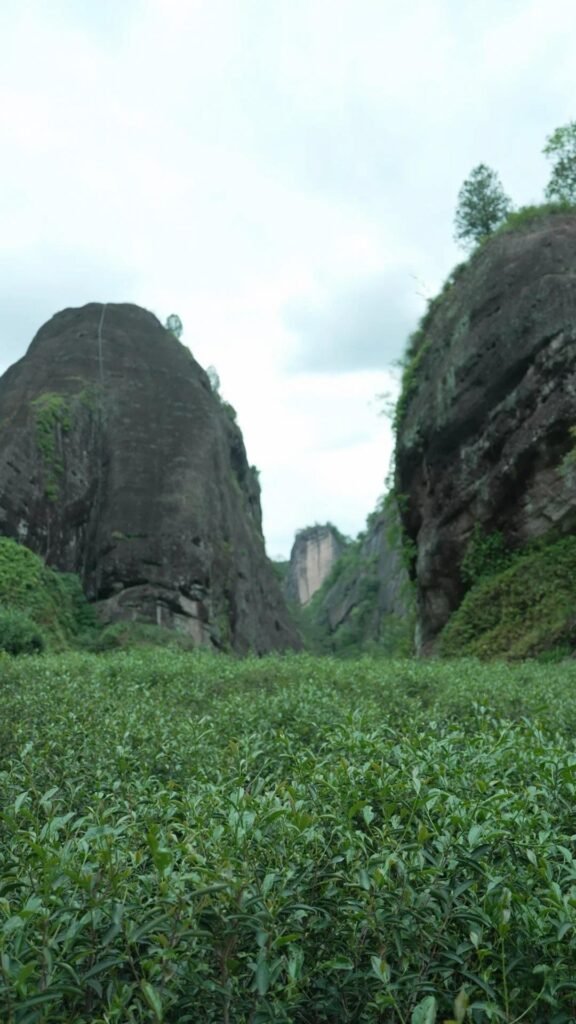
Any discussion of rock tea terroir divides the producing area roughly into three bands, based on position within the scenic core.
The scenic core is commonly given as around 70 square kilometres, though published figures vary between 69 and 72 and no official map fixes the line. Within it, the most cited sites are the san keng liang jian, the three pits and two streams: Huiyuan Pit, Niulan Pit, Dakeng Mouth, Liuxiang Stream and Wuyuan Stream.
The surrounding area covers gardens outside the core but still within Wuyishan, grown in similar conditions without the specific valley microclimates.
River-edge plots sit on alluvial flats near water, where the soil is deeper, sandier and faster-draining, and where the tea generally comes out thinner and less structured.
None of these bands has a legal definition. What they describe, however, is a real environmental gradient, and the gradient is what produces the difference.
Pits, Slopes and Why Position Matters
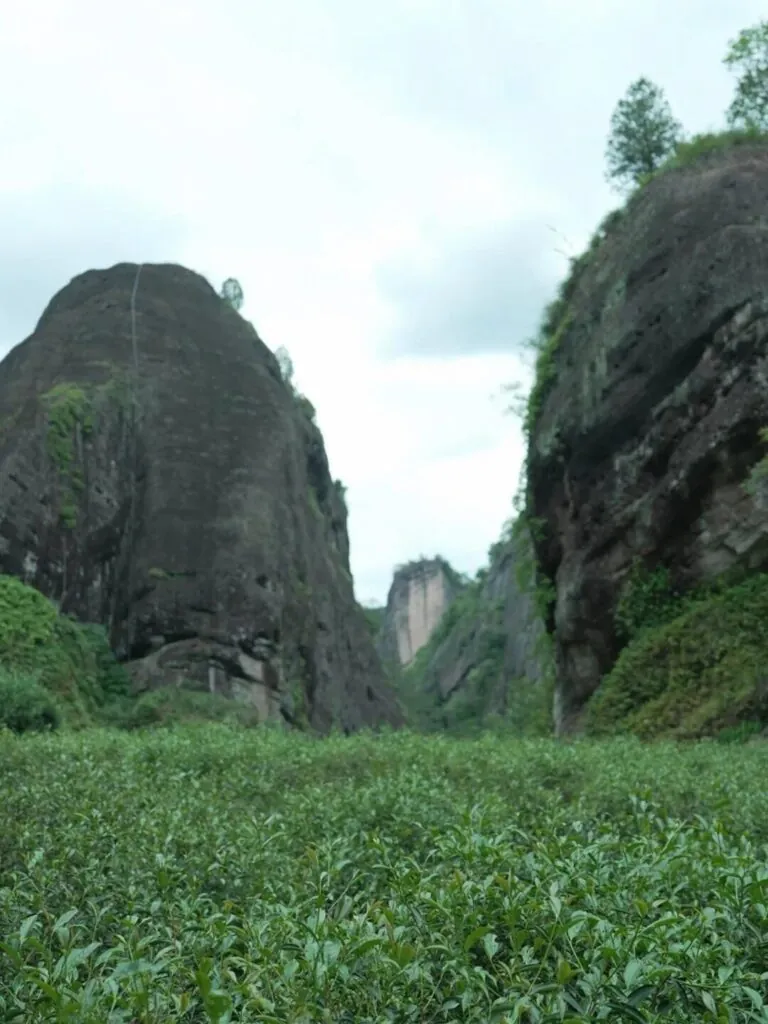
This is where rock tea terroir stops being a label and becomes a mechanism. A tea garden in a valley and one on an exposed slope, a few hundred metres apart and at the same altitude, produce different leaf. The mechanism is mostly sunlight hours and humidity.
A pit is a concave landform. It receives direct sun for only part of the day; Niulan Pit is often described as getting fewer than four or five hours of direct light in a day. It stays humid, the air moves slowly, and the soil is a gravelly loam with relatively high potassium and manganese. The leaf that grows there is typically thicker, with a denser structure and a more restrained aroma.
A slope is convex. It gets full sun, dries faster, and produces leaf that is more aromatic and more forward, sometimes with a sharper edge. Matou Rock, the exposed site most associated with Rougui, is the reference for this type.
Neither is better in the abstract, and this is where the market’s shorthand gets sloppy. Pits and slopes give different teas, and a drinker may prefer one over the other for reasons that have nothing to do with price.
What the Chemistry of Rock Tea Terroir Shows
The rock tea terroir claim has been tested, and the result is more specific than the marketing language suggests.
A 2025 study compared authentic core-area material against outside material across 137 samples. It identified a set of marker compounds that discriminated the two groups with 99 percent accuracy: hotrienol, dihydroactinidiolide, benzyl alcohol and trans-nerolidol.
That is a striking result. It means the difference between core material and outside material is not merely a matter of reputation; it has a chemical signature that can be measured. What the study does not do is tell you that any particular tin is authentic, because running the analysis is not part of ordinary commerce.
A separate line of work found that the “regional aroma” quality correlates with phosphorus levels. Across 350 gardens and 3,500 samples, high phosphorus significantly reduced the key aroma compounds. That gives a plausible mechanism: soil mineral composition shapes the aroma profile, and the valleys and slopes differ in their soils.
Mineral element and stable isotope analysis has also been used to discriminate production areas, which is the technique behind any serious origin-verification effort.
Decoding the Market Slang
Rougui from named gardens is sold under a set of nicknames that outsiders find baffling and insiders use casually.
| Nickname | Meaning |
|---|---|
| Niurou (beef) | Rougui from Niulan Pit |
| Marou (horse) | Rougui from Matou Rock |
| Xintourou (heart meat) | Rougui from Tianxin Rock |
| Longrou (dragon) | Rougui from Jiulongke |
| Hurou (tiger) | Rougui from Huxiao Rock |
| Guirou (ghost) | Rougui from Guidong |
None of these terms has a definition in any standard. They are trade slang, and their value in the market is exactly the problem: a nickname can add more to a price than a better roast would.
The Rock Tea Terroir Verification Problem
Here is the uncomfortable arithmetic. A single famous pit produces a small quantity of finished tea each year. The volume of tea sold under that pit’s nickname is much larger. Both statements are widely accepted within the trade, and together they mean a significant share of garden-named tea is not from the garden named.
Documented practices include moving outside leaf into the core area to be processed, and mislabelling the garden. Another is selling ordinary material under a famous name at a price that seems plausible rather than absurd.
What you can do about it is limited but not nothing.
Check price plausibility. A famous-pit nickname at a price far below the market is not a bargain. The economics do not allow it.
Buy from sellers who name the garden and the producer. Specificity is not proof, but vagueness is a signal.
Taste across gardens. If two teas carrying different famous nicknames taste identical, at least one is not what it claims.
Prefer a specific tea to a famous name. A well-made tea from an unnamed garden in the core area is usually better value than a mediocre tea carrying a celebrated label.
Altitude, and Why It Is Not Rock Tea Terroir
One more correction. “High mountain” and “proper rock” are not the same thing and cannot be ranked against each other.
High-mountain rock tea is grown at around 800 metres, which in Wuyishan generally means outside the scenic core. It is a legitimate category with its own character: cooler, slower growth, often a softer cup. But it is not zhengyan material, and a listing that uses “high mountain” to imply core-area status is conflating two different claims.
Altitude is also only a proxy for what actually matters, which is slow growth. A well-managed lower garden can produce better leaf than a badly managed high one. Treat elevation as a starting point rather than a guarantee.
Reading a Garden Name on a Label
A garden name is the least structured piece of information on a rock tea label. It is worth knowing which forms of it carry more weight than others.
A generic famous name — “Zhengyan Rougui”, with no further detail — says almost nothing. It places the tea in a reputed band without identifying a garden, and there is no way to test the claim.
A named garden — “Matou Rock”, “Niulan Pit” — is more specific and therefore more falsifiable, which is a modest improvement. A producer who names a site is usually prepared to be asked about it.
A named garden plus a producer is the strongest form short of laboratory analysis. It creates a chain of accountability: the name attaches to a specific operation rather than to an anonymous tin.
What no label can do is prove the claim inside the shop. Rock tea terroir sits in an awkward position: real enough to matter, claimed often enough to be unreliable, and unverifiable at the point of sale.
What Terroir Costs
The price gap between bands is large, and it is worth understanding what part of that gap is terroir and what part is narrative.
Three things contribute. The first is genuine scarcity: a famous pit produces a small absolute quantity, and scarcity has a price regardless of quality. The second is measurable difference: as the chemistry shows, core material does taste different, so some of the premium is buying a real distinction. The third is market weight, and this is the largest and least defensible component. A nickname can command multiples over a neighbouring site with comparable tea because buyers recognise the name and not the flavour.
For a drinker, the practical consequence is that the premium is worth paying only if you can taste the difference yourself. Buy a small quantity of a famous-garden tea and a small quantity of a well-made unnamed one at a fraction of the price, and compare them blind. If you cannot separate them, the premium is buying something other than flavour.
That test costs one tasting session and settles a question that no amount of reading about rock tea terroir will answer for you.
Frequently Asked Questions
Is zhengyan a legal classification?
No. It is industry shorthand with no definition in GB/T 18745. The standard defines only the geographical indication area, which is the whole of Wuyishan. The 2002 edition had a zone division; the 2006 revision removed it.
What are the three pits and two streams?
A trade grouping of five core sites: Huiyuan Pit, Niulan Pit, Dakeng Mouth, Liuxiang Stream and Wuyuan Stream. Some lists substitute Daoshui Pit for Liuxiang Stream, which is the same water system under a different name.
Can rock tea terroir be verified?
Chemically, yes: marker compounds discriminate core from outside material with high accuracy in research settings. Commercially, no: the analysis is not routine, so a garden name remains a claim.
Is high-mountain rock tea the same as zhengyan?
No. High-mountain tea is grown around 800 metres, generally outside the scenic core. It is a real category, but it is a different claim from core-area status.
Why is Niulan Pit Rougui so expensive?
Because the pit is small, the output is limited, and the nickname carries market weight. The leaf does have distinctive character, but the price also reflects scarcity and narrative rather than quality alone.
What This Means When You Buy
Three practical conclusions follow from everything above about rock tea terroir.
Treat the word zhengyan as a style signal, not a guarantee. It tells you roughly what kind of tea the seller is aiming at. It does not tell you where the leaf grew.
Ask for the garden and the fire level together. Either one alone is weak. A named garden with no fire level is a marketing claim; a fire level with no garden name is a style description. Both together are the minimum for an informed purchase.
Price the tea you can taste. The most reliable route through the rock tea terroir question is comparative tasting rather than label reading. Two small tins and an evening will teach you more than any article, including this one.
Shop the rock teas in this guide
Sold directly from our own stock. Every listing states the cultivar, the garden and the fire level.
- Matouyan Rougui, Wuyishan zhengyan — $23.90
- Liuxiangjian Rougui, Wuyishan zhengyan — $49.90
- Jiulongke Rougui, Wuyishan zhengyan — $23.90
Or browse the full rock tea collection.
Related Reading
Rougui, the cultivar most sold by garden, what terroir costs and the category as a whole.
Sources & References
Standards
Standard numbers and dates can be verified at China’s national standards platform: openstd.samr.gov.cn.
- GB/T 18745-2006 — Geographical indication product: Wuyi rock tea. Chapter 3 defines the area as the Wuyishan administrative region; no sub-zone division.
- GB 18745-2002 — The earlier edition, which did divide production into a famous-rock zone and a red-rock zone.
Peer-Reviewed Research
- Food Chemistry: X (2025). Marker compounds discriminating core-area rock tea: hotrienol, dihydroactinidiolide, benzyl alcohol, trans-nerolidol; 137 samples, 99% accuracy. DOI:
10.1016/j.fochx.2025.103194 - DOI: 10.1360/ssv-2021-0140 — Phosphorus levels and regional aroma; 350 gardens, 3,500 samples.
- Journal of Chemistry (2017). Mineral elements and stable isotopes for origin discrimination. DOI:
10.1155/2017/5454231
What this page does not claim
We do not claim zhengyan is a legal term, that a garden name can be verified from a tin, or that one site is better than another. Where the trade uses undefined words, the page explains what they point at rather than pretending they are precise.
