
Wuyi Rock Tea (Yan Cha): What It Is and Why It Costs So Much
Wuyi rock tea is an oolong from the Wuyi Mountains in northern Fujian. The law defines it narrowly: clonal cultivars, grown inside the Wuyishan administrative area, processed the traditional way, and carrying a quality the standard calls yan yun, rock rhyme.
It is also one of the most expensive tea categories in the world, and one of the most frequently misdescribed.
This page covers what the definition actually requires, what rock rhyme is and is not, why prices span three orders of magnitude, and where to start. The deeper topics each have their own page, linked as they come up.
Table of Contents
The Legal Definition
Wuyi rock tea is governed by a single national standard, GB/T 18745. There is no part one and part two. The multi-part standard people sometimes cite is GB/T 30357, which covers oolong tea generally and is a different document.
The current version is GB/T 18745-2006, Geographical indication product: Wuyi rock tea. A revised version, GB/T 18745-2026, was published in March 2026 and takes effect on 1 April 2027. Until then, the 2006 text governs.
The 2006 definition is worth quoting because it is unusually specific:
Wuyi rock tea is an oolong made from suitable tea cultivars, propagated clonally and cultivated within the unique natural ecological conditions of the Wuyi Mountains as defined in Chapter 3 of this standard, using the distinctive traditional processing method, and possessing the quality characteristic of yan yun (rock rhyme).
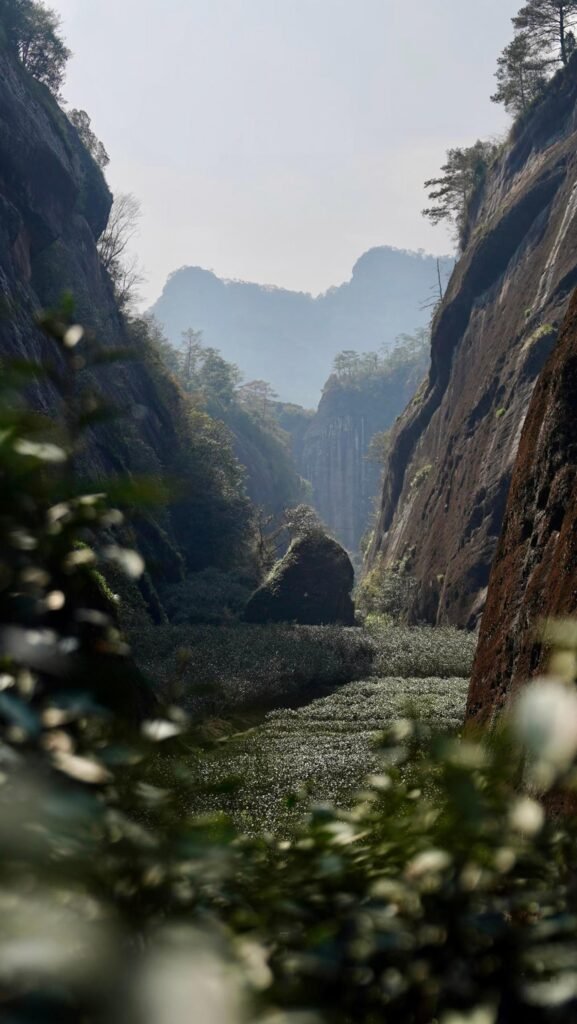
Three things in that definition do real work. Clonal propagation rules out seed-grown material, which is why the related category qi zhong sits outside it. The defined area is the whole of Wuyishan’s administrative territory, not a smaller core zone. That point is worth returning to. And yan yun is written into the definition as a required quality, not a marketing flourish.
What Rock Rhyme Actually Means
Rock rhyme is the phrase every seller uses and almost nobody defines. The standard does not define it either. It appears in the definition of the product and in the sensory requirements, but there is no separate clause explaining what it is. That is not laziness; it reflects that the term is a tasting judgement rather than a measurement.
The phrase behind it is yan gu hua xiang — rock bone, flower fragrance. “Bone” refers to structure: a mineral, savoury depth that sits under the aroma and persists after the fruit and floral notes have gone. “Flower” is the aromatic layer on top. A tea with fragrance but no bone is described as thin; a tea with bone but no fragrance as flat.
Historically the term has been described rather than defined. The Qianlong emperor’s line about Wuyi tea, “clear and harmonious in flavour, with bone”, is the version most often quoted. The Qing scholar Liang Zhangju’s four characters, fragrance, clarity, sweetness and liveliness, are still used as a tasting framework.
What can be measured is the chemistry behind it. A 2025 study comparing authentic core-area rock tea against outside material identified a set of marker compounds that discriminated the two groups with 99% accuracy across 137 samples: hotrienol, dihydroactinidiolide, benzyl alcohol and trans-nerolidol. That does not mean those four compounds are rock rhyme, but it does mean the sensory difference has a chemical signature rather than being pure suggestion.
The Area, and the Words That Are Not in the Standard
Here is the correction that matters most for buyers. The words zhengyan (proper rock), banyan (half rock) and zhoucha (river tea) are not in the national standard. They are industry shorthand.
The 2002 edition of the standard did divide production into a “famous rock” zone inside the scenic area and a “red rock” zone outside it. The 2006 revision removed that division entirely and kept only the geographical indication area, which is the whole of Wuyishan. So a tea labelled zhengyan is making a claim the standard does not define, and the boundaries are set by convention rather than law.
The convention itself is well understood within the trade. The scenic core is commonly given as roughly 70 square kilometres, though published figures vary between 69 and 72 and no official boundary exists. Within it, the most cited sites are the san keng liang jian — three pits and two streams: Huiyuan Pit, Niulan Pit, Dakeng Mouth, Liuxiang Stream and Wuyuan Stream. These are valleys: short sunlight, high humidity, gravel soils rich in potassium and manganese. The opposite terrain, the exposed slopes at Matou Rock, gives hotter, more aromatic leaf. River-edge plots give thin, flat tea.
None of that is disputed. What is disputed is where the line falls, and no standard settles it. Rock tea terroir covers the sites in detail.
The Five Categories
The standard divides Wuyi rock tea into five product categories, and this part is legally defined:
| Category | What it means |
|---|---|
| Da Hong Pao | Blended from the semi-finished leaf of several clonal cultivars, then bulked and blended. This is the 2026 definition, and it surprised many drinkers |
| Mingcong | Clonal material from a single selected bush or single cultivar, excluding Rougui and Shui Xian |
| Rougui | Made from the Rougui clonal cultivar |
| Shui Xian | Made from the Shui Xian clonal cultivar |
| Qizhong | Made from seed-grown Wuyi cai cha — the population variety |
Two things follow that surprise people. First, Da Hong Pao is legally a blended product, not a single-bush tea. Second, Qizhong is defined by being seed-grown, which is the opposite of the clonal requirement everywhere else. The full treatment, including the mother trees and the mingcong question, is in the five categories of Wuyi rock tea.
Why It Costs What It Costs
Wuyi rock tea is the most labour-intensive tea category in China, and the process explains most of the price.
It is a heavily oxidised oolong, withered and then alternately shaken and rested through five to eight rounds over seven to nine hours until the leaf edges redden. That is the step that builds the aroma. Then it is fired, and then roasted over charcoal. That second step is the one outsiders underestimate. Traditionally it runs in two or three passes, with the final low-temperature pass lasting hours.
Roasting is slow, skilled and risky: over-fire and the tea is ruined, under-fire and it is thin and green. A controlled study of charcoal roasting found that 12 hours at 120 °C was the working window, with sensory quality peaking around ten hours and declining after.
How rock tea is made covers the process and the chemistry, including what roasting actually creates.
Roast Levels, and Why They Matter
Rock tea is sold by fire level, and the label is one of the few pieces of information that genuinely predicts what the cup will be like.
Light fire keeps more of the floral and fruit aromas but leaves the tea with less structure and a shorter finish. Medium fire is the commercial centre of gravity: enough roast to build the savoury base without burying the aroma. Full fire produces the darkest, most mineral style, and it needs the longest rest before drinking.
Fire level also determines how long a tea should sit before it is sold. Newly roasted rock tea is harsh and carries a burnt edge that the trade calls fire qi. A controlled study on resting found that light-fire tea reached its sensory peak at about six months and medium-fire at about eight. Over twelve months of storage the same teas lost roughly a fifth of their polyphenols and catechins, and 13 to 18 percent of their caffeine.
That is the practical argument against drinking rock tea the week it arrives. The roast needs time to settle into the leaf. See resting rock tea for timings by fire level.
How to Drink It
Rock tea is brewed hot and fast, in small vessels. The professional tasting standard, GB/T 23776-2018, uses 5 g of leaf in 110 ml of boiling water and three infusions of two, three and five minutes. The second infusion is the primary judgement.
For drinking rather than assessing, most people use a gaiwan at 7 to 8 g per 110 ml, boiling water, and very short first infusions of five to ten seconds, lengthening each round. A good rock tea will run eight to ten infusions and change as it goes.
One habit worth dropping: the idea that the first infusion must be poured away. In Wuyi the traditional practice is the opposite: the first steep is kept aside as huan hun tang, the returning-soul soup, and drunk at the end. Research on rinsing does show it removes a measurable fraction of pesticide residue, so rinsing is defensible on those grounds, but it is not a Wuyi tradition and it does cost flavour. Rock tea brewing has the detail.
Caffeine
Rock tea contains less caffeine by dry weight than green tea, Tieguanyin or black tea. Measured values sit at 18 to 23 mg per gram across roast levels, about 2.3% of dry weight, and roasting does not meaningfully change the figure.
A 5 g session therefore holds roughly 90 to 115 mg in total, of which perhaps 40 to 70 mg reaches a given cup depending on steep time. Figures and method are in rock tea caffeine.
Where to Start
If you have not drunk rock tea before, the sensible entry point is a medium-fire Rougui or Shui Xian rather than Da Hong Pao. Rougui gives you the category’s signature aroma immediately and is hard to mistake; Shui Xian is rounder and more forgiving of a careless brew. Da Hong Pao carries the highest price expectation and the most ambiguous definition, which makes it a poor first purchase.
Buy in small quantity and from a seller who states the cultivar and the fire level. Those two facts predict more about the cup than the mountain name on the front, and unlike the mountain name they can be checked.
Frequently Asked Questions
Is Wuyi rock tea a black tea?
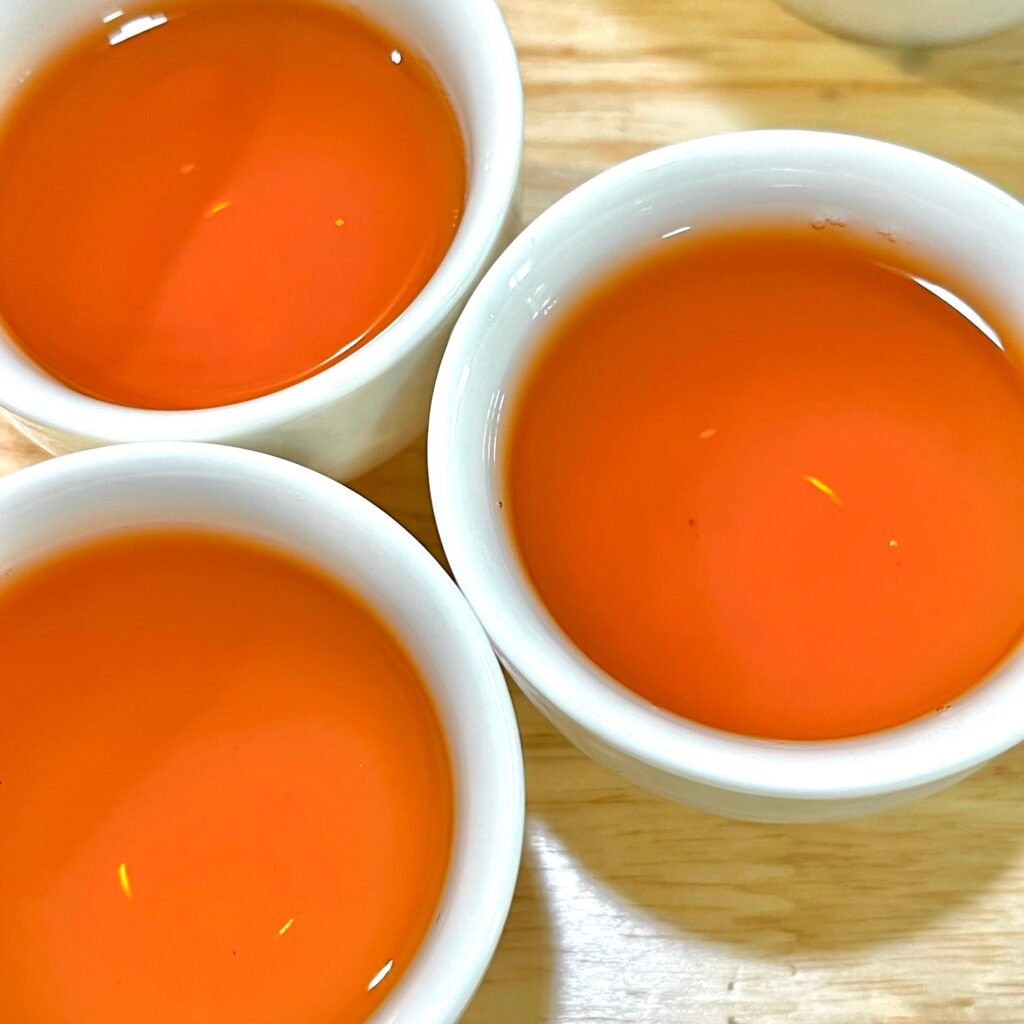
No. It is an oolong, partially oxidised and then fired and roasted. The liquor is amber to deep orange rather than red, and the flavour is roasted and mineral rather than malty.
What does “rock rhyme” taste like?
A mineral, savoury depth under floral and fruity aromas, which persists after the top notes fade. It is a structural quality rather than a flavour you can name in one word, which is why the term has stayed vague for three centuries.
Is zhengyan a legal classification?
No. It is industry shorthand with no definition in the national standard. The standard defines only the geographical indication area, which is the whole of Wuyishan.
Why is Da Hong Pao so expensive if it is a blend?
Because the mother trees are unobtainable, having stopped being picked in 2006, and the name carries three centuries of reputation. The blended product is the legal category, and its price reflects the quality of the material blended into it rather than a single bush.
How should I store it?
Sealed, dry, dark, at 25 °C or below and 50% relative humidity or below. Those are the limits GB/T 30375-2013 sets for oolong. Roasted tea also needs time to settle before drinking; see resting rock tea.
Shop the rock teas in this guide
Sold directly from our own stock. Every listing states the cultivar, the garden and the fire level.
- Wuyi Shui Xian, 38-year-old bush reserve — $9.90
- Wuyi Rougui from Taoyuan Ke, 2026 — $10.90
- High Mountain Da Hong Pao, 2026 — $9.90
Or browse the full rock tea collection.
Related Reading
the five legal categories, how the leaf is made, why zhengyan is not a legal term and what the price bands mean.
Sources & References
Standards
- GB/T 18745-2006 — Geographical indication product: Wuyi rock tea. Definition in 4.1; five product categories in 5.1; grades; sensory and physical requirements.
- GB/T 18745-2026 — Geographical indication product quality requirements: Wuyi rock tea. Published 2026-03-31, effective 2027-04-01.
- GB/T 23776-2018 — Tea sensory evaluation. Oolong brewed at 5.0 g per 110 ml, boiling water, 2/3/5 minutes.
- GB/T 30375-2013 — Tea storage. Oolong at ≤25 °C and ≤50% relative humidity.
Peer-Reviewed Research
- Food Chemistry: X (2025). Marker compounds discriminating authentic core-area Wuyi rock tea, 137 samples, 99% accuracy. DOI:
10.1016/j.fochx.2025.103194 - Journal of Food Composition and Analysis (2024). Charcoal roasting of rock tea: 120 °C, 12 hours, sensory optimum at 10 hours. DOI:
10.1016/j.jfca.2024.106662 - RSC Advances (2020). Caffeine content of rock tea across roast levels, 18–23 mg/g. DOI:
10.1039/d0ra09703a - Journal of Agricultural and Food Chemistry (2019). Effect of rinsing on pesticide transfer and catechin loss. DOI:
10.1021/acs.jafc.8b04908
Industry Data
- Wuyishan tea production 2024: 30,100 tonnes of dry rough tea, 14.8 million mu of tea gardens. Wuyishan Municipal Tea Industry Development Centre.
What this page does not claim
We do not claim zhengyan is a legal term, that rock rhyme has been chemically defined, or that price reflects quality in any predictable way. Where the standard is silent, we say so rather than inventing a rule.


6 Comments