
Rock Tea Processing: How the Leaf Is Shaken and Roasted
Rock tea processing is really two processes wearing one name. The first is an oolong fermentation that builds aroma and colour. The second is a charcoal roast that builds structure and changes almost everything the first step produced. Understanding that split explains most of what makes Wuyi tea taste like Wuyi tea.
What follows covers the full sequence, what the two critical stages do chemically, and why the second is the reason you cannot drink most rock tea the month it is finished.
Table of Contents
The Rock Tea Processing Sequence
The full rock tea processing run is: withering, shaking and resting, kill-green, rolling, drying, sorting, and roasting. The standard requires the traditional method but does not prescribe process parameters in detail. The numbers below therefore come from industry practice and the research literature rather than from a clause in GB/T 18745.
| Stage | What happens |
|---|---|
| Withering | Leaf loses moisture and becomes pliable, setting up the next stage |
| Shaking and resting | Repeated cycles over several hours; leaf edges bruise and oxidise |
| Kill-green | Heat stops the enzymes and fixes the aromatic profile |
| Rolling | Shapes the leaf and expresses juice |
| Drying | Removes most moisture; the tea is now semi-finished |
| Roasting | Charcoal, in two or three passes, over hours or days |
Sorting and blending happen between drying and roasting, which is the detail that matters for blended products: components are combined before the final fire so the roast can unify them.
The Critical Stage: Shaking and Resting
This is the stage of rock tea processing that decides whether the tea has aroma at all, and it is the one most often described vaguely. It runs through five to eight cycles over roughly seven to nine hours, with the leaf held at about 22 to 26 °C and 70 to 80 percent humidity. Shaking is progressively longer and harder with each round; resting between shakes is progressively longer too.
The judgement is visual and olfactory. Growers look for lü ye hong xiang bian, green leaf with a red border, and wait for the raw, green smell to turn into fruit and flowers. Those are the signals, not a clock. A batch that reaches the right colour too fast is over-oxidised and will be flat; one that never reddens is under-oxidised and will be grassy.
What is happening chemically is a controlled wound response. Bruising the leaf edges breaks cells and lets enzymes meet substrates, which starts oxidation. But the plant also responds to wounding and water loss as a living system, activating the lipoxygenase and mevalonate pathways. The result is a rise in compounds that did not exist in the fresh leaf: nerolidol, jasmine lactone, methyl jasmonate, indole and phenylacetaldehyde all increase while the green-smelling volatiles fall.
That is the chemical definition of qu qing xian xiang, and it is the reason this stage cannot be faked in later rock tea processing — removing the green and revealing the fragrance. It also explains why this stage cannot be shortcut with heat or chemistry: it depends on the leaf being alive and stressed in a particular way.
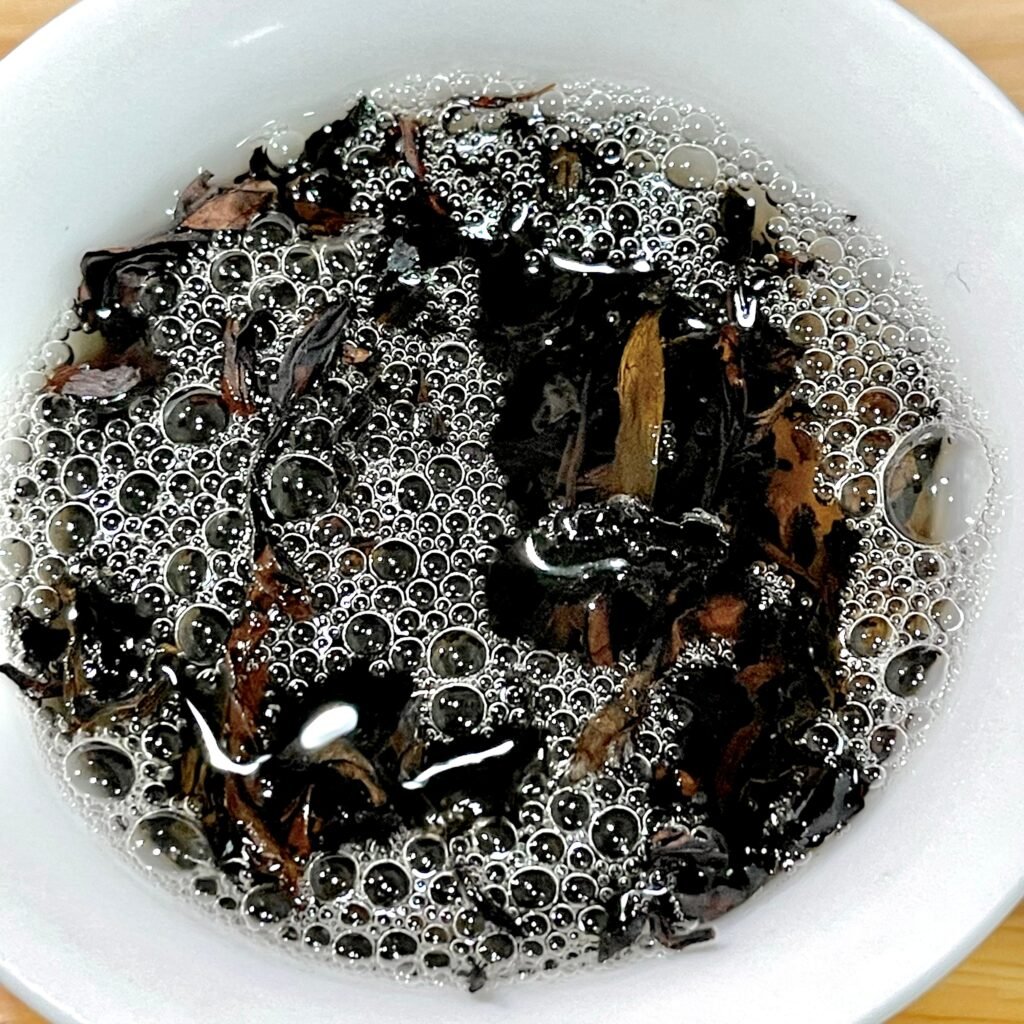
How Much Oxidation
Rock tea processing produces a heavily oxidised oolong, and the figure is worth having.
A metabolomic study following the full process found that roughly 78% of the flavan-3-ols — the catechin family — were consumed during the oxidation stage and converted into theaflavins and related products. Flavonols, phenolic acids and the xanthine alkaloids stayed essentially stable.
Two consequences follow. First, tea polyphenols decline substantially through processing, which is why the finished-product minimum in the 2026 standard is 12 percent rather than the 18 to 20 percent sometimes quoted for fresh leaf. Second, caffeine is barely affected: the xanthine alkaloids are stable across the whole process, which is why roast level does not change caffeine content.
That last point is worth stating plainly because the opposite is widely assumed. Measured caffeine in rock tea sits at 18 to 23 mg per gram across light, medium and full fire, with no consistent trend.
Roasting, the Stage That Changes Everything
If oxidation builds the aroma, roasting builds the tea. It is also the stage of rock tea processing where most of the risk lies.
Roasting is done over charcoal, traditionally in two or three passes. The first is at higher heat to drive off moisture and set the leaf; later passes run cooler and longer. The final stage, called dun huo or eating fire, is a low-temperature hold that can run for many hours and is finished by packing the tea while still warm.
Industry temperature ranges run broadly from 70 to 140 °C depending on the pass and the producer. A controlled study that sampled every two hours during a 12-hour roast at 120 °C found sensory quality peaked at about ten hours and declined after that. That gives a concrete sense of the window: longer is not automatically better, and the difference between good and over-fired is measured in hours.
The chemistry of roasting is a Maillard reaction between the leaf’s own amino acids and sugars. A 2025 study using isotope labelling traced the nitrogen in the resulting pyrazines to alanine and most of the carbon to glucose, with the leaf matrix contributing a further share. Fifteen odour-active compounds were identified, including three alkylpyrazines, furfural and 5-methylfurfural, several with odour activity values above one.
Those compounds read as roasted, nutty and woody. At low concentration they sit under the cultivar aroma and add depth; at high concentration they cover it. That is the whole argument about fire level in one sentence.
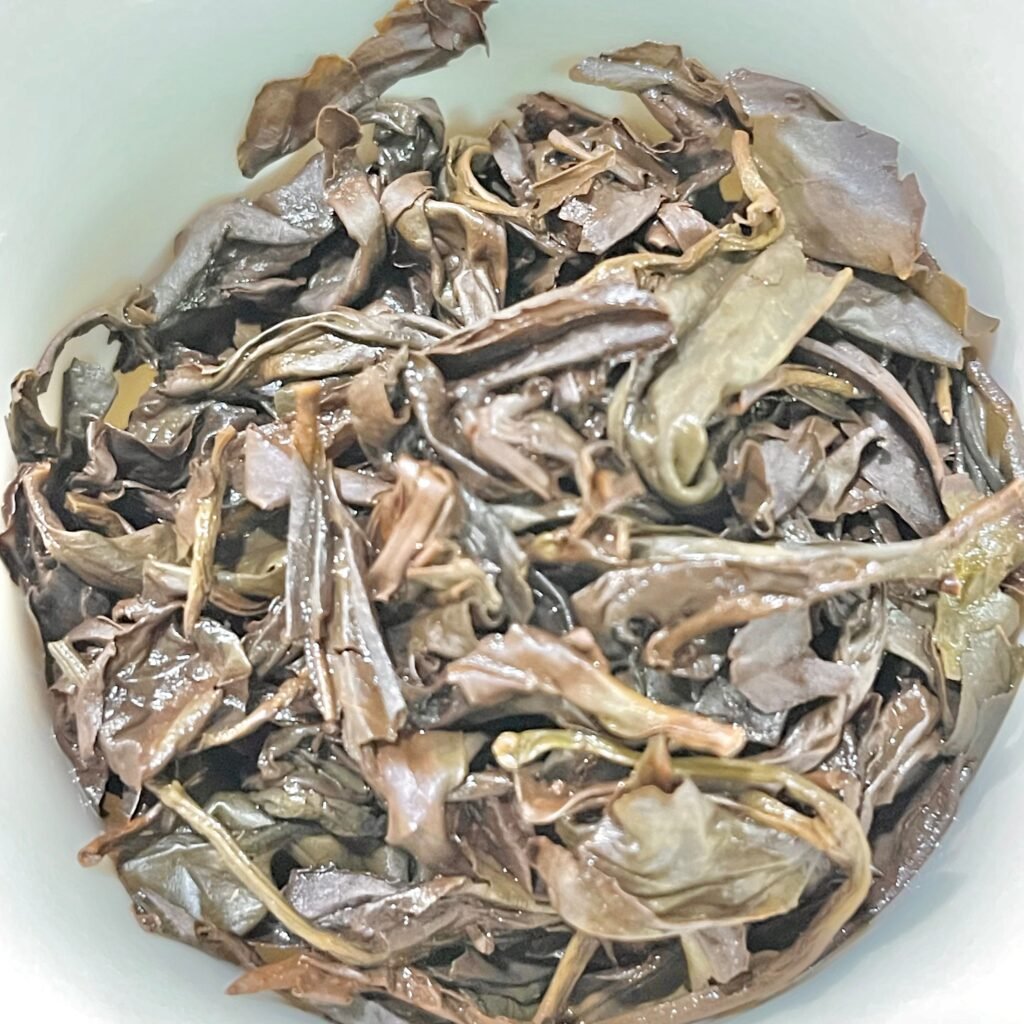
Fire Levels, and How Rock Tea Processing Varies
Three broad bands are used commercially, and the choice shapes everything downstream in rock tea processing.
Light fire preserves the floral and fruit aromatics and produces a tea that is ready to drink relatively soon. It is the style that shows a cultivar most clearly, which makes it useful for comparison and less useful for aging.
Medium fire is the commercial centre. Enough roast to build a savoury base without burying the aroma, and the band where most Rougui and Shui Xian sits.
Full fire produces the darkest, most mineral style. It requires the longest rest, and it can hide indifferent material, which is why heavy roast is the most common shortcut in the category.
Fire level is not a quality scale. A light-fire tea and a full-fire tea are different products, and judging one by the other’s standard tells you nothing.
Why It Cannot Be Drunk Immediately
The final consideration in rock tea processing is time. Newly roasted tea carries what the trade calls fire qi — a burnt, sometimes acrid edge that dominates the cup. It fades with storage, and the process is called tui huo, returning fire.
A controlled study measured the curve. Light-fire tea reached its sensory peak at about six months and medium-fire at about eight. Over twelve months the same teas lost roughly a fifth of their polyphenols and catechins, and 13 to 18 percent of their caffeine. That is a meaningful loss, and it argues against over-resting as much as against drinking too early.
The practical implication is that a rock tea has a window, not just a date. Resting rock tea sets out the timings by fire level and what changes in the cup.
What Goes Wrong
Four failures account for most bad rock tea, and each traces to a specific stage.
Under-oxidised leaf. The shaking cycles were too few or too gentle, so the leaf never reddened properly. The tea tastes grassy, thin and slightly raw however well it is roasted. This is the most common fault in cheap rock tea processing, because the stage is labour-intensive and time-bound.
Over-oxidised leaf. The opposite failure, usually from warm weather or a batch left too long between shakes. The tea loses the brightness that oxidation is supposed to build and turns dull. It is harder to spot than under-oxidation because it does not taste actively bad, just flat.
Under-fired tea. Roasting stopped too early leaves the cup thin with a green edge, and the tea will not keep. This is the failure most often passed off as a light-fire style. The difference is that genuine light fire is balanced and clean, while under-fired tea is merely unfinished.
Over-fired tea. Too much heat or too many hours, and the pyrazines and furfurals bury the cultivar completely. The cup reads as char and little else. Because heavy roast masks indifferent material, over-firing is the fault most often committed deliberately.
The common thread is that all four are judgement failures at a live stage of rock tea processing, not equipment failures. That is why the same cultivar from the same garden can produce very different tea in different hands.
Frequently Asked Questions
How long does rock tea processing take?
The primary processing — withering through drying — runs one to two days, with the shaking and resting cycles alone taking seven to nine hours. Roasting then adds days to weeks depending on the number of passes and the fire level, and the tea is usually rested for months before sale.
Is rock tea fermented?
It is oxidised, not fermented in the microbial sense. The shaking stage lets leaf enzymes react with oxygen. No microorganism is involved, which distinguishes it from pu-erh.
Does roasting change caffeine?
No, in any meaningful way. Measured values are 18 to 23 mg per gram across light, medium and full fire with no consistent trend, because the xanthine alkaloids are stable through processing.
Why does rock tea taste burnt when it is new?
Fire qi from the roast. It fades over months of storage. Light-fire tea settles in about six months, medium-fire in about eight.
What is the difference between light and full fire?
Light fire keeps cultivar aroma forward and produces a fresher cup. Full fire suppresses aroma and builds a darker, mineral profile. They are styles, not grades.
How It Differs From Other Oolongs
Rock tea processing differs from other Chinese oolongs in two places: how far oxidation runs, and how much fire is applied afterwards.
Strip-style oolongs from Anxi, such as Tieguanyin, are typically oxidised lightly, in the range of 15 to 25 percent, and fired gently or not at all, because the goal is a green, floral cup. Rock tea runs much further, closer to 60 to 70 percent oxidation by the leaf-edge convention, and is then charcoal roasted for hours or days. The two products are not variations on one method; they are opposite ends of the same continuum pulled in different directions.
Phoenix dancong sits between them. It is oxidised lightly like Anxi oolong but roasted, sometimes heavily, to stabilise aroma. Where dancong uses roast to preserve a single-bush aroma, rock tea uses roast to build structure and to bind several components together.
That difference is why roasted rock tea improves over months while light oolongs are best fresh. The roast is not a defect to be waited out in one case and a defining feature to be developed in the other.
Shop the rock teas in this guide
Sold directly from our own stock. Every listing states the cultivar, the garden and the fire level.
- Wuyi Rougui from Taoyuan Ke, 2026 — $10.90
- High Mountain Da Hong Pao, 2026 — $9.90
Or browse the full rock tea collection.
Related Reading
why it cannot be drunk immediately, the five categories and the category as a whole.
Sources & References
Standards
- GB/T 18745-2006 — Geographical indication product: Wuyi rock tea. Requires traditional processing; sets product requirements rather than process parameters.
- GB/T 18745-2026 — Effective 2027-04-01. Adds water extract ≥34% and tea polyphenols ≥12%.
Peer-Reviewed Research
- Food Chemistry (2021). Metabolomic changes through the full process; ~78% of flavan-3-ols oxidised; xanthine alkaloids stable. DOI:
10.1016/j.foodchem.2021.130624 - Food Chemistry: X (2026). Wounding and water-loss response in the shaking stage; LOX-HPL and MVA pathways. DOI:
10.1016/j.fochx.2026.104185 - Journal of Food Composition and Analysis (2024). Charcoal roasting at 120 °C for 12 hours; sensory peak at 10 hours. DOI:
10.1016/j.jfca.2024.106662 - Food Chemistry (2025). Roasting aroma chemistry; alanine and glucose as pyrazine precursors. DOI:
10.1016/j.foodchem.2025.143174 - DOI: 10.3969/j.issn.2095-6002.2020.05.015 — Resting curves: light fire 6 months, medium fire 8 months; polyphenol and caffeine loss over 12 months.
Process parameters such as cycle counts, temperatures and humidity ranges are industry practice rather than a published standard; the standard requires the traditional method without specifying them.
What this page does not claim
We do not claim a single correct process, that fuller fire is better, or that roasting changes caffeine. Where a number comes from industry practice rather than a standard, the page says so.
