
Rock Tea Resting: Why New Tea Tastes Burnt, and When Not
Rock tea resting is the interval between roasting and drinking, and it is the single most neglected variable in how a rock tea tastes. A tea that is harsh, burnt or flat is very often not a bad tea. It is a tea that was drunk too soon.
This page covers why roasted tea needs to settle, how long that takes at each fire level, what changes chemically while it happens, and how to store the tea through the wait.
Table of Contents
Why Roasted Tea Needs to Rest
Charcoal roasting does two things at once. It builds the aroma compounds that give rock tea its roasted, woody depth, and it leaves the leaf in a thermally stressed state. Immediately after roasting, those roast-derived compounds dominate the cup so completely that the tea’s own character is hidden.
The trade calls this fire qi, fire breath. It reads as a burnt, sometimes acrid edge, occasionally with a metallic note, and it masks everything underneath. Nothing is wrong with the tea at that point; the roast simply has not settled into the leaf yet.
Resting is the process by which it settles. The Chinese term is tui huo, returning fire, which describes the direction accurately: the aggressive roast character recedes and the tea underneath becomes legible again.
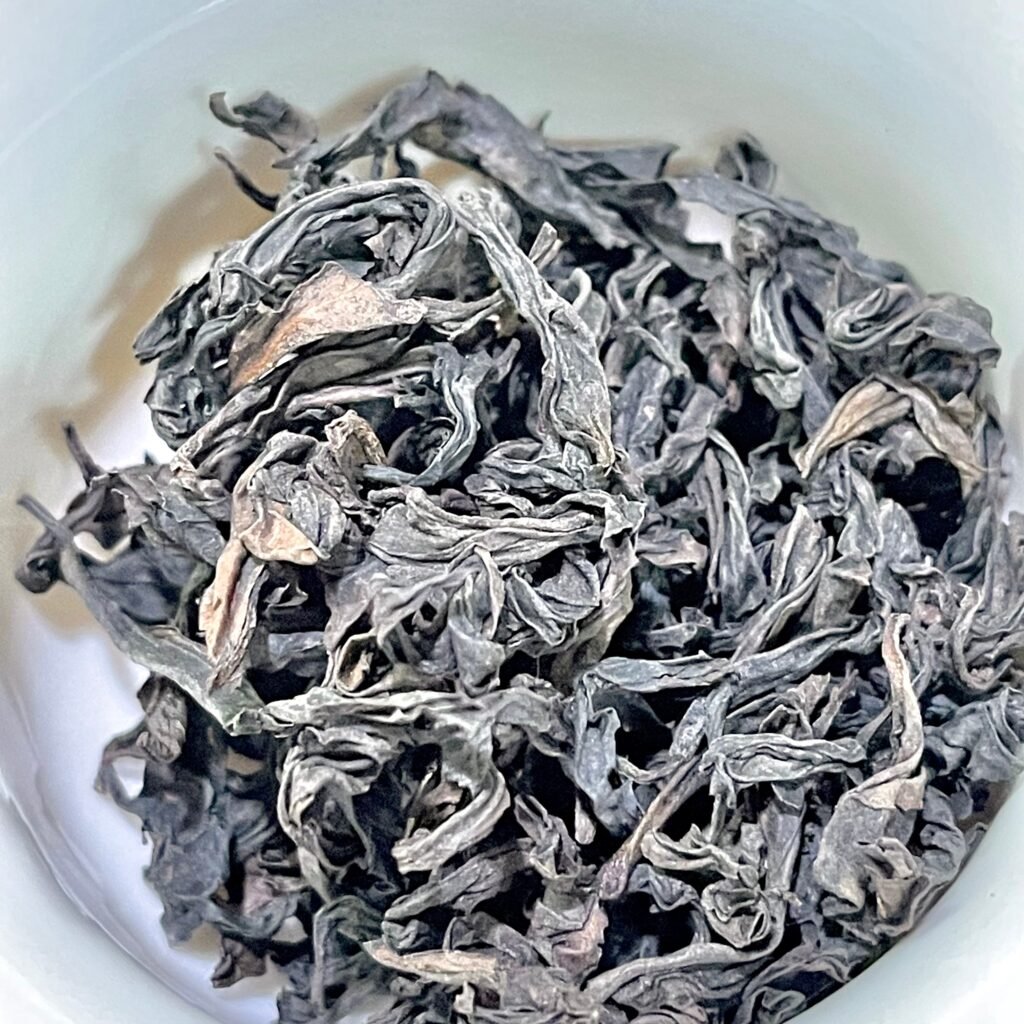
How Long Rock Tea Resting Takes
The timing for rock tea resting depends on how hard the tea was roasted, and there is measured data rather than only folklore.
A controlled study on resting tracked white tea and rock tea samples across a year. Light-fire tea reached its sensory peak at about six months after roasting. Medium-fire tea peaked at about eight months. Beyond those points, quality began to decline rather than improve.
The same study quantified the loss over twelve months of storage: tea polyphenols fell by roughly 21 percent and 19.5 percent in the two samples, catechins by 21.9 percent and 17.2 percent, and caffeine by 17.6 percent and 13.4 percent.
That last set of figures is the part most drinkers do not expect. Resting is not a free improvement; it is a trade. The harsh edge goes, and so does a fifth of the polyphenols. The skill is in stopping at the right point rather than waiting as long as possible.
| Fire level | Typical resting time | What happens if you wait too long |
|---|---|---|
| Light fire | About 6 months | Aroma fades; cup turns flat |
| Medium fire | About 8 months | Roast recedes past balance; body thins |
| Full fire | Longer, commonly 12 months or more | Loss of both roast and aroma; hollow cup |
The full-fire row is the least precise because roasting practice varies more at that end. Some producers rest full-fire tea for a year or more; others sell at nine months. The only reliable guide is tasting, which is why buying a small quantity before committing is sensible.
What Changes Chemically
Two different things are happening during rock tea resting, and separating them explains why the timing matters as much as it does.
The first is the dissipation of roast-derived volatiles. The pyrazines and furfurals that roasting creates are relatively volatile, and they decline in concentration over months. This is the fire qi leaving.
The second is slower and less welcome. Polyphenols and catechins oxidise further in storage even in sealed conditions, and free amino acids and soluble sugars decline. The tea softens and darkens, gaining what the trade calls smoothness at the cost of brightness.
Those two curves do not run at the same speed. The roast fades faster than the underlying compounds decline, which is why there is a window: a period where the fire has gone but the tea still has its structure. Before that window the tea is harsh; after it, the tea is dull. Rock tea resting is, in practice, the craft of finding that window.
How to Tell When It Is Ready
Four signals, in order of reliability.
The smell of the dry leaf. Freshly roasted rock tea smells of the roast: char, toast, sometimes a hot-metal edge. When the leaf smells of the tea rather than the fire, the roast has largely settled.
The first infusion. Too-early tea is sharp on the first steep and then improves across the session. Ready tea is balanced from the first infusion onward.
The finish. Fire qi leaves a dry, slightly burnt aftertaste that persists. When the finish turns sweet and savoury instead, the tea is ready.
The second day. Brew the same tea the next day. A tea that was harsh on day one and clean on day two is close to ready. One that is harsh both days is not.
Storing Rock Tea Through the Wait
Resting and storage are the same operation, and the conditions are not negotiable if the goal of rock tea resting is a predictable result.
GB/T 30375-2013 sets the limits for oolong at 25 °C or below and 50 percent relative humidity or below. It also advises 10 °C or below for teas finished over a low fire, which is a stricter requirement than most domestic storage meets.
In practice: sealed, opaque, away from strong smells, and not in the refrigerator unless vacuum-sealed. Roasted tea is hygroscopic and picks up odours readily, and condensation from fridge cycling is the fastest way to ruin a batch.
For rock tea resting, a simple approach is to buy in small tins and open one at a time. A large tin opened and closed for a year will have stale tea at the bottom long before it is finished.
Resting and Aging Are Not the Same Thing
The two are often conflated, and they answer different questions.
Rock tea resting is measured in months and its purpose is to remove fire qi. It is a settling process, and the endpoint is the tea tasting as intended.
Aged rock tea is measured in years and its purpose is transformation. The chemistry is different: research on a decade of stored rock tea found gallic acid 166 to 168 percent higher than in new tea, with catechins moving in both directions rather than declining uniformly.
In the cup, aged rock tea is less aromatic, more savoury, and often described as medicinal or woody. Whether you prefer it is a matter of taste. It is not simply better-rested tea; it is a different drink.
A separate study on Shui Xian identified 29 compounds that could serve as year markers, which means the aging trajectory is measurable. Shui Xian tea covers that cultivar’s aging behaviour in more detail.
Three Mistakes in Rock Tea Resting
Drinking it the week it arrives. The most common error, and the easiest to fix. If a rock tea tastes burnt, put it away for a month and try again.
Waiting for a fixed date. Resting times are ranges, not deadlines. A tea that is ready at five months does not improve by being held to eight.
Storing it badly while you wait. A tea rested for eight months in an open tin beside a spice rack will not taste like the same tea. The storage conditions do as much work as the time.
What Speeds It Up or Slows It Down
Four variables shift the resting window, which is why a fixed number is only ever a starting point.
Roast intensity. The harder the fire, the longer the wait. This is the dominant variable and the reason fire level is more useful to know than harvest date.
Leaf size and grade. Larger, thicker leaf holds roast character for longer. A coarse-leaf lot at the same fire level will take weeks longer to settle than a fine one, which matters when comparing teas from different gardens.
Storage temperature. Warmth accelerates the dissipation of roast volatiles, so a tea stored at 30 °C settles faster than one at 20 °C. It also accelerates the loss of polyphenols, so the apparent speed comes at a cost in quality. This is the one variable where faster is not better.
Air exchange. A tin opened repeatedly lets volatiles escape faster. This is why producers sometimes recommend opening a new tin and letting it breathe for a week, and why the same tea can taste different a fortnight after opening.
What does not help is heat. Some drinkers try to speed up rock tea resting by warming the tin, which drives off the roast and the aroma together. The result settles faster and tastes thinner.
Resting by Category
The five rock tea categories do not rest identically, because they are not roasted identically and some have more structure to lose.
Rougui is usually roasted to medium fire and peaks around eight months. Its aroma is the thing being protected, so over-resting costs more here than in any other category. Rougui tea should generally be drunk on the earlier side of the window.
Shui Xian has more body and holds up better to longer resting. Old-bush material in particular benefits from extended settling because the leaf is thicker and the roast sits deeper. Shui Xian tea covers this in more detail.
Da Hong Pao, being a blend, rests according to its heaviest component. A blend built around full-fire material will need a year; one built around light-fire material will be ready sooner. The category tells you less about timing than the individual tea does.
Mingcong varies too much for a general rule. Each named bush has its own leaf structure and its own typical roast.
Qizhong is often roasted lightly and settles relatively quickly, but it is also the category least likely to be sold with clear fire information.
Frequently Asked Questions
How long should rock tea rest after roasting?
About six months for light fire and eight for medium fire, based on measured sensory peaks. Full-fire tea usually needs longer, commonly a year or more, though practice varies.
Can I drink rock tea immediately without resting it?
You can, and it will taste of the roast rather than of the tea. The harshness fades.
What is fire qi?
The burnt, acrid edge that freshly roasted tea carries. It is caused by roast-derived volatile compounds, and it dissipates over months of storage.
Does resting improve the tea?
It removes a fault rather than adding a quality. Over twelve months the tea also loses roughly a fifth of its polyphenols and a similar share of catechins, so resting is a trade rather than a free gain.
How should I store rock tea while it rests?
Sealed, opaque, dark, at 25 °C or below and 50 percent relative humidity or below, per GB/T 30375-2013. Not the refrigerator unless vacuum-sealed.
Does rock tea resting change the flavour much?
Substantially. The same tea tasted at one month and at eight months reads as two different drinks: harsh and roasted at one month, balanced and layered at eight. That is why producers hold stock rather than selling fresh, and why a discount on newly roasted tea is not the bargain it appears to be.
Is aged rock tea the same as rested rock tea?
No. Resting takes months and removes fire qi. Aging takes years and transforms the tea chemically, with measurable changes in gallic acid and catechins.
Shop the rock teas in this guide
Sold directly from our own stock. Every listing states the cultivar, the garden and the fire level.
Or browse the full rock tea collection.
Related Reading
brewing it, what roasting does and aging in Shui Xian.
Sources & References
Standards
- GB/T 30375-2013 — Tea storage. Oolong at ≤25 °C and ≤50% relative humidity; ≤10 °C for low-fired tea.
- GB/T 18745-2006 — Geographical indication product: Wuyi rock tea. No single shelf life is specified; producers set it by fire level.
Peer-Reviewed Research
- DOI: 10.3969/j.issn.2095-6002.2020.05.015 — Resting curves: light fire peaks at 6 months, medium fire at 8; twelve-month losses in polyphenols, catechins and caffeine.
- Journal of Food Composition and Analysis (2024). Charcoal roasting at 120 °C for 12 hours; sensory peak at 10 hours. DOI:
10.1016/j.jfca.2024.106662 - Food Chemistry: X (2026). Gallic acid 166–168% higher in decade-aged rock tea. DOI:
10.1016/j.fochx.2026.104613 - Food Science & Nutrition (2024). 29 age markers identified in Shui Xian. DOI:
10.1002/fsn3.4327
What this page does not claim
We do not claim a single correct resting time, that longer is better, or that aged tea is superior to rested tea. The timing curves are measured; the preference is yours.


