
Green Tea Processing: Kill-Green and Four Drying Routes
A picked leaf will brown within hours unless something stops it. Green tea processing is that intervention: heat applied fast enough to disable the enzymes, followed by shaping and drying that decide the final cup.
What follows covers the sequence, what kill-green does at the enzyme level, and where the differences between pan-fired and steamed leaf begin.
Table of Contents
The Sequence
Green tea processing runs: picking, spreading, kill-green, rolling, and drying. The Chinese standard defines the tea by the middle three — kill-green, rolling, drying — which is unusual among tea categories for how short the list is.
| Stage | What happens |
|---|---|
| Picking | Bud and leaf taken by hand or machine, graded by tenderness |
| Spreading | Leaf rested and partly wilted, losing surface moisture |
| Kill-green | High heat stops enzyme activity |
| Rolling | Leaf twisted or pressed, shaping it and breaking cells |
| Drying | Moisture removed by pan, oven or sun |
The standard that governs the product, GB/T 14456.1-2017, sets requirements for the finished tea, not the process. There is no national standard for green tea processing technique. The nearest equivalents are a specific standard for eyebrow tea production, a trade-standard code of practice and a general good-manufacturing standard covering buildings and hygiene, not temperatures. The process parameters below therefore come from regional regulations and from published research, and should be read as typical values, not legal limits.
Kill-Green, Precisely Defined
The Chinese term sha qing has a formal definition in a processing terminology standard: applying heat so that the fresh leaf’s temperature rises quickly, destroying enzyme activity and preventing the stem and leaf from reddening.
Three heating media are recognised: wok, steam and hot-water immersion. The first two are commercially important; the third is rare.
The enzymes being targeted are polyphenol oxidase and peroxidase. Both catalyse the reactions that turn tea leaf brown when the cells are broken, and both are heat-sensitive.
What the research shows is more interesting than a simple on-off switch. A study on steamed green tea found peroxidase was almost completely inactivated, around 99 percent under the conditions tested, while polyphenol oxidase was only partly inactivated — at most about 34 percent. That asymmetry has consequences: it explains why steamed green tea retains more catechins but is also more prone to browning later, and it is the reason a precise “temperature and time threshold” cannot be stated. The right value depends on the initial enzyme activity of the particular leaf on the particular day.
Typical regional parameters give a sense of the range. Drum kill-green runs at a drum temperature of about 260 to 280 °C for five to seven minutes; continuous units run hotter, around 300 to 350 °C, for one and a half to two minutes; wok kill-green sits at 260 to 280 °C for five to eight minutes. The visual endpoint is a dull green leaf, a smell without raw greenness, and a moisture content of about 60 to 65 percent.
Spreading
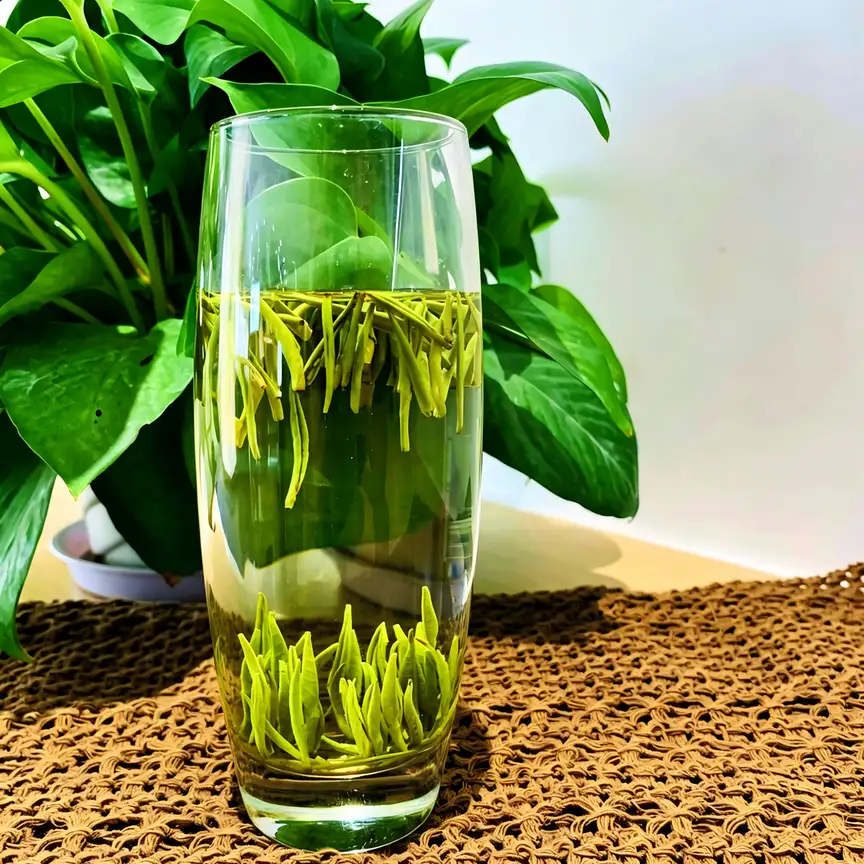
Before the heat, the leaf is spread thin and left for a few hours. Regional regulations give depths of two to three centimetres and times from three to six hours, extending to eight to twelve hours in cooler conditions.
Spreading does two things. It reduces surface moisture, which makes kill-green more even, and it starts the volatile chemistry that produces fresh aroma. A study tracking the compounds during spreading identified 38 endogenous volatiles following four distinct patterns across the shikimate, mevalonate, MEP and fatty-acid pathways. What it did not establish is a quantified gain in amino acids, so the common claim that spreading raises amino acid content is not something this page will assert.
Rolling
Rolling does two jobs: it shapes the leaf, and it breaks cell walls so that compounds become extractable when the tea is brewed.
The relationship between cell-breakage rate and extraction is intuitive and universally assumed in the industry, but a quantitative study of that relationship in green tea was not found in the literature reviewed for this page. The mechanism is not in doubt; the numbers are.
The shaping that happens during rolling is what divides Longjing’s flat leaf from Biluochun’s tight curls from Taiping Houkui’s pressed leaves. Some of that shaping continues during drying, which is why the process is sometimes described as rolling and drying, not rolling then drying.
Drying, and Where Aroma Comes From
Drying is the stage that decides the tea’s aroma character, and it is where the four green tea types diverge.
A controlled study dried green tea at four temperatures and found a clean progression: 90 °C produced a fresh green aroma, 110 °C chestnut, 140 °C cooked bean, and 160 °C a high-fire character. Ninety-five volatile compounds were identified across the set. That single result explains most of the vocabulary used to describe Chinese green tea, including the chestnut and bean notes associated with Longjing and the cooked-rice quality of some baked teas.
The drying method is the classifying feature:
| Green tea type | Drying |
|---|---|
| Pan-fired | Pan or drum, in contact with a hot surface |
| Baked | Hot air throughout |
| Sun-dried | Spread in sunlight |
| Steamed | Baked, after steam kill-green |
Sun-drying is the outlier. It produces a rougher, more assertive tea, and its main commercial importance is that Yunnan sun-dried green tea is the raw material for raw pu-erh.
Pan-Fired Versus Steamed
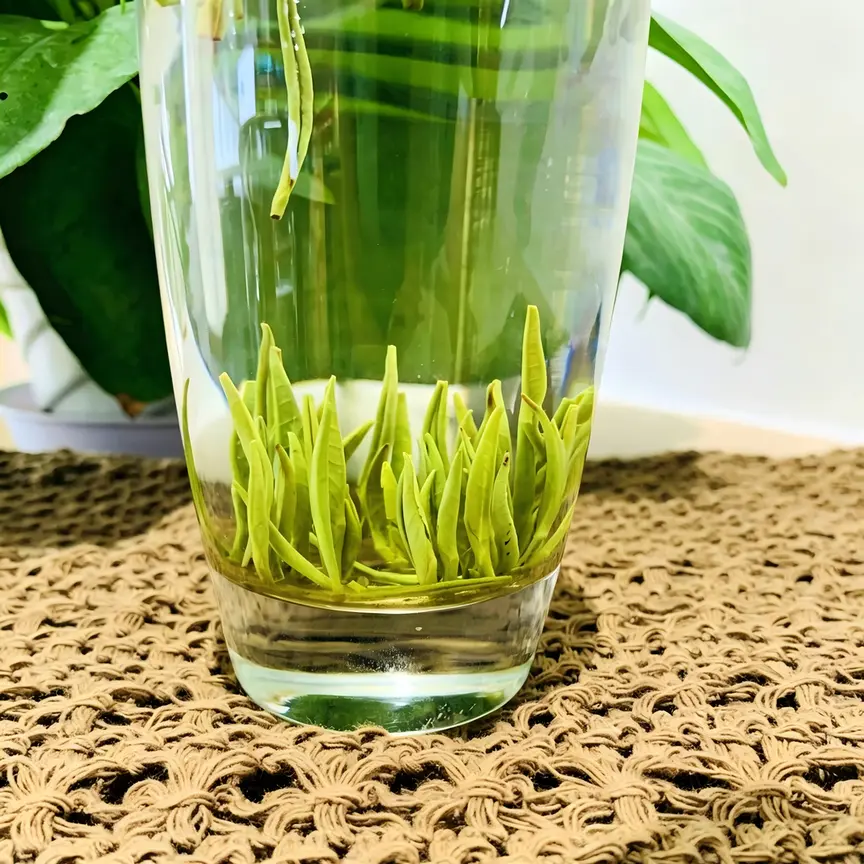
The single most consequential choice in green tea processing is whether the leaf meets steam or a hot surface, and a same-batch comparison gives the numbers.
| Measure | Pan-fired | Steamed |
|---|---|---|
| Amino acids | 41.47 mg/g | 33.79 mg/g |
| Catechins | 111.36 mg/g | 139.68 mg/g |
| Dominant aroma class | Esters, 22.63% | Alcohols, 44.75% |
| Cup impression | Fruity, sweet, rounder | Green, floral, more astringent |
Both samples were rated strong in umami and low in bitterness on electronic tongue analysis. What separates them is direction: pan-firing pushes toward sweetness and chestnut, steaming toward greenness and marine notes.
This is also why China and Japan diverged. Japan’s green tea production is overwhelmingly steamed, with only small amounts of pan-fired tea; China’s is overwhelmingly pan-fired, with steam surviving in a handful of products, Enshi Yulu being the best known.
Green tea types covers the four manufacturing styles and the named teas inside each.
One process, many shapes
The same five-stage sequence produces flat Longjing, curled Biluochun, strip-shaped Maofeng and large pressed Houkui. The difference is entirely in how much pressure is applied, when, and against what surface.
Longjing is pressed flat against the wok during drying, using a documented sequence of ten hand movements the standard describes: grab, shake, press down, flatten, knead, push, button, flick, polish and press. The leaf is held in contact with the hot surface throughout, which is why the shape and the firing are inseparable.
Biluochun is rolled into tight curls while still warm and pliable. The leaf is nearly all bud, so the pressure has to be light — enough to curl, not enough to break.
Huangshan Maofeng is baked, not pressed, so the leaf keeps a loose strip shape and the downy buds stay intact. Nothing flattens it.
Taiping Houkui is the extreme case: large leaves pressed between cloth during drying, which produces flat leaves with a visible grid pattern on the surface. It is the only green tea shape that is unmistakable at a glance.
What all four share is that shaping happens while the leaf is hot. Green tea processing does not separate shaping from firing, and the reason is mechanical: the leaf is only pliable in the window between kill-green and full drying. Miss that window and you have a shaped tea that was shaped cold, which is a different and worse product.
Why the Clock Starts at Drying
Green tea processing ends with a tea that is chemically still changing, and that is the most important thing to understand about it.
Because kill-green inactivates peroxidase almost completely but polyphenol oxidase only partly, some oxidative capacity survives in the finished leaf. Storage therefore continues to alter the tea: catechins oxidise, chlorophyll degrades, and the fresh green character fades toward something flatter and slightly duller.
This is why green tea is the one category where the processing date is a genuine quality variable, not a marketing line. A well-made green tea stored badly for a year is worse than a modestly made one drunk fresh. The processing sets the ceiling; the storage decides how much of it you actually get.
It is also why the standard sets no shelf life. GB/T 14456.1 does not fix a duration, and industry practice runs 12 to 18 months under refrigeration, with some producers declaring two years. Those numbers describe a storage regime, not a property of the tea.
What Goes Wrong
Four failures account for most bad green tea, and each traces to a specific stage.
Under-fired kill-green. The leaf did not reach temperature long enough, enzymes survived, and the tea darkens in the tin and tastes dull. This is the most common manufacturing fault in cheap green tea, because the stage is time-critical and easy to rush.
Over-fired kill-green. Too much heat scorches the leaf, producing a burnt edge and a yellow-brown colour that no amount of careful drying fixes. The tea looks old even when it is fresh.
Wrong drying temperature. Drying at 140 °C or above when the style calls for 110 °C pushes the aroma from chestnut into cooked bean and eventually high-fire. It is not a defect in the abstract, but it is a defect relative to the tea’s stated style.
Late or slow drying. Leaf held too long between rolling and drying continues to change, and the result is a flat, slightly sour cup. Green tea processing rewards speed at every stage after kill-green.
Three things to remember
- Kill-green is the step that defines green tea.
- Rolling sets the shape and the extraction speed.
- Aroma is largely decided at drying, not at picking.
Frequently Asked Questions
What is kill-green in green tea processing?
Applying heat to raise the leaf’s temperature quickly and destroy enzyme activity, preventing oxidation. It is defined in a processing terminology standard and can be done with a wok, steam or hot water.
Does green tea processing involve fermentation?
No. There is no fermentation step. The kill-green stage actively prevents the enzyme-driven oxidation that would otherwise turn the leaf dark.
Why is green tea dried at different temperatures?
Because drying temperature determines aroma. A controlled study found 90 °C gives a fresh green note, 110 °C chestnut, 140 °C cooked bean and 160 °C a high-fire character.
What is the difference between pan-fired and steamed green tea processing?
Steam heats the leaf faster and more evenly; a hot surface also presses and shapes it. Steamed leaf retains more catechins and fewer amino acids, and reads greener and more astringent. Pan-fired leaf is sweeter and more chestnut.
Is there a national standard for green tea processing?
Not a general one. The product standard sets requirements for the finished tea. A specific standard exists for eyebrow tea production, and a trade code covers general processing practice, but the temperature and time values come from regional regulations and research.
Compare the two heating methods. A pan-fired Longjing against a steamed green tea shows what kill-green choices do to aroma and colour. Shifeng Longjing · Green tea range.
- Shifeng Pre-Qingming Longjing, $14.90
- Huangshan Pre-Qingming Maofeng, $19.90
Or browse the full green tea collection.
Read next
For the styles that come out of this process, see the green tea types guide. For the category, read Chinese green tea. Also worth opening: the four styles, the category as a whole and why fresh matters. For the other half of that decision, see black tea vs green tea.
Sources & References
Standards
- GB/T 14456.1-2017 — Green tea, Part 1: Basic requirements.
- GB/T 14456.2-2018 — Large-leaf green tea; definitions of the pan-fired, baked and sun-dried types at 3.3–3.5.
- GB/T 14456.6-2016 — Steamed green tea.
- SB/T 10034-92 — Terminology for tea processing; kill-green defined at 4.1.4.
- GB/T 32742-2016 — Technical specification for eyebrow tea production.
- GH/T 1077-2011 — Tea processing technical code of practice.
- GB/T 32744-2016 — Good manufacturing practice for tea processing (premises and hygiene only).
Peer-Reviewed Research
- LWT (2015). Steamed green tea: peroxidase ~99% inactivated, polyphenol oxidase only partly (~34% maximum); 3-minute steaming best. DOI:
10.1016/j.lwt.2015.07.068 - Foods (2022). Same-batch pan-fired versus steamed: amino acids, catechins and aroma classes. DOI:
10.3390/foods11111582 - LWT (2022). Drying temperature and aroma: 90/110/140/160 °C. DOI:
10.1016/j.lwt.2022.113394 - ACS Omega (2022). Volatile dynamics during spreading; 38 compounds across four pathways. DOI:
10.1021/acsomega.2c04654
Boundary of this page: We do not claim a single correct process, that spreading raises amino acids, or that there is a fixed temperature threshold for kill-green. Where the numbers come from regional regulations, not the national standard, the page says so.


2 Comments