
Pu-erh Processing: Sun-Dried Tea and Pile Fermentation
Pu-erh processing is really two processes, and only one of them is famous. The first is a sun-dried green tea method that leaves the leaf alive. The second is a controlled microbial fermentation that the standard calls post-fermentation and the trade calls pile fermentation.
This page covers the full sequence for both raw and ripe pu-erh tea, what the pile actually does, which microorganisms are involved, and where the safety questions sit.
Table of Contents
Pu-erh Processing Stage One: Sun-Dried Tea
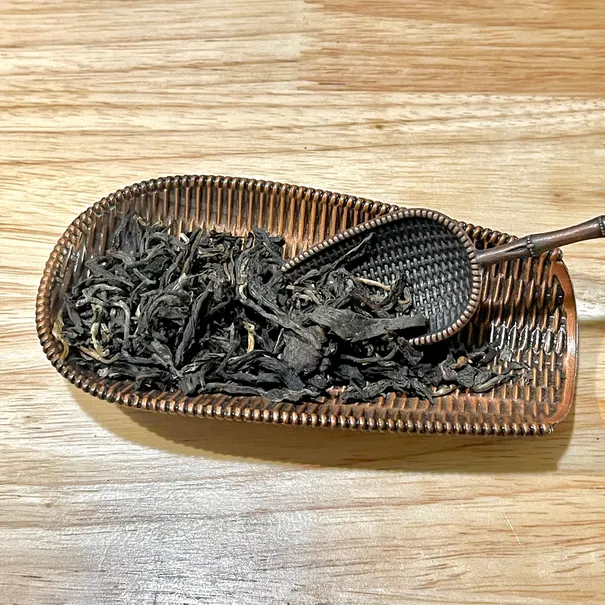
In pu-erh processing everything starts as sun-dried tea, the raw material the standard names. The sequence is short: spread the leaf, kill-green in a hot wok, roll, break up the clumps, and dry in sunlight.
| Step | What happens |
|---|---|
| Spreading | Leaf rested thin, surface moisture lost |
| Kill-green | Hot wok stops enzyme activity |
| Rolling | Leaf twisted, cells broken, shape formed |
| Breaking up | Clumps separated so drying is even |
| Sun-drying | Moisture falls to 10 percent or below |
The standard specifies the steps but not the temperatures. Industry practice runs a wok temperature of 200 to 300 °C with leaf temperature around 80 to 85 °C for five to eight minutes, aiming at 20 to 30 percent moisture loss. Those figures come from working practice rather than from a published standard, and should be read as typical values.
Why Sun-Drying Changes Everything
The single decision that makes pu-erh processing possible is drying in sunlight rather than over heat.
Green tea is kill-green and then dried by pan or oven, which finishes the leaf and stops change. Sun-dried tea is kill-green too, but the gentle drying leaves enzymes and microorganisms in place. That surviving biological activity is what later drives fermentation, both the slow kind in storage and the fast kind in a pile.
This is why the standard calls the raw material sun-dried tea rather than green tea, even though the earlier steps are similar. The difference is not a marketing distinction; it is the difference between a finished product and a substrate.
Green tea processing covers the comparison from the other side.
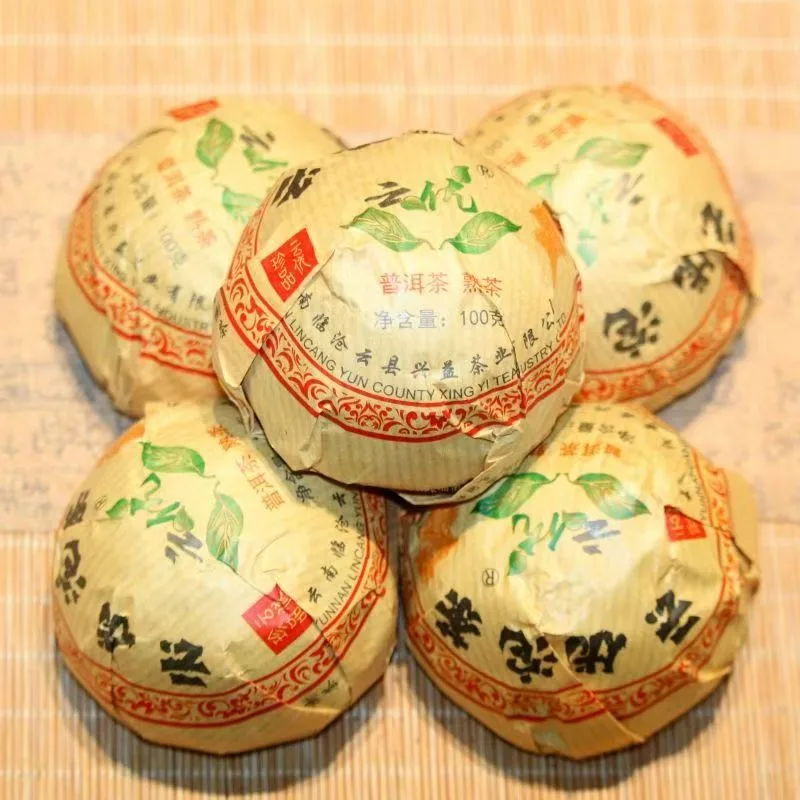
Stage Two for Raw Tea: Pressing
Raw pu-erh tea is sun-dried tea that has been steamed, pressed and dried. Nothing else happens.
Steam softens the leaf enough to compress it without breaking it, typically at 100 to 116 °C for five to twenty seconds at around 5 kg/cm². The pressed cake is then dried slowly at 45 to 55 °C, which takes days rather than hours because a dense cake releases moisture slowly.
That slow drying matters. A cake dried too fast case-hardens, sealing moisture inside where it can cause problems later. The low temperature is not a shortcut missed; it is the method.
Pressing is also functional rather than decorative. A compressed cake exposes less surface area than loose leaf, so it ages more slowly and more evenly. The shape is part of the ageing method.
Pu-erh Processing Stage Two: Pile Fermentation
Ripe pu-erh tea takes the same sun-dried material through an accelerated fermentation.
The leaf is piled and wetted to roughly 30 to 45 percent moisture, with the higher end giving better results. Over the following days the pile heats itself through microbial activity, reaching about 50 °C within days and holding there. The pile is turned on schedule and broken up where it has clumped, which redistributes moisture and heat. The whole cycle runs about fifty days.
Measured conditions: pile temperature around 50 °C through to about day 35, moisture content around 30 percent, pH between 5 and 6. Some published processes describe peaks of 55 to 65 °C, and the standard’s own technical requirement sets the ceiling at 65 °C.
Temperature control is the whole craft. Too cool and fermentation stalls; too hot and the microbial community is killed off and the leaf scorches. That is why pile fermentation is done by experienced producers rather than by recipe.
What Is Actually Doing the Work
Pile fermentation is a solid-state microbial process, and the community is better characterised than most tea writing suggests.
The fungi are dominated by Aspergillus niger, black aspergillus, along with a specific yeast, Blastobotrys adeninivorans. Penicillium, other aspergilli and Trichoderma species are also commonly present. These are the organisms that produce the enzymes breaking down the leaf.
The bacteria outnumber the fungi overall. A metagenomic study found actinobacteria at 30.1 percent, proteobacteria at 24.5 percent and firmicutes at 20.2 percent, with ascomycete fungi at 15.2 percent. Bacteria are not incidental to this process; they are the majority of it.
The enzymes follow a schedule. Cellulase and pectinase peak at the second turning, and both include enzymes contributed by the leaf itself as well as by microbes. Protease and polyphenol oxidase come from the microorganisms, and polyphenol oxidase is the one that matters most for colour: it drives catechin oxidation into theaflavins, thearubigins and theabrownins.
That is a managed fermentation, not spoilage. Describing pu-erh processing as “mould-fermented” or “rotten tea” is both inaccurate and the source of most consumer confusion about the category.
What the Chemistry Looks Like
Fermentation consumes the catechins and builds pigments, and the numbers are substantial.
Across 43 ripe pu-erh tea samples, tea polyphenols measured between 4.55 and 11.16 percent with a mean of 7.90 percent — well under the standard’s 15 percent ceiling, and far below the 28 percent minimum required of raw tea.
Theabrownin, the pigment responsible for the dark red colour, reached 18.56 percent in one cultivar study. Gallic acid rises as the catechins are broken down, which is why ripe pu-erh tastes less astringent and slightly more sour-bright than young raw tea.
The standard’s own limits record this: raw pu-erh tea must contain at least 28 percent polyphenols, and ripe must contain no more than 15 percent. Fermentation does most of that work.
Pu-erh Processing and Safety
Any fermented food raises a mycotoxin question, and pu-erh processing has been studied on this point.
A survey of 36 samples found ochratoxin A in 4 samples, about 11 percent, while aflatoxins and fumonisins were not detected. A separate study of 31 modern samples found all below regulatory limits, and samples older than 30 years measured aflatoxin B1 below 1 ppb.
So the picture is not “no risk” and it is not “dangerous.” It is a fermented product with a measurable contaminant profile that is regulated. Chinese limits for mycotoxins in food are set in GB 2762, and compliant production is designed to stay inside them.
What a buyer can reasonably do is buy from producers who control the pile, and treat a musty or sharply bitter cake as a quality signal rather than a character note. Pu-erh buying covers what to look for.
What Goes Wrong in Pu-erh Processing
Under-fired kill-green. The leaf oxidises before it can be dried, and the sun-dried tea is flat and dull rather than bright.
Rain during drying. Sun-dried tea caught in rain darkens unevenly and carries an off-flavour that no amount of ageing fixes.
Pile too hot. The microbial community dies and the leaf scorches, producing a cake that tastes burnt rather than fermented.
Pile too cool. Fermentation stalls, the tea stays bitter and green, and the producer either extends the cycle or sells an unfinished product.
Wet storage after pressing. Damp conditions invite the wrong organisms, and the result is the mustiness buyers rightly reject.
The Full Timeline, Side by Side
The clearest way to see how pu-erh processing divides is to put both routes on one timeline.
| Day | Raw route | Ripe route |
|---|---|---|
| 0–2 | Spread, kill-green, roll, sun-dry | Spread, kill-green, roll, sun-dry |
| 2–5 | Steam, press, slow dry | Pile built, wetted, heats to about 50 °C |
| 5–35 | Finished product resting | Turning, breaking up, temperature held |
| 35–50 | Finished product resting | Fermentation completes, pH 5–6 |
| 50+ | Ageing in storage, years | Pressing or packing, months to drinkable |
Two things stand out from that comparison. The raw route reaches a finished product in under a week and then spends years changing; the ripe route spends roughly fifty days in a controlled process and is essentially finished when it comes out.
It also explains why the two cannot be substituted. The raw route is pu-erh processing that hands the work to time. The ripe route compresses that work into a pile, and the result is a different tea rather than a shortcut to the same one.
Where the Numbers Come From
One point deserves emphasis for anyone reading a specification: almost none of the pu-erh processing numbers in circulation are fixed by the standard.
GB/T 22111 specifies the operations — kill-green, rolling, sun-drying, pressing, post-fermentation — and sets a temperature ceiling of 65 °C for the pile. It does not specify wok temperature, leaf temperature, moisture percentage, pile height, turning schedule or cycle length.
Everything else comes from working practice and from research. The 200 to 300 °C wok figure, the 30 to 45 percent moisture range, the fifty-day cycle and the 50 °C pile temperature are all reported values rather than requirements. A producer working to different parameters is not necessarily non-compliant, only different.
That is worth knowing because it explains the range of quality in the market. When the standard sets a ceiling rather than a recipe, the outcome depends entirely on the producer’s judgement.
Frequently Asked Questions
How is pu-erh tea processed?
Sun-dried tea is made first, by kill-green, rolling and drying in sunlight. Raw pu-erh tea is then steamed and pressed. Ripe pu-erh tea goes through a pile fermentation of roughly fifty days before pressing or packing.
Why is pu-erh tea dried in the sun?
Sun-drying is gentle enough to leave enzymes and microorganisms alive in the leaf, which is what allows fermentation later. Heat-drying would finish the leaf the way green tea is finished.
Why does sun-dried tea need to be pressed for raw pu-erh?
Because compression is what slows the change down enough to be controlled. An unpressed pile of sun-dried tea oxidises unevenly and dries out at the edges, while a cake changes from the surface inward at a predictable rate. Pressing is part of how raw pu-erh processing manages time.
Is pile fermentation the same as composting?
No. It is a controlled solid-state fermentation with a defined moisture range, a temperature ceiling and a turning schedule. Composting is uncontrolled and produces a different result.
How hot does the pile get?
Around 50 °C through most of the cycle, with some published processes peaking higher. The standard sets a ceiling of 65 °C.
Is pu-erh tea safe to drink?
The mycotoxin profile has been surveyed and is regulated under GB 2762. One study found ochratoxin A in 4 of 36 samples, with aflatoxins not detected; modern compliant production sits within limits.
What is the white powder on an old pu-erh cake?
Usually not mould. Cakes stored dry often develop a light frosting of crystallised compounds, sometimes called tea frost. Genuine mould is fuzzy, coloured and smells musty rather than woody.
One practical note for buyers: because pu-erh processing tolerates such a wide range of parameters, the gap between a good and a poor cake is mostly invisible from the outside. A clean wrapper, a firm press and an even colour tell you the pressing was competent; they tell you nothing about the pile. That is why the producer’s track record matters more here than in almost any other tea category.
Shop the pu-erh teas in this guide
Sold from our own stock. Every listing states the year, the region and the storage.
- 2021 Lincang ripe tuocha, $19.90
- 2023 Phoenix Mountain raw tuocha, $19.90
Or browse the full pu-erh collection.
Related Reading
the category as a whole, raw versus ripe, what ageing does and the health evidence, and where it grows.
Sources & References
Standards
- GB/T 22111-2008 — Geographical indication product: Pu-erh tea. Process requirements; polyphenol limits; pile temperature ceiling of 65 °C under the 2008 approval announcement.
- GB 2762 — Maximum levels of mycotoxins in food.
- GB/T 23776-2018 — Tea sensory evaluation.
Peer-Reviewed Research
- International Journal of Food Microbiology (2008). Pile microbiology; Aspergillus niger and Blastobotrys adeninivorans dominant; pile temperature and pH. DOI:
10.1016/j.ijfoodmicro.2008.03.008 - Journal of the Science of Food and Agriculture (2013). Metagenomic profile; actinobacteria 30.1%, proteobacteria 24.5%, firmicutes 20.2%, ascomycetes 15.2%. DOI:
10.1002/jsfa.6149 - International Journal of Food Microbiology (2013). Enzyme activity during turning; lovastatin production. DOI:
10.1016/j.ijfoodmicro.2013.03.018 - International Journal of Food Microbiology (2013). Mycotoxin survey: ochratoxin A in 4 of 36 samples; aflatoxins and fumonisins not detected. DOI:
10.1016/j.ijfoodmicro.2013.07.024 - Foods (2026). Storage and ageing chemistry. DOI:
10.3390/foods15193448
What this page does not claim
We do not claim pile fermentation is a form of spoilage, that pu-erh tea is mycotoxin-free, or that the process parameters are fixed by the standard. Where a number comes from working practice rather than regulation, the page says so.


One Comment