
Pu-erh Tea: What the National Standard Defines
Pu-erh tea is the only Chinese tea category defined by a geographical indication, a specific raw material and a microbial fermentation step. Almost everything confusing about it follows from those three constraints.
This page covers what the national standard actually defines, the two types and why one of them has no loose-leaf form, what “post-fermentation” means in the standard’s own words, and where the boundaries of the category sit.
Table of Contents
What the Standard Defines
Pu-erh tea is governed by GB/T 22111-2008, a geographical indication product standard. It was published in June 2008 and took effect that December. A 2025 review concluded it remains valid, and as of late 2026 no revision has been issued.
The definition is worth quoting because it does more work than most tea definitions:
Pu-erh tea is made from Yunnan large-leaf sun-dried tea within the geographical indication protection area, using a specific processing method within that same area, and possesses distinctive quality characteristics. According to its processing method and quality characteristics, pu-erh tea is divided into pu-erh tea (raw) and pu-erh tea (ripe).
Three constraints are packed into that sentence, and each one is enforceable. The raw material must be Yunnan large-leaf sun-dried tea. The production must happen inside the protected area. And the product must fall into one of two types, raw or ripe.
That makes pu-erh tea a geographical indication product name rather than a general tea category. Tea made from the same cultivar outside Yunnan, or processed by a similar method elsewhere, cannot legally be sold under the name.
The Protected Area
The geographical indication was approved by the former quality supervision administration under announcement No. 60 of 2008. The protected area is unusually large for a tea indication: 11 prefectures and cities, 75 counties, 639 townships.
The 11 prefectures are Kunming, Chuxiong, Yuxi, Honghe, Wenshan, Pu’er, Xishuangbanna, Dali, Baoshan, Dehong and Lincang. That is most of Yunnan’s tea-growing territory rather than a single mountain.
Both the raw material and the processing must be inside the boundary. Tea grown in the protected area but processed outside it does not qualify, and neither does tea brought in from outside and processed within.
Pu-erh tea was also included in the first batch of the EU-China geographical indication agreement, which took effect on 1 March 2021 under the registration number PGI-CN-2668. The certification mark has been administered by the Yunnan Pu-erh Tea Association since 2007.
The Two Types
The standard divides pu-erh tea into raw and ripe. The distinction is not a grade or a style preference; it is a processing difference that the standard treats as fundamental.
| Raw (生茶) | Ripe (熟茶) | |
|---|---|---|
| Base | Sun-dried tea, steamed, pressed, dried | Sun-dried tea, pile-fermented, then pressed or left loose |
| Fermentation | Slow, during storage | Accelerated, completed before sale |
| Loose-leaf form | Not a standard product | Yes — graded in 11 tiers |
| Pressed form | Yes | Yes |
| Cup | Bright, bitter, changing with age | Dark red, earthy, smooth |
The row that surprises people is the third. Raw pu-erh tea has no loose-leaf product type under the standard. Sun-dried tea on its own is a raw material and is graded separately; it becomes raw pu-erh tea only after being steamed, pressed into a shape and dried. A seller offering “loose raw pu-erh” is offering sun-dried tea under a different name.
What “Post-Fermentation” Means
The standard’s third defined term is hou fa jiao, post-fermentation. This is the microbial step that separates pu-erh from every other tea category, and the standard describes it in terms of process rather than mechanism.
The published technical requirements are more specific. The pile is built, moisture is adjusted, the pile is turned on schedule and broken up where it has clumped, and the pile temperature is held at or below 65 °C.
What the standard does not do is call this wo dui, the term the trade uses. Anyone writing about pu-erh needs to know both words, because the standard will not match the packaging.
The microbiology is covered in detail on pu-erh processing, but the short version is that this is a controlled solid-state fermentation dominated by Aspergillus niger and specific yeasts, with bacteria outnumbering fungi overall. It is not spoilage, and describing it as “mould-fermented” is both inaccurate and misleading.
Grades, and Why Pressed Tea Has None
Grading in pu-erh tea is asymmetric, and the asymmetry is easy to miss.
Ripe loose-leaf tea is graded into special grade plus grades one through ten — eleven tiers in total. Each is described on eight sensory factors, and physical standard samples are prepared on an odd-number cycle and replaced every three years.
Pressed tea is not graded at all, whether raw or ripe. It is classified by shape and specification instead: round cake, bowl-shaped, square, column. There is no quality ladder to climb, which is why “special grade” claims on a cake should be treated as marketing.
That is a genuinely useful fact for buyers. A pressed pu-erh tea cannot be graded, so a grade claim on a cake or brick is not a standard designation.
What the Standard Requires Physically
The physical requirements differ sharply between raw and ripe, and the difference in tea polyphenols is the clearest marker of what fermentation does.
| Requirement | Sun-dried tea | Raw pressed | Ripe loose | Ripe pressed |
|---|---|---|---|---|
| Moisture, max | 10.0% | 13.0% | 12.0% | 12.5% |
| Total ash, max | 7.5% | 7.5% | 8.0% | 8.5% |
| Water extract, min | 35.0% | 35.0% | 28.0% | 28.0% |
| Tea polyphenols | ≥28.0% | ≥28.0% | ≤15.0% | ≤15.0% |
Raw pu-erh tea must contain at least 28 percent polyphenols; ripe must contain no more than 15 percent. The fermentation consumes the catechins and converts them into theaflavins, thearubigins and theabrownins, and the standard’s limits simply record that fact.
Measured ripe teas typically land between 4.5 and 11 percent, comfortably inside the ceiling. Theabrownin, the pigment that gives ripe pu-erh tea its colour, can reach more than 18 percent in some lots.
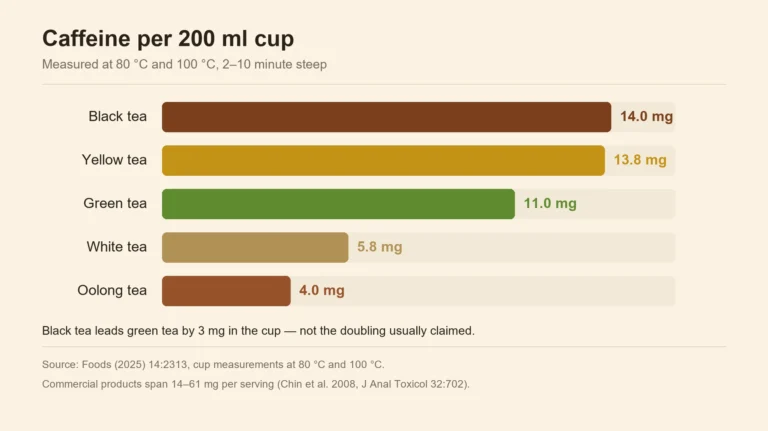
One thing the standard does not set is a caffeine limit. Caffeine is not one of its test items, so any caffeine figure quoted for pu-erh tea comes from measurement rather than regulation. Pu-erh caffeine has the numbers.
Shelf Life and the Ageing Question
The standard sets no shelf life. It states that under compliant storage conditions, pu-erh tea is suitable for long-term storage — a permission rather than a guarantee.
Storage requirements are specific: clean, ventilated, dark, dry, free of odours, and never stored alongside toxic or strongly scented materials.
What the standard does not contain is the word “ageing,” and it does not contain the phrase usually translated as “the older the better.” The closest official statement is a note in the approval announcement: under suitable storage conditions, the sensory and physical indicators of raw tea will move in the direction of ripe pressed tea. There is no quantified timeline attached.
That distinction matters. “The older the better” is a market claim with a chemical basis and a boundary, and pu-erh aging sets out where the boundary falls.
A Short History, Without the Legends
The earliest documented use of the name is from the Wanli period of the Ming dynasty, in Xie Zhaozhe’s Dianlüe, which notes that everyone from scholars to commoners used “pu tea,” steamed and formed into cakes. By the late Ming the three characters of the modern name appear in Fang Yizhi’s Wulizhishi.
A claim that circulates widely is that the Ming pharmacopoeia Bencao Gangmu records “pu-erh tea comes from Pu’er, Yunnan.” The standard modern editions do not contain that entry, and the claim should not be repeated.
The place name itself became an administrative name in 1729, when the Pu’er prefecture was established. The city was renamed Pu’er in 2007, having previously been Simao.
The ripe process is much younger than the raw one. In 1973 the provincial tea company sent seven technicians to Guangdong to learn pile fermentation, and on their return the Kunming factory succeeded by switching from hot water to cold. Ripe tea was exported to Hong Kong that same year, with Menghai following in 1974 and Xiaguan in 1975. It was a collective technical transfer, not a single inventor, and the “father of ripe pu-erh” title has no official basis.
The Market
Yunnan produced around 560,000 tonnes of tea in 2024, of which pu-erh tea was roughly 173,000 tonnes by industry estimates. The largest producing prefectures are Pu’er, Lincang and Xishuangbanna.
The market also has a history worth knowing. In April 2007 a speculative bubble collapsed: the benchmark Dayi 7542 recipe fell from about 22,000 to 23,000 yuan per case to roughly 11,000 yuan within six weeks, and the wider market dropped 20 to 50 percent. Industry estimates put the value destroyed at 200 to 340 million yuan.
That episode explains a lot about how pu-erh tea is sold today, including the emphasis on vintage and mountain claims. Pu-erh buying covers what those claims are worth.
The Shapes You Will See
Pressed pu-erh tea comes in a small set of standard shapes, and the shape carries more information than buyers usually assume.
Round cakes are the default, most commonly 357 g. A tube holds seven cakes and a case twelve tubes, which works out to roughly 2.5 kg and 30 kg respectively. That consistency is a packaging convention rather than a legal requirement.
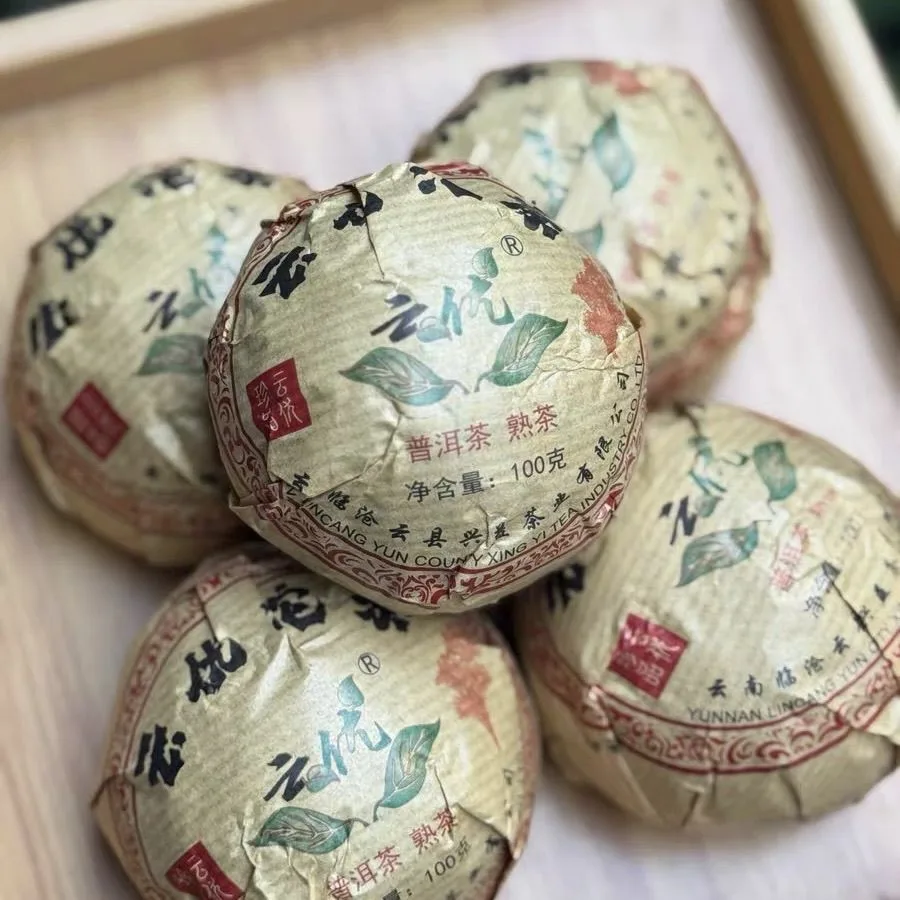
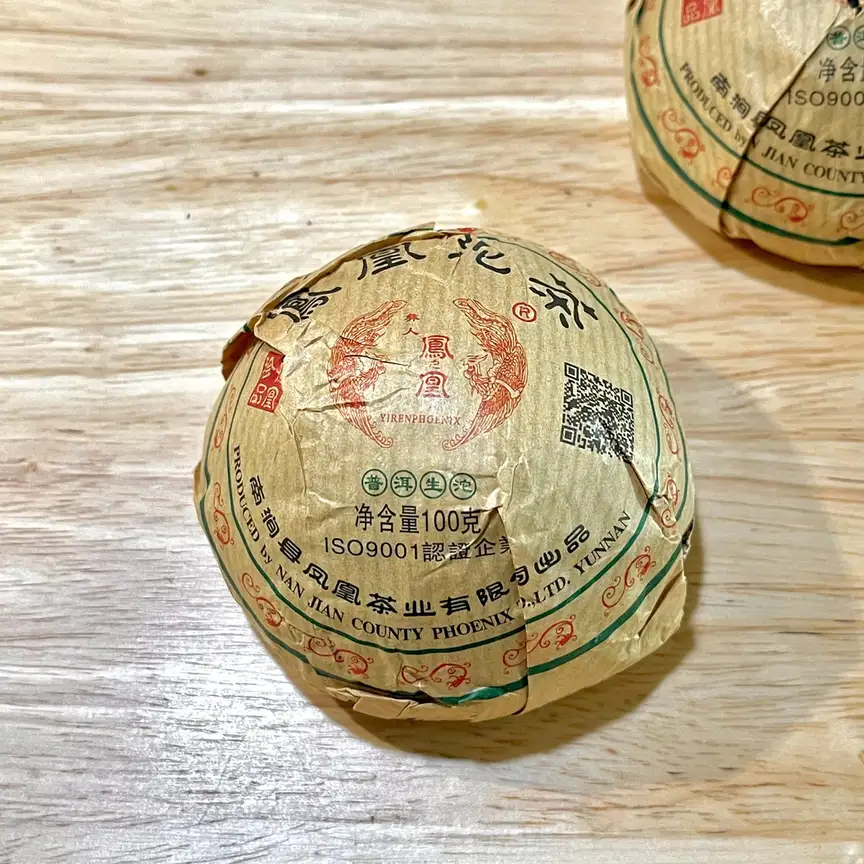
Bricks run from 250 g to 1 kg and were historically easier to transport and stack. Bowl-shaped tuo cha are 100 g or 250 g and were designed for trade, especially the Sichuan route. Larger compressed forms exist as presentation pieces rather than as drinking formats.
Shape affects ageing as well as transport. A pressed cake exposes less surface area than loose leaf, so it changes more slowly and more evenly. That is one reason raw pu-erh tea is pressed rather than sold loose — the shape is part of the ageing method, not just the packaging.
Pu-erh shapes covers the formats, the 357 g question and what the numbers mean.
Frequently Asked Questions
Is pu-erh tea a black tea?
No. In Chinese classification it sits in the dark tea family for ripe tea, and raw pu-erh is closer to a sun-dried green tea that has been pressed. The category is defined by geography and post-fermentation rather than by oxidation level.
What is the difference between raw and ripe pu-erh tea?
Ripe tea goes through an accelerated pile fermentation before sale, which darkens it and removes most of the bitterness. Raw tea skips that step and changes slowly in storage instead. Raw vs ripe pu-erh covers the comparison.
Can raw pu-erh tea be sold loose?
Not as a standard product. Sun-dried tea is a raw material with its own grading; raw pu-erh tea is defined as pressed. Loose-leaf “raw pu-erh” is sun-dried tea described differently.
Does pu-erh tea expire?
The standard sets no shelf life and states that the tea is suitable for long-term storage under compliant conditions. That is a permission, not a promise that age improves every cake.
Is pu-erh tea fermented with mould?
It is fermented by a controlled microbial community in which Aspergillus niger and specific yeasts dominate, with bacteria more numerous than fungi overall. That is a managed fermentation rather than spoilage, and describing it as mouldy is inaccurate.
Shop the pu-erh teas in this guide
Sold from our own stock. Every listing states the year, the region and the storage.
- 2023 Phoenix Mountain raw tuocha, $19.90
- 2021 Lincang ripe tuocha, $19.90
Or browse the full pu-erh collection.
Related Reading
raw versus ripe, how it is made, what ageing does, cakes and tuo cha and how to buy it, and where in Yunnan it comes from, and how to brew it.
Sources & References
Standards
- GB/T 22111-2008 — Geographical indication product: Pu-erh tea. Definition at 4.1; classification at 5.1; physical requirements tables 4–6; storage and shelf-life clauses.
- Announcement No. 60 of 2008 — former General Administration of Quality Supervision, Inspection and Quarantine; protected area of 11 prefectures, 75 counties, 639 townships; pile temperature limit of 65 °C.
- GB/T 23776-2018 — Tea sensory evaluation.
- GB/T 30375-2013 — Tea storage.
- GB/T 30766-2014 — Classification of tea.
Geographical Indication
- EU-China GI agreement, first batch, effective 1 March 2021; registration PGI-CN-2668.
- Certification mark administered by the Yunnan Pu-erh Tea Association since 1 July 2007.
Peer-Reviewed Research
- International Journal of Food Microbiology (2008). Microbial community of pile fermentation; Aspergillus niger and Blastobotrys adeninivorans dominant. DOI:
10.1016/j.ijfoodmicro.2008.03.008 - Journal of the Science of Food and Agriculture (2013). Metagenomic profile; bacteria outnumber fungi. DOI:
10.1002/jsfa.6149 - Foods (2026). Chemical changes across 1–22 years of storage. DOI:
10.3390/foods15193448
What this page does not claim
We do not claim pu-erh tea is a generic category name, that raw tea can be sold loose, that “the older the better” is a standard, or that a single technician invented ripe tea. Where the standard is silent — on ageing, on caffeine, on mountain names — the page says so.

One Comment