
How to Start Drinking White Tea: A Beginner’s Roadmap
About our source: Min Tea Shop sources the white teas featured in this article from Shouning, a mountainous county in northern Fujian with more than a thousand years of tea cultivation. Official provincial information reports more than 600,000 mu of mountainous land at elevations of 500–1,200 metres, with nearly two-thirds of the county above 800 metres. The protected production area for “Shouning High Mountain Tea” covers 190 villages and communities located above 500 metres. These figures describe the county’s mountain resources and the official protected tea area, not the verified elevation of every garden supplying our shop.[1][2]
White tea is an approachable Chinese tea category with a relatively simple production process. This guide walks you through your first cup: which of the four types to pick, how to brew it without bitterness, and how to store what you buy.
Our usual recommendation for a first purchase is White Peony. This is an editorial recommendation rather than a scientifically established preference: White Peony combines buds and young leaves, costs less than many Silver Needle teas, and usually produces a more noticeable cup than a delicate bud-only tea.
Quick answer: China’s national standard defines four white tea product types: Baihao Yinzhen (Silver Needle), Bai Mudan (White Peony), Gongmei, and Shoumei. For gaiwan brewing, try about 5 g of tea in a 110 ml vessel, then adjust the temperature and infusion time to suit the leaves and your taste.
Start here. If you have never brewed white tea before, this page is written for you. The short version: pick a type, brew it at 85–90 °C, keep it dry and dark. Everything else below is detail you can come back to once you have a cup in front of you.
What Is White Tea?
White tea is one of the six major categories used to classify Chinese tea. The other five are green tea, yellow tea, oolong tea, black tea, and dark tea, also called post-fermented tea in some professional contexts.[3]
China’s current national standard, GB/T 22291-2017, White Tea, defines white tea as a product made from the buds, leaves, and tender stems of Camellia sinensis through specific processes that include:
- Withering
- Drying
- Sorting
Traditional white tea is typically made without high-temperature fixation, known in Chinese as shaqing, and without rolling. It still receives heat during the final drying stage.
A variant called new craft white tea may include light rolling after withering. For this reason, it would be inaccurate to say that no white tea is ever rolled.
White tea naturally contains amino acids such as L-theanine, as well as polyphenols and flavonoids. Their levels vary widely with the plant variety, bud or leaf maturity, season, origin, and processing. Research does not support a blanket claim that every white tea contains more of these compounds than every other category of tea.
Fujian is widely recognized as a traditional center of modern Chinese white tea production. Fuding, Zhenghe, Jianyang, and Songxi are among its established producing areas. Shouning also produces white tea, but current evidence supports describing it as a developing production area rather than one of the historical core origins.
Standards note: No publicly available local standard dedicated specifically to “Shouning white tea” was identified in the supplied research. White tea made in Shouning should therefore be described with reference to applicable national standards such as GB/T 22291-2017. The protected “Shouning High Mountain Tea” designation should not be presented as a white-tea geographical indication without separate proof that white tea is included.
Which of the Four Types Should You Start With?
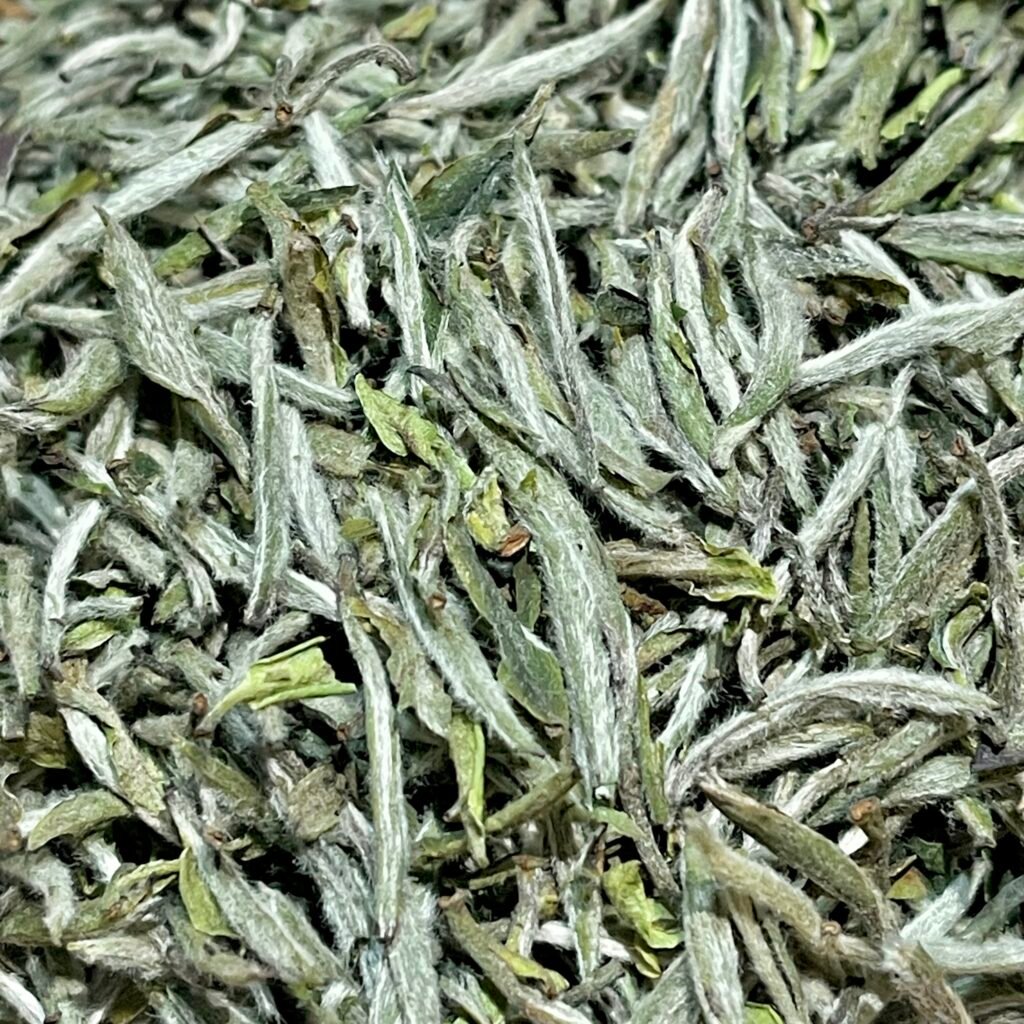
White tea is sold as four product types, and the difference comes down to how much leaf goes in beside the bud. Silver Needle is buds only; White Peony adds one or two young leaves; Gongmei two or three; Shoumei three or four. More leaf means more body, more flavour for your money and better ageing — fewer leaves means a softer, sweeter, more delicate cup.
For a first purchase, most people are happier starting with White Peony: it has enough body to taste like something, and it costs a fraction of Silver Needle. If you already know you want the delicate end, take Silver Needle. And if you want a tea that improves in the cupboard, take a Shoumei cake rather than loose leaf.
That is all you need to start. For the full comparison of the four types — flavour, caffeine, ageing and price — read our separate guide →
How Is White Tea Made?
White tea uses a short production framework, but each stage requires control. Under GB/T 22291-2017, its defining processes include withering, drying, and sorting.
Step 1: Picking
Workers collect buds, leaves, or tender shoots according to the intended product:
- Silver Needle uses single buds from Dabai or Shuixian plants.
- White Peony uses one bud with one or two leaves from Dabai or Shuixian plants.
- Gongmei uses tender shoots from local population tea plants.
- Shoumei may use tender shoots or leaves from Dabai, Shuixian, or population plants.
Step 2: Withering
Workers spread the fresh material in thin layers on trays or racks. Airflow, temperature, humidity, light, and time control the loss of water and the chemical changes within the leaves.
Producers may use indoor natural withering, sunlight withering, heated withering, or a combination suited to local weather and equipment.
A method known in Chinese as 复式萎凋 combines short periods of sunlight with indoor natural withering. A clear English description is combined sunlight and indoor withering.
This method is part of wider Fujian production practice. Current public evidence does not establish it as a distinctive or universal technique used by every Shouning producer.
Step 3: Drying
Drying lowers the moisture content and makes the tea stable enough for sorting, packing, and storage. Traditional white tea does not undergo high-temperature fixation, but this does not mean it receives no heat. Final drying is still required.
Drying parameters vary by material, weather, equipment, and the intended style.
Step 4: Sorting
Sorting is part of the white tea production framework defined in GB/T 22291-2017. It removes off-grade leaves and unwanted material.
Sorting may include:
- Sieving
- Air separation
- Colour sorting
- Manual picking and inspection
The standard requires sorting but does not state that every product must be completely sorted by hand.
Step 5: Cooling and packing
After drying, producers typically allow the tea to cool and rest before packing. This helps reduce condensation risk and allows moisture within the leaves to become more even.
GB/T 22291-2017 sets a maximum moisture level for finished white tea. Before citing a precise percentage on the live page, verify the value and applicable table directly against the official full standard rather than a secondary summary.
If a producer performs moisture testing, it should retain the batch results. If no testing record exists, avoid saying that the moisture level was “verified” or “confirmed.”

What Does Shouning’s Climate Mean for Tea?
Shouning has a relatively cool mountain climate. The 2023 Fujian Climate Bulletin reported an annual mean temperature of 16.3°C for Shouning, among the lowest county-level readings in Fujian that year.[4]
That figure represents one year, not a long-term climate normal. It should therefore be cited as a dated observation rather than as Shouning’s permanent average.
Lower temperatures at higher elevations generally tend to slow the growth of new tea shoots when other conditions are similar. However, the result also depends on:
- Tea plant variety
- Slope and aspect
- Sunlight
- Rainfall and humidity
- Pruning
- Fertilization
- Irrigation
- Harvest schedule
Shouning is often described as cloudy or misty, but the supplied research did not find a published long-term official fog-day count. It is safer to call “misty” a qualitative regional description rather than a quantified climate fact.
The precise effect on a particular garden would require plot-level temperature, humidity, elevation, growth, and harvest data.
What Does Good White Tea Taste Like?
Chinese sensory standards use general terms such as clean aroma, freshness, mellowness, sweetness, and purity. Scientific aroma studies often use broader categories such as:
- Fresh
- Green or grassy
- Floral
- Fruity
- Sweet
- Herbal
- Woody
- Aged
More specific comparisons—such as dried apricot, honey, hay, ripe fruit, or sweet wood—are tasting impressions. They may describe a particular batch, but they should not be presented as universal qualities of an entire product type.
Look for a clean aroma
A suitable young batch may smell fresh, floral, fruity, sweet, or green. A properly stored older batch may develop woody, herbal, or aged qualities.
The aroma should remain clean. Dusty, smoky, sour-stale, and musty characteristics are generally defects in white tea.
Check the body
The infusion should not feel empty or harsh. Bud-heavy tea may feel delicate, while leaf-heavy tea may feel fuller.
“Smooth” and “round” are useful tasting words, but they are subjective. When describing a product for sale, include the actual tasting date and brewing method.
Watch how the tea changes
A tea may change over several infusions. This does not prove quality on its own, but it can show how the leaf responds to repeated brewing.
Check the finish
Strong bitterness or a drying sensation may result from too much leaf, hot water, long infusions, water chemistry, or the tea itself.
A persistent dusty, smoky, sour-stale, or musty character should not be explained away as normal “aged flavor.”
How Do You Brew White Tea in a Gaiwan?
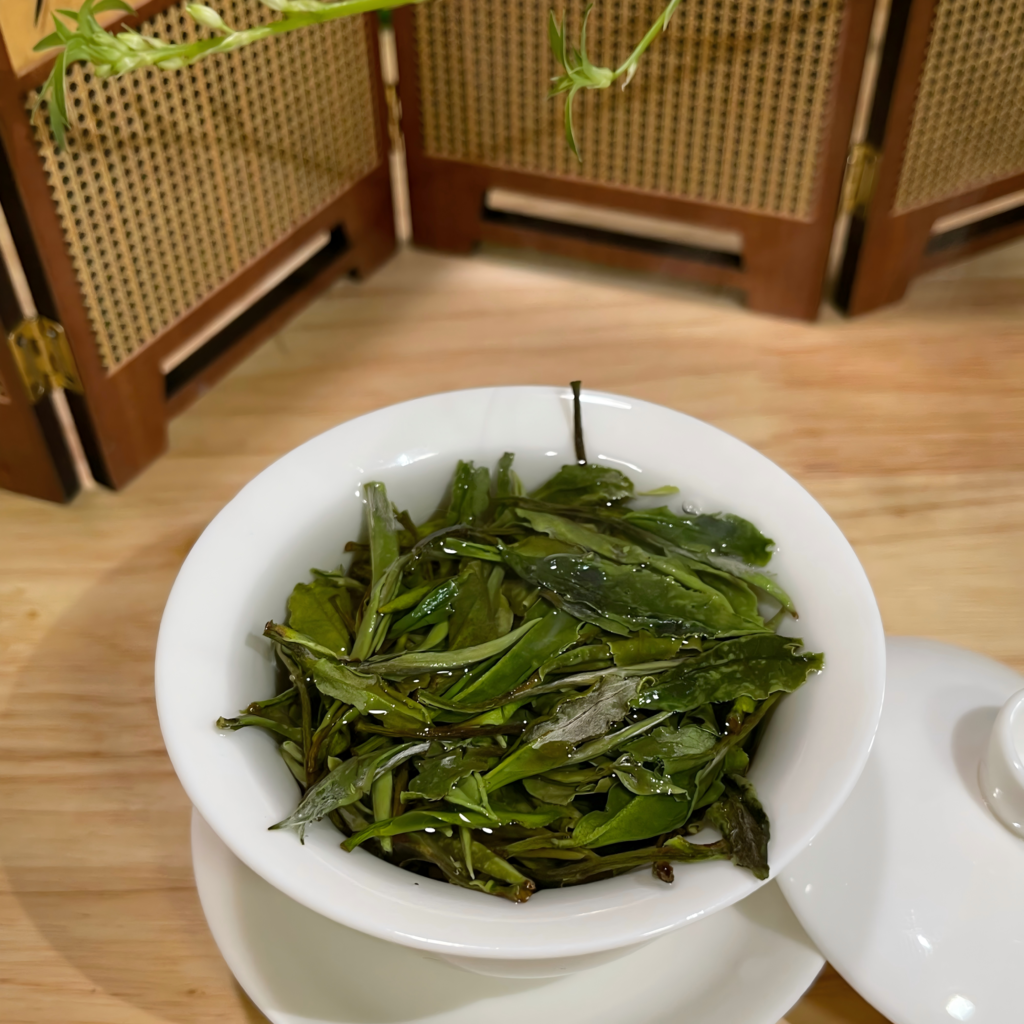
There is no national standard requiring 5 g of white tea in a 110 ml gaiwan for 15–20 seconds. It is a common starting recipe used by many tea drinkers for short, repeated infusions.
What you need
- About 5 g of tea
- A 100–120 ml gaiwan
- A kettle
- A scale
- A cup or serving pitcher
- Fresh water without a strong taste or smell
Starting temperatures
Research and producer practice support a broad tendency: tender teas often perform well at slightly lower temperatures, while mature or aged teas can handle hotter water.
Try these as starting points:
- Silver Needle: 85–90°C
- White Peony: 85–90°C
- Young Gongmei: 90–95°C
- Shoumei: 95–100°C
- Aged white tea: 95–100°C
These are not national standards or fixed rules. Laboratory extraction studies and daily gaiwan brewing use different conditions. Adjust the temperature, leaf quantity, and time for the individual tea.
Brewing steps
- Warm the gaiwan, then discard the warming water.
- Add about 5 g of tea.
- Add approximately 110 ml of water.
- Steep for about 15–20 seconds.
- Pour out the complete infusion.
- Taste and adjust the next infusion.
- If the cup is too strong, shorten the time or use cooler water.
- If it is too light, extend the time or raise the temperature.
For specific recipes on the site:
Should You Rinse White Tea?
Rinsing is optional. It is mainly a practical or sensory step, not a reliable food-safety measure.
For young Silver Needle or White Peony, many drinkers keep the first infusion because a rinse can remove some soluble flavor and aroma.
For a tightly compressed cake, a brief rinse may help wet and loosen the leaves. It may also reduce a light storage odor.
A rinse cannot reliably remove pesticide residues, microbial contamination, or mold toxins. If tea shows visible mold or a persistent musty odor, do not attempt to repair it by rinsing.
Can You Brew White Tea in a Clay Teapot?
Yes, but claims about clay should be stated carefully.
Tea culture often describes Yixing and other porous clay pots as creating a rounder or softer infusion. Studies suggest that pot material can affect some compounds in brewed tea. Direct evidence that clay consistently reduces bitterness or releases aromas from earlier brewing sessions is still limited.
Use porcelain when you want a neutral comparison between samples. Use a clean clay pot when you enjoy the brewing style and understand that its effect may vary with the clay, firing, porosity, and use history.
Can You Simmer Aged White Tea?
Mature or aged Gongmei and Shoumei are often used for simmering.
The following is a starting recipe, not an official standard:
- Heat 500 ml of water.
- Add 3–5 g of mature or aged tea.
- Simmer gently for about 3 minutes.
- Taste the liquid.
- Continue for up to 2 more minutes if needed.
Longer and hotter extraction generally releases more caffeine and polyphenols. Too much leaf or prolonged boiling may create a bitter or rough infusion.
Do not use simmering as a way to make moldy or poorly stored tea safe.
Should You Brew White Tea in a Thermos?
A thermos is convenient, but 3 g in 500 ml for 30 minutes is an experience-based recipe rather than a scientifically established optimum.
Prolonged hot extraction generally increases caffeine and polyphenol release. This can make the tea stronger and more bitter.
Mature Shoumei or Gongmei is usually more suitable for this method than delicate Silver Needle. If you want to try it:
- Start with 2–3 g in 500 ml.
- Taste after 10–15 minutes.
- Remove or strain the leaves when the strength suits you.
- Use less tea for bud-heavy products.
Do not claim that this method preserves more nutrients or provides health benefits without product-specific evidence.
How Should You Store White Tea?
Tea-storage guidance should focus on five factors:
- Moisture
- Light
- Odors
- Temperature stability
- Suitable packaging
GB/T 30375-2013, Tea Storage, requires tea to be kept in a dry, clean, odor-free environment and protected from contamination and moisture.
Short-term home storage
For tea you plan to finish within a few months:
- Keep it in clean, food-safe packaging.
- Seal the package after each use.
- Store it in a dark, dry cupboard.
- Keep it away from spices, coffee, perfume, smoke, and cleaning products.
- Keep it away from walls, floors, sinks, kettles, and other moisture sources.
For specific White Peony storage tips already on the site:
Should white tea be refrigerated?
“Never refrigerate white tea” is too absolute.
New, unopened tea may be refrigerated for short-term freshness if it is tightly sealed against moisture and odors. Allow the sealed package to return fully to room temperature before opening it.
Household refrigeration is generally less suitable for:
- Opened tea
- Tea used every day
- Tea intended for long-term aging
Frequent movement between cold and warm conditions can create condensation. Food odors may also enter poorly sealed packaging.
For opened or aging tea, a cool, dry, dark, stable room-temperature location is usually simpler.
Long-term packaging
A layered packing system is common in the Fujian white-tea trade, but it is not a mandatory national “three-layer standard.”
A practical setup may include:
- A sealed food-contact-safe inner bag
- A high-barrier foil or moisture-resistant outer bag
- A closed carton for protection from light and handling
The number of layers matters less than the performance of the packaging. It should be:
- Safe for food contact
- Clean and free from odor
- Resistant to moisture
- Properly sealed
- Protected from light and damage
Cardboard absorbs moisture, so it must not be treated as the main moisture barrier. Keep cartons off damp floors and away from walls.
Do not add desiccants or oxygen absorbers unless they are approved for food packaging and used according to their manufacturer’s instructions. Do not let loose packets come into direct contact with the tea unless the product is designed for that use.
How often should storage be checked?
Chinese tea-storage standards require monitoring but do not set a mandatory six-month interval.
Check the outer package and storage area periodically—for example, every few months or after a major seasonal change.
Look for:
- Package damage
- Dampness
- Insect activity
- Strong outside odors
- Warping or mold on the carton
Keep the inner package sealed unless there is a reason to inspect it.
What Should You Do If White Tea Smells Musty?
Do not drink tea with visible mold or a persistent musty odor.
Warning signs include:
- White, green, or grey fuzzy growth
- Damp clumps
- A cellar-like or moldy smell
- Sour-stale or rotten odors
- Moist or sticky leaves
Airing, sun-drying, roasting, rinsing, or boiling cannot reliably remove mold toxins. Discard moldy tea rather than attempting to restore it.
Normal aged aroma should be clean. Woody or herbal notes should not smell damp, rotten, or moldy.
Is Fresh or Aged White Tea Better?
Neither is automatically better.
Young tea may show:
- Fresh
- Floral
- Fruity
- Green or grassy
- Sweet aromatic qualities
Stored tea may develop:
- Mellow
- Herbal
- Woody
- Aged qualities
Research suggests that some floral and fruity compounds decrease during storage, while compounds linked with woody or aged aromas may increase. However, most studies compare different batches or market samples rather than tracking the same tea for many years.
Age alone cannot predict quality. Storage conditions, material, cultivar, processing, and packaging all matter.
If buying an older tea, ask for:
- Harvest year
- Origin
- Cultivar or plant type
- Batch identifier
- Processing records
- Storage history
Do not treat a printed vintage as proof by itself.
For related reading already on the site:
Is Loose or Compressed White Tea Better?
Neither form guarantees quality.
Producers make compressed tea by softening finished loose tea and pressing it into cakes, bricks, or other shapes. A further drying step is needed after pressing.
Loose-tea advantages
- Easy to inspect
- Easy to measure
- No tool needed to separate the leaves
- Often retains more of its original floral and fruity character
Compressed-tea advantages
- Takes less space
- Easier to stack and transport
- May develop more pronounced aged or woody aromas under suitable storage
- Convenient for keeping a complete batch together
Some studies suggest that compression may change the rate and direction of sensory and chemical transformation. Compressed tea may develop aged aromas sooner in some conditions, while loose tea may retain more floral and fruity qualities.
This does not mean cakes always age faster or taste better. Compression density, moisture, packaging, temperature, humidity, and starting material all affect the outcome.
Avoid calling these changes “mild fermentation.” A more cautious description is:
Slow oxidative, enzymatic, and possibly microbially influenced changes occur during storage.
When Is the Best Season to Drink White Tea?
You can drink it throughout the year.
Some tea enthusiasts suggest seasonal pairings:
- White Peony in spring
- Silver Needle in summer
- Gongmei in autumn
- Shoumei in winter
These are cultural and lifestyle preferences, not scientifically established rules. There is no strong consumer or clinical evidence that a specific white tea provides unique benefits in a particular season.
Choose the tea, strength, and serving temperature you enjoy.
What Beginner Mistakes Should You Avoid?
Treating brewing suggestions as fixed rules
The recommended leaf quantity, temperature, and time are starting points. Adjust them to the tea.
Leaving water in the gaiwan
Pour out the complete infusion. Water left behind continues extracting the leaves.
Using the same method for every product
A compressed Shoumei cake behaves differently from loose Silver Needle.
Treating rinsing as a safety step
A brief rinse may wet the leaves, but it cannot make moldy or contaminated tea safe.
Storing opened tea in a humid refrigerator
Cold storage may be suitable for sealed new tea, but opened packages face condensation and odor risks.
Believing every aged aroma is desirable
Musty, dusty, smoky, and sour-stale qualities are defects in white tea.
Buying old tea without records
Age labels are not proof. Ask for batch and storage details.
Assuming a higher price means higher quality
Taste a sample before buying a full cake or large bag.
Why Choose Min Tea Shop?
Min Tea Shop sources its teas from producing regions across China and offers white tea, black tea, oolong tea, green tea, and pu-erh tea. Our white tea is sourced from Shouning, a mountainous county in Ningde, northern Fujian, with more than a thousand years of tea cultivation.
Official provincial information reports more than 600,000 mu of mountainous land at 500–1,200 metres, with nearly two-thirds of the county above 800 metres. Local official information describes the protected production area for “Shouning High Mountain Tea” as including 190 villages and communities located above 500 metres.[1][2]
These official figures support Shouning’s high-mountain tea identity. They do not prove that every white-tea garden supplying our shop is located within a particular elevation range.
For each product, the shop should publish only the origin details it can document. Useful batch fields include:
- Producing village
- Garden or producer
- Harvest date
- Tea plant variety
- Picking standard
- Processing date
- Packing date
- Batch number
- Verified garden elevation, where available
Which White Tea Should a Beginner Buy?
Our usual recommendation is White Peony because it combines buds and young leaves and often produces a balanced cup.
This is our editorial recommendation—not the result of a consumer study proving that it is best for every beginner.
Choose according to taste:
- Silver Needle: for a lighter, bud-focused cup → 2026 Silver Needle
- White Peony: for a balance of freshness and body → 2026 loose, 2023 cake, 2024 cake, 2019 Dragon Pearl
- Gongmei: for local-population material and a fuller profile
- Shoumei: for mature leaves, stronger brewing, or simmering → 2025 Shoumei, 2020 cake, 2019 Shoumei, 2014 Dragon Pearl
| Product | Grade | Vintage | Best For | Link |
|---|---|---|---|---|
| 🥇 Baihao Yinzhen (Silver Needle) | Top grade | 2026 | First-time buyers, gifts | Shop now → |
| 🌸 Bai Mudan (White Peony) | Daily grade | 2026 | Everyday drinking, beginners | Shop now → |
| 🍂 Shoumei (Longevity Eyebrow) | Aged-grade | 2025 | Aging enthusiasts, value | Shop now → |
Frequently Asked Questions About White Tea
What is white tea?
u003cemu003eUnder China’s current national standard, white tea is made from tea-plant buds, leaves, or tender stems through specific processes that include withering, drying, and sorting.u003c/emu003e
What are the four main white tea product types?
u003cemu003eThey are Baihao Yinzhen, Bai Mudan, Gongmei, and Shoumei. They are product categories, not four quality levels of one product.u003c/emu003e
Is White Peony proven to be the best type for beginners?
u003cemu003eNo controlled consumer research supplied here proves that. We recommend it as a practical starting point based on its bud-and-leaf composition, typical price, and brewing experience.u003c/emu003e
How do you brew it in a gaiwan?
u003cemu003eAs a starting point, use about 5 g in a 110 ml gaiwan and steep for 15–20 seconds. Adjust the time and temperature after tasting.u003c/emu003e
What water temperature should you use?
u003cemu003eTry 85–90°C for tender Silver Needle or White Peony and 95–100°C for mature Shoumei or aged tea. These are starting ranges, not fixed standards.u003c/emu003e
Should you rinse it?
u003cemu003eRinsing is optional. It may help loosen a compressed cake, but it is not a reliable method for removing pesticides, microbes, or mold toxins.u003c/emu003e
How should it be stored?
u003cemu003eKeep it dry, dark, sealed, and away from odors. Avoid unstable temperatures and household moisture sources.u003c/emu003e
Can it go bad?
u003cemu003eYes. Moisture, poor packaging, strong odors, and heat can damage it. Do not consume tea with visible mold or a persistent musty smell.u003c/emu003e
Is older tea always more valuable?
u003cemu003eNo. Age does not correct weak material or bad storage. Quality depends on the original tea and its documented storage history.u003c/emu003e
Are Shouning tea gardens all at 600–1,200 metres?
u003cemu003ePublic sources do not prove that. Official information supports a broader u003cstrongu003e500–1,200-metre mountain-resource rangeu003c/strongu003e and identifies high-mountain tea communities above 500 metres. Specific garden elevations need garden-level records.u003c/emu003e
Final Thoughts
White tea is simple to begin with, but its production and classification deserve accurate language.
Remember these points:
- White tea is made through processes that include withering, drying, and sorting.
- Silver Needle, White Peony, Gongmei, and Shoumei are four product types, not four grades.
- Brewing numbers are starting suggestions, not fixed standards.
- Age alone does not prove quality.
- Store the leaves in clean, dry, dark, sealed packaging.
- Do not drink tea with visible mold or a persistent musty odor.
- Verify garden-level origin claims before publishing them.
If you want a balanced place to begin, our editorial recommendation is White Peony. Begin with the currently available 2026 White Peony.
Commercial Disclosure, Health Disclaimer, and Editorial Standards
Commercial disclosure: Min Tea Shop publishes this article and sells products linked from this page. The shop earns revenue when readers buy those products. This is a direct commercial relationship, not necessarily an affiliate relationship.
Editorial disclosure: Product recommendations reflect the publisher’s commercial experience and tasting preferences unless a separate independent study is cited.
Health disclaimer: White tea naturally contains compounds such as L-theanine, polyphenols, and flavonoids. This statement describes tea composition and does not claim that the product prevents, treats, or cures a disease. The presence of these compounds should not be used to imply unauthorized health benefits.
Do not use phrases such as:
- Treats or prevents disease
- Soothes a sore throat
- Detoxifies the body
- Provides therapeutic benefits
- Reduces disease risk
A disclaimer does not correct an unsupported health claim in the main article.
Storage warning: Do not consume tea with visible mold or a persistent musty odor. Home methods such as airing, rinsing, sun-drying, roasting, or boiling cannot reliably remove mold toxins.
Storage reminder from the shop: Store tea in a dry, cool place away from sunlight and strong odors.
Customer service: Email support@minteashop.com.
Editorial standards: Add a named author or reviewer only after verifying their identity, qualifications, role, and dated review record.
References
- Fujian Provincial Department of Agriculture and Rural Affairs. “品牌农业|寿宁:高山有好茶.” June 6, 2023.
http://nynct.fujian.gov.cn/ztzl/fsfsfnyp/202306/t20230608_6184018.htm - Shouning County information page. “寿宁高山茶.” September 30, 2021.
http://www.snxww.gov.cn/wap/2021-09/30/content_1160254.htm - State Administration for Market Regulation. GB/T 30766-2014, Classification of Tea.
https://openstd.samr.gov.cn/bzgk/std/newGbInfo?hcno=1FF5A0EB54D6C8ADF201F54F53BA32DC - Fujian Provincial Climate Bulletin, 2023. Shouning annual mean temperature reported as 16.3°C for 2023.
https://www.weather.com.cn/fujian/zxfw/qhgb/07/3797835.shtml - State Administration for Market Regulation. GB/T 22291-2017, White Tea.
https://openstd.samr.gov.cn/bzgk/std/newGbInfo?hcno=A87456F46DAA499E87883069D484F365 - State Administration for Market Regulation. GB/T 30375-2013, Tea Storage.
https://openstd.samr.gov.cn/bzgk/std/newGbInfo?hcno=4F91CFE70972635C672A4C8CADB853FE - “L-Theanine Content and Related Gene Expression: Novel Insights into Theanine Biosynthesis and Hydrolysis among Different Tea Plant Tissues and Cultivars.” Frontiers in Plant Science, 2017.
https://www.frontiersin.org/journals/plant-science/articles/10.3389/fpls.2017.00498/full - “基于游离氨基酸组分的白茶滋味品质研究.” 福建农业学报, 2016.
http://fjnyxb.xml-journal.net/cn/article/id/2933 - “Identification of Aroma Composition and Key Odorants Contributing to Aroma Characteristics of White Teas.” 2020.
https://pubmed.ncbi.nlm.nih.gov/33371407/ - “Influence of Brewing Conditions on Taste Components in Fuding White Tea Infusions.”
https://pubmed.ncbi.nlm.nih.gov/27786360/ - “The Characteristic of the Key Aroma-Active Components in White Tea…” Journal of the Science of Food and Agriculture, 2023.
https://onlinelibrary.wiley.com/doi/full/10.1002/jsfa.12798 - “Characteristic Volatile Compounds of White Tea with Different Storage Times…” 2024.
https://pubmed.ncbi.nlm.nih.gov/39630468/

8 Comments