
How to Brew Pu-erh Tea: Rinses, Ratios and Boiling
How to brew pu-erh tea is not one method. Raw and ripe behave differently, young raw tea needs more care than aged, and compressed tea needs to be opened up before it will give anything. The constants are boiling water, a heavy leaf ratio and short early infusions.
This page covers the parameters, why the rinses matter, how to adjust for raw versus ripe and young versus aged, and how to boil a cake when the gaiwan has given everything it has.
Table of Contents
The Numbers
How to brew pu-erh tea comes down to four values, and they are higher and hotter than most tea categories.
| Standard method | Range | |
|---|---|---|
| Leaf | 6–8 g per 100 ml | 5–10 g depending on age and compression |
| Water | Boiling, 95–100 °C | Always near boiling |
| Rinses | Two, 10 s each | One to two |
| First infusion | 10–15 s | 8–25 s |
| Later infusions | Add 5–10 s | Ten or more rounds |
Two things stand out against other categories. The leaf ratio is high, roughly double what you would use for oolong, and the water is always boiling. Pu-erh tea is compressed, heavily processed and often old, and none of that responds well to gentle treatment.
How to Brew Pu-erh Tea: Why Two Rinses
Rinsing is the first thing to get right when you learn how to brew pu-erh tea, and the usual explanations are worth separating from the wrong one. and the usual explanations are worth separating from the wrong one.
The first rinse removes dust and loose particles from the surface of a compressed cake, which has usually been stored for years and handled repeatedly.
The second rinse opens the leaf. Compression slows water penetration, and a wetted cake gives up its contents more evenly on the first real infusion.
What rinsing does not do is remove pesticide residue. That claim circulates widely and it is false: residues bound in the leaf are not washed off by a ten-second rinse. If you are concerned about residues, the answer is the producer, not the kettle.
Both rinses are discarded. Ten seconds each is enough; longer rinses waste the compounds you want.
How to Brew Pu-erh Tea: Raw vs Ripe
How to brew pu-erh tea changes depending on which type you have, and the difference is more than a matter of taste.
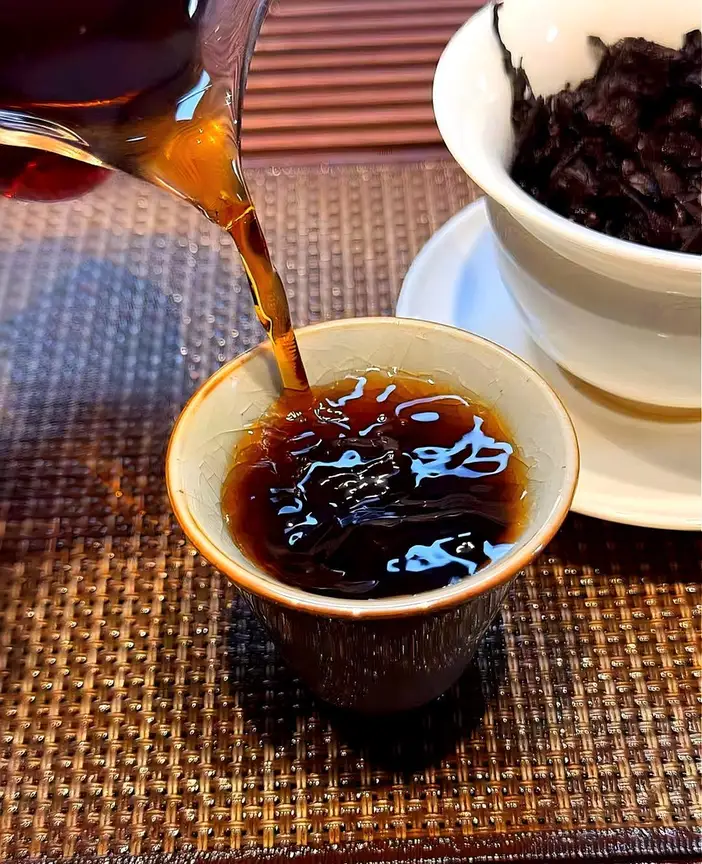
Ripe pu-erh tea is forgiving. It has already been fermented, so it gives up its character quickly and will tolerate a heavy hand. Use 6 to 8 g, two rinses, and a first infusion of 10 to 15 seconds. It will run ten or more rounds and the later ones are often the sweetest.
Raw pu-erh tea needs more judgement, because young raw is bitter and old raw is not. A fresh cake benefits from a shorter first infusion and slightly less leaf, since the catechins are still there and extract fast. An aged cake behaves more like ripe tea and can be pushed harder.
The practical rule: the older and darker the tea, the more it tolerates. The younger and greener, the more restraint it needs.
Vessel Choice for Pu-erh Brewing
Three vessels are conventional for pu-erh brewing, and each has a real use.
A gaiwan is the neutral choice and the right one for comparison. Porcelain does not absorb, so you taste the tea rather than the vessel, and you can assess a new cake before committing it to a pot.
A Yixing clay pot is the traditional choice and it changes the cup. Seasoned clay absorbs compounds and releases them into later infusions, which rounds the tea and tends to soften harshness. The cost is that a pot carries flavour between sessions, so it should be dedicated to one style.
A large pot or thermos is the everyday Chinese method for ripe tea, especially in offices. It is not elegant and it over-extracts, but ripe pu-erh tea tolerates it better than almost any other tea.
How to Brew Pu-erh Tea by Boiling
Pu-erh is one of the few tea categories where boiling the leaf is a legitimate method rather than a mistake.
After a gaiwan session has thinned out, usually somewhere past the tenth infusion, transfer the spent leaf to a pot with cold water and bring it slowly to a bare simmer. Hold it there for three to five minutes. The result is a sweet, woody infusion quite unlike the brewed cups, and for an aged cake it is often the best thing the tea produces.
Ripe tea and old raw tea both work this way. Young raw tea does not: it is bitter enough already, and boiling concentrates exactly the compounds you were managing.
Some drinkers go further and boil a cake from the start, particularly older tea. That produces a stewed, deeply savoury drink that has its own following and bears no resemblance to a gaiwan session.
Water and Temperature for Pu-erh Brewing
Pu-erh tea needs mineral content. Very soft water makes it taste thin and oddly sweet; very hard water makes it dull and leaves a scum.
Temperature should be as close to boiling as your setup allows. A kettle taken off the boil and poured immediately is right. Pu-erh brewing does not have the two-minute cooling step that green tea requires, and there is no upper limit worth worrying about.
If your tea tastes harsh rather than strong, the problem is almost always over-steeping rather than water that is too hot.
Troubleshooting Pu-erh Brewing
Flat and lifeless. Usually too little leaf or a cake that has dried out. Compression means the surface can be dry while the interior is fine, so a cake that has been stored badly at the edges may still be good inside.
Bitter at the back of the mouth. Young raw tea over-steeped. Shorten the early infusions and drop the leaf by a gram.
Musty or cellar-like. A storage problem, not a brewing one. No amount of technique fixes a cake that was stored wet.
Fishy or sour. Usually an under-fermented ripe tea, or one that was pressed too soon after fermentation. It may improve with a year or two in storage.
Tastes of nothing after four infusions. A cake made from thin material. Aged or not, it was never going to give much.
Raw vs ripe pu-erh covers the differences in the cup; pu-erh aging covers what storage does to them.
Between Sessions
A cake in use should be broken up as needed rather than all at once. Break off what you will drink over a few weeks, keep it in a breathable container, and leave the rest intact.
Once a cake is fully broken, it changes faster because the surface area increases. That is not necessarily bad, but it means a broken cake is a cake being drunk rather than a cake being stored.
Green tea storage is a different problem entirely, cold and sealed, and the two methods should not be confused.
How to Brew Pu-erh Tea by Age
How to brew pu-erh tea depends more on the age of the cake than on its type, and this is the part most guides skip.
Young raw, under five years. The most demanding case. Use 5 to 6 g rather than 8, keep the first infusion very short, and accept that the tea will be bitter. It is not a fault and it will not be fixed by technique; a young raw cake is meant to be assertive. If the bitterness is unpleasant rather than merely strong, the cake needs more time.
Raw at five to fifteen years. The sweet spot for most drinkers. Bitterness has receded, aroma has developed, and the tea tolerates a normal ratio and normal timings. This is the range where how to brew pu-erh tea becomes straightforward.
Raw past fifteen years. Treat it closer to ripe tea. It will take a full 8 g, tolerate longer infusions, and reward boiling at the end. Older cakes also open faster, so the first infusion can be shorter than you expect.
Ripe, any age. The easiest case. Ripe tea gives up its character quickly and tolerates almost anything. The main risk is over-steeping into a flat, muddy cup rather than a bitter one.
Five Mistakes
Using too little leaf. Compressed tea looks like more than it is. A scoop of broken cake can weigh four grams when it looks like eight. Weigh it for the first few sessions.
Rinsing once and calling it done. One rinse wets the surface; two open the leaf. The difference is visible in the first real infusion.
Brewing at 90 °C. Pu-erh needs boiling water. Cooler water produces a thin, slightly sour cup that people often blame on the tea.
Drinking the first infusion. The rinses are discarded for a reason. The first real infusion is the one to taste.
Storing the broken cake badly. Once you break a cake, the pieces change faster. Keep them in a breathable container away from light and smells, and break only what you will drink over a few weeks.
How Much to Break Off
A 357 g cake gives roughly 45 to 60 sessions at 6 to 8 g. That is a lot of tea, which is why breaking the whole cake at once is a mistake.
Break off enough for two to four weeks and leave the rest intact. Compression protects the interior, and a cake left whole will change more slowly and more predictably than a pile of loose pieces.
When breaking, work from the edge with a tea pick or a thin blade, following the layers rather than forcing through. A cake that shatters into dust wastes the leaf and extracts unevenly.
Your First Session
If you have never brewed pu-erh tea before, the first session is worth approaching deliberately rather than by experiment.
Start with ripe tea. It is forgiving, cheap and drinkable immediately, and it will teach you the mechanics, how much 7 g of compressed leaf looks like, how fast the first infusion colours, how the leaf opens across the session, without punishing mistakes.
Use a gaiwan and a scale. Porcelain shows you the tea rather than the vessel, and the scale settles the leaf-ratio question that causes most beginner disappointment. Break off 7 g, rinse twice, then brew ten seconds and adjust from there.
Expect the first two sessions to be imperfect. The variables that matter, how tightly your particular cake is pressed, how dry it is, how much it has aged, are specific to that cake, and no guide can tell you how to brew pu-erh tea from a cake it has never seen. Adjust on the second infusion, not the first.
Frequently Asked Questions
What temperature should pu-erh tea be brewed at?
Boiling, 95 to 100 °C. Pu-erh is compressed and often aged, and cooler water will not open the leaf.
How many times should I rinse pu-erh tea?
Twice, about ten seconds each. The first removes surface dust, the second opens the leaf. Both are discarded.
How much pu-erh tea per cup?
6 to 8 g per 100 ml, which is roughly double an oolong ratio. Compressed tea is dense, so weigh it rather than judging by eye.
Does rinsing remove pesticides from pu-erh tea?
No. A ten-second rinse does not remove residues bound in the leaf. The claim is common and false.
Can you boil pu-erh tea?
Yes, and for ripe or aged raw tea it is a good method, especially after a gaiwan session has thinned. Young raw tea should not be boiled.
Why does my pu-erh taste musty?
A storage problem. A cake kept too humid develops off-flavours that no brewing technique removes. Pu-erh aging covers the storage conditions that prevent it.
Shop the pu-erh teas in this guide
Sold from our own stock. Every listing states the year, the region and the storage.
- 2021 Lincang ripe tuocha, $19.90
- 2023 Phoenix Mountain raw tuocha, $19.90
Or browse the full pu-erh collection.
Related Reading
the category as a whole, raw versus ripe, what ageing does and the caffeine figures.
Product and testing requirements are set in GB/T 22111, published on China’s national standards platform. Sensory evaluation follows GB/T 23776.
Sources & References
Standards
Standard text and dates are published on China’s national standards platform: openstd.samr.gov.cn.
- GB/T 22111-2008, Geographical indication product: Pu-erh tea. Product types and pressed formats.
- GB/T 23776-2018, Tea sensory evaluation.
Related Guides
- Raw vs ripe pu-erh tea, processing and taste differences.
- Pu-erh processing, sun-drying and pile fermentation.
- Pu-erh aging, what storage does.
What this page does not claim
We do not claim rinsing removes pesticide residue, that one vessel is correct, or that boiling suits every cake. Where a practice is convention rather than regulation, the page says so.
