Green Tea Types: The Four Manufacturing Styles
Two green teas can look nothing alike and still belong to the same manufacturing style; two that look identical can be processed differently. The Chinese standard sorts them by how the leaf is heated, not by shape, region or colour.
This page covers the four styles, the named teas that represent them, and the two labels on a tin that mislead most often.
Table of Contents
The Four Green Tea Types
The division is set by GB/T 14456 and rests on two questions: what medium heats the leaf during kill-green, and how the leaf is finally dried.
| Green tea type | Kill-green | Drying | Representative teas |
|---|---|---|---|
| Pan-fired (炒青) | Hot wok or drum | Pan-fired | Longjing, Biluochun, Xinyang Maojian, Yuhua |
| Baked (烘青) | Hot wok or drum | Baked | Huangshan Maofeng, Taiping Houkui |
| Sun-dried (晒青) | Hot wok | Sunlight | Dianqing, Chuanqing, Shanqing |
| Steamed (蒸青) | Steam | Baked | Enshi Yulu |
Most green tea types sold outside China are the first two. The fourth is nearly absent from the Chinese market and dominant in Japan, which is the source of much confusion about what “green tea types” even means.
Pan-Fired Green Tea Types
Pan-firing is the Chinese default. The leaf goes into a hot wok or a heated drum and is turned and pressed by hand or machine, which kills the enzymes and begins to shape the leaf at the same time.
The sensory result is the profile most Western drinkers associate with Chinese green tea: a roasted, chestnut or cooked-bean aroma over a sweet base. The chemistry behind that is documented. A controlled study drying green tea at four temperatures found 90 °C produced a fresh green aroma, 110 °C chestnut, 140 °C cooked bean and 160 °C a high-fire character, with 95 volatile compounds identified across the set.
Pan-fired green tea types also tend to have more amino acids and fewer catechins than steamed leaf from the same harvest. A same-batch comparison found 41.47 mg per gram of amino acids against 33.79 for steamed, and 111.36 mg per gram of catechins against 139.68. The pan-fired cup is consequently rounder and sweeter; the steamed cup is greener and more astringent.
Longjing is the reference. Flat, pressed, pale green, picked before Qingming at the top grades. Biluochun is the opposite shape from the same family of methods: tiny, curled and bud-heavy. Xinyang Maojian is needle-shaped and comes from Henan, the northernmost of the major green tea regions.
Baked Green Tea Types
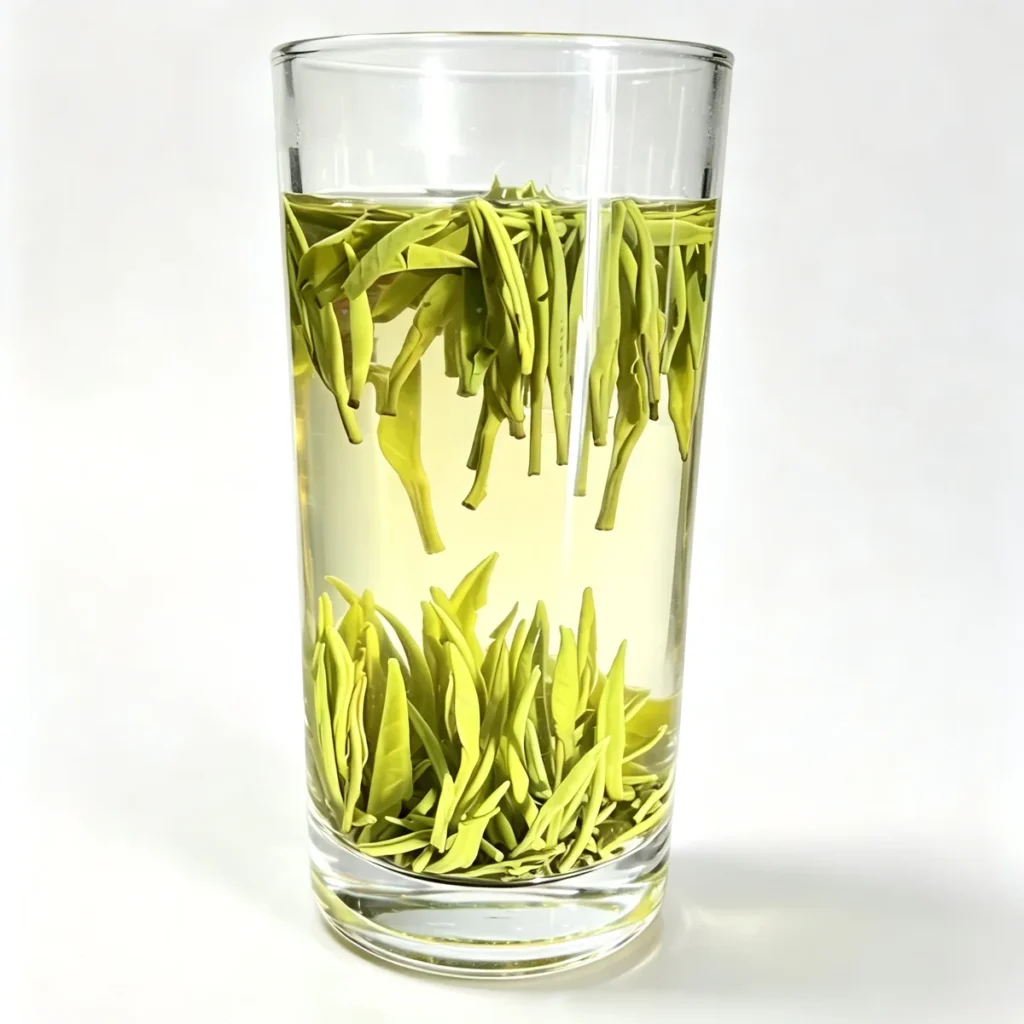
Baked green tea uses the same kill-green as pan-fired tea but dries the leaf entirely with hot air. The leaf is not pressed against a hot surface during drying, so it keeps a looser, strip-like shape, not a flat one.
The cup is softer. Baked green tea types generally show less roast character and more of a sweet, slightly floral quality, and they hold up a little better to a slightly hotter brew than a delicate pan-fired tea. The trade often describes them as gentler, which is imprecise but points at something real: the aroma sits lower and the finish is shorter.
Huangshan Maofeng is the best-known example, from the Yellow Mountain region of Anhui, with downy buds and a shape often described as a sparrow’s tongue. Taiping Houkui is the shape outlier of the whole category, with large flat leaves pressed between cloth during drying, with a distinctive grid pattern on the surface.
Liu’an Guapian is the awkward case in this group. It is pan-fired to shape the leaf and then finished with a heavy baking stage, so published sources classify it as pan-fired, as baked, or as neither. Describing it as sitting between the two green tea types is more accurate than forcing it into one.
Sun-Dried Green Tea Types
Sun-dried green tea is pan-fired and then spread out to dry in sunlight, not over heat. It is the smallest of the four green tea types in commercial terms outside China, and the most consequential.
Dianqing, Yunnan sun-dried green tea made from large-leaf material, is the raw material for raw pu-erh. That means the tea most drinkers think of as a separate category begins its life inside the green tea standard, and only becomes pu-erh after pressing and, for the ripe style, pile fermentation.
In the cup, sun-dried green tea types are rougher and more assertive than the pan-fired and baked styles. They carry a sun-warmed, slightly smoky quality and a bitterness that reads as structural, not as a fault. They are not usually drunk young as a delicate green tea; they are either aged as pu-erh or brewed hard.
Steamed Green Tea Types
Steam kill-green is the oldest documented method in China and the standard method in Japan.
The Tang dynasty tea classic describes the sequence directly: steam it, pound it, press it, bake it, string it, seal it. That is steamed green tea in cake form. Steaming was later displaced in China by pan-firing, first appearing in the late Yuan and spreading through the Ming, with the 1391 abolition of tribute cake tea marking the institutional turn.
Enshi Yulu in Hubei is the representative surviving Chinese steamed green tea, a needle-shaped tea with roots in the Kangxi period. It is often described as the only surviving steamed needle-shaped green tea in the country, which is close enough to true to be useful and precise enough to be worth checking before repeating.
Steamed green tea types are chemically distinct. The same-batch comparison cited above found steamed leaf higher in catechins and lower in amino acids, with an aroma dominated by alcohols, not esters. In the cup that reads as bright green, marine, slightly grassy, with more astringency and less chestnut sweetness.
Green tea processing covers the kill-green step and why steaming and pan-firing diverge.
By region
Chinese green tea is grown across four production regions, and each has a characteristic set of named teas.
Jiangnan, the lower Yangtze region, is the most famous: West Lake Longjing, Dongting Biluochun, Huangshan Maofeng, Taiping Houkui and Lushan Yunwu all come from here. This is the region that established the international image of Chinese green tea.
Jiangbei, north of the Yangtze, is cooler and produces teas with more pronounced aroma and slower growth: Xinyang Maojian, Liu’an Guapian, Laoshan green tea and Ziyang Maojian.
Xinan, the southwest, covers Sichuan, Guizhou and Yunnan: Mengding Ganlu, Duyun Maojian, Zhu Ye Qing and Dianqing.
Huanan, the south, is dominated by oolong and dark tea, with green tea a minor product: Yingde green tea and Guilin Maojian.
The Label That Misleads Most: Anji Bai Cha
Anji Bai Cha is a green tea, and the name says otherwise to almost everyone who reads it.
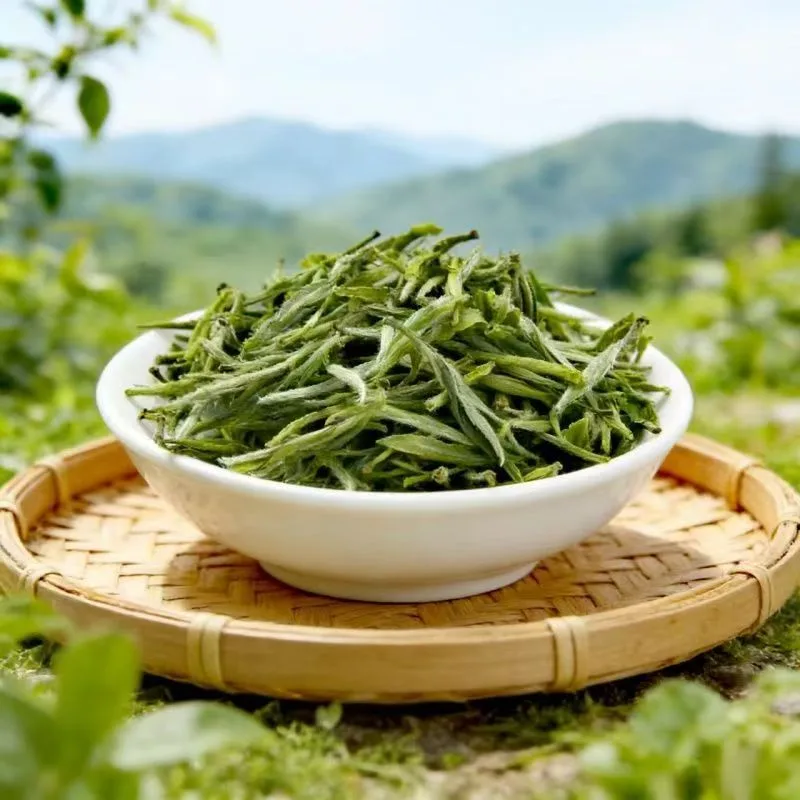
“Bai” means white. The tea is not white tea, and no part of its processing resembles white tea. The name refers to the cultivar: Bai Ye No. 1, a tea plant that turns pale, almost yellow-white, during a cold-induced phase in early spring. The leaf is picked during that albino window, when chlorophyll is low and amino acids are high, then processed by the standard green tea method.
So Anji Bai Cha is one of the green tea types, legally and technically. It was granted geographical indication protection in 2004 and is covered by GB/T 20354. The confusion is understandable and the tea is genuinely unusual, but it is not a white tea.
The Second Misleading Label: “Que She”
Que She means bird’s tongue, a shape description, not a tea name.
There is no protected tea called Que She. What exists are specific protected products that use the name as part of a longer one: Pujiang Que She, a geographical indication since 2008, and Jintan Que She, covered by a Jiangsu provincial standard. A product sold simply as “Que She” is describing its leaf shape and nothing else.
That does not make it bad tea. A single-bud green tea shaped like a bird’s tongue can be excellent. It does mean the name carries no origin claim and no verifiable quality standard, which is worth knowing before paying a premium for it.
Why Shape Became a Category
The four legal green tea types are defined by heat and drying, but the trade talks about shape constantly. The reason is practical: shape is the only quality signal visible before you buy.
A flat Longjing tells you the leaf was pressed against a hot surface while it dried, which means the producer invested in shaping. A tightly curled Biluochun tells you the buds were rolled while fragile, which takes skill. A large flat Houkui leaf tells you someone pressed it between cloth by hand, which is slow and expensive.
None of that is a guarantee. Shape can be produced mechanically, and a well-shaped leaf can hide indifferent material. But the correlation is real enough that the trade uses shape as a first filter, and buyers who learn the four or five characteristic shapes can place most teas in the correct green tea types within seconds of opening a tin.
Telling the types apart
Shape and colour give you the manufacturing style before you brew anything.
Flat and pressed almost always means pan-fired, and usually Longjing or a tea imitating it. Tightly curled and bud-heavy points to Biluochun. Loose strips with downy buds suggests baked, most likely Maofeng. Large flat leaves with a grid pattern is Taiping Houkui and nothing else. Needle-shaped and deep green could be steamed Enshi Yulu or a pan-fired needle tea, and the aroma decides: marine and grassy means steamed, chestnut means pan-fired.
Two cautions. First, shape can be imitated. Flat-pressing machinery means any leaf can be made to look like Longjing, which is the basis of the most common mislabelling in the category. Second, roast level can override cultivar character, so a heavily fired tea may smell more like its processing than like its origin.
What to Look For
Four pieces of information, in order of usefulness:
- The processing style: pan-fired, baked, sun-dried or steamed. This predicts the cup more reliably than the tea name.
- The harvest date, ideally before or after Qingming. Early spring leaf is scarcer and higher in amino acids.
- The product standard. A named tea should map to one: Longjing to GB/T 18650, Biluochun to GB/T 18957, Maofeng to GB/T 19460.
- The cultivar, for teas where it matters. Anji Bai Cha’s Bai Ye No. 1 is the clearest case.
What a label cannot tell you is whether the origin claim is true. Longjing’s geographical indication covers 18 counties across four prefecture-level cities; only the West Lake zone is what most buyers think they are paying for. Longjing tea sets out what that distinction means.
Three things to remember
- Four manufacturing styles cover the category.
- Anji Bai Cha is a green tea, despite the pale leaf.
- “Que She” describes a leaf shape, not a protected grade.
Frequently Asked Questions
How many green tea types are there?
Four manufacturing types under the Chinese standard: pan-fired, baked, sun-dried and steamed. Named teas sit inside those types, not beside them.
Is matcha a green tea type?
Matcha is a green tea, but it is a product, not one of the four manufacturing types. It is made from shaded leaf, steamed, dried without rolling, and ground to powder. The shading changes the leaf chemistry before processing.
Which green tea types are best for beginners?
Pan-fired and baked types are the most forgiving and the most familiar. Steamed green tea has a marine, grassy profile that some drinkers find bracing and others find off-putting. Sun-dried tea is usually drunk as pu-erh, not as green tea.
Is Anji Bai Cha a white tea?
No. It is a green tea made from a cultivar that turns pale in spring. The “bai” in the name refers to the leaf colour during that phase, not to white tea processing.
What is Que She tea?
A shape name meaning bird’s tongue, not a protected tea name. Specific products like Pujiang Que She and Jintan Que She are protected; a plain Que She label is describing appearance only.
Taste two styles side by side. Pan-fired Longjing against steamed or baked leaf shows the heating step directly; brew both at 80 °C. Shifeng Longjing · Shouning green tea.
- Shifeng Pre-Qingming Longjing, $14.90
- Huangshan Pre-Qingming Maofeng, $19.90
- Dongting Biluochun, $19.90
Or browse the full green tea collection.
Read next
For the category as a whole, see Chinese green tea. For the process, read how green tea is made. Also worth opening: what green tea is, the three Longjing zones, Biluochun in depth and how the leaf is made, matcha, a product rather than a manufacturing style and green tea vs matcha, compared in detail.
Sources & References
Standards
- GB/T 14456.1-2017 — Green tea, Part 1: Basic requirements. The four-type classification is in clause 4.1.
- GB/T 14456.2-2018 — Large-leaf green tea; definitions of pan-fired, baked and sun-dried at 3.3–3.5.
- GB/T 14456.6-2016 — Steamed green tea.
- GB/T 20354-2006 — Geographical indication product: Anji Bai Cha.
- GB/T 18650-2008, GB/T 18957-2008, GB/T 19460-2008 — Longjing, Biluochun, Huangshan Maofeng.
Peer-Reviewed Research
- LWT (2022). Drying temperature maps to aroma: 90/110/140/160 °C for fresh, chestnut, bean and high-fire. DOI:
10.1016/j.lwt.2022.113394 - Foods (2022). Pan-fired versus steamed from the same leaf: amino acids 41.47 vs 33.79 mg/g, catechins 111.36 vs 139.68 mg/g. DOI:
10.3390/foods11111582 - Current Research in Food Science (2022). Aroma comparison across the four manufacturing types. DOI:
10.1016/j.crfs.2022.06.012
Boundary of this page: We do not claim Anji Bai Cha is a white tea, that Que She is a protected name, or that Liu’an Guapian belongs cleanly to one processing type. Where sources disagree, the page says so.