
Biluochun Tea: The Two-Town Origin and the Legend
Biluochun is the tea most often described by its shape: tight coils of downy leaf that unfurl into a cup with a peach and apricot aroma. The shape is a processing result, not a variety, and the name has a longer story than the legend suggests.
This page covers where it comes from, how it is made, the harvest window, brewing, and how to tell it from Longjing.
Table of Contents
Where Biluochun Tea Comes From
The protected origin is small and specific: Dongting, on the shores of Lake Tai in Suzhou, Jiangsu. The geographical indication was approved on 9 December 2002 under announcement No. 127, and the protected area covers the towns of Dongshan and Jintin, the latter being the former Xishan, in Suzhou’s Wuzhong district.
That is a compact area, and it is the reason Biluochun tea is scarce. Unlike Longjing, whose protected region spans 18 counties across four cities, Biluochun’s origin is two towns on a lake. The supply constraint is structural, not a matter of marketing.
The product standard is GB/T 18957-2008, which replaced the 2003 edition. As with Longjing, the standard fixes the origin, the cultivars and the processing instead of leaving them to convention.
The Shape
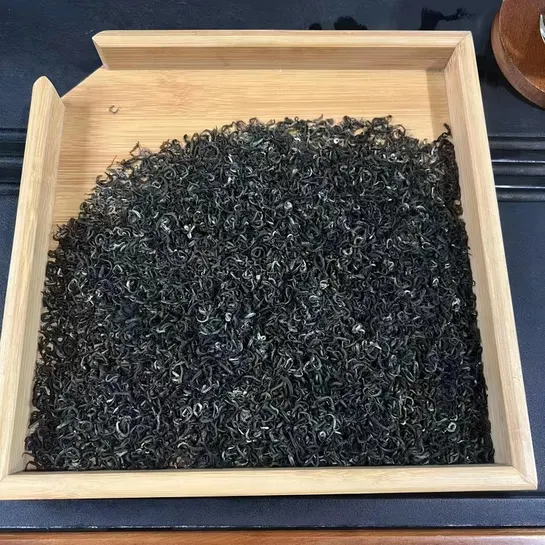
Biluochun is among the smallest-shaped teas in China. The leaf is rolled into fine, tight curls compared to a snail, the “snail spring” of the English name, and the highest grades are essentially all bud, with the downy white hairs still visible.
The shape is the reason the tea is difficult to process. Bud-heavy leaf is fragile, and rolling it into tight curls without breaking it takes a light hand and precise timing. It is also the reason the tea is easy to counterfeit: the shape can be approximated by machine, and a curled green tea from almost anywhere can be sold under the name.
What the shape tells you is that the leaf was young and handled carefully. What it does not tell you is where it grew.

How It Is Made
Biluochun is a pan-fired green tea. The leaf is picked in early spring, spread briefly, then kill-green in a hot wok and rolled while still warm and pliable.
The hand movements are the same family as those used for Longjing, pressing, twisting and turning against a hot surface, but the target is different. Longjing is pressed flat; Biluochun is rolled into a curl. Both are using the same heat to stop the enzymes and the same manual pressure to shape the leaf, and both produce the chestnut-sweet profile that characterises pan-fired Chinese green tea.
That profile is a firing outcome, not a cultivar trait. A controlled study drying green tea at four temperatures found a clean progression, with roughly 110 °C producing a chestnut aroma and higher temperatures pushing toward cooked-bean and then high-fire notes. Biluochun’s sweetness sits at the gentler end of that range, which is also why it can turn harsh if the leaf is over-fired.
Green tea processing explains the kill-green step and why pan-firing and steaming diverge so sharply in the cup.
The Name and the Legend
The name Biluochun is usually translated as “green snail spring”, referring to the shape and the season. The story attached to it is more colourful.
According to the most repeated version, a local woman’s tea was so fragrant that she exclaimed it would “scare a person to death” — xia sha ren xiang, and the name stuck. The tale continues that the Kangxi emperor, tasting it during a southern tour, found the name vulgar and renamed it Biluochun.
The documented trace for this is a Qing dynasty notebook, Wang Yingkui’s Liunan xubi, which records that in the 38th year of Kangxi — 1699 — the official Song Luo presented a tea called “xia sha ren xiang”, and that Kangxi gave it the name Biluochun. That is a Qing source, not an imperial archive, so the story is a documented anecdote, not a verified event. It is reasonable to repeat it with attribution and unreasonable to present it as record.
The Award That Did Not Happen
Biluochun is frequently described as having won a gold medal at the 1915 Panama-Pacific International Exposition. The claim appears on packaging and in marketing copy across the category.
It is not supported by the record. According to the Chinese delegation’s own published account of the exposition, China received 21 gold medals, and the tea winners included Keemun black tea, Taiping Houkui, Yunhe Huiming and Xinyang Maojian. Neither Biluochun nor Longjing appears on that list.
This matters beyond pedantry. Biluochun tea already has a genuine geographical indication, a national product standard and a documented origin. The invented award adds nothing except a reason to distrust the rest of the description.
The Harvest Window
Biluochun is picked in a short window in early spring, and the highest grades are pre-Qingming leaf, picked before the Qingming solar term in early April.
The term has no national standard definition; it is a Jiangnan seasonal label. What it signals is that the leaf grew slowly in cool weather, which generally means higher amino acids, lower catechins and a sweeter cup. It also means very low yield, which is why pre-Qingming Biluochun tea costs what it does.
Leaf picked after Qingming but before Grain Rain is larger, stronger and considerably cheaper. It is a legitimate product, not a fraud, as long as the harvest date is stated.
Brewing Biluochun Tea
This is where Biluochun punishes carelessness. The leaf is almost all bud, which means it extracts quickly and turns astringent if pushed.
Use 3 g in 150 ml of water at 80 °C. Pour the water first and add the leaf, or add the leaf and pour gently; either way, avoid dumping boiling water onto bud-heavy leaf. Steep for 60 to 90 seconds on the first infusion shorter than Longjing needs, because the buds give up their contents faster.
Do not use a covered vessel for long. Bud tea scalds easily, and trapping the heat accelerates the extraction of the catechins that make the cup bitter.
A glass is the usual vessel, and it is a practical choice, not an antique one: the leaf unfurls visibly and you can watch the colour develop. Expect two or three infusions. Biluochun does not have the structure for a long session.
How to brew green tea sets out the general method and the chemistry behind the temperature advice.
Judging What You Are Buying
Biluochun is expensive, small in volume, and easy to imitate. Four checks are worth making.
Is the origin stated? Dongting, Dongshan or Jintin are the claims that matter. A Biluochun label with no origin is describing a shape.
Is the harvest date given? Pre-Qingming and post-Qingming Biluochun differ enough that a listing should say which.
Does the leaf look like bud? The highest grades are essentially all bud with visible white down. Large leaves with few buds mean a later pick, which is fine if the price reflects it.
Is the price plausible? Media reporting puts e-commerce Biluochun at roughly 130 to 260 yuan per 50 g, which works out to about 1,300 to 2,600 yuan per 500 g for the products sampled. A Dongting claim at a fraction of that is not a bargain.
Biluochun Against Longjing
The two are the reference pan-fired green teas and are often compared, usually unfairly to one of them.
| Biluochun tea | Longjing tea | |
|---|---|---|
| Shape | Tight curls, bud-heavy | Flat and pressed |
| Origin size | Two towns on Lake Tai | 18 counties, four cities |
| Cup | Softer, sweeter, more floral | Chestnut, bean, more structure |
| Forgiveness | Low | Moderate |
| Infusions | Two to three | Two to three |
Biluochun is the more delicate tea and the harder one to brew well. Longjing has a little more margin. Which is better is a matter of what you want from the cup and both are frequently counterfeited, for the same reason.
Storing Biluochun Tea
Biluochun degrades faster than almost any tea in the category, and the reason is structural: the leaf is nearly all bud, which means a high proportion of surface area to volume and little protective structure.
Green tea has no standard shelf life. GB/T 14456.1-2017 does not set one, and packaged food labelling rules require the producer to declare a date instead of comply with a fixed limit. Industry practice runs 12 to 18 months when refrigerated, with some producers declaring two years.
For Biluochun tea specifically, the practical advice is to buy in quantities you will finish in three months and to refrigerate what you do not open. Sealed, opaque, 0 to 5 °C, away from anything with a smell. Frozen storage at minus 18 °C extends the window further if the packaging is genuinely airtight.
What ruins this tea fastest is condensation. Moving a tin in and out of the refrigerator lets moisture form inside, and bud tea absorbs it immediately. Portion the tea into small sealed units before chilling so that each one is opened once.
How to store green tea covers the wider method and the arithmetic of how long a tin actually lasts.
The Dongting Setting
The origin is worth understanding because it explains the tea’s character better than any processing description.
Dongting is not a mountain. It is a pair of peninsulas and islands in Lake Tai, west of Suzhou, in a landscape of low hills and water. The moderating effect of a large lake keeps spring temperatures stable, which matters for a tea picked in the coldest weeks of the growing season.
Stable temperatures mean slow, even growth, and slow growth is what concentrates amino acids relative to catechins. That is the same chemistry that makes pre-Qingming leaf valuable across the category, and in Dongting the lake makes it more reliable.
It also means the growing area is small and bounded by water. There is no possibility of expanding the protected origin outward the way a land-based region could. Biluochun tea is scarce because the geography says so.
Three things to remember
- The coil shape comes from hand-rolling while the leaf is still warm.
- The Dongting hills are the traditional origin; the harvest window is short.
- Brew it cooler than Longjing, around 75 to 80 °C.
Frequently Asked Questions
Is Biluochun tea a green tea?
Yes. It is a pan-fired green tea from the Dongting area of Suzhou, protected as a geographical indication since December 2002.
Why is Biluochun so expensive?
Two structural reasons: the protected origin is only two towns on Lake Tai, and the highest grades are picked before Qingming, a short window with very low yield. Bud-heavy leaf also takes more picking and more careful processing.
Did Biluochun win a gold medal at the 1915 Panama Exposition?
Not according to the Chinese delegation’s published record, which lists 21 gold medals including Keemun, Taiping Houkui, Yunhe Huiming and Xinyang Maojian. Biluochun is not among them.
What water temperature for Biluochun?
Around 80 °C. Boiling water scalds the buds and drives the extraction of astringent catechins. Steep for 60 to 90 seconds on the first infusion.
Does Biluochun have caffeine?
Yes, like all true tea. Caffeine in dry green tea leaf runs 3 to 6 percent by weight, and how much reaches the cup depends on leaf quantity, water temperature and steep time. Green tea caffeine has the figures.
Taste the coil shape for yourself. Dongting Biluochun is the reference; brew it at 75 to 80 °C and watch the coils open.
- Dongting Biluochun, $19.90
- Meitan Que She, single bud, $9.90
Or browse the full green tea collection.
Read next
Read Longjing is the closest comparison, because the two are often confused and brewed differently. Also worth opening: the category as a whole, the four styles, brewing bud tea and storing it.
Sources & References
Standards
- GB/T 18957-2008 — Geographical indication product: Dongting Biluochun tea. Replaces GB 18957-2003.
- Geographical indication approval: 9 December 2002, announcement No. 127, State Administration for Quality Supervision and Inspection and Quarantine.
- GB/T 14456.1-2017 — Green tea, Part 1: Basic requirements.
Historical Sources
- Wang Yingkui, Liunan xubi, the Qing notebook recording the 1699 presentation and the Kangxi renaming.
- Record of China’s Participation in the Panama-Pacific Exposition, the delegation’s published list of 21 gold medals.
Peer-Reviewed Research
- LWT (2022). Drying temperature and green tea aroma; 110 °C chestnut, 140 °C cooked bean. DOI:
10.1016/j.lwt.2022.113394 - Food Chemistry (2005). Catechin extraction at 80 °C versus 95 °C. DOI:
10.1016/j.foodchem.2005.03.015 - Critical Reviews in Food Science and Nutrition (1997). Caffeine at 3–6% of dry leaf weight. DOI:
10.1080/10408399709527797
Boundary of this page: We do not claim the Kangxi story is documented fact, that Biluochun won a Panama medal, or that the tea is caffeine-free. Where the record is an anecdote, not an archive, the page says so.


