
Gongmei vs Shoumei: Which White Tea Grade to Choose
Gongmei and Shoumei are the two leaf-dominant white teas, and they are routinely confused — sometimes by drinkers, occasionally by sellers. The confusion is partly justified: the national standard draws a line between them that is precise on paper and nearly invisible in a bag of dry leaf.
Here is what the line actually is, why it only became a line in 2018, and what it means when you are choosing between them.
Table of Contents

The One Real Difference
GB/T 22291-2017 defines both grades by raw material, and the definitions differ on two points.
| Gongmei (贡眉) | Shoumei (寿眉) | |
|---|---|---|
| Cultivars permitted | 群体种 (population varieties) only | Daibai, Shuixian, or 群体种 (population varieties) |
| Plant part | Tender shoots | Tender shoots or leaves |
| Grades in standard | 4 | 2 |
Read it carefully, because the asymmetry matters. Gongmei is restricted to population varieties — the sexually reproduced landraces known as Cai Cha (菜茶). Shoumei may use those or the named Daibai and Shuixian cultivars, and may use leaves as well as shoots.
That means Shoumei is the broader category: everything that could be Gongmei could also legally be Shoumei, but not the reverse. It is a one-way relationship, and it explains most of the confusion that follows.
Why This Only Became a Rule in 2018
The cultivar restriction is recent, and knowing that changes how you read older sources.
The 2008 standard, GB/T 22291-2008, recognised three products: Baihao Yinzhen, Baimudan and Gongmei. There was no Shoumei as a standardised category at all, and no cultivar requirement for Gongmei.
The 2017 standard, effective from May 2018, added Shoumei as a fourth product — and simultaneously restricted Gongmei to population varieties. So “Gongmei must be Cai Cha (菜茶)” is a claim that was conventional before 2018 and regulatory after it.
This is not a trivial distinction for buyers. A tea sold as Gongmei in 2015 made from Daibai material would have been entirely legal. The same tea sold today as Gongmei would not be.
Why the Boundary Is Fuzzy in Practice
Knowing the rule does not make identification easy, for three reasons.
Shoumei can use the same cultivar. Because Shoumei may be made from 群体种 (population varieties), a tea made from population-variety shoots could legitimately be sold as either grade. The difference is what the producer chose to call it.
The sensory descriptions overlap. The standard’s own language for Gongmei’s lower grades and Shoumei’s grades is close to identical — both use 浓纯 for aroma and 浓厚 for taste at the lower end. There is no sensory test that separates them.
Cultivar is invisible in the leaf. You cannot tell Cai Cha (菜茶) from Daibai by looking at dried leaf with any confidence. Population varieties are generally smaller-leaved and thinner, but “generally” is doing a lot of work in that sentence.
What this means practically: the grade name on a Gongmei packet is a declaration about cultivar, and you are trusting the seller. The grade name on a Shoumei packet is a declaration about raw material, which is somewhat easier to verify by eye — leaves and stem are visible.
What the Standard Says They Taste Like
Where the standard does differentiate is at the higher grades, and the difference is worth knowing.
Gongmei, special grade: leaf form rolled (叶态卷), bud hearts present, uniform, clean, grey-green or dark green. Aroma 鲜嫩 with 毫香 (down fragrance). Taste 清甜醇爽 — clean, sweet, mellow. Liquor 橙黄, orange-yellow. Wet leaf shows bud tips, tender and bright.
Shoumei, first grade: leaf form still slightly rolled (叶态尚紧卷), fairly uniform, fairly clean, still grey-green. Aroma 纯 — pure. Taste 醇厚尚爽 — mellow and thick, still brisk. Liquor 尚橙黄, yellowish-orange. Wet leaf shows some bud tips, soft and bright.
The distinguishing words are 毫香 (down fragrance) and 清甜 (clean sweetness) in Gongmei against 醇厚 (mellow and thick) in Shoumei. In plain terms: Gongmei at its best retains a downy sweetness and a suggestion of the bud grades; Shoumei at its best is thicker and more savoury. Gongmei has four grades against Shoumei’s two, which means the Gongmei range is wider at the top.
In the mouth the distinction is easier than in the bag. Gongmei’s downy sweetness reads as a lift at the front of the sip — the same 毫香 you find in the bud grades, diluted but present. Shoumei’s weight sits in the middle: thicker texture, less perfume, a longer and flatter finish. If you brew both at the same time and taste them side by side, the difference is obvious within two sips, even though neither the leaf nor the standard’s wording made it obvious beforehand.
How They Age Differently
Both are considered aging grades, and both are commonly pressed into cakes. The differences are subtle but real.
Shoumei contains more stem and more mature leaf, and both carry sugars and structural material that transform slowly. That is why Shoumei is the classic aging grade: it has more to work with, and it holds up over years better than the bud-dominant grades.
Gongmei, being restricted to population varieties, ages in a way that reflects the Cai Cha (菜茶) character — generally described as having more inherent aroma and a slightly more complex base. Whether that translates into better aged tea is a matter of taste rather than something the research settles.
What the research does establish is that the “older is better” assumption is unreliable for either. A study of white tea cakes aged 2 to 19 years found four years scoring best on sensory evaluation. A separate trial found optimal storage conditions differed by grade — White Peony at 25 °C and 40% humidity, Shoumei at 25 °C and 60%. So grade and storage interact, and the peak is not simply a function of time.
Full detail on aging is in the Shoumei aging guide.
Brewing Gongmei and Shoumei
Both are leaf-dominant teas and both want more heat and more time than the bud grades, but there is a difference between them.
Gongmei retains some bud content and a downy sweetness, so it sits between White Peony and Shoumei in brewing terms: 90–95 °C, 5 g per 110 ml, 15–20 seconds for the first infusion.
Shoumei has more mature leaf and stem, which resists water more. 95 °C, the same ratio, and 20–25 seconds to start. Younger Shoumei can be brewed like Gongmei; aged Shoumei wants the hotter end, and can be simmered.
One point both share: pour the whole infusion off each time. Leaf-dominant teas extract fast once wet, and leaving water on them turns the second steep bitter while leaving the third thin.
Full vessel-by-vessel instructions are in how to brew white tea.
Which Should You Buy?
Three honest answers depending on what you want.
If you want value for daily drinking, Shoumei. It is the cheapest white tea category, it is forgiving to brew, and a good Shoumei is genuinely pleasant rather than merely acceptable.
If you want to age something, Shoumei again — more stem and mature leaf means more material to transform, and it is the conventional choice for cakes.
If you want to explore Cai Cha (菜茶), Gongmei. It is the only standardised outlet for population-variety white tea, and the flavour is genuinely different from Daibai-based tea: more aromatic, slightly more complex, less uniformly sweet.
There is also a practical buying point that applies to both: buy a small quantity first. These are inexpensive categories relative to Silver Needle, but they are also the categories where the gap between a well-made and a poorly made example is widest. Fifty grams tells you which you have before you commit to a cake.
What we would not recommend is paying a Gongmei premium on the assumption that it is “higher grade” than Shoumei. The standard does not rank them, and the price difference reflects scarcity of Cai Cha (菜茶) rather than a quality hierarchy.
What to Check When Buying
Because the two grades are hard to separate in the leaf, buying well depends on asking the right questions rather than on visual inspection alone.
- Ask for the cultivar, not just the grade. “Gongmei” is a claim about cultivar since 2018. A seller who can name Cai Cha (菜茶) and explain why it matters is giving you something checkable; one who cannot may be using the label loosely.
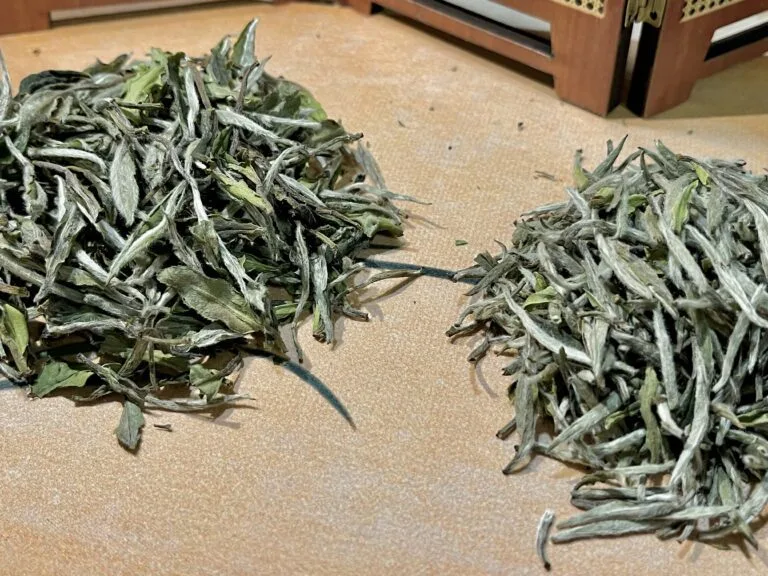
- Look at stem thickness. Thick woody stem points to mature Shoumei leaf. Thin supple stem is more typical of Gongmei shoots.
- Check the bud content. Gongmei’s higher grades should show visible bud tips. A “special grade Gongmei” with no buds is a contradiction.
- Check colour evenness. Grey-green with some variation is normal for both. Large brown or red patches suggest uneven withering or poor storage.
- Smell the wet leaf, not just the dry. Both grades should smell clean and slightly sweet when wet. Damp earth or sourness is a storage problem, and at these prices it is not worth accepting.
And a caution about ageing claims: since both are commonly pressed into cakes and sold as vintages, the same rules apply as for any aged white tea. The label year cannot be verified from the leaf, and the standard definition of “aged white tea” requires five years or more. How to judge a vintage claim is covered in how to buy white tea.
A Note on Cai Cha
菜茶 — literally “vegetable tea”, also called 土茶 or 小白 — is the collective name for the sexually reproduced population varieties of northern Fujian.
These are landraces, not a named cultivar: plants grown from seed, genetically diverse, adapted locally over generations. They are small-leaved, late-sprouting and lower-yielding than the named 大白 cultivars, which is why they were largely displaced in twentieth-century planting.
Their current importance is regulatory, since Gongmei now depends on them. Some producing counties retain significant plantings — Shouning, for instance, reports around 12,000 mu of Cai Cha (菜茶) — and the survival of the Gongmei category depends on those plantings continuing.
The industry formulation attributed to Zhang Tianfu captures the sequence: 「先有小白,后有大白,再有水仙白」 — first small-leaf white, then large-leaf white, then Narcissus white. Cai Cha is the oldest layer.
One last framing that helps: think of Gongmei as a cultivar category and Shoumei as a material category. Gongmei tells you which bushes the tea came from; Shoumei tells you which parts of the bush were picked. That is why the two overlap so much in the leaf and why the standard needed two separate definitions to describe what is, in the cup, a fairly subtle difference.
Neither category is hard to enjoy. Both are forgiving to brew, both take well to aging, and both cost a fraction of the bud grades. The argument between them is interesting to tea people and largely irrelevant to whether your next cup is good.
Frequently Asked Questions
Is Gongmei better than Shoumei?
No. The national standard does not rank them. Gongmei is restricted to population varieties and has four grades; Shoumei may use named cultivars or population varieties and has two grades. They are different raw materials, not a hierarchy.
Must Gongmei be made from Cai Cha?
Since the 2017 standard, yes — it is restricted to 群体种, the population varieties commonly called Cai Cha (菜茶). Before 2018 there was no cultivar requirement, so older sources and older tea may not follow this rule.
Why can’t I tell Gongmei and Shoumei apart by looking?
Because Shoumei may also be made from population varieties, and the standard’s sensory descriptions for the lower grades of each are nearly identical. Cultivar is not reliably visible in dried leaf.
Which one should I age?
Shoumei is the conventional choice. It has more stem and mature leaf, which gives it more material to transform over years. That said, studies show the optimal aging period is finite for both — one trial found four years scoring best.
What does Gongmei taste like?
At its best, clean and sweet with a downy fragrance and a suggestion of the bud grades. The standard describes the special grade as 清甜醇爽 (clean, sweet and mellow) with 毫香 (down fragrance). It is generally more aromatic and slightly more complex than Shoumei.
Related reading: what defines shoumei tea on its own.
Sources & References
Standards
- GB/T 22291-2017 — White tea product standard. §3.3 defines Gongmei as tender shoots of 群体种 (population varieties); §3.4 defines Shoumei as tender shoots or leaves of Daibai, Shuixian or 群体种 (population varieties). Tables 3–4 set sensory requirements.
- GB/T 22291-2008 — Previous version. Three categories, no Shoumei, no cultivar restriction on Gongmei.
Peer-Reviewed Research
- Xie, K. et al. (2024). Changes in the main chemical components of white tea cakes of different vintages. 中国食品学报 24(1):252–262. (Chinese-language)
- Wang, P.-F. et al. (2025). Optimization of storage conditions for Zhenghe white tea. Journal of Agriculture and Food Research 24:102448. DOI:
10.1016/j.jafr.2025.102448
Industry Sources
- 张天福 (Zhang Tianfu), 1963. The formulation 「先有小白,后有大白,再有水仙白」, an industry summary of cultivar succession.
- 寿宁县茶产业中心 — county figures including Cai Cha (菜茶) planting area.
What this page does not claim
We do not claim one grade is superior, that cultivar is verifiable by eye, or that aging improves either indefinitely. Where the standard’s own descriptions are nearly identical, we say so rather than inventing a distinction.
Shop the teas in this guide
The grades described above, sold directly from our own stock. Prices are for the smallest size; every listing states the harvest, the county and the size options.
- Shou Mei with stem, 2025 Shouning, loose leaf — $9.90
- Panxi Shou Mei, 2026 Fuding, loose leaf — $9.90
Editorial note
This guide is written by Steve Wood and reflects both published research and our own brewing. Where evidence is thin or contested, we say so rather than filling the gap. We sell white tea, which is a conflict of interest we disclose rather than hide.


5 Comments