
Rock Tea Caffeine: Lower Than Green Tea, Roast or Not
Rock tea caffeine is lower than most drinkers expect, and the reason is straightforward. The leaf is mature, and mature leaf carries less caffeine than buds. The figure also barely moves with roast level, which contradicts a common assumption.
This page sets out the measured numbers, why the leaf’s age matters more than its processing, what a cup actually delivers, and the one thing about rock tea caffeine that is genuinely surprising.
Table of Contents
The Measured Numbers
Rock tea contains roughly 18 to 23 milligrams of caffeine per gram of dry leaf, measured across light, medium and full roast. Expressed as a percentage of dry weight, that is about 2.3 percent.
For context, that is lower than green tea, lower than Tieguanyin, and lower than black tea. The comparison runs against the intuition that darker, more heavily processed tea must be stronger. It is not, and the reason is the raw material rather than the process.
The leaf position explains most of it. Caffeine concentration is highest in the young bud and falls as the leaf matures. Rock tea is made from open, mature leaf — three or four leaves rather than a bud and one leaf — so there is simply less caffeine per gram to begin with. Silver Needle, which is all bud, sits at the opposite end of the same gradient.
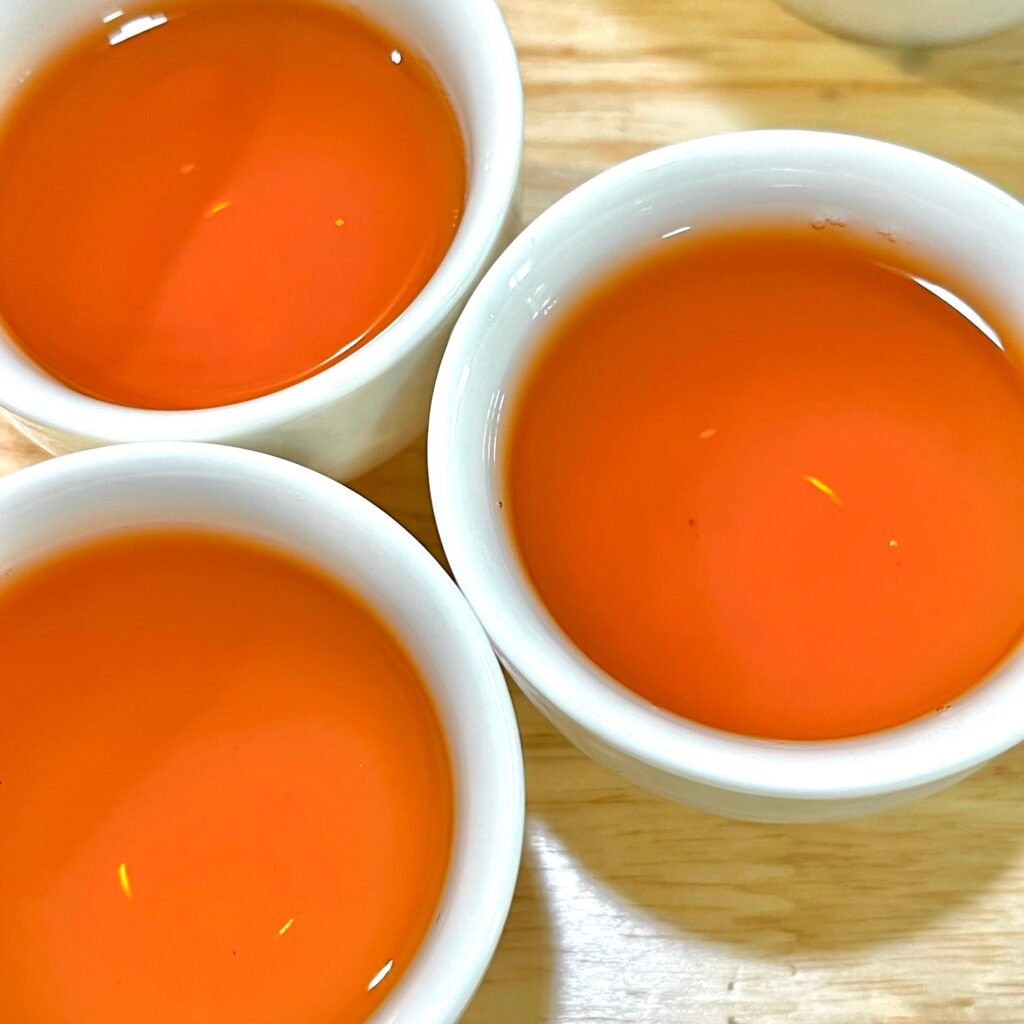
Roasting Does Not Change Rock Tea Caffeine
This is the part most drinkers get wrong. Charcoal roasting, which transforms almost everything else about the leaf, leaves caffeine essentially alone.
The reason is chemical. Caffeine is a xanthine alkaloid, a stable molecule that does not participate in the Maillard reactions and oxidative cascades that roasting drives. A metabolomic study following rock tea through the full process found the xanthine alkaloids stable across withering, oxidation, firing and roasting, while the flavan-3-ols were being consumed at a rate of roughly 78 percent.
So a full-fire rock tea and a light-fire rock tea from the same garden carry the same caffeine. The roast changes flavour, aroma, colour and body. It does not change the stimulant load.
That matters practically because buyers often choose a heavy-roast tea expecting a stronger hit, or avoid one expecting to be kept awake. Neither expectation is supported.
Rock Tea Caffeine in the Cup
Dry-leaf content is not what you drink. Extraction depends on leaf quantity, water temperature, steeping time and how many infusions you take.
A 5-gram session holds roughly 90 to 115 milligrams of caffeine in total. Of that, somewhere between 40 and 70 milligrams typically reaches a given cup, depending on how long that infusion runs.
Two measurements help calibrate this. Boiling water extracts about 46.6 percent of the available caffeine within the first 60 seconds, which is why the first infusion of a rock tea is the strongest and why the later infusions taper. And because rock tea is brewed repeatedly rather than once, the caffeine is spread across the session rather than delivered in a single dose.
That last point is the practical difference from coffee. A 5 g session might deliver 60 to 80 milligrams total over an hour of drinking, spread across eight infusions. A single cup of coffee delivers roughly 95 milligrams in five minutes. The totals are comparable; the delivery is not.
Against Other Teas and Coffee
| Drink | Caffeine per serving |
|---|---|
| Brewed coffee, 8 oz | About 95 mg |
| Rock tea, 5 g session | Roughly 40–80 mg over the session |
| Black tea, 8 oz | 14–61 mg |
| Green tea, 8 oz | About 11–30 mg |
The rock tea figure is a session rather than a cup, which makes it look high. Per infusion it is modest. The comparison that matters is per hour of drinking, and on that measure rock tea sits between coffee and green tea.
People who are sensitive to caffeine should note that a long session accumulates. Eight infusions of a strong brew is not the same dose as one, and the total creeps up in a way that a single cup does not.
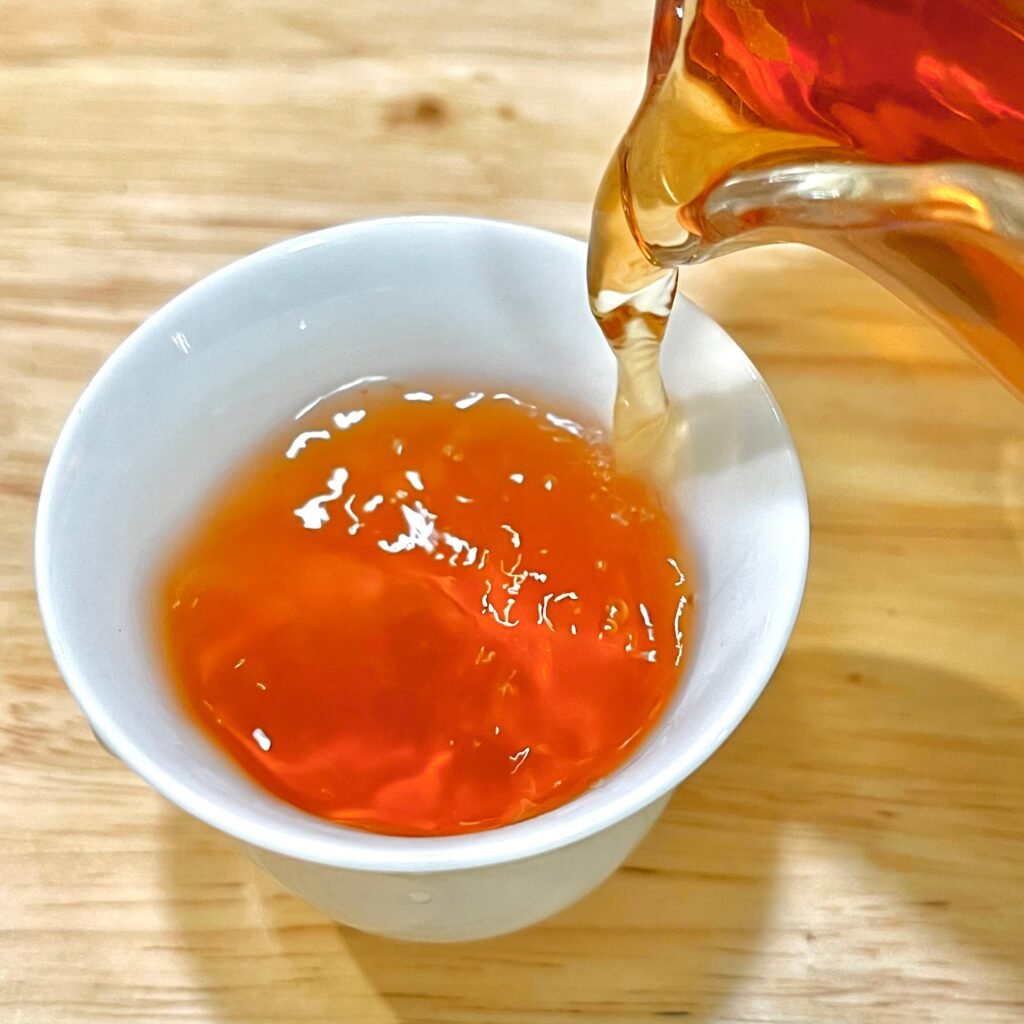
If You Are Sensitive to Rock Tea Caffeine
Three adjustments work, in order of effectiveness.
Use less leaf. Caffeine scales roughly linearly with leaf mass, so dropping from 8 g to 5 g cuts the session dose by more than a third. This is the most direct lever.
Take fewer infusions. The early infusions carry the most caffeine, so stopping at four or five rather than running ten reduces the total substantially.
Shorten the early infusions. Caffeine extracts fast; a five-second first infusion carries noticeably less than a fifteen-second one.
One adjustment people rarely consider is changing the vessel. A larger gaiwan with the same leaf weight produces more, weaker infusions, which spreads the same caffeine across a longer session. It does not reduce the dose, but it slows the rate at which you take it in, and for many drinkers that is what determines whether they notice it at all.
What does not work is switching to a lighter roast, because roast level does not affect caffeine. Nor does switching to white tea assuming it is caffeine-free; white tea made from buds is lower but not zero.
Two reference limits are worth knowing. The European Food Safety Authority sets an upper limit of 400 mg per day for healthy adults, with 200 mg in a single dose. The American College of Obstetricians and Gynecologists advises keeping total caffeine below 200 mg per day during pregnancy. Against a rock tea session of 40 to 80 milligrams, both limits are generous, but a long session plus a morning coffee adds up.
Health Claims and Rock Tea Caffeine
Rock tea has been studied, and the honest summary is that the evidence base is thin.
Published work on rock tea includes a mouse study in which aged rock tea reduced body weight in diet-induced obese animals, a rat study on polysaccharides and blood glucose, and in-vitro work on polyphenols inhibiting a viral protease. All of it is animal or test-tube work.
There is no human randomised controlled trial on rock tea, and the general tea literature does not support strong claims for any tea. Statements that rock tea promotes weight loss, lowers blood sugar or protects against disease are extrapolations from animal work, and should be read as such.
What can be said with confidence is narrow: rock tea is a caffeinated beverage with a lower caffeine load per gram than several other teas, and it contains polyphenols. That is a description, not a health claim, and it is about as far as the evidence goes.
Working Out Your Own Dose
Because rock tea caffeine is spread across a session, the per-session total is what matters, and it is calculable within a useful range.
The arithmetic is simple. Take the leaf weight, multiply by 18 to 23 mg, and then apply an extraction factor. A 7-gram session therefore holds roughly 126 to 161 milligrams in total; a 5-gram session holds 90 to 115. Of that, perhaps half reaches the first two or three infusions and the rest tapers across the remaining rounds.
What that means in practice is that a full gongfu session with seven grams is not a small dose. It is comparable to one and a half cups of coffee, drunk slowly. A three-infusion session with five grams is closer to half a cup.
For anyone tracking intake, a kitchen scale settles the question in a way no label can. The published figures describe a range, but the leaf in front of you may sit anywhere in it, and the only way to narrow that is to know how much you used.
The useful habit is to weigh leaf for the first few sessions rather than judging by eye. Rock tea leaf is bulky and a scoop varies widely in weight, which means the caffeine in a cup can vary by a factor of two without the drinker noticing.
Rock Tea Caffeine and Sleep
Caffeine has a half-life of roughly five hours in most people, with a wide individual spread. A session carrying 80 milligrams leaves about 40 milligrams five hours later, which is still enough to affect sleep in sensitive people.
The timing issue with rock tea is different from coffee in one respect: a session runs long. A morning coffee is finished in minutes and the dose is fixed. A gongfu session can extend over an hour, which means the last infusion is drunk much later than the first.
The practical implication is that a late session accumulates. Two people drinking the same tea at the same time of evening may experience very different effects, because one stopped after four infusions and the other ran ten.
Research on sleep and caffeine finds that 400 milligrams taken up to six hours before bed impairs sleep quality. A rock tea session is well below that, but anyone sensitive should treat a long evening session as a moderate dose rather than a small one.
Why This Question Comes Up
Rock tea caffeine is a recurring question for a specific reason: the category’s price and ritual suggest something potent, and the dark liquor reinforces the impression. The measured content does not match that expectation.
That gap creates two opposite errors. Some buyers assume high-roast tea is stronger and pay a premium for a stimulant effect it does not deliver. Others avoid rock tea in the evening on the assumption that a dark, roasted tea must be heavy, when the caffeine load is lower than a green tea brewed strongly.
The correct mental model is that rock tea caffeine depends on how much leaf you use and how long you brew, and almost not at all on which tea you bought. That is unusual among the factors that shape a cup: roast, cultivar and garden change flavour enormously and caffeine not at all.
Which makes the caffeine question easy to answer once you know the numbers. The variables that matter are on your side of the table.
Frequently Asked Questions
How much caffeine is in rock tea?
About 18 to 23 mg per gram of dry leaf, roughly 2.3 percent by weight. That is lower than green tea, Tieguanyin and black tea.
Does roasting change rock tea caffeine?
No. Caffeine is a stable xanthine alkaloid and does not participate in the reactions that roasting drives. Light-fire and full-fire tea from the same garden carry the same amount.
Is rock tea high in caffeine?
Per gram, no. Per session it can look high because a session uses 7 to 8 grams, but the dose is spread across many infusions over an hour or more.
Can I drink rock tea before bed?
That depends on your sensitivity and your total intake. A short session of a lightly brewed tea carries little; a ten-infusion session carries more. The caffeine content is the same regardless of roast level.
Is rock tea safe in pregnancy?
It is a caffeinated drink, so it counts toward the 200 mg daily limit that ACOG advises. A modest session is well inside that; a long one plus other caffeine may not be.
Does the first infusion have more caffeine?
Yes. Boiling water extracts about 46.6 percent of available caffeine within 60 seconds, so the early infusions dominate the session total.
Shop the rock teas in this guide
Sold directly from our own stock. Every listing states the cultivar, the garden and the fire level.
Or browse the full rock tea collection.
Related Reading
brewing parameters that change the dose, why roasting does not change caffeine and the category as a whole.
Sources & References
Peer-Reviewed Research
- RSC Advances (2020). Caffeine in rock tea at 18–23 mg/g across light, medium and full roast. DOI:
10.1039/d0ra09703a - DOI: 10.13652/j.issn.1003-5788.2016.10.006 — Caffeine 2.341% of dry weight; 46.6% extracted in the first 60 seconds at boiling.
- Food Chemistry (2021). Xanthine alkaloids stable through processing while ~78% of flavan-3-ols are consumed. DOI:
10.1016/j.foodchem.2021.130624 - Food & Function (2022). Aged rock tea and body weight in diet-induced obese mice (animal study). DOI:
10.1039/d2fo03577d
Clinical Guidance
- EFSA (2015). 400 mg per day for healthy adults; 200 mg single dose; 200 mg per day in pregnancy. DOI:
10.2903/j.efsa.2015.4102 - ACOG (2010). Under 200 mg per day during pregnancy. DOI:
10.1097/AOG.0b013e3181eeb2a1
What this page does not claim
We do not claim rock tea promotes weight loss, lowers blood sugar, or protects against disease. The studies that exist are animal or in-vitro work, and the page labels them as such rather than presenting them as findings about people.
