
How to Drink Black Tea Right: A Stomach-Friendly Guide
First Published: September 10, 2026 | Last Updated: September 15, 2026
Editorial Team: minteashop.com Tea Specialists
Quality Review: minteashop.com Quality & Safety Committee
Reading Time: ~12 minutes
🍵 Before We Begin: There’s no single “best” tea — only the one that suits you. If you love a warm, mellow flavor, black tea is practically made for autumn and winter — especially for anyone with a sensitive stomach.
But many people drink black tea for years without unlocking its real benefits. Some brew it wrong and end up with a bitter, flat cup. Others ignore their constitution and drink it indiscriminately, only to deal with internal heat, bloating, or poor sleep.
Today, I’ll walk you through three angles — brewing technique, body-type compatibility, and a pitfall guide. By the end, even beginners can brew a rich, sweet, aromatic cup and gradually build a healthier relationship with this traditional drink.
💡 A note on the evidence: Rather than relying on any single routine, this article synthesizes findings from peer-reviewed food-science research, tea-industry standards, and specialist brewing practice. The goal is a practical overview of what is known about choosing, brewing, and enjoying black tea — and what is still unproven.
1. Why Is Black Tea Called a “Stomach-Nourishing” Tea?
In Chinese food culture, black tea is traditionally classified as warming in nature and credited with “nourishing the stomach” (养胃). These are traditional wellness concepts, not clinically established diagnoses or treatment claims. Modern research provides plausible biological mechanisms, but it has not demonstrated that drinking black tea heals gastritis, ulcers, or dyspepsia in humans.
Black tea is a fully fermented tea — unlike green tea (unfermented) or oolong (semi-fermented). During processing, leaf catechins are enzymatically oxidized into theaflavins, thearubigins, and related polyphenols. This transformation shifts the tea from the sharp, catechin-dominant profile of unoxidized leaf toward black tea’s characteristic briskness, red-brown color, body, and layered astringency. (Tanaka et al., Int. J. Mol. Sci., 2022)
What the TCM concept means
- Warming in nature. In traditional Chinese medicine, black tea is classified as warming rather than cooling. From a modern standpoint, this is a traditional framework — current human research has not validated it as a specific medical effect.
- “Nourishes the stomach.” This phrase refers to a perceived soothing of the stomach rather than a measurable biological action.
What modern research shows
The evidence does not support “black tea heals the stomach” as a clinical claim:
- A 2015 Bulgarian observational study of 150 dyspepsia patients found that weekly green or black tea drinkers had lower Helicobacter pylori positivity (45.2% vs 64.8%). This is an association, not proof of treatment. (Boyanova et al., 2015)
- A 2022 review explicitly stated that no published clinical trial had tested green or black tea for H. pylori eradication.
- A 2020 Japanese cohort study found no association between black-tea consumption and gastric-cancer risk in either sex.
- Lab and animal studies show tea polyphenols can inhibit H. pylori and reduce mucosal injury in models — but these findings have not translated into convincing human treatment evidence.
⚠️ Bottom line: Black tea polyphenols have biologically plausible effects and some preliminary observational signals, but you should not treat black tea as a remedy for stomach pain, reflux, ulcers, or suspected H. pylori infection. Those conditions need appropriate medical evaluation. If you tolerate black tea and enjoy it, a moderate cup need not be harmful.
For a broader overview of black tea types, brewing parameters, and the science behind each variety, see our Black Tea 2026 Guide: Types, Benefits & Brewing.
2. How to Brew Black Tea the Right Way? 3 Key Techniques
Most bitter or flat cups come from missing these three details.
(1) Pick the Right Teaware — Don’t Let Your Teaware “Kill” the Tea
- For beginners: A white porcelain gaiwan (~100ml). It dissipates heat quickly and doesn’t absorb flavor, letting the honey and floral aromas shine through. Hard to mess up.
- For the office: A glass cup. Easy to monitor color, works with both tea bags and loose leaf.
- For advanced brewers: A Yixing clay teapot. Absorbs some astringency and produces a rounder, mellower mouthfeel. Clean it regularly to prevent tea scale from masking the aroma. For a step-by-step gongfu walkthrough, see our How to Brew Black Tea guide.
❌ Pitfall to avoid: Never steep black tea in a thermos for hours. Sustained high temperature extracts bitter compounds in large amounts, destroys the aroma, and leaves you with a harsh brew.
(2) Water Temperature & Tea-to-Water Ratio — The Soul of the Brew
Water temperature
There is no single “correct” temperature, but peer-reviewed evidence points in a clear direction:
- For maximum analytical extraction of phenolics and antioxidants, near-boiling water (~100°C) tends to produce the highest measured values.
- For a balanced everyday cup, a 2019 study (Baptista et al.) found the most meaningful extraction gain for black tea occurred between 80°C and 90°C, with 90°C delivering significantly higher phenolic and antioxidant values than 70°C or 80°C. (Baptista et al., Braz. J. Pharm. Sci., 2019)
- A 2024 study comparing cold brew (25°C, 2h) vs hot brew (100°C, 6 min) found hot brewing delivered higher catechins, theaflavins, thearubigins, total phenolics, and antioxidant capacity.
- Industry guidance lines up: the UK Tea & Infusions Association recommends 90–98°C; the Tea and Herbal Association of Canada recommends roughly 95–100°C for 3–5 minutes.
Practical recommendation: Aim for 90–95°C as your default. Let freshly boiled water sit for about 1 minute, or use a kettle with a precise temperature setting. Higher temperatures maximize extraction; lower temperatures give a lighter, less astringent cup.
Tea-to-water ratio
A 1:50 ratio (2g tea per 100ml water) is widely used in tea sensory research and standardized laboratory protocols — but it is a research benchmark, not a universal “gold standard” for everyday brewing. (Yinghong No. 9 sensory study, 2023; Hunan dark-tea study, 2019)
- For Western-style brewing: 1:40 to 1:50 is a sensible starting point. For a 100ml gaiwan, use 2g of tea; for a stronger cup, up to 2.5g.
- For gongfu-style brewing: Ratios of 1:15 to 1:25 are typical, paired with very short infusions. This is a different high-leaf, short-steep design and should not be ranked against Western ratios using a single-cup metric.
- For standardized laboratory comparison: ISO 3103:2019 specifies 2g of black tea per 100ml of boiling water with a 6-minute infusion — designed for comparability between samples, not as a household brewing recipe.
(3) Steeping Time — The Heart of Every Cup
- First rinse: 5–10 seconds. Pour and discard — this awakens the leaves and washes away surface dust.
- Main infusions: 30–60 seconds. The first three infusions offer the best flavor — rich honey and sweetness. From the fourth infusion onward, extend by 10–15 seconds per brew to keep it from tasting weak.
- Special cases: Broken black tea or tea bags can steep for 2–3 minutes, but not more than 5 minutes. These formats suit quick, convenient brewing.
3. How Long Should You Steep Black Tea?
Here’s a universal timing chart:
| Infusion | Recommended Time | Flavor Profile |
|---|---|---|
| 1st (rinse) | 5–10 sec | Awakens the leaves; discard |
| 2nd–4th | 30–45 sec | Peak flavor window — honeyed and sweet |
| 5th–7th | 45–60 sec | Softer aroma; great for slow sipping |
| 8th onward | 90–120 sec | Fading strength; good as a milk tea base |
This “extending each brew” rhythm reflects the fact that polyphenol levels drop after the first few infusions.
4. Who Should Avoid Drinking Black Tea? 4 Groups to Watch Out For
Black tea suits most people, but it’s not a universal wellness drink. Four groups need to pay extra attention:
(1) People Prone to Internal Heat
In TCM, people prone to dry mouth, sore throat, breakouts, or constipation are considered to have excess “internal heat.” From a modern standpoint, this is a traditional classification rather than a clinical diagnosis. If you notice black tea consistently triggers these symptoms for you personally, that’s a useful signal to reduce or switch.
✅ Alternative: A lighter green tea may feel more comfortable. To match tea style with your body type and preferences, see our complete black tea guide.
(2) People with Stomach Ulcers or Excess Stomach Acid
Black tea contains caffeine, which can influence gastric acid secretion — but the relationship is more complex than “caffeine = more acid”:
- A 2017 human mechanistic study (Liszt et al.) found that encapsulated caffeine stimulated gastric acid secretion, whereas orally tasted caffeine actually delayed gastric re-acidification through bitter-taste receptor signaling. (Liszt et al., PNAS, 2017)
There is no direct clinical evidence that black tea improves fat digestion. Most dietary fat is digested in the small intestine via bile and pancreatic enzymes, not gastric acid.
✅ Recommendation: If you have ulcers or acid reflux, drink black tea about one hour after meals, brew it on the lighter side, and stop if symptoms worsen.
(3) People with Insomnia
Caffeine and theophylline stimulate the nervous system. Caffeine has a half-life of roughly 5–6 hours in adults, but individual variation is large — some sensitive people feel effects much longer.
✅ Practical guidance: Many people avoid black tea in the late afternoon and evening. A commonly cited rule is “no black tea after 3 PM,” but this is a conservative cutoff; sensitive individuals may need to stop earlier. (EFSA, 2015)
✅ Alternative: Switch to plain warm water in the afternoon and evening, or a light red date and goji berry infusion.
(4) Pregnant or Breastfeeding Women
The American College of Obstetricians and Gynecologists (ACOG) Committee Opinion No. 462 recommends keeping total caffeine intake below 200 mg per day during pregnancy — counting caffeine from all sources: coffee, black and green tea, energy drinks, cola, chocolate, and some medications.
This 200 mg/day pregnancy limit is different from the 400 mg/day adult threshold that EFSA uses for healthy, non-pregnant adults. The two figures answer different questions for different populations.
✅ Recommendation: An occasional small cup of lightly brewed black tea can fit within 200 mg/day total caffeine. Avoid strong brews, and account for all other caffeine sources.
5. What Pairs Well with Black Tea in Autumn and Winter? 3 Classic Recipes
Plain black tea gets repetitive. Add one or two seasonal ingredients and you unlock a whole new range of pairings. Beginners can copy these directly:
(1) Red Dates + Black Tea
Best for: A warming, mildly sweet cup. In TCM, red dates are considered to “tonify Qi and blood” — these are traditional concepts, not biomedical indications.
Method: 2g black tea + 3 pitted red dates. Steep with 90°C water for 5 minutes.
(2) Fresh Ginger + Black Tea
Best for: A spicy, warming cup. Some randomized trials suggest ginger may help reduce primary dysmenorrhea pain — but that evidence applies to ginger, not to black tea.
Method: 2g black tea + 2 slices of fresh ginger. Pour just-boiled water and steep for 3 minutes.
(3) Dried Tangerine Peel + Black Tea
Best for: A citrusy, refreshing cup that may help cut through a heavy meal.
Method: 2g black tea + 1 piece of dried tangerine peel. Steep with 90°C water.
Tip: This pairing works especially well with high-mountain black teas whose deeper, more layered body can stand up to the citrus oil. For more seasonal pairing recipes and stomach-friendly tea ideas, browse our How to Brew Black Tea collection.
6. How to Pick Quality Black Tea? 3 Buyer Tips
The market is flooded with options — Jin Jun Mei, Zhengshan Xiaozhong, Dian Hong, Keemun — with prices ranging from tens to thousands of dollars.
(1) Look at the Appearance to Judge Quality
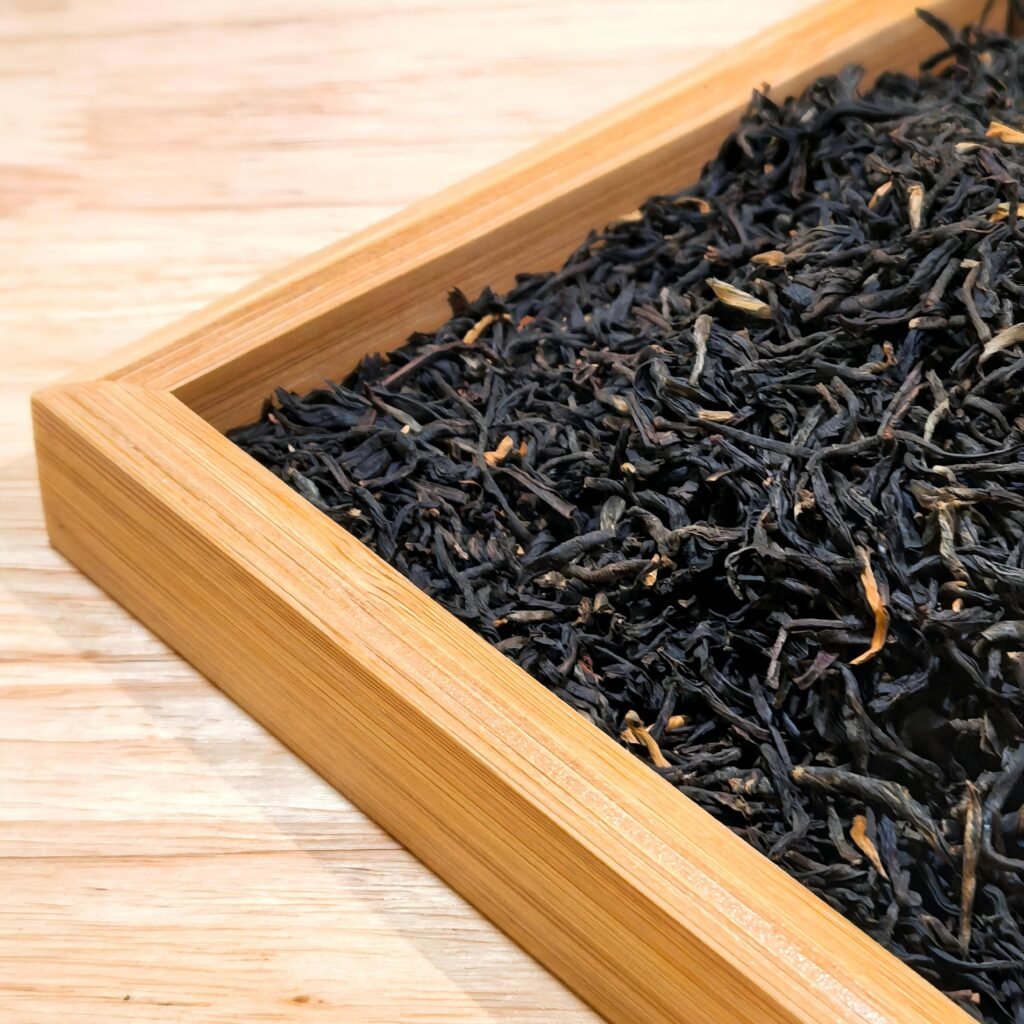
- High-quality black tea: Tight, fine, even strips; glossy, dark color. Jin Jun Mei shows distinct golden tips; Zhengshan Xiaozhong has slender, refined strips.
- Low-quality black tea: Loose, broken leaves with lots of fannings; dull, lifeless color; and possibly musty or sour odors. Steer clear.
(2) Smell the Aroma to Match Your Preference
- Jin Jun Mei: Naturally honeyed and floral, with a sweet, smooth taste.
- Zhengshan Xiaozhong: Pine-smoke and dried longan notes, with a rich, full body.
- Dian Hong: Bright, lifted aroma with floral and fruity notes and a fresh taste.
- Keemun: Rich, layered fragrance with orchid notes and a clean, sweet taste.
(3) Check the Origin to Ensure Authenticity
- Classic core production areas: Jin Jun Mei from Tongmu Pass in the Wuyi Mountains, Fujian; Zhengshan Xiaozhong from the core Tongmu Pass area; Dian Hong from Fengqing, Yunnan; Keemun from Qimen, Anhui.
- High-mountain regions worth knowing: Beyond the classic names, Shouning in northern Fujian is a thousand-year tea hometown where high-altitude gardens (typically 600–900m elevation) produce black teas with notably clean aroma, good steeping endurance, and a naturally sweet finish — qualities that come from slower leaf growth in cooler mountain nights.
(4) Featured Black Teas From Our Shouning Collection
If the brewing principles above have you curious, here are four black teas from our own Shouning, Fujian cellar that showcase the high-mountain character described throughout this article. All are hand-processed from single-origin leaves and ship directly from our facility.
- Jin Jun Mei 2026 Spring — Our flagship spring-harvest Jin Jun Mei. Naturally honeyed with layered floral notes and a long, sweet finish. Best brewed at 90°C with a 1:50 ratio for the cleanest expression of aroma.
- High Mountain Jin Mu Dan Black Tea 2026 — A “Golden Peony” black tea from high-altitude gardens. Rich body, balanced flavor, and steeping endurance across 6–8 infusions — a good example of how mountain terroir translates to a more durable cup.
- High Mountain Xiao Cai Cha Black Tea — A bright, lively black tea with stone-fruit notes and a clean, refreshing finish. An approachable daily drinker that responds well to a slightly lighter ratio (1:60).
- Jin Jun Mei Black Tea — Our classic Jin Jun Mei expression with the signature golden tips and concentrated sweet-honey aroma. A reliable benchmark for understanding what makes a well-made Jin Jun Mei.
💡 Note from the cellar: All four come from the same Shouning terroir. The high-altitude growing conditions — cooler nights, slower leaf development, and a wider day-night temperature swing — concentrate the flavor compounds that give these teas their aroma and their ability to hold up across multiple infusions. This is the practical “why” behind the brewing ratios and temperatures recommended in Section 2.
7. Black Tea FAQ: Your Top Questions Answered
Can I cold-brew black tea?
Yes — but the profile differs. Refrigerated cold brewing (4–8 hours) generally yields a lighter, smoother infusion with slower caffeine extraction than hot brewing under matched recipes. The difference is not absolute: a long cold steep with more leaf can match or exceed a quick hot brew. Cold brew also extracts noticeably less thearubigin — the pigment fraction that gives black tea its body. (Hsieh et al., 2021; Kurt et al., 2024)
Is overnight black tea safe to drink?
Plain black tea left at room temperature for 8–12 hours is not automatically unsafe, but it is a poor food-safety practice. Any contamination introduced during brewing or handling can multiply at room temperature, especially in sweetened or milk-based drinks. (China tea microbiology study, 2023) For refrigerated plain tea in a clean covered container, overnight storage is generally more a freshness issue than an acute safety hazard.
Can I add milk to black tea?
Yes. Milk proteins can bind tea polyphenols and may lower some in-vitro antioxidant measurements, but human studies have not consistently found that milk reduces absorption of tea catechins or flavonols. (Hollman et al., 2001; van der Burg-Koorevaar et al., 1998) The popular claim that milk “cancels” black tea’s benefits is stronger than the human evidence supports.
How much black tea can I drink per day?
This depends on the leaf’s caffeine content, which varies considerably. Analytical studies commonly place caffeine in dry black tea at roughly 15–35 mg per gram (about 1.5–3.5% by weight), though individual samples fall outside that range. (Ayakdaş et al., 2025) On that basis, 8–10g of leaf typically contains 120–350 mg of caffeine before brewing — not always reaching the EFSA 400 mg/day threshold for healthy adults. EFSA’s 2015 opinion distinguishes between 200 mg per single dose (the acute threshold) and 400 mg/day habitual intake (the daily total). Pregnant women should follow the ACOG 200 mg/day pregnancy limit.
Wrapping Up
A single cup of black tea holds more craft than most people realize.
- Which variety is your favorite — Jin Jun Mei, Zhengshan Xiaozhong, or Dian Hong?
- When you drink black tea in autumn and winter, do you pair it with red dates, ginger, or dried tangerine peel?
- Have you ever experienced discomfort after drinking black tea? Share your story in the comments so we can all learn together.
One final reminder: The traditional wisdom around black tea — drink it warm, drink it light, drink it according to your constitution — is consistent with both modern food-science evidence and centuries of practice. But the warming, stomach-nourishing, and TCM-style benefits described in traditional sources are traditional classifications, not clinically proven outcomes. For persistent symptoms, consult a healthcare professional.
During autumn and winter, a daily cup of well-brewed black tea can be a comforting, well-tolerated pleasure. Brew it at 90–95°C, use about 2g per 100ml, and adjust to your taste.
🏔️ About the source
The teas referenced in this article are sourced from our family-run facility in Shouning, Fujian — a thousand-year tea hometown in China’s southeastern highlands. We ship worldwide via DHL, FedEx, and a Europe-local line, with most orders arriving in 7–15 business days. Secure payment is available through PayPal, Visa, Mastercard, JCB, and bank transfer (contact support). Orders are processed within 24–48 hours. Returns and exchanges are accepted within 7 calendar days of receipt for defects or our errors. For questions, our team is reachable 7×24.
⚕️ Health Disclaimer: This article is for general wellness reference only and does not constitute medical advice. Black tea is a traditional beverage and cannot replace medical treatment. People with stomach ulcers, insomnia, or those who are pregnant or breastfeeding should consult a doctor before consuming. The TCM concepts discussed (养胃, 温性, 气血) are traditional classifications, not biomedical diagnoses.
🛒 Merchant Disclosure (FTC & EU Consumer Rights compliant): This article is published by minteashop.com, an online retailer specializing in Chinese teas including white tea, red tea, rock tea (Wuyi Yancha), green tea, and Pu-erh. Some links in this article lead to products sold in our own store. As the merchant, we have a material interest in those sales. Product recommendations reflect our editorial team’s direct tasting experience; we only recommend teas we have personally brewed and reviewed. We do not accept paid placements or sponsored reviews.
📦 Ordering & Shipping: Orders are processed within 24–48 hours. Standard shipping (China Post, Cainiao) takes 9–25 days; express shipping (DHL, FedEx, Europe-local line) takes 7–15 days. Delivery may be delayed by force majeure events (severe weather, earthquakes, etc.).
💳 Payment Methods: PayPal, Visa, Mastercard, JCB, Western Union, and bank transfer (the latter two require contacting customer service).
🔄 Returns & Refunds: Returns or exchanges are accepted within 7 calendar days of receipt for store fault (defective items, wrong shipment, etc.). Customer-change-of-mind, accidental damage, and taste preference after opening are not eligible for return. Customers should inspect packaging and contents upon receipt. Store tea in a cool, dry place away from direct sunlight. Approved refunds are issued via the original payment method within 3–30 business days.
📝 Editorial Note: Researched and written by the minteashop.com Tea Editorial Team and reviewed by the minteashop.com Quality & Safety Committee. minteashop.com is a family-run online tea retailer based in Shouning, Fujian, with direct sourcing from local high-mountain tea gardens. For health questions specific to your situation, please consult a qualified healthcare provider.
📅 Last updated: September 17, 2026. Content has been verified against current peer-reviewed research.
