White Tea History: Why Song Dynasty ‘White Tea’ Was a Different Drink
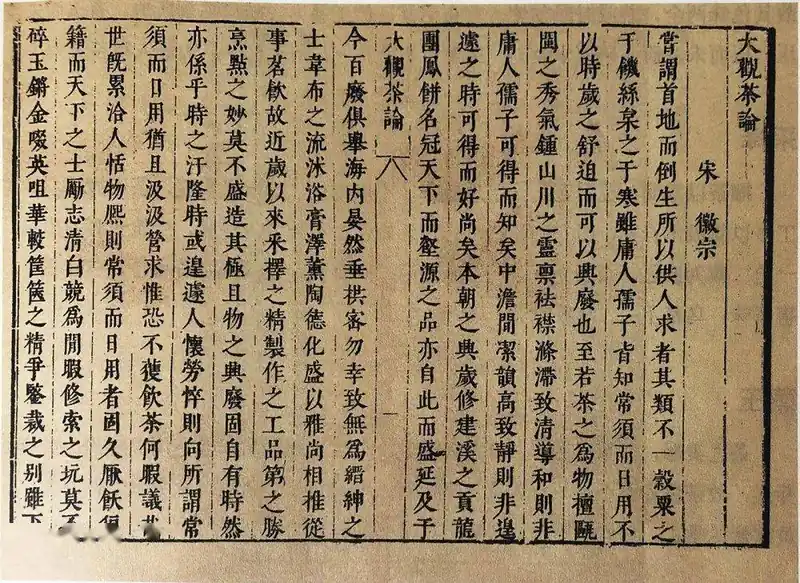
White tea history is one of the most confidently repeated stories in Chinese tea, and one of the least accurate. Open almost any tea shop’s white tea page and you will find some version of this sentence: white tea is the oldest tea in China, mentioned by Emperor Huizong in his Treatise on Tea in 1107. It is a good story. It is also wrong in a specific and interesting way.
The emperor did write about a tea he called 白茶 — white tea. But what he described was not the drink in your cup.
Table of Contents
What the Text Actually Says
The passage is short enough to quote in full. From the Daguan Chalun (大观茶论), the chapter on white tea:
「白茶自为一种,与常茶不同。其条敷阐,其叶莹薄,崖林之间,偶然生出,虽非人力所可致。有者不过四五家,生者不过一二株,所造止于二三銙而已。芽英不多,尤难蒸焙,汤火一失,则已变而为常品。须制造精微,运度得宜,则表里昭彻,如玉之在璞,它无与伦也。浅焙亦有之,但品不及。」
The gist: white tea is a category of its own, unlike ordinary tea. Its branches spread, its leaves are thin and translucent. It grows wild in cliff forests, beyond human control. No more than four or five households have it, and only one or two bushes grow. The buds are few and especially difficult to steam and roast (蒸焙); if the water and fire are mishandled it reverts to ordinary tea. Made with precision, it is translucent inside and out, like jade in the rough.
The Clue Is Two Characters Long
Everything turns on 蒸焙 — steaming and roasting.
Song dynasty tea was made from steamed leaf that was then pressed into cakes, ground to powder and whisked. The leaf was steamed to fix it, pressed while warm, and baked dry. That is a completely different process from white tea’s withering and air-drying, and it produces a completely different product.
The scholarly reading follows from this. The Song “white tea” is generally understood as referring to a specific tea bush — a naturally pale-leafed variety growing at the Beiyuan imperial gardens — and to the steamed, pressed cake made from it. “White” described the appearance of the leaf and the rarity of the bush, not a processing method.
The emperor’s own words confirm it was a curiosity, not a category: four or five households, one or two bushes, a few cakes. This is a tribute item, not a production method that could be repeated at scale.
What Song Dynasty Tea Was Actually Like
To see why the emperor’s 白茶 cannot be the ancestor of the modern product, it helps to know what he was drinking.
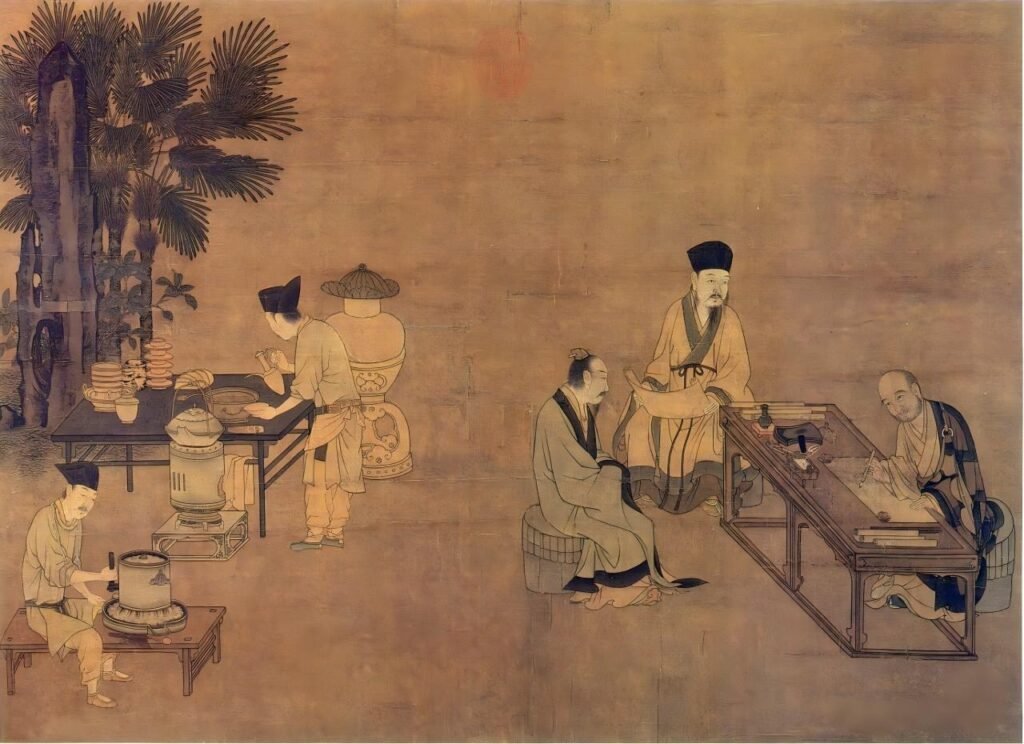
Song tea was made from steamed leaf pressed into small cakes. To drink it, you broke off a piece, ground it to fine powder, put the powder in a pre-warmed bowl, and added hot water in stages while whisking with a bamboo brush until a pale foam formed. The result was a suspension, not an infusion — you drank the leaf, not water that had passed through it.
Every step of that sequence has a purpose that white tea does not share. Steaming fixes the leaf, which white tea never does. Pressing into cakes makes the tea transportable and ageable in a specific way. Grinding and whisking extract a completely different fraction of the leaf than steeping whole leaf does. The flavour of a whisked Song tea is closer to a thick, foamy broth than to the pale gold liquor in a modern gaiwan.
This is also why the emperor’s remark about difficulty — 汤火一失,则已变而为常品, “if the water and fire are mishandled it reverts to ordinary tea” — makes sense in context. He is describing the difficulty of steaming and roasting a rare pale-leafed cake correctly. He is not describing the difficulty of drying leaves in the sun.
The two products share a word and a country. They do not share a method, a form, or a flavour. Calling modern white tea “the tea of the Song dynasty” is roughly as accurate as calling a modern green salad “the bread of the Pharaohs” because both are ancient and both are food.
Why the Mistake Is Easy to Make
Chinese tea names are not systematic. The same word can describe a colour, a cultivar, a grade or a process, and which one it is has to be inferred from context — often across a thousand years of changed context.
白茶 in the Song sense meant “pale-leaf tea bush”. 白茶 in the modern sense means a category of tea defined by processing: withered, dried and sorted, with no kill-green and no rolling, made from specified cultivars. Both are legitimate uses of the word. They are not the same thing.
The confusion is not innocent. “Since the Song dynasty” is a powerful marketing line, and it converts an ordinary agricultural product into a heritage object. It also lets a seller imply a thousand years of continuity in a product that was standardised in 2017.
When Modern White Tea Actually Appeared
Here the honest answer is that specialists do not agree, and the disagreement is substantive rather than pedantic.
The Fuding account
The coastal Fuding region is usually credited with the modern product. In this account, buds were first made into needle-shaped white tea around 1796; from the 1850s onward the local 大白 tea cultivar was used to produce what became known as Baihao Yinzhen (Silver Needle); and the process was refined into its recognisable form during the Guangxu reign at the end of the nineteenth century. The grade that account produces is described in our Silver Needle guide.
The Jianyang account
A competing case places the origin inland, in Jianyang’s Zhangdun area. Research by Lin Jintuan dates a local product called 南坑白 to roughly 1772–1782, arguing that the modern process — withering and drying without kill-green or rolling — was already mature there before the Fuding chronology begins.
Both accounts rely on local records and lineage evidence. Neither has been established to the exclusion of the other, and writing “white tea was invented in [year] in [place]” is a claim the evidence does not support. What can be said is that the modern process emerged in northern Fujian sometime in the late eighteenth century, and that Fuding and Jianyang both have genuine claims to early practice.
“First Small White, Then Big White, Then Narcissus White”
A more useful framework comes from Zhang Tianfu, writing in 1963, whose summary of the category’s development is still quoted: 「先有小白,后有大白,再有水仙白」 — first came small-leaf white tea, then large-leaf white, then Narcissus white.
The saying maps onto cultivars rather than dates, and it explains why white tea is not one thing:
- Small white (小白) — made from 菜茶, the sexually reproduced local population varieties. Small-leaved, late-sprouting, and the traditional source of Gongmei.
- Big white (大白) — the named cultivars Fuding Daibai and Fuding Dahao, with large buds and heavy down. The material for Silver Needle and White Peony.
- Narcissus white (水仙白) — made from the Shuixian cultivar, which is also used for oolong. Distinctive aroma, fuller body.
This is a cultivar history, not a manufacturing one, and it is the clearest explanation of why four white tea grades exist at all.
The Cultivars Behind the Grades
The four modern grades are not a quality ladder. They are different raw materials from different cultivars, and the cultivar explains more about the cup than the grade name does.
Under GB/T 22291-2017, each grade has a specified raw material:
| Grade | Raw material required | Cultivars typically used |
|---|---|---|
| Baihao Yinzhen | Single bud | Fuding Daibai, Fuding Dahao, Zhenghe Daibai, Shuixian |
| Baimudan | One bud, one or two leaves | Fuding Daibai, Fuding Dahao, Zhenghe Daibai, Shuixian |
| Gongmei | Tender shoots of 群体种 | Population varieties (菜茶) only |
| Shoumei | Tender shoots or leaves | Daibai, Shuixian, or 群体种 |
Three things follow from that table.
Silver Needle requires a big-bud cultivar. A single bud has to be substantial enough to make a product out of, and the named 大白 cultivars — Fuding Daibai (Hua Cha No. 1) and Fuding Dahao (Hua Cha No. 2) — are grown for exactly that. Their buds are large and heavily downed, which is why Silver Needle looks the way it does.
Shuixian is the crossover cultivar. It makes oolong in Wuyi and white tea in northern Fujian, and white tea from Shuixian is traditionally called 水仙白 — Narcissus white. It is typically described as having a higher, more aromatic profile than 大白 material.
Gongmei is the population-variety grade. Since 2018 the standard restricts it to 群体种 — the sexually reproduced local populations known as 菜茶. These are genetically diverse, small-leaved and late-sprouting, and they cannot make Silver Needle: the buds are too small. This is the single most misunderstood rule in white tea, and it only became a rule in the 2017 standard.
Regional identity reinforces the cultivar picture. Fuding tea was granted geographical indication protection in 2009, Zhenghe in 2007. Both are protected-product designations, which is a stronger status than a certification trademark — a distinction worth checking, because some producing areas hold only the latter and marketing sometimes blurs the two.
How the Categories Got Fixed
For most of the twentieth century, “white tea” in commerce meant whatever the producing region said it meant. The national standard changed that, and the change is recent enough to matter.
The 2008 standard (GB/T 22291-2008) recognised three products: Baihao Yinzhen, Baimudan and Gongmei. There was no Shoumei as a standardised category, and there was no cultivar restriction on Gongmei.
The 2017 standard (GB/T 22291-2017), effective from May 2018, changed both points. It added Shoumei as a fourth product, and it specified raw materials for each category — including restricting Gongmei to 群体种, the sexually reproduced population varieties. It also raised the permitted moisture content from 7.0% to 8.5% and added a water-extract minimum.
So a claim like “Gongmei has always been made from 菜茶” is historically reasonable as a description of regional practice and legally accurate only from 2018 onward. Before that, it was convention rather than rule.
Why the History Matters to a Buyer
Three practical reasons, none of them academic.
You can discount a whole class of claims. “Ancient tea, favoured by emperors” tells you nothing about the leaf in front of you. What tells you something is the execution standard on the package, the harvest year, and the grade name used correctly.
You can date a shop’s expertise. A seller who says Gongmei must be 菜茶 is repeating a rule that only became binding in 2018. A seller who says white tea was invented in 1796 is picking one side of an unresolved question. Neither error is fatal, but the pattern is informative.
You can appreciate what is actually old. The genuinely continuous tradition is not the Song cake; it is the cultivar lineage — the small-leaf population varieties that have been growing in northern Fujian for centuries, and which still make up the material for Gongmei and much Shoumei. That is a more interesting heritage than a misread poem, and it is verifiable.
There is a version of white tea history that is both older and more interesting than the imperial one: the population varieties themselves. 菜茶 has been growing in northern Fujian for centuries without being bred for uniformity, and it is still the only permitted material for Gongmei. Whatever happened at court in 1107, that lineage is continuous, undocumented in poetry, and verifiable in the cup.
If you want the practical side — how those four categories differ in the cup — see the four types of white tea. For how the leaf is actually made today, see how white tea is made.
Frequently Asked Questions
When does white tea history actually begin?
White tea history splits into two unrelated stories. The Song dynasty text usually cited describes a steamed, pressed cake, not the withered leaf drunk today. The modern chapter of white tea history starts in the late eighteenth century in northern Fujian.
Did Emperor Huizong drink white tea?
Not the tea we call white tea. The passage in his Daguan Chalun describes a rare pale-leaf variety that was steamed and pressed into cakes — a different product from the withered, unrolled leaf in modern white tea history.
Is the Song dynasty claim in white tea history accurate?
Only partly. The words are real, but using them as evidence of modern white tea history confuses two processing methods. The original text itself notes how hard the leaf was to steam and press, which is a green-tea process.
Where does the modern chapter of white tea history start?
Northern Fujian, in the late 1700s. White tea history records bud picking for Silver Needle from around 1796 in Fuding, and a separate claim of white tea making in Jianyang between 1772 and 1782. Both are argued in the literature.
How did white tea history change in the twentieth century?
Standardisation. White tea history through the 1900s moved from a local craft to a defined product, ending with national standards that fix four categories and their raw materials.
Was white tea ever a tribute tea?
The Song cakes were, but they were not white tea in the modern sense. Later white tea history does not describe a formal tribute system for the withered leaf, and claims that it does are usually repeated without a source.
Why does white tea history matter to a buyer?
Because most of the age claims on packaging lean on it. Knowing that the Song reference describes a different product, and that the modern date is late-eighteenth-century, makes it easier to judge a “thousand-year history” claim for what it is.
Sources & References
Primary Source
- 赵佶 (Emperor Huizong), 《大观茶论》 (Treatise on Tea), 1107–1110. Chapter on white tea. The received text is transmitted through Ming and Qing compilations; the Song original is not extant. The full text is on Wikisource (大觀茶論).
Standards
- GB/T 22291-2008 — White tea (superseded). Three categories; moisture ≤7.0%.
- GB/T 22291-2017 — White tea (current, effective 2018-05-01). Four categories including Shoumei; cultivar requirements including Gongmei restricted to 群体种; moisture ≤8.5%; water extract ≥30%. Listed on the national standards portal.
Secondary and Scholarly Sources
- 张天福 (Zhang Tianfu), 1963. The formulation 「先有小白,后有大白,再有水仙白」 — an industry summary of cultivar succession, not a standard provision.
- 林今团 (Lin Jintuan). Research on the Zhangdun 南坑白 and the Jianyang chronology of modern white tea, placing mature practice at roughly 1772–1782. Published in Fujian tea scholarship.
- Chinese tea classics scholarship on the Song dynasty tea process — steaming, pressing and roasting (蒸青压黄) — and on the identification of Song 白茶 with pale-leafed Beiyuan cultivars.
What this page does not claim
We do not claim a single invention date or place for modern white tea, because the evidence does not settle it. We do not claim the Song “white tea” was a precursor of the modern product, because the processes are different. And we do not treat a 1963 industry summary as a historical record — it is a useful framework, not a document.
Related reading: aged white tea — the storage tradition that grew out of the grades described here — and Shouning white tea for the county where much of it is made today.
Shop the teas in this guide
The grades described above, sold directly from our own stock. Prices are for the smallest size; every listing states the harvest, the county and the size options.
Editorial note
This guide is written by Steve Wood and reflects both published research and our own brewing. Where evidence is thin or contested, we say so rather than filling the gap. We sell white tea, which is a conflict of interest we disclose rather than hide.


