
What Is Rock Tea (Wuyi Yan Cha)? A Beginner’s Guide
If this is your first time hearing the term “Rock Tea,” a few questions might pop into your head:
“Is it tea that grows out of rocks?”
“Is it Mazhenfeng Rou Gui — and what’s all the fuss about Niu Lan Keng?”
“Why are there so many 9.9-yuan Niu Lan Keng Rou Gui out there?”
Hold on. By the end of this guide, you’ll be able to spot the fakes, taste the difference between a budget daily-driver and a connoisseur’s reserve, and understand why rock tea might just be the most characterful of China’s six major tea categories.
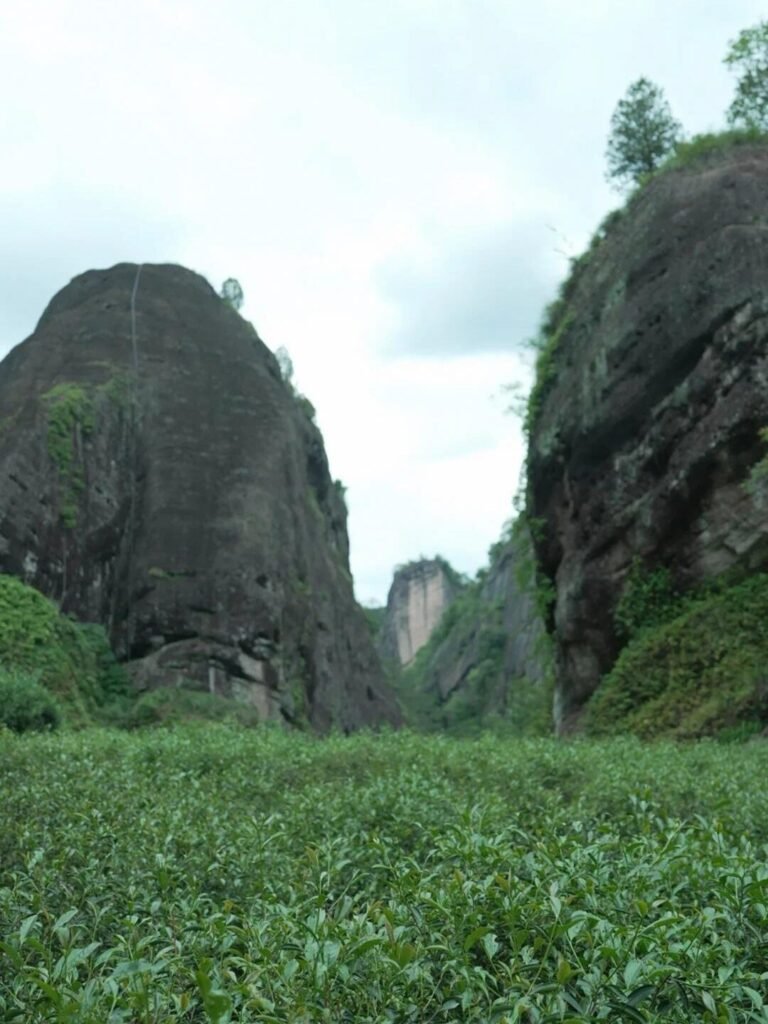
What Exactly Is Rock Tea?
Rock tea’s official name is Wuyi Rock Tea (Wuyi Yan Cha, 武夷岩茶). It comes from the Wuyi Mountains in Fujian Province, and belongs to the oolong tea family with a semi-fermented processing style.
But that’s a pretty dry explanation. Here’s an analogy that might click: if green tea is a fresh pastoral poem, black tea is a warm piece of narrative prose, then rock tea is the rock ‘n’ roll of the tea world. It has depth, power, and personality. It might not ease its way onto your palate, but once you truly understand it, you’ll be hooked by that “stuff in its bones” — and there’s no going back.
That “stuff in the bones” is what the Chinese call Yan Yun (岩韵, “Rock Rhyme”) — the soul of Wuyi Rock Tea. We’ll get into that properly in a minute.
The Official Definition (GB/T 18745)
In 2006, China’s national standard GB/T 18745 (last amended in 2019, with a new 2026 revision set to take effect on April 1, 2027) gives Wuyi Rock Tea this legal definition:
“An oolong tea propagated and cultivated from suitable tea cultivars under Wuyishan’s distinctive natural ecological conditions, processed using distinctive traditional processing methods, and possessing the quality characteristic of Yan Yun (Yan Gu Hua Xiang) — ‘Rock Rhyme,’ conventionally expressed as ‘Rock Bone and Floral Fragrance.'”
Crucially, the legally protected geographic boundary under this standard is the entire administrative area of Wuyishan City — not just the scenic cliffs you see on tourism posters. So a tea labelled “Wuyi Rock Tea” can come from anywhere in Wuyishan’s jurisdiction, as long as it’s made the traditional way.
What Does “Yan Yun” (Rock Rhyme) Actually Taste Like?
Yan Yun isn’t a flavor note. It’s an integrated sensory experience.
To pin it down, we have to go back almost two centuries. The famous Qing-dynasty scholar Liang Zhangju (梁章钜, 1775–1849) laid out the canonical framework in his book Gui Tian Suo Ji (《归田琐记》). The original sequence is “Fragrant, Pure, Sweet, Alive” (香、清、甘、活) — a hierarchy where each quality rises above the last:
“First is fragrance. One step higher is purity. Still higher, sweetness. Still higher, vitality (活)… ‘alive’ must be discerned at the root of the tongue — it is exceedingly subtle.”
Modern Wuyi tea discourse often reverses this to “活、甘、清、香” (Alive, Sweet, Pure, Fragrant) to highlight vitality as the peak. Either way, the four characters together describe a thick, coating liquor that feels alive in your mouth, returns sweetness fast, and leaves a long-lasting impression.
Yan Yun vs. Yan Gu Hua Xiang
You might also see the term Yan Gu Hua Xiang (岩骨花香, “Rock Bone and Floral Fragrance”) — this is the classic way to express Yan Yun in tasting language:
- Yan Gu (Rock Bone) = the structural, firm, mineral body of the liquor
- Hua Xiang (Floral Fragrance) = the high, elegant, enduring aroma
- Yan Yun = the broader experience that includes both, plus duration, throat sensation, and the ineffable “rhythm”
Think of it this way: Yan Gu Hua Xiang is the visible part of the iceberg; Yan Yun is everything below the waterline.
⚠️ Reality check: Yan Yun is not a number you can measure. Modern research uses sensory panels, GC-MS volatile analysis, and metabolomics to find chemical correlates, but there is no universally accepted “Yan Yun score.” If someone tells you their tea scores “92 points on Yan Yun,” take it as marketing.
The Rock Tea Family Registry: Five Core Cultivars
Wuyi has over a thousand documented cultivars. As a beginner, you really only need to remember these five product categories (which is also the legal classification under GB/T 18745):
🥇 Shui Xian — “The Gentlest One”
- Aroma: Orchid dominant; old-grove Shui Xian adds woody and mossy notes
- Texture: Mellow, thick, smooth — the liquor feels as viscous as rice porridge
- Translation: Gentle, welcoming, the easiest on-ramp from black tea
- Try it: For an authentic old-bush experience, look for Wu San Di Lao Cong — the most famous old-bush Shui Xian producing village, with bushes over 100 years old. See the Wu San Di Lao Cong 2026 listing.
🥈 Rou Gui — “The Most Aggressive One”
- Aroma: Cinnamon, spicy, sharp; top examples add floral, fruity, or creamy notes
- Texture: Strong stimulation, swift and powerful returning sweetness
- Translation: The loud one. Hard to miss, hard to forget.
- Try it: Start with a single-cliff Rou Gui to understand terroir expression. The Ma Zhen Feng Rou Gui 2026 (Ma Zhen Feng is a classic Zhengyan cliff neighboring Ma Tou Yan) — or go for the legendary Xiao Niu Rou if you want to try “Niu Rou” at a starter price.
🥉 Da Hong Pao — “The Most Famous One”
- Legal status: Mother trees officially retired from harvest on May 13, 2006 (the last picking, on May 3, 2005, was a 20g ceremonial harvest; 20g from that picking is now preserved in the National Museum of China)
- Today’s reality: Almost all commercial Da Hong Pao is blended from cuttings of the original mother-tree cultivars — typically Beidou (北斗), Qidan (奇丹), and Queshe (雀舌)
- Translation: The politician — diplomatic, balanced, knows how to please a crowd
- Try it: For a Jiulongke-origin experience (the actual site of the mother trees), see the Jiulongke Rou Gui 2026 — Rou Gui produced in the same valley where Da Hong Pao’s legendary bushes grow.
💡 About the famous 1972 Mao-Nixon “200g gift” story: Chinese popular history loves to say Mao gave Nixon 200g (four liǎng) of mother-tree Da Hong Pao, calling it “half of China.” This story is widely circulated but has not been verified in U.S. State Department diplomatic archives for the Nixon visit. Treat it as cultural legend, not historical fact.
🏅 Ming Cong — “The Ones with the Best Stories”
The traditional “Four Famous Ming Cong” are usually listed as Da Hong Pao, Tie Luo Han (铁罗汉), Bai Ji Guan (白鸡冠), and Shui Jin Gui (水金龟). Some modern lists swap Da Hong Pao for Ban Tian Yao (半天妖) — there’s no single canonical answer.
Among these, Tie Luo Han has the strongest historical claim to seniority: an 1886 Qing source, Min Chan Lu Yi, describes it as “a Song-dynasty tree name of Wuyi” — making it the earliest historically documented Wuyi mingcong.
The other three carry legends and taste profiles that make them worth seeking out, but their discovery dates can’t be pinned down to specific years.
🎖 Qi Zhong — “The Most Primal One”
Qi Zhong is best understood as a product category made from the local seed-propagated population called Cai Cha (菜茶, “vegetable tea”) — Wuyi’s native, genetically diverse landrace.
The earliest documented use of the exact term “Cai Cha” appears in Lin Fuquan’s 1943 monograph Wuyi Chaye zhi Shengchan Zhizao ji Yunxiao — Wuyi tea’s first major specialist study.
Because Cai Cha is sexually propagated, every seedling is slightly different — leaf shapes vary, flavor profiles vary. This is the “wild, forest-floor character” you can taste: it isn’t a single clonal cultivar, it’s the raw genetic diversity of Wuyi Mountain in a cup.
⚠️ Important distinction — Qi Zhong is NOT a single selected clone of Cai Cha. It’s a heterogeneous product category from the seedling population. Two Qi Zhong bushes may not taste the same.
Why Such Wild Price Differences? — Mountain-Terroir Grading
⚠️ Critical Fact Check on “Zhengyan / Banyan / Zhoucha”
Here’s something that surprises most newcomers: the terms Zhengyan (正岩, “core rock”), Banyan (半岩, “mid-rock”), and Zhoucha (洲茶, “riverbank”) are NOT legally defined in GB/T 18745. They’re traditional commercial and sensory categories used by tea merchants, not statutory tiers with audited boundaries.
So when a vendor claims “Zhengyan tea,” take it as a marketing claim, not a government certification.
The “Three Pits and Two Streams” — Wuyi’s Core Terroirs
Among the most revered specific sites in the Zhengyan zone are the Three Pits and Two Streams (三坑两涧): Niu Lan Keng (牛栏坑), Hui Yuan Keng (慧苑坑), Dao Shui Keng (倒水坑), Liu Xiang Jian (流香涧), and Wu Yuan Jian (悟源涧). Tea from these sites shows the most pronounced Yan Yun — and commands the highest premiums.
But the Three Pits and Two Streams aren’t the only famous sites. Other celebrated named cliffs include:
- Ma Zhen Feng (马枕峰) — a Zhengyan cliff neighboring Ma Tou Yan, classic Rou Gui terroir
- Yan Zi Ke (燕子窠) — “Swallow’s Nest,” a steep cliff prized for its concentrated aroma
- Ye Zhu Ke (野猪窠) — “Wild Boar’s Nest,” known for thick, deep-bodied teas
- San Yang Peak (三仰峰) — one of Wuyi’s tallest peaks; clean, high-elevation character
- Yi Xian Tian (一线天) — “A Thread of Sky,” a famous narrow gorge with distinctive microclimate
Here’s a real-estate analogy: Zhengyan ≈ a school-district property in a tier-one city; Banyan ≈ a newer build near the second ring road; Zhoucha ≈ a large development in the outer suburbs. All livable, but the premium logic is completely different.
How the2024–2026 Market Is Structured (Without Hard Numbers)
Rather than quoting specific prices — which fluctuate by season, harvest, and producer — here’s how the market is generally tiered. Treat these as rough order-of-magnitude guides, not exact benchmarks.
| Tier | Order of Magnitude (USD/500g) | What You Get |
|---|---|---|
| Entry commercial (Zhoucha, generic Da Hong Pao) | Low double digits | Mass-market gift tins, blended Da Hong Pao, everyday drinking |
| Better Banyan (half-rock Rou Gui, Shui Xian) | Low to mid triple digits | Semi-rock daily drinking tea |
| Standard Zhengyan (traceable site) | High triple digits | Real Zhengyan tea from named cliffs |
| Named-site Zhengyan (e.g., Ma Tou Yan, Ma Zhen Feng) | Low four figures | Single-cliff origin, producer-identified |
| Three Pits and Two Streams | Mid to high four figures, sometimes into five | Top-tier core-terroir Rou Gui and Shui Xian |
| Elite / collector | Five figures and up | Branded limited releases, gift/collector grade |
What drives the spread is essentially four premiums stacked on top of each other: mountain-terroir premium + cultivar premium + craftsmanship premium + scarcity premium. The same100g of tea from a Zhoucha field and from Niu Lan Keng can differ in price by two orders of magnitude — even though both are legal “Wuyi Rock Tea.”
The practical takeaway: if a “Niu Lan Keng Rou Gui” listing is priced anywhere near a budget daily-driver Banyan tea, walk away. Genuine single-origin core-terroir tea is never cheap. Current pricing in our own collection can be checked on the Rock Tea page.
How to Avoid Getting Scammed: A Buyer’s 3-Step Screen
In April 2025, Wuyishan market regulators opened a formal investigation into a livestream seller claiming to sell “pure-material Zhengyan Ma Tou Yan Rou Gui” — only to find the claim was unverifiable. Fraud is real, organized, and ongoing.
The 5 Most Common Fraud Patterns
- Fake terroir labels — ordinary Banyan or Zhoucha Rou Gui is repackaged as “Niu Lan Keng” or “Three Pits and Two Streams”
- “Master tea” / “Mother tree” claims — unsubstantiated prestige marketing
- Packaging forgery — fake certificates, government-looking logos, fabricated QR traceability
- Fake aging — “old stock” or “stored for decades” with no provenance
- Heavy roasting to fake depth — over-roasting lower-terroir tea to simulate body
A Practical 3-Step Screen
Step 1 — Provenance check (before you even look at the leaf)
- Real Niu Rou for a few dollars? Don’t even open the package.
- Ask for: producer name, garden/site, harvest year, bush age, roast level, batch/lot, net weight
- “Core area,” “pure material,” “mother tree,” “master’s tea” without specifics = red flag
Step 2 — Aroma check (the lid vs. the cup)
- Aroma should be integrated into the liquor, not just loud on the lid
- Real Zhengyan Rou Gui: cinnamon aroma that stays in the water, evolves across infusions
- Fake: huge perfume blast on the first pour, gone by infusion two
Step 3 — Texture, finish, durability test (across 5+ infusions)
- Real Zhengyan: thick, coating body; bitterness that transforms into returning sweetness; long throat finish; coherent across many infusions
- Fake: thin middle, persistent harsh astringency, dramatic collapse after a few rounds
If you can only afford one rule: trust your tongue across multiple infusions, not the vendor’s pitch on the first steep.
How Is Rock Tea Made?
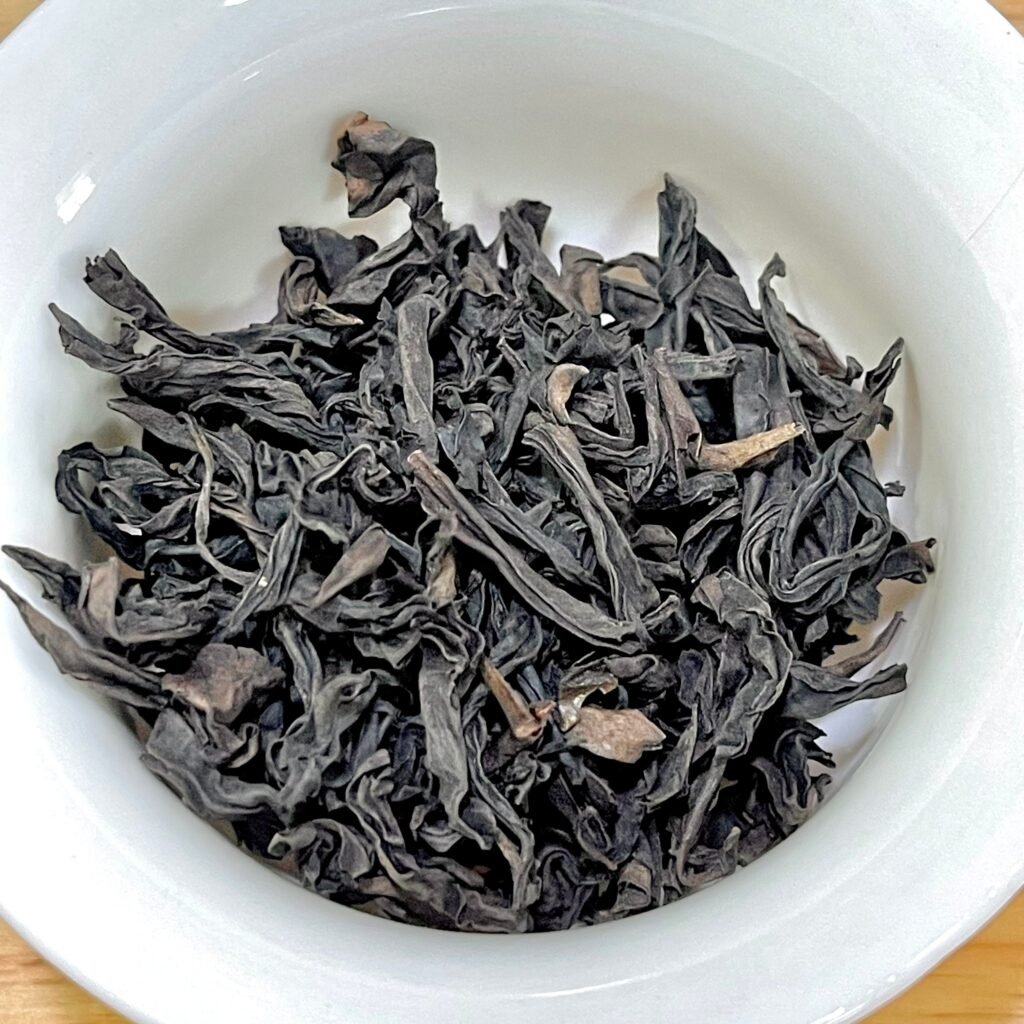
Wuyi Rock Tea goes through more processing steps and takes longer than any other tea category. The core sequence is:
Fresh leaves → Sun-withering or wilting → Zuo Qing (摇青, “making green” — tumbler-turning + air-rest) → Kill-green → Rolling → Drying (initial bake, cool, re-bake) → Rough tea
Among these, Zuo Qing determines the aroma; Roasting (焙火) determines the texture and shelf life.
Roasting Levels
- Light fire (轻火) — Floral notes stand out; beginner-friendly; best drunk within a year
- Medium fire (中火) — Floral-fruity plus ripe-fruit notes; the most classic style
- Full fire (足火) — Charcoal and caramel notes; thick, heavy liquor; beloved by seasoned drinkers
The 2006 Intangible Cultural Heritage Listing
In 2006, Wuyi Rock Tea (Da Hong Pao) Making Technique was inscribed as Item Ⅷ–63 in China’s first national list of intangible cultural heritage. In 2022, it became part of the UNESCO Representative List inscription of Traditional tea processing techniques and associated customs in China — meaning this craft has formal international recognition.
The 2006 inscription happened the same year the mother trees were retired from harvest — not a coincidence. It marked the institutional moment when Wuyi tea was recognized as heritage worth protecting.
Our Picks from the Wuyi Rock Tea Collection
Looking to buy real Wuyi Rock Tea online? Here are nine traceable, named-terroir picks from our Rock Tea collection — each tied to a specific cliff or village so you know exactly what terroir you’re getting.
Best for Beginners
- Yi Xian Tian Rock Tea 2026 — Named after the famous “A Thread of Sky” gorge. A great entry-level single-site tea with a clear, balanced profile that shows you what a named cliff can do without breaking the bank.
Best for the “Cinnamon Spice” Lover (Rou Gui)
- Ma Zhen Feng Rou Gui 2026 — Rou Gui from Ma Zhen Feng, a Zhengyan cliff neighboring the famous Ma Tou Yan. Classic cinnamon character with strong returning sweetness.
- San Yang Peak Rou Gui 2026 — Rou Gui grown on the high-altitude San Yang Peak; cleaner, more lifted aroma than mid-mountain Rou Gui.
- Xun Tao Rou Gui 2026 — Another single-site Rou Gui option; useful for side-by-side tasting to feel how site affects flavor.
- Yan Zi Ke Rou Gui 2026 — Rou Gui from “Swallow’s Nest” cliff, known for concentrated aroma and tighter body.
Best for the Adventurous
- Xiao Niu Rou — A smaller-batch, more accessible version of the legendary “Niu Rou” (Niu Lan Keng Rou Gui). Same core terroir, easier entry point.
- Jiulongke Rou Gui 2026 — Rou Gui grown in Jiulongke, the very valley where Da Hong Pao’s mother trees live. Buy a few grams to taste what the location does to a non-Da-Hong-Pao cultivar.
- Ye Zhu Ke Rou Gui 2026 — From “Wild Boar’s Nest,” a steep cliff prized for thick, deep-bodied teas.
- Wu San Di Lao Cong 2026 — Old-bush Shui Xian (100+ year bushes) from Wu San Di village. The benchmark “Lao Cong” experience: woody, mossy, with the famed cong wei (枞味).
💡 Tip: If you’re buying a single tin as a starter, choose Yi Xian Tian or Ma Zhen Feng Rou Gui — both are traceable single-site teas at accessible prices that let you taste terroir without committing to a top-tier core-terroir purchase.
Quick Answers to Common Beginner Questions
Q: What teaware should I use for rock tea? A: A white porcelain gaiwan is ideal (100–120 ml with 6–8 g of tea), with a Yixing clay teapot as a second choice. Never use a glass mug for steeping ❌ — you’ll stew bitterness out of the tea.
Q: What water temperature? A: Use freshly boiled water (98–100°C) for nearly all rock teas. This isn’t just common advice — it’s what senior Wuyi tea masters like Chen Yurong (陈郁榕) and Liu Guoying (刘国英) publicly recommend. Liu Guoying’s rule: “The water should reach the boil; the tea should be brewed out, not soaked.”
If a light-fire tea tastes too aggressive, reduce steep time (try 5–10 seconds for the first infusion), not the water temperature.
Q: How many infusions can I get? A: A good rock tea should give you at least 8 to 10 infusions. The first few explode with aroma, the middle ones hit peak mellowness, and the tail-end brews taste as sweet as sugar water.
Q: How should I store it? A: Sealed, away from light, moisture, and odors. Store in a dry, cool place — never in the fridge unless you plan to age it for decades. Full-fire rock tea can be kept for several years; light-fire versions are best drunk within a year.
Q: Is rock tea high in caffeine? Will it keep me awake? A: There is no published, standardized caffeine measurement specifically for Wuyi Rock Tea — the amount depends on your leaf dose, water temperature, and steep time. As a working estimate, a typical 100ml serving falls around 15–45 mg of caffeine, similar to black tea or pu’er.
If sleep matters: NHS guidance notes caffeine can affect sleep for up to 7 hours after consumption. For evening drinking, use a lower leaf dose, fewer infusions, or switch to herbal alternatives.
China’s National Health Commission advises against drinking large amounts of strong tea, and recommends that children aged 12 and under not consume caffeinated drinks.
Q: Do you ship internationally? How long does it take? A: Yes — we ship worldwide via DHL, FedEx, and dedicated European lines (typically 7–15 business days). For budget shipping to most regions, China Post or Cainiao is also available (9–25 days). Delivery may be delayed by snowstorms, typhoons, earthquakes, or other force majeure events.
Q: What payment methods do you accept? A: We accept PayPal, credit/debit cards (Visa, MasterCard, JCB), Western Union, and bank transfer. For bank transfer or Western Union, please contact our customer service first for details.
Q: How fast will my order be processed? A: Orders are picked, packed, and quality-checked within 24–48 hours of confirmation. You’ll receive a tracking number by email once the package ships.
Q: What’s your return and refund policy? A: You have 7 calendar days from receiving your order to request an exchange or return. We cover return shipping if the issue is on our side (defective product, wrong item shipped). For buyer’s-remorse returns (changed mind, doesn’t suit your taste, accidental damage), the customer covers return shipping.
Refunds are issued to the original payment method within 3–30 business days after we confirm the return with you.
Q: Can I modify or cancel my order after placing it? A: Yes — if the order hasn’t shipped yet, just contact our 7×24 customer service to modify or cancel. Once shipped, the order can’t be cancelled, but you can request an exchange after delivery.
Final Thoughts
Rock tea doesn’t finish you — it wears you down, then wins you over.
It’s not as instantly transparent as green tea, and it doesn’t cozy up to you the way black tea does. It asks you to sit down, settle your mind, brew infusion after infusion, and slowly work through it. But the reward? One day you’ll suddenly realize everything else tastes flat — and you’ll never quite go back to the way you used to drink tea.
One last piece of context: Wuyi Mountain itself was inscribed as a UNESCO World Heritage Site in 1999 — a mixed property (cultural + natural). When you’re drinking a properly made Wuyi Rock Tea, you’re tasting a piece of a landscape that’s been recognized as internationally significant for over 25 years. That’s not marketing fluff. That’s real cultural weight in your cup.
About This Guide
This article is part of our Wuyi Rock Tea educational series. We are Min Tea Shop, an online Chinese tea merchant headquartered in Fuzhou (福州), the capital of Fujian Province. We source directly from multiple tea regions across Fujian — including Shouning (寿宁) in the high mountains of the north (home to outstanding white and black teas) and Wuyishan (武夷山) in the northwest (the only legally recognized origin for Yan Cha) — selecting traceable, named-terroir lots cliff by cliff, garden by garden.
For our rock tea collection specifically, we work with producers on named Zhengyan cliffs like Ma Zhen Feng, Jiulongke, Yi Xian Tian, San Yang Peak, and the legendary Three Pits and Two Streams. We sell in USD with international shipping to most countries.
Browse our full Wuyi Rock Tea collection → minteashop.com/rock-tea/
Have a question we didn’t cover? Our 7×24 customer service team is here to help.
Primary sources consulted: GB/T 18745-2006 (current standard, with Amendment 1 effective 2019); UNESCO World Heritage Centre records on Mount Wuyi (inscription 1999); Guofa [2006] No. 18 (China’s first national ICH list, entry Ⅷ–63); Lin Fuquan 1943 monograph on Wuyi tea; Liang Zhangju’s Gui Tian Suo Ji (Qing dynasty, c. 1849); Xinhua 14 May 2006 report on Da Hong Pao mother tree retirement; NHS sleep & caffeine guidance; China National Health Commission dietary guidance.

4 Comments