
Black Tea vs Green Tea: One Decision Explains It All
The black tea vs green tea question usually gets answered with a list of health claims in which one is declared the winner. That framing is not useful, because the two teas are not competing products — they are the same leaf taken in different directions, and the differences that matter are chemical, sensory and practical rather than moral.
What follows is what actually differs in black tea vs green tea, what does not, and how to decide which one suits you without pretending the answer is the same for everyone.
Table of Contents
The One Real Difference
Black tea and green tea come from the same plant, Camellia sinensis, and often from the same cultivar. The difference is a single decision made after picking: whether to let the leaf oxidise.
Green tea is heat-treated soon after picking — pan-fired or steamed — which destroys the enzymes that would otherwise drive oxidation. The leaf stays green and its catechins stay intact.
Black tea is rolled or cut to bruise the leaf, releasing those enzymes into contact with oxygen. The catechins are consumed in the reaction and converted into theaflavins and thearubigins. The leaf turns dark and the liquor turns red.
Everything else — the taste, the colour, the chemistry, the brewing advice — follows from that one decision. If you remember nothing else about black tea vs green tea, remember that the difference is timing rather than ingredients. In any black tea vs green tea comparison, this is the only structural difference, and it accounts for most of the rest.
Catechins: The Big Divide
The numbers here are large enough to settle the argument about which is “healthier” in the antioxidant sense.
A study comparing green, oolong and black tea made from the same cultivar and the same batch of fresh leaf found that black tea contained 82.9% to 84.6% less total catechin than the green tea made alongside it. Total flavonol glycosides were 14.2% to 28.8% lower.
That is not a small processing effect. It is the defining chemical consequence of oxidation: the compounds that make green tea green are the substrate that makes black tea black. You cannot have both.
Black tea does gain something green tea does not have: theaflavins, which are formed during oxidation and are biologically active in their own right. Research has found that theaflavins have antioxidant potency comparable to green tea catechins. So black tea is not devoid of activity — it is a different set of compounds, not simply a degraded version.
Antioxidant Capacity, Measured
When the two are compared directly in the lab, the ranking is consistent.
One study measured white, green and black tea — the black split into orthodox and CTC processing — using ORAC, ABTS and LDL oxidation assays. The order came out as: green tea ≥ low-caffeine green tea > white tea ≥ orthodox black tea > CTC black tea.
Two things are worth drawing from this. First, green tea comes out ahead, which is what the catechin numbers predict. Second, processing method inside black tea matters: orthodox black tea ranked above CTC. How the leaf was handled changed the result as much as the category did.
What this does not tell you is anything about health outcomes in people. Antioxidant capacity in a test tube is a chemical property, not a clinical finding.
Caffeine: No Reliable Difference
This is the comparison most often got wrong. The common claim — that black tea has more caffeine because it is darker and more processed — is not supported.
The dry-leaf data has green tea slightly ahead: measured as extractable caffeine over three infusions, black tea yielded 32.8 mg/g and green tea 36.6 mg/g. A study of twenty commercial teas found a range of 14 to 61 mg per serving with no consistent trend between tea types.
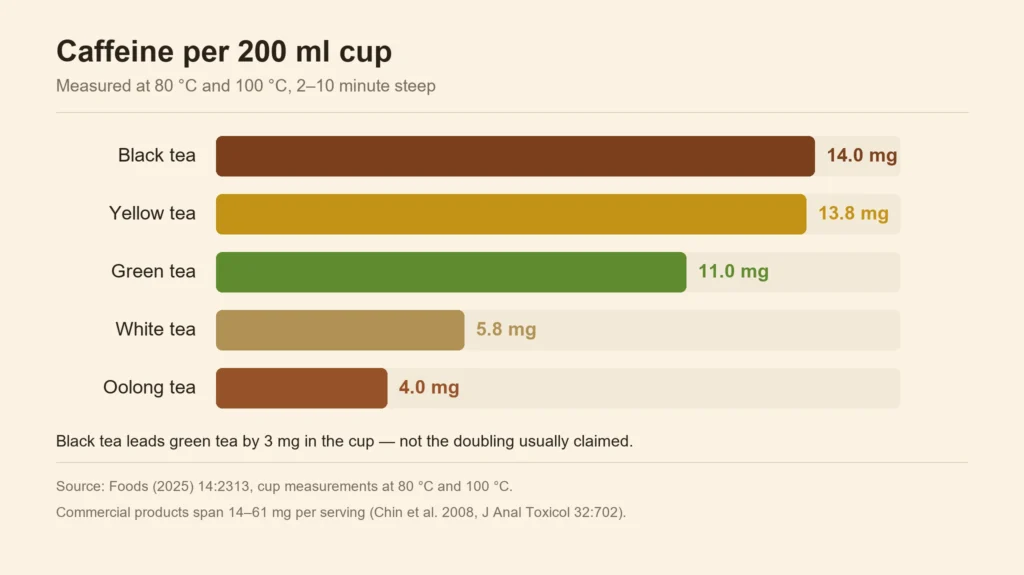
A 2025 study measuring the cup under controlled conditions did find black tea highest at 14 mg per 200 ml against green at 11, but that is one set of conditions and it does not establish a general rule.
The honest conclusion for black tea vs green tea on caffeine: there is no reliable difference. What determines the caffeine in your cup is how much leaf you use, how long you steep and what grade the leaf is — all of which you control. Full figures are in black tea caffeine.
Taste: The Difference You Notice
Chemistry aside, taste is the part of black tea vs green tea that decides which one you actually drink, and it is the part least served by arguing about antioxidants.
Green tea is vegetal, grassy and often savoury, with a fresh quality that comes from intact catechins and amino acids. It can be sweet, marine or nutty depending on type. It turns bitter quickly at high temperatures.
Black tea is malty, with dried fruit, cocoa and sometimes floral or smoky notes. The malt character comes from the browning reactions of oxidation. It is fuller in body and tolerates heat much better.
The practical consequence: green tea punishes temperature, black tea punishes time. If you have a habit of pouring boiling water and walking away, black tea will forgive you for longer — though not indefinitely. See how to brew black tea for the numbers.
Health Evidence Compared
Both have evidence, and neither supports strong claims.
Cardiovascular. Both show small effects in trials and modest associations in cohort studies. The evidence for green tea is somewhat larger in volume but not clearly stronger in effect. Neither is a treatment.
Cancer. A pooled analysis of 41 prospective cohorts found no inverse association for tea overall with the five major cancers. Some cancer-specific analyses favour green tea; black tea showed a small positive association with breast cancer that is most likely confounding.
Weight. The catechins in green tea have been studied for weight effects, with small results. Black tea has no human weight-loss evidence at all — the study usually cited is in mice.
Iron absorption. Both inhibit non-haem iron absorption, because both contain polyphenols. Black tea inhibited it by 79% to 94% in isotope studies. Green tea does the same thing.
The summary for black tea vs green tea on health: green tea’s catechin advantage is real and measurable, but the clinical evidence for either is modest, and choosing between them on health grounds is not a decision the data supports particularly strongly.
Brewing Differences
| Green tea | Black tea | |
|---|---|---|
| Water | 70–85 °C | 90–100 °C |
| Leaf | 2–3 g per 200 ml | 2–3 g per 200 ml |
| Time | 1–2 minutes | 2–4 minutes |
| Milk | No | Often |
| Re-steeps | 2–3 | 1–2 Western, 6–10 gongfu |
The temperature gap is the main one. Green tea’s intact catechins extract readily and turn harsh above 85 °C; black tea’s converted compounds need more heat to come out. Using black tea temperatures on green tea is the single most common way to make green tea taste bad.
Milk is the other practical difference. It works with black tea because the body is there to support it, and it does not work with green tea because there is nothing for it to sit against.
Which Should You Drink
Four honest reasons to pick one over the other.
Pick green tea if you drink tea plain, you like vegetal and fresh flavours, and you are willing to mind the water temperature. It is the more rewarding tea to drink carefully.
Pick black tea if you drink tea with milk, you want something that survives a busy morning, or you like malt and dried fruit. It is the more forgiving tea to drink casually.
If you are still weighing black tea vs green tea and cannot decide, drink both for a week and let your own taste settle it. Drink both if you drink enough tea to want variety. There is no rule against it, and the brewing skills transfer.
Do not pick either for the health claims. The differences are real but small, and both are pleasant drinks rather than interventions. If you want a specific health effect, a doctor is more useful than a tea tin.
Frequently Asked Questions
In the black tea vs green tea comparison, which is healthier?
Green tea retains far more catechins — black tea has 83% to 85% less — and ranks higher in antioxidant assays. But the clinical evidence for both is modest, and the difference in health outcomes is not established. “Healthier” is not a well-defined question here.
On black tea vs green tea, which has more caffeine?
No reliable difference. Dry-leaf data has green slightly ahead; cup measurements vary by study. What matters is leaf quantity, steep time and grade.
Can I drink black tea instead of green tea for antioxidants?
You can drink it, but you will get a different set of compounds. Black tea’s theaflavins are active, but the catechin content is far lower. If antioxidants are the specific goal, green tea is the better choice on the chemistry.
Why is black tea brewed hotter than green tea?
Because its catechins have already been converted. Green tea’s intact catechins extract readily and turn harsh at high temperature; black tea’s larger molecules need more heat to dissolve.
Is black tea stronger than green tea?
In flavour, usually yes — fuller body and malt. In caffeine, no. In antioxidant content, green tea is ahead. “Stronger” needs a qualifier to mean anything.
The Processing Difference in Detail
The one-sentence version of black tea vs green tea is “one is oxidised and one is not”, but the mechanics are worth a paragraph because they explain the sensory gap.
Green tea is fixed early. Within hours of picking, the leaf is heated — pan-fired in most Chinese production, steamed in Japanese styles — to a temperature that denatures the enzymes polyphenol oxidase and peroxidase. With those enzymes inactive, the catechins stay as they were in the fresh leaf. The leaf dries green and the liquor is pale.
Black tea is deliberately not fixed. The leaf is withered, then rolled or cut so that cells rupture and the enzymes meet both their substrates and oxygen. The reaction runs for three to six hours, controlled by temperature and humidity, and is stopped by heat at the end rather than the beginning.
That inversion — heat at the start versus heat at the end — is the whole of it. It also explains why the two teas behave differently in the kettle. Green tea’s intact catechins are small, soluble and quick to turn harsh, so they need cool water and a short steep. Black tea’s converted compounds are larger and need more heat and more time to dissolve.
Anyone learning to taste the difference should try the same cultivar processed both ways if they can find it. It is the clearest demonstration of how much processing, rather than plant or place, determines what ends up in the cup.
Which Is Better Iced?
For iced tea, black tea usually wins, and the reason is structural rather than a matter of preference.
Green tea’s appeal is delicate and volatile. Chilling mutes aroma, and dilution with ice mutes it further, so a green tea that tastes vivid hot can taste like weak water over ice. Black tea’s malt and body survive both chilling and dilution much better.
If you want iced green tea, cold brewing is the better route — it extracts fewer harsh compounds and preserves more of the fresh character. For black tea, either hot-brew-and-chill or cold brew works.
One practical note: iced black tea goes bitter easily because people brew it double-strength to allow for dilution. Brew it at the strength you want to drink and accept a little dilution instead.
More Questions
Can I mix black tea and green tea?
You can, and blends exist, but they brew badly together: green tea wants 80 °C and black tea wants 95 °C, so one of them is always wrong. Drink them separately.
Does black tea vs green tea matter for iron absorption?
Not much — both contain polyphenols and both inhibit non-haem iron absorption. The black tea figure measured 79% to 94% inhibition; green tea does the same thing by the same mechanism. If you are anaemic, the advice applies to both.
Which has more theanine?
Green tea generally retains more L-theanine, because it is an amino acid that is not consumed by oxidation. The difference is modest and the practical effect is small.
Is one better for sleep?
Neither is caffeine-free, so both can affect sleep. Green tea’s slightly lower typical caffeine per cup makes it marginally the safer evening choice, but the brewing variables matter more than the category.
Related reading: black tea benefits, black tea caffeine, how to brew black tea.
Shop the black teas in this guide
Sold directly from our own stock. Every listing states the harvest, the county and the size options.
- Jin Mu Dan 2026, Shouning — $19.90
- Jin Jun Mei 2026, single bud, Shouning — $19.90
Not sure which one? Browse the full black tea collection — or start with the guides above.
Sources & References
Peer-Reviewed Research
- Journal of Food Composition and Analysis (2018). Same cultivar, same leaf, processed three ways: black tea total catechins 82.9–84.6% lower than green; flavonol glycosides 14.2–28.8% lower. DOI:
10.1016/j.jfca.2017.12.016 - Carloni, P. et al. (2013). ORAC, ABTS and LDL oxidation across white, green, orthodox black and CTC black tea. Food Research International 53:900–908. DOI:
10.1016/j.foodres.2012.07.057 - Chin, J.M. et al. (2008). Caffeine in 20 commercial teas, 14–61 mg per serving, no trend between types. DOI:
10.1093/jat/32.8.702 - Hicks, M.B. et al. (1996). Dry leaf caffeine: black 32.8, green 36.6, oolong 23.8 mg/g. DOI:
10.1016/0963-9969(96)00038-5 - Journal of Nutrition (2001). Theaflavin antioxidant potency comparable to green tea catechins. DOI:
10.1093/jn/131.9.2248 - Yu, F. et al. (2014). 41 prospective cohorts, no inverse association with five major cancers. DOI:
10.1186/1471-2407-14-197 - Hurrell, R.F. et al. (1999). Tea polyphenols inhibit non-haem iron absorption 79–94%. DOI:
10.1017/S0007114599000537
Standards
Standard numbers and dates can be verified at China’s national standards platform: std.samr.gov.cn.
- GB/T 30766-2014 — Tea classification. Defines black tea by withering, rolling or cutting, oxidation and drying; green tea by heat treatment that prevents oxidation.
- GB/T 30375-2013 — Tea storage. Green tea at ≤10 °C; black tea at ≤25 °C.
What this page does not claim
We do not claim either tea is healthier, that one is objectively better, or that antioxidant capacity in a lab translates into a health outcome. Where green tea has the chemical advantage, we say so; where the clinical evidence is thin for both, we say that too.

One Comment