How to Store White Peony Tea So They Last
Most of the good white peony tea sold in China comes from a few towns in northern Fujian — Fuding, Zhenghe, and our home county, Shouning (寿宁). All three sit at the kind of elevation where morning fog rolls off the ridges and the buds grow slowly, leaf by leaf. That’s what gives the silvery down and the long, soft finish that defines a good white tea.
I grew up in Shouning, which tea growers here call a thousand-year tea town. Shouning sits in the northeastern corner of Ningde prefecture, with a county-average elevation of about 845 meters and tea gardens concentrated between roughly 400 and 800 meters above sea level, with our premium plots above 800. The mountain soil is yellow and red loam, around pH 5.0 to 5.5, with 2 to 3 percent organic matter — which is part of why our leaves taste the way they do, and part of why they keep getting better once they leave the drying rack.
That’s why this article isn’t theory for me. If you store a white peony cake the right way, you can drink the same cake in five years, ten years, longer. It just gets better. In Fujian we have a saying: one year, it’s tea. Three years, it’s medicine. Seven years, it’s treasure.
But here’s the catch. The same cake stored badly — left in a kitchen drawer or on a sunlit shelf — turns musty in a month. White peony in cake form is pickier than loose-leaf white tea, because the compressed form traps moisture easily and soaks up odors from anything nearby.
So how should you store white peony tea cakes so they last? Four steps. Each one matters.
What Is the Best Container for White Peony Tea Cakes?
Start with the container. Pick the wrong one, and the other three steps won’t save you.
White peony has two big enemies: moisture and light. So your container has to block both. From a food-science angle, the FDA’s own guidance on water activity in foods treats tea as a low-moisture dry good, which means it wants a stable, dry, sealed environment — exactly what a good canister provides.
Here’s how the common options stack up:
| Container | Moisture block | Light block | My take |
|---|---|---|---|
| Tin canister / iron barrel | Excellent | Excellent | Top pick |
| Ceramic jar with tight lid | Great | Great | Close second |
| Colored glass bottle | Decent | Decent | Fine for short-term |
| Clear glass bottle | Decent | None | Skip it |
| Paper bag or cardboard box | None | None | Only for transit |
A clear glass bottle is tempting because the cake looks pretty inside it. Skip it. Light dulls the silvery down and flattens the fragrance within weeks.
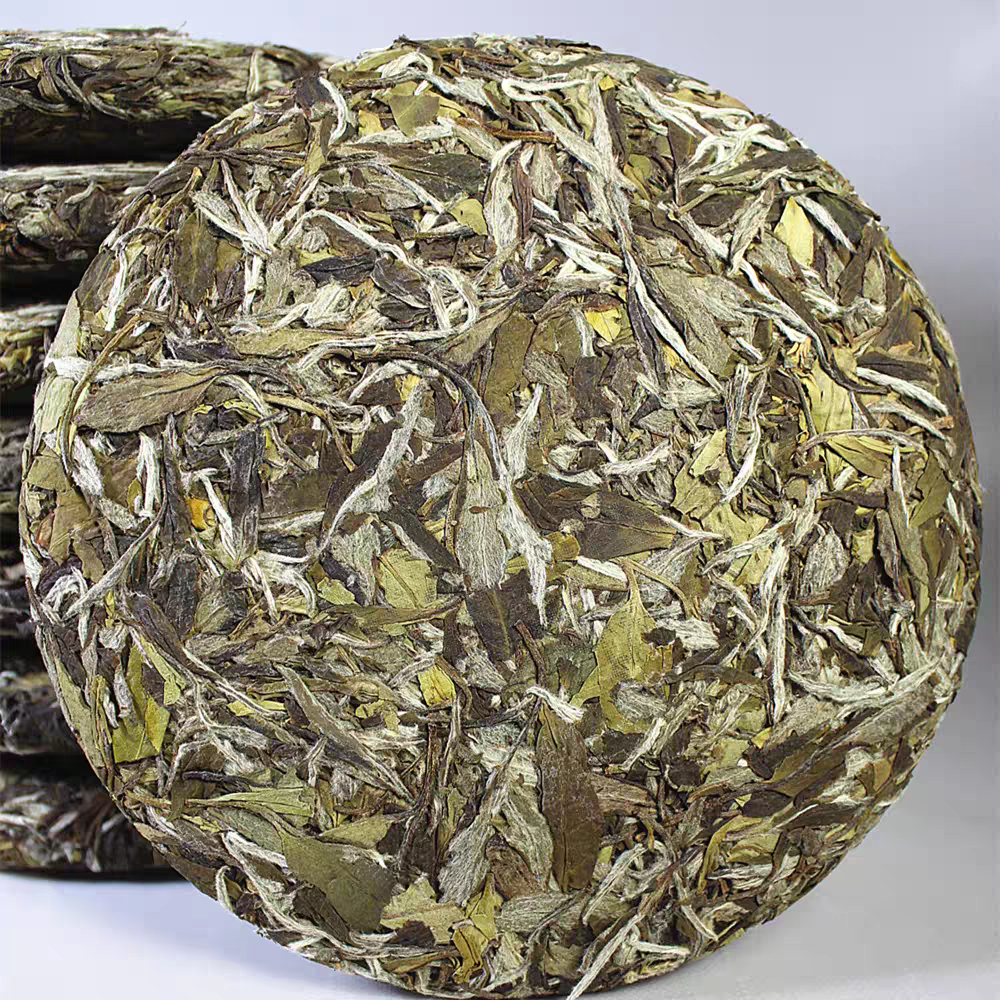
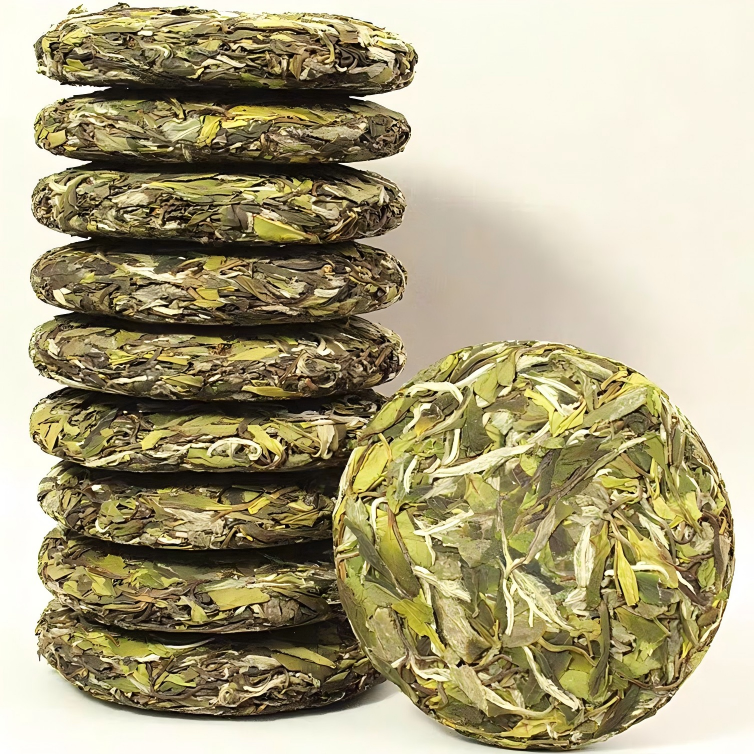
For one or two cakes, a tin canister or ceramic jar works well. If you bought a stack of four or six cakes — what’s called a tong — keep the original bamboo and kraft paper wrap on the whole stack. The bamboo sheath isn’t decoration. It’s traditional moisture control that works better than most modern containers.
At MinTea, every white peony cake we ship leaves our warehouse sealed inside this exact setup — kraft paper + food-grade foil + tin canister. We use the same chain our grandfathers used. For the full range, see our white tea collection.
Should You Seal White Peony Tea Cakes in Plastic or Foil?
Seal the cake before you put it in the container. Always.
Air, moisture, and stray smells don’t wait outside the container — they sneak in every time you open it. A second layer of sealing keeps them out between sessions.
Here’s the routine we use at the MinTea warehouse:
- Wrap the cake snugly in food-grade aluminum foil or thick kraft paper.
- Push out as much air as you can by hand. A heat sealer is best. A sealing clip is fine for short-term storage.
- Drop the wrapped cake into your tin canister or ceramic jar and seal the lid.
Two things to avoid:
- Clear plastic bags. They breathe. Air, moisture, and odors all pass through. Your cake will pick up kitchen smells within months.
- Newspaper. Ink smells. Tea absorbs them. Use plain kraft paper instead.
Quick warning: if your cake came in its original bamboo sheath, leave the bamboo on. Don’t unwrap it.
A note on preparing a brand-new tin: don’t bake it in the oven to “burn off the factory smell.” Most food-grade tins have interior coatings, gaskets, or printed layers that aren’t rated for oven temperatures, and you can damage the protective layer that actually blocks rust. The safer routine — which lines up with both Chinese tea storage guidance and the long-running r/tea community advice on cleaning new tea tins — is to rinse with warm water and mild soap, dry thoroughly, leave the lid off in a well-ventilated spot for 24 to 48 hours, then drop in a small handful of cheap loose-leaf tea or a spoonful of baking soda overnight to absorb any lingering odor. If after that you can still smell chemicals, don’t use that tin for tea.
What Temperature and Humidity Do White Peony Tea Cakes Need?
The environment matters as much as the container. Think cool, dry, and dark.
Cool means under 25°C (77°F). Room temperature is fine, as long as you stay away from heaters, sunny windows, and kitchen stoves. White peony also doesn’t like big temperature swings — so avoid placing your storage cabinet next to a wall that gets blasted by an air conditioner all day.
Dry means relative humidity under 60%. The sweet spot is 50 to 55%. Tea sits well within the FDA’s general framework for low-water-activity foods — below that band, microbial and quality degradation slows sharply; above it, the cake starts to absorb ambient moisture and lose its crispness. If you live in a humid climate, toss a small packet of food-grade desiccant into the cabinet — just don’t let it touch the cake directly.
Dark means no direct light at all. UV rays slowly break down the chlorophyll, amino acids, and natural enzymes that give white tea its flavor. That’s why the best storage spots are inside cupboards, not on open shelves.
A basic digital hygrometer is a few dollars online and tells you exactly what your cabinet is doing. Worth it if you’re storing anything for more than a year. For a broader take on how the USDA frames “keep food quality, reduce waste” through stable dry storage, the USDA FoodKeeper app covers the same principles that apply to tea.
A north-facing tea shelf, the corner of a home office, or a dedicated tea cabinet is fine. The goal is dry, ventilated, dark, and smelling of absolutely nothing.
Can White Peony Tea Absorb Odors from the Fridge?
Short answer: yes. Don’t store tea in the fridge.
White tea is one of the smelliest teas when it comes to absorbing odors. Butter, garlic, perfume, cigarettes, fresh paint, mothballs — if it’s nearby, your cake will pick it up. The fridge is the worst offender because it has its own smells, plus constant humidity swings every time the door opens.
I tested this myself once: I left a wrapped cake next to an open bottle of perfume for a week. By the third infusion, the brew smelled faintly floral in a way that had nothing to do with tea.
A few “neighbors” to keep your cakes far away from:
- The fridge
- The kitchen stove or counter
- A perfume cabinet or cosmetics drawer
- A freshly painted shelf
- Cigarettes
- Mothballs or camphor blocks
- Strong spices (star anise, cinnamon, Sichuan peppercorn)
If you’re in the middle of brewing and want a clean routine that won’t cross-contaminate the storage tin, our guide on how to brew white peony tea covers the safe pouring setup.
How Long Can You Store White Peony Tea Cakes?
Here’s the part most people find surprising: white tea improves with age.
It’s not just a folk belief. Real peer-reviewed chemistry backs it up. A PubMed-indexed study tracking 1- to 13-year-old white tea samples found that total polyphenols and catechins drop steadily over storage, while total flavonoids, thearubigins, and theabrownins rise. A separate broad-target metabolomics study of aged Bai Mu Dan found the same direction: amino acids, flavonoids, and tannins reorganize over the years, which matches the taste shift people describe — less bite and brightness, more body, sweetness, and a brownish, mellowed liquor. A newer multi-omics study tracking 0- to 11-year storage adds that volatiles and even the leaf microbiome shift alongside the chemistry, moving the flavor profile from fresh / grassy / fruity toward woody / honeyed / aged.
Put plainly: when white peony “ages well,” what’s actually happening is that polyphenols are slowly converting into larger, softer-tasting flavonoids and pigment compounds, while the amino acids that give young tea its bright edge are breaking down.
Here’s how the taste changes in practice:
- Fresh (1–2 years): sweet, brisk, high floral notes. If you like something bright and clean, drink it now.
- Aged (3–5 years): deeper, rounder. The florals fade; date, dry hay, and a soft medicinal quality show up.
- Old (7+ years): thick, smooth, almost like a young pu’er. The liquor goes amber. This is the treasure the saying talks about.
It’s also worth noting that white tea has had a long secondary life as a pharmacy ingredient in China. Late-Qing era accounts hold that Beijing Tongrentang — founded in 1669 and imperial pharmacist from 1723 — was purchasing aged white tea from Fujian for use in its preparations, and trade-period records describe the company acquiring roughly 50 jin of aged white tea a year for that purpose. Modern historians treat this as a well-attested industry narrative rather than a formally codified Pharmacopoeia entry, but the practice still shapes how the aged-tea market is priced today.
If you’d like to compare fresh and aged side by side, MinTea keeps a small rotation of both — our 2024 Bai Mu Dan cake for fresh-style drinkers, and the 2023 White Peony Bai Mu Dan Cake for drinkers chasing that aged profile.
For broader context, our white peony tea guide covers grades, origins, and how to read a cake label, and our Shou Mei aging guide walks through the same chemistry for MinTea’s related Shou Mei line.
MinTea’s Quick Checklist Before You Store
Before you close the lid on your cake, run through this:
- Container? Tin canister, ceramic jar, or a foil bag inside any sealed box.
- Sealed? Food-grade foil or kraft paper, air pushed out, clip or heat-sealed.
- Temperature? Under 25°C, no direct sun.
- Humidity? Under 60%, ideally 50–55%. Desiccant nearby if you live somewhere humid.
- Light? Stored in complete darkness.
- Smell? No odors from kitchen, perfume, paint, or fridge nearby.
- New tin prepped? Washed, air-dried 24–48h, baking soda or cheap tea used to absorb any smell.
All seven checked? You’re set.
Where to Buy White Peony Tea Cakes Worth Storing
Storing the cake properly only matters if the cake itself was good to begin with. MinTea sources directly from small farms in Shouning County (寿宁), Fujian — a high-mountain tea region with gardens mostly at 400 to 800 meters elevation and premium plots above 800. The altitude, the morning fog, and the cool mountain nights give the leaves their slow growth and dense, durable flavor.
Every cake we ship goes out pressed, sealed, and storage-ready. Most orders leave our warehouse within 24 to 48 hours and reach Europe in 7 to 15 days via DHL, FedEx, or our European line. If customs policy forces a slower route, we switch to EMS or Cainiao, which adds 15 to 25 days. Payment is flexible — Visa, Mastercard, JCB, PayPal, Western Union, or direct bank transfer through our support team. Every order is covered by a 7-day return window and a 24/7 support inbox.
A few cakes to start with, depending on what kind of storage plan you have in mind:
For storing 3–5 years (aged-style drinkers):
- White Peony Bai Mu Dan Cake — 2023 — already mellow, will only get better.
- Bai Mu Dan Tea Cake 2024 — slightly younger, lots of room to evolve.
For drinking within 1–2 years (fresh-style drinkers):
- White Peony Bai Mu Dan 2026 — current crop, bright and floral.
- Bai Hao Yin Zhen 2026 — pure buds, the gentlest white tea we stock.
You can browse the full MinTea white tea collection, read our beginner’s guide to white tea, or check the 4 main types of white tea if you want the full picture. For health and caffeine notes, see what white tea is good for.
Final Thoughts
Storing white peony isn’t complicated — it just asks you to be a little careful up front. Pick the right container. Seal the cake. Keep it cool, dry, and dark. Keep it away from smells.
After that, time does most of the work.
For over a thousand years, growers in Shouning have been making tea this way — pressed, sealed, and set aside to age. You’re not doing anything fancy. You’re doing what the tradition already knows works.
References
- PubMed — Storage aging of white tea (1–13 years), tracking flavonoids, thearubigins, and theabrownins. https://pubmed.ncbi.nlm.nih.gov/34314928/
- PubMed — Broad-target metabolomics of aged Bai Mu Dan (white peony). https://pubmed.ncbi.nlm.nih.gov/34118510/
- PubMed — Multi-omics analysis of volatile and non-volatile changes during 0–11 year white tea storage. https://pubmed.ncbi.nlm.nih.gov/41412669/
- PubMed — Polyphenol and antioxidant activity changes during white tea aging. https://pubmed.ncbi.nlm.nih.gov/31061706/
- PMC — General review of tea chemistry and aging. https://pmc.ncbi.nlm.nih.gov/articles/PMC8533055/
- U.S. FDA — Water Activity (aw) in Foods. https://www.fda.gov/inspections-compliance-enforcement-and-criminal-investigations/inspection-technical-guides/water-activity-aw-foods
- U.S. FDA — “Are You Storing Food Safely?” consumer guidance. https://www.fda.gov/consumers/consumer-updates/are-you-storing-food-safely
- USDA FoodKeeper App — official dry-food storage reference. https://apps.apple.com/il/app/usda-foodkeeper/id978186100
- Fujian Provincial Department of Agriculture — Shouning high-mountain tea region profile. http://nynct.fujian.gov.cn/ztzl/fsfsfnyp/202306/t20230608_6184018.htm
- Fujian Provincial Government — Shouning tea industry overview (高山茶 / 平均海拔 845 m). http://www.fj.gov.cn/zwgk/ztzl/sxzygwzxsgzx/sdjj/wvjj/202312/t20231214_6330723.htm
- Yoshantea (zh-CN) — Tea storage and container-prep guidance for tin canisters. https://www.yoshantea.com/pc/news.php?id=25022167b8431757a3b&lang=zh-cn
- Reddit r/tea — Community thread on seasoning new tea tins (no-bake approach). https://www.reddit.com/r/tea/comments/zyvaat/when_you_buy_new_tea_tins_what_do_you_clean_them/
- Beijing Tongrentang (同仁堂) — Corporate history and pharmacy background. https://www.tongrentang.com/
Disclaimer: This article covers tea storage for taste and quality purposes only. The saying one year tea, three years medicine, seven years treasure is a traditional Fujian folk saying, not a medical claim. Anyone with specific health questions should consult a qualified professional.
Commercial disclosure: MinTea is the seller of the products linked in this article. When you purchase through these links, we may earn a commission or revenue at no extra cost to you. We only recommend cakes we drink ourselves. The Tongrentang history note, PubMed chemistry studies, FDA/USDA references, and Shouning altitude data are independent sources and are not affiliated.

3 Comments