



Alloy Incense Burner: Dragon & Phoenix, 2-Piece Censer
$89.90
Dragon and Phoenix alloy incense burner from Yongchun, Fujian, with an antique bronze finish and openwork lid for coils, cones and short sticks.
10 in stock
Description
First published: 17 May 2026 · Last updated: 2 November 2026
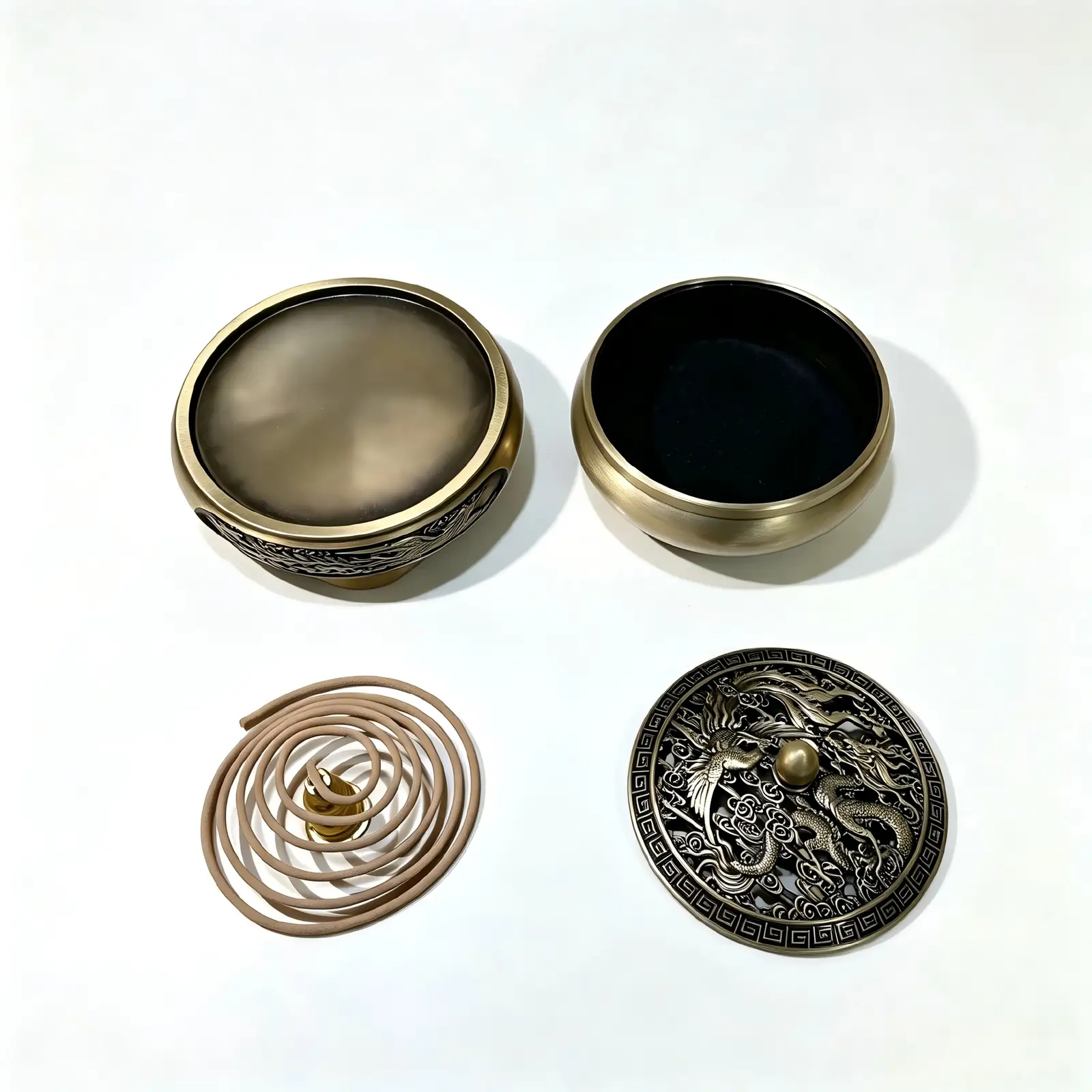
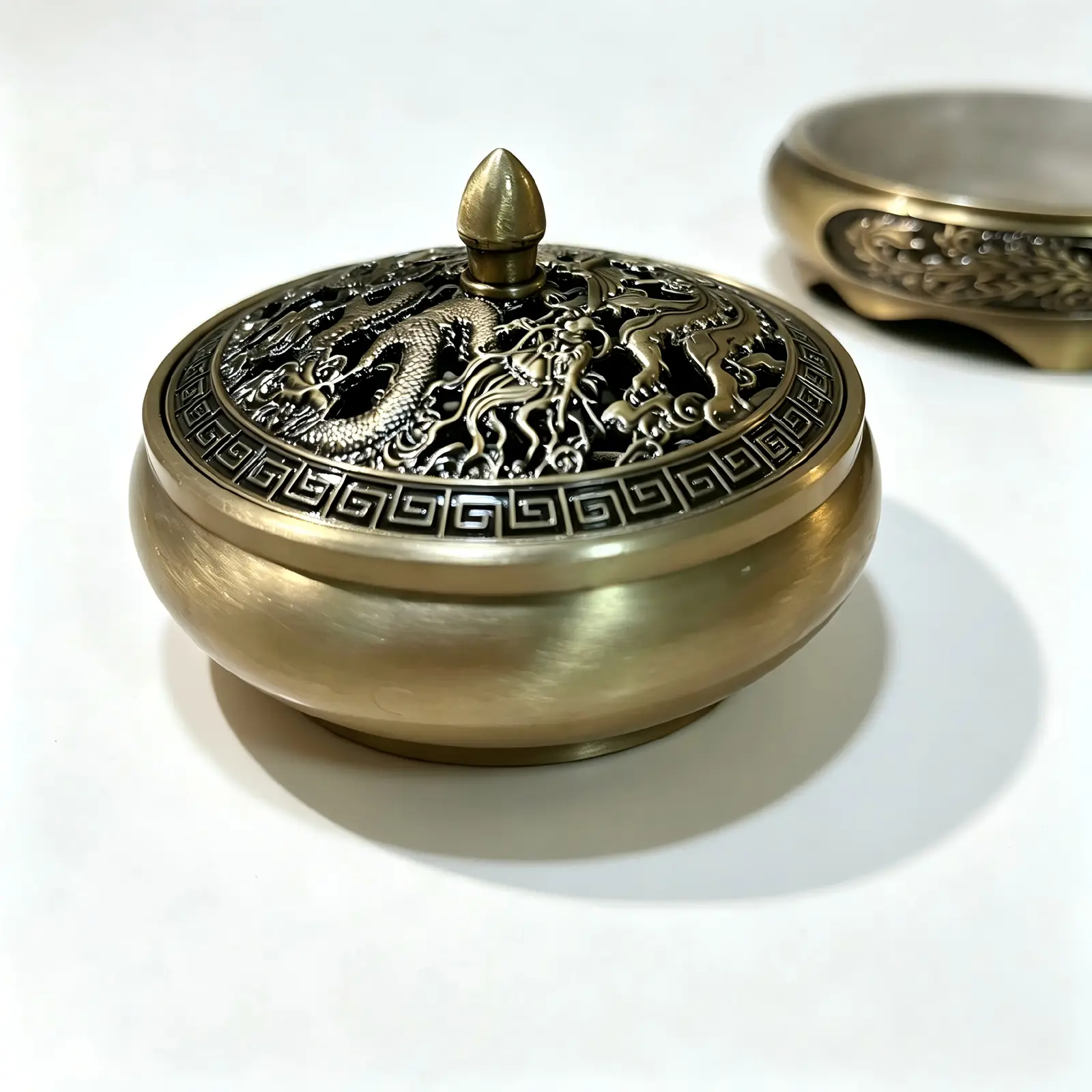
This alloy incense burner is a two-piece cast censer from Yongchun, Fujian: an openwork-lidded bowl that lifts off a three-legged base, finished in an antique bronze patina and sized for Chinese coil incense, cones, tower incense, and short sticks. It suits tea rooms, meditation corners, and desks where you want a small ritual object with real weight in the hand, and it is a practical gift for anyone who burns incense regularly.
What is this alloy incense burner?
It is a cast metal censer in two pieces: a lidded bowl that holds the incense and a three-legged base that holds the bowl, sized for a standard Chinese coil and weighing 300 g.
The lid is the part worth looking at. It is pierced with an openwork dragon and phoenix, and the recessed lines of that carving are darkened by hand so the relief reads clearly against the burnished high points of the metal. It is an object that does something while you use it: smoke leaves through the carving, so you see it pass.
Two details make it practical rather than purely decorative. The bowl lifts out of the base once the incense has burnt down, which makes emptying ash quick. And the three-legged base is wide and low, which keeps a long coil burning steady on a table.
Where is it made, and why does Yongchun matter?
It is made in Yongchun County, in Quanzhou, Fujian, and that county is the reason for the shape and the motif.
Yongchun has been making incense for more than a thousand years. The county government records that Yongchun’s bamboo-frame incense, 篾香, descends from a craft brought into Quanzhou by descendants of the Pu family, Arab traders who settled there during the Tang and Song dynasties, and that it developed into a regional industry from the late Ming and early Qing onward. In 1646 the Pu family moved to Dabu town, and the family technique took root there. Yongchun miexiang is now a protected Chinese geographical indication product.
The scale today is striking. The Quanzhou municipal government describes Yongchun’s Dabu town as the “China Incense Capital”, the birthplace of the county’s incense culture and the cluster where the industry sits, and notes that the technique for making Fujian incense is listed as a national intangible cultural heritage. The provincial government reports close to 300 incense businesses in the county, more than 30,000 people working in the trade, and over a thousand incense products. In 2024 the full-chain output reached 14.2 billion yuan.
To be precise about what that means for this object: this alloy incense burner is cast in the same county where the incense tradition lives, and it borrows that region’s dragon-and-phoenix vocabulary. It is not made by incense makers, and it is not a temple implement. It is a home censer from a county that knows the culture it is drawing on.
What is it made of, and how big is it?
Cast alloy with a hand-applied antique bronze finish, darkened in the recesses, and small enough to sit in the middle of a tea tray.
| Specification | Measurement |
|---|---|
| Total height | 3.15 in (8.0 cm) |
| Inner basin diameter | 2.95 in (7.5 cm) |
| Outer basin diameter | 3.35 in (8.5 cm) |
| Base diameter | 3.94 in (10.0 cm) |
| Weight | 0.66 lb (300 g) |
| Material | Cast alloy, hand-applied antique bronze/copper finish |
| Made in | Yongchun County, Quanzhou, Fujian, China |
The inner basin is the number that matters in practice, because that is what has to clear a standard coil. At 2.95 in (7.5 cm) this alloy incense burner takes the common Chinese coil directly, without a holder.
We have asked the supplier for the exact alloy composition and the finish specification, since “alloy” covers several quite different materials. We have also asked whether the patina is sealed with a clear lacquer, and we will publish both answers here when we have them.
How do you use it, and what incense fits?
Load the basin, light the incense, and let the smoke leave through the openwork.
Four formats work in this censer:
- Coil incense, the standard 2 to 4 hour Chinese coil, sitting directly on the basin floor
- Cone incense, which needs a bed of white ash underneath so it stands upright
- Tower incense, the stacked pagoda style, which also wants an ash bed
- Short incense sticks, which sit across the basin on the rim
In practice: set the bowl on the base, place the coil in the middle of the basin, light the outer end of the coil, and leave it. A coil burns from the outside in and typically lasts two to four hours. Keep the censer away from draughts, because a moving air current will pull the smoke sideways rather than up through the carving.
If you are burning this alloy incense burner as part of a tea session, our glass automatic tea set and a Zisha teapot cover the brewing side, and a pot of Jin Jun Mei is the kind of tea that suits the room.
Never leave burning incense unattended, and keep the censer away from curtains, paper, and anything else that can catch.
Will the finish wear off over time?
It will change slowly, and that is normal for a copper-bearing alloy with an applied patina, rather than something going wrong.
The finish on this piece is a stabilised antique-style surface with darkened detail worked into the recesses. Handled indoors and wiped dry, it holds its look for years. It will still darken slowly in patches, and any copper-bearing alloy can develop a greenish bloom if it sits in a damp place for a long time. A tea room or a study is fine; a bathroom or an unheated porch in a wet climate is not.
Two rules keep it in good shape. Do not use metal polish, and do not use abrasive cleaners, because both strip the patina rather than clean it. Wipe it with a soft dry cloth, and keep the ash in the basin from getting damp.
How do you clean it?
Let it cool completely, lift the bowl off, and wipe out the ash.
Never handle the censer while a coil is still glowing. Once everything has cooled, lift the upper bowl away from the base and remove the ash with a soft brush or a dry cloth. For the burnished surfaces, a barely damp cloth is enough, followed by a dry one.
Over time the ash can leave a grey film inside the basin. A soft sponge with a little mild detergent and warm water removes it; rinse and dry the bowl before you reassemble it. Keep water out of the three-legged base and away from the feet, since that is where standing moisture would do most of the damage.
Is it a feng shui object, and what does the dragon and phoenix mean?
The dragon and phoenix are a traditional Chinese pairing for balance and harmony, and the censer borrows that symbolism rather than making a claim about it.
In traditional Chinese symbolism the dragon and the phoenix are complementary rather than opposed, and the pairing, often called dragon and phoenix in harmony, is used for marital union, auspiciousness, and settled prosperity. Placing a censer with this motif in a tea room or a study draws on that vocabulary.
It is worth being plain about feng shui itself: in the Western philosophy of science it is generally regarded as non-scientific, and some classify it as a pseudoscience. We think the honest case for this object is craft and atmosphere rather than metaphysics. It is a well-made censer with a traditional motif, and that is a good reason to own one.
A note on incense smoke and ventilation
Indoor incense burning is a measurable source of indoor air pollution, and the numbers are worth having before you light one.
A study of incense burning in a household environment measured PM10 close to the altar at 723 micrograms per cubic metre with the room closed, and 178 with the room ventilated, which is more than nine times background concentration in the closed case. Particulate polycyclic aromatic hydrocarbon concentrations followed the same pattern, and levels stayed elevated for at least six hours after the incense had gone out in a closed room (Lung et al., 2003). A later review of home incense use concluded that it can have significant adverse health effects, particularly cardiopulmonary, while noting that it is still not established which types of incense and which individuals are most affected.
So: burn it in a ventilated room, not a sealed one. Open a window, or use it in a space that already has airflow. Keep it away from where children or pets spend time, and if you have asthma or COPD, treat it as you would any smoke. For an evening ritual with no smoke at all, a caffeine-free rose dragon ball gives you a scented cup instead of a scented room.
Who is this alloy incense burner for?
This alloy incense burner is for people who already burn incense and want a better vessel for it, and for anyone who wants one traditional object in a room rather than a matching set.
It is built around the standard Chinese coil, which is what most people mean by incense, so it is an upgrade to an existing habit rather than a new ritual to learn. The 300 g weight and the wide base mean it stays put, which matters if you are working in a small space with a cup of tea going.
As a gift, it suits someone who has a tea table or a study and is hard to buy for. It is also a good choice if you want the dragon and phoenix motif specifically, because there is not a lot of cast metalwork on the market with it.
It is not the right choice if you want a large temple-style burner, or a chimney-style burner for long sticks, or a simple tray for a few sticks.
Three other pieces sit in the same category, and they solve different problems. The three-layer lotus incense holder is a flat, wide ash basin with tiers of petal holes above it, for burning a lot of short sticks at once rather than holding a single coil. The Aladdin lamp incense burner is a lidded burner with a curved handle and a long spout, shaped to sit on a hook and direct the smoke upward in a narrow column. The Pixiu incense burner
is a heavier lidded censer with a guardian-beast finial and two sculpted dragon handles. If you want one vessel for a standard Chinese coil, with a lid you can lift to watch the smoke, this is the one. The rest of the collection is in our zen and incense collection .
Frequently Asked Questions
What size incense fits this alloy incense burner?
The inner basin is 2.95 in (7.5 cm) across, which takes a standard Chinese coil of the 2 to 4 hour type directly, with no separate holder needed. Cones and tower incense need a bed of white ash underneath so they stand upright, and short sticks can be laid across the rim.
How do I clean it?
Let everything cool down first, then lift the upper bowl off the base and remove the ash with a soft brush or dry cloth. For the burnished surfaces use a barely damp cloth and dry it afterwards. Avoid abrasive pads and metal polish, which strip the antique patina rather than clean it, and keep water out of the base so nothing sits damp.
Will the alloy tarnish or turn green?
It will darken slowly, and that is expected on a copper-bearing alloy with an applied patina. Handled indoors it stays in good condition for years, but a copper-bearing alloy can develop a greenish bloom if it is left in a damp place. Keeping it dry, wiping it with a soft dry cloth, and keeping it out of bathrooms or wet porches will avoid that.
Can I burn incense indoors with this alloy incense burner?
Yes, as long as the room is ventilated. Indoor incense burning measurably raises indoor particulate levels: one study measured PM10 near the altar at 723 micrograms per cubic metre with the room closed against 178 with a window open, and levels stayed elevated for at least six hours after burning in a closed room. Open a window, keep it away from children and pets, never leave it unattended, and skip it if you have asthma or COPD.
What does the dragon and phoenix symbolism mean?
The dragon and the phoenix are a traditional Chinese pairing associated with balance, harmony, and auspiciousness, and censers with this motif have a long history as scholar’s desk objects and tea room pieces. We are describing the cultural meaning rather than a working principle: feng shui itself is generally regarded as non-scientific in Western philosophy of science.
Does it come with everything needed?
You receive the upper censer bowl with its pierced lid, the three-legged alloy base, and a protective padded box. Incense is not included. The two pieces separate for cleaning and sit together as one object when assembled.
Author and reviewer disclosure
This page was written by the founder and head tea buyer at Min Tea Shop, who has bought and brewed tea in Fujian for eight years. We sell this censer, the specifications above are the supplier’s for this model, and the open questions are marked in the text.
Statements about indoor incense smoke are general, come from published measurements, and are included because they matter for how you use the object. They are not medical advice. No sponsored content, no paid placements, and no affiliate links appear on this page, and we do not sell or share your personal data — see our privacy policy for details. If a specification on this page is wrong, tell us and we will correct it.
Additional information
| Weight | 0.3 kg |
|---|
Related products
-

Chinese Tea Pet: Giggling Stream Water-Spitting Figurine
$39.90Select options This product has multiple variants. The options may be chosen on the product page -
-
-
Dehua Zisha Tea Pet: Hand-Carved Dragon Fish, Unglazed
$39.90Select options This product has multiple variants. The options may be chosen on the product page


Reviews
There are no reviews yet.